
12 Weeks of JXL069

Most people testing hair loss compounds are doing it under normal conditions.
I’m not.
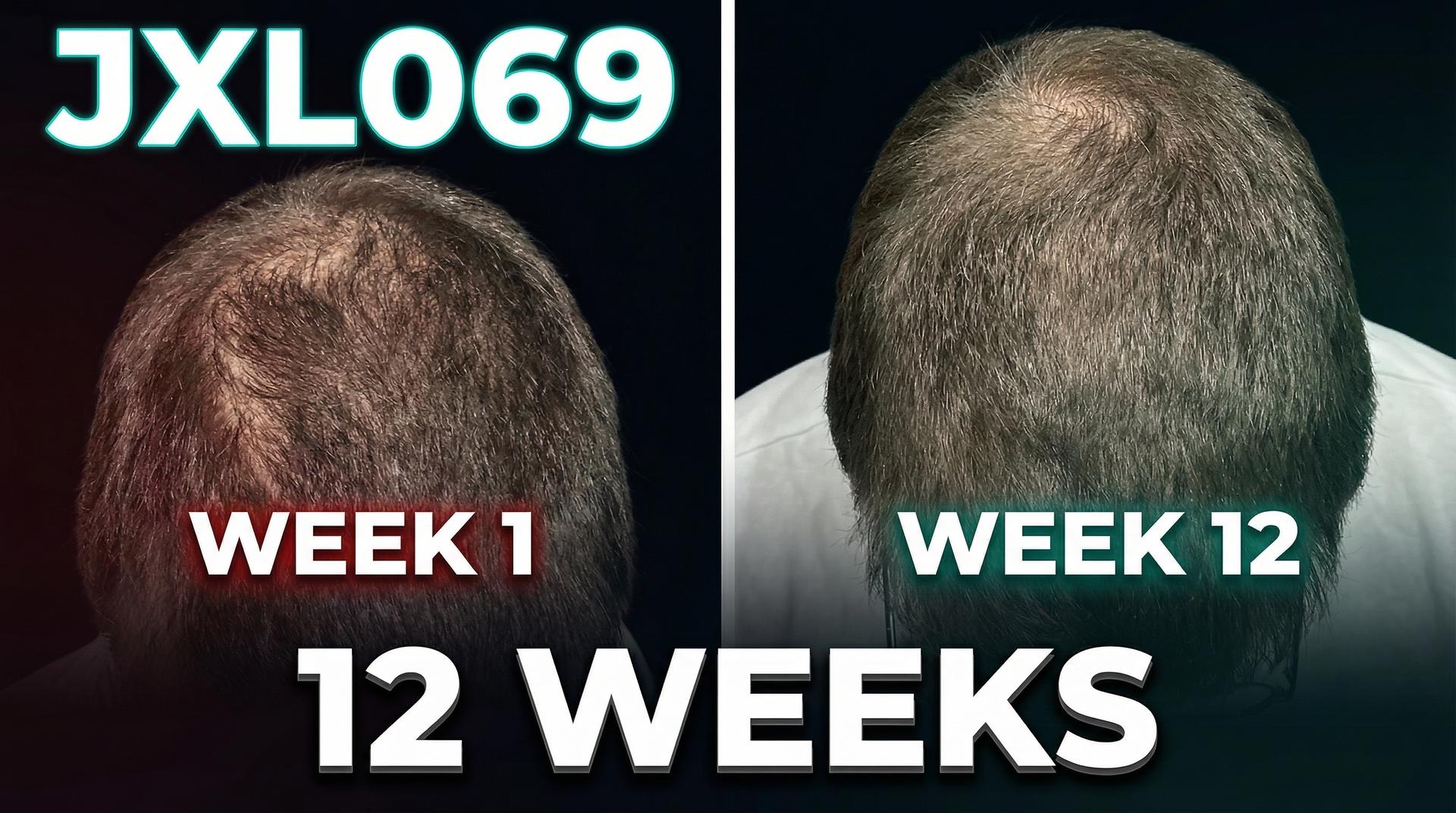
For the past 12 weeks, I’ve been running an experiment with JXL069 — while simultaneously maintaining a supraphysiological androgen load through 200mg/week testosterone.
And that changes everything.
Because if something works here… it’s not just interesting — it’s meaningful.
The Setup: Not Your Typical Hair Loss Experiment
Let’s establish the context clearly.
This wasn’t:
- A clean baseline
- A low-testosterone environment
- Or a “best-case scenario” for hair
This was the opposite.
Protocol:
- JXL069: 0.5mg / 1ml topical — nightly
- Dutasteride: 0.5mg daily
- Testosterone: 200mg/week (TRT)
- RU58841: 80mg a day
- Ketoconazole shampoo 3x weekly
That level of testosterone puts me well above natural baseline — meaning:
👉 Higher androgenic pressure on the hair follicle
👉 A more difficult environment for regrowth or even maintenance
So the question becomes:
Can JXL actually do something meaningful… under pressure?
What JXL069 Is Actually Targeting
Most hair loss treatments today work by blocking the problem.
- Finasteride → reduces DHT
- Dutasteride → reduces DHT more
- RU58841 → blocks androgen receptors locally
They all operate in the same framework:
👉 Reduce androgenic damage
JXL069 is different.
Instead of blocking hormones, it’s thought to act at the cellular metabolism level, specifically:
- Influencing pyruvate utilization
- Altering mitochondrial activity
- Shifting stem cells from an inactive → active state
The key idea:
Hair follicle stem cells don’t disappear — they become inactive.
If you can shift their metabolic state, you may be able to:
👉 Reactivate the follicle
👉 Push it back into the growth phase (anagen)
This is the same mechanistic direction being explored with compounds like PP405.
The Results at 12 Weeks
Let’s be precise.
1. Hairline (Vellus → Terminal Shift)
There are visible small hairs along the hairline that appear:
- Thicker
- More pigmented
- More structured than baseline

This suggests a potential transition — but:
This is not conclusive proof of regrowth.
It’s a signal, not a conclusion.
2. Crown Density
This is where things get more interesting.
Comparing week 1 to week 12:
- Slight improvement in perceived density
- Less visible scalp in certain lighting
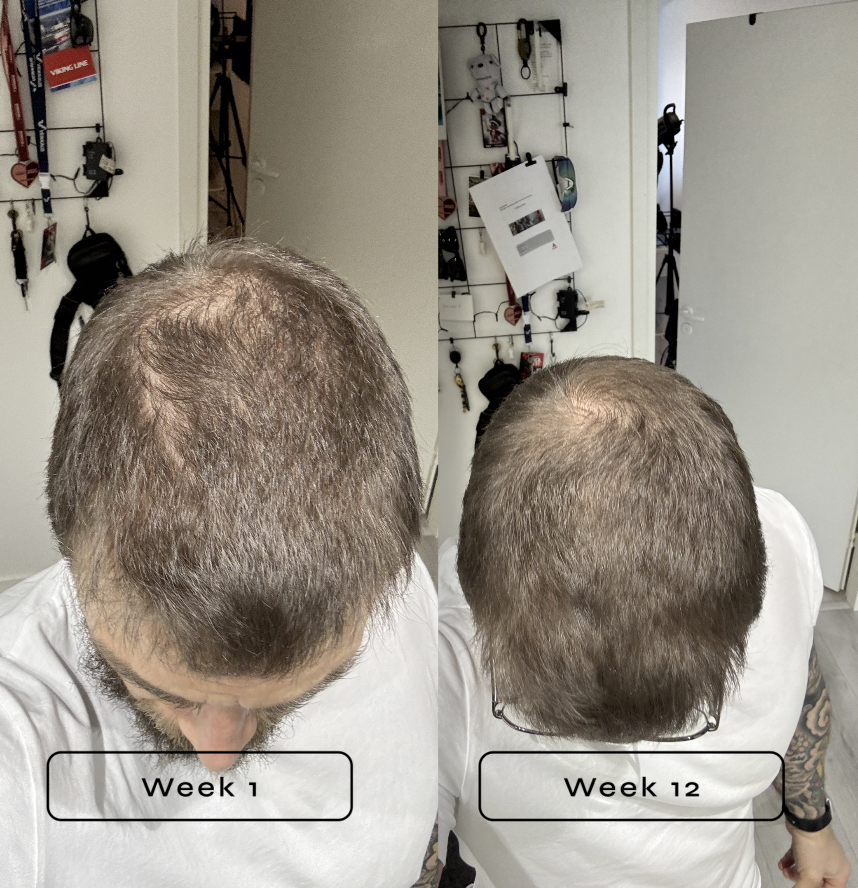
But here’s the reality:
- Lighting matters
- Angles matter
- Bias matters
So I’ll say this clearly:
Subjectively: it looks better
Objectively: it’s suggestive, not definitive
The Most Important Variable: Androgen Load
This is the part most people ignore.
Running 200mg testosterone per week means:
- Elevated serum testosterone (~1000–1100 ng/dL range)
- Increased androgenic signaling at the follicle
Under these conditions, you would expect:
👉 Acceleration of hair loss — not stabilization
So even maintaining density is meaningful.
And if there is any improvement?
That suggests JXL may be:
👉 Acting independently of androgen suppression
👉 Potentially “holding the line” under stress
Why This Matters
This is where things get interesting conceptually.
We’re moving from:
Old model:
“Block the hormone, slow the loss”
To:
New model:
“Reactivate the follicle itself”
That’s a completely different paradigm.
Important Disclaimer (Read This)
JXL069 is:
- Experimental
- Not clinically approved
- Lacking long-term human safety data
Especially regarding:
👉 Systemic absorption
👉 Long-term metabolic effects
This is a personal experiment, not medical advice.
What Happens Next: 30-Week Update
12 weeks is not enough.
Hair growth operates on cycles — not timelines we prefer.
So I’m continuing this experiment to:
👉 30 weeks total
Same protocol. No changes.
Because the real question isn’t:
“Did something happen in 12 weeks?”
It’s:
“Does this compound sustain and build over time?”
Watch the Full Breakdown (With Visual Evidence)
This article gives you the structure.
But the full context — including:
- Before & after images
- Crown analysis
- Hairline close-ups
- My honest interpretation
…is in the video.
👉 Watch the full 12-week update here:
Protocol Breakdown & Resources
One compound often discussed in hair-loss research communities for protecting hair follicles from androgen activity is RU58841.
RU58841 is a topical androgen receptor antagonist, meaning it works locally at the scalp to reduce the ability of androgens like DHT and testosterone to bind to hair follicle receptors.
Unlike systemic medications such as Finasteride or Dutasteride, RU58841 is designed to act directly at the follicle level, which is why many people include it as part of a broader hair-loss prevention protocol.
Because RU58841 is typically sold for research purposes, sourcing a reliable supplier is important.
One supplier frequently used in the hair-loss community is Anagen Inc, which provides laboratory-grade research compounds.
You can find their RU58841 solution here:
RU58841 Solution (50 ml)
If you decide to purchase from them, you can use the discount code:
BLUEPRINT – For 10% Discount
(Disclosure: the link above is an affiliate link that helps support the research and educational content on
Final Thought
Most people online are trying to sell you certainty.
I’m showing you uncertainty — in real time.
Because that’s where the truth usually is.
If you want to follow the 30-week update and future experiments:
👉 Subscribe on YouTube
👉 Or follow along here on the site
This is just the beginning.
Get my free hair-loss protocol
The exact evidence-based routine I actually use and recommend: what works, in what order, with no hype. Enter your email on the next page and I’ll send it straight to you.
Send me the free protocol →