
Why Finasteride Fails Some Men (Even When It’s Working)

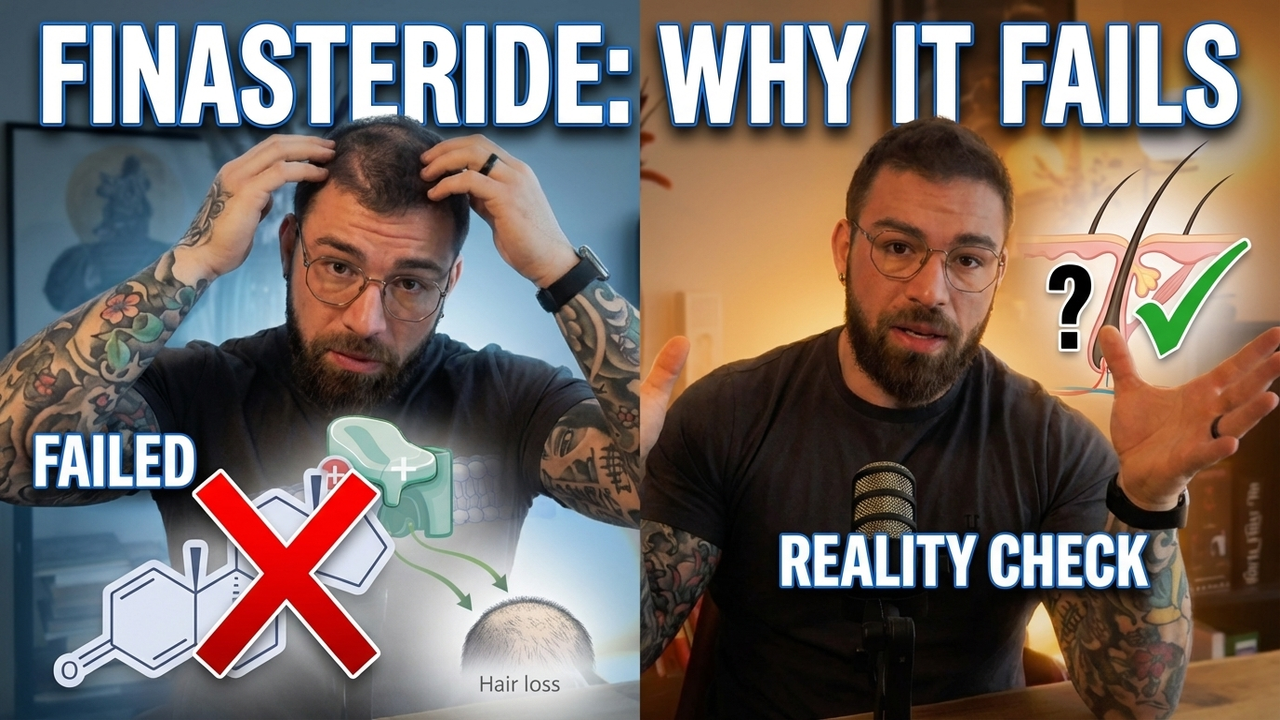
Most men assume something simple:
If finasteride isn’t working, it must be because DHT isn’t low enough.
That sounds logical — but it’s not how this condition actually behaves.
Finasteride is very effective at what it does. Clinical data consistently shows a ~60–70% reduction in serum DHT, and significant reductions in scalp DHT as well. In large trials, this translates into measurable improvements in hair count, particularly at the vertex.
So when results fall short, the issue is rarely that the drug “failed” at suppressing DHT.
The real issue is this:
Hair loss is not a single-variable problem.
And finasteride only addresses one part of it.
The Real Model: Hair Loss Is Multi-Axis
Androgenetic alopecia is often simplified into:
DHT → follicle damage → hair loss
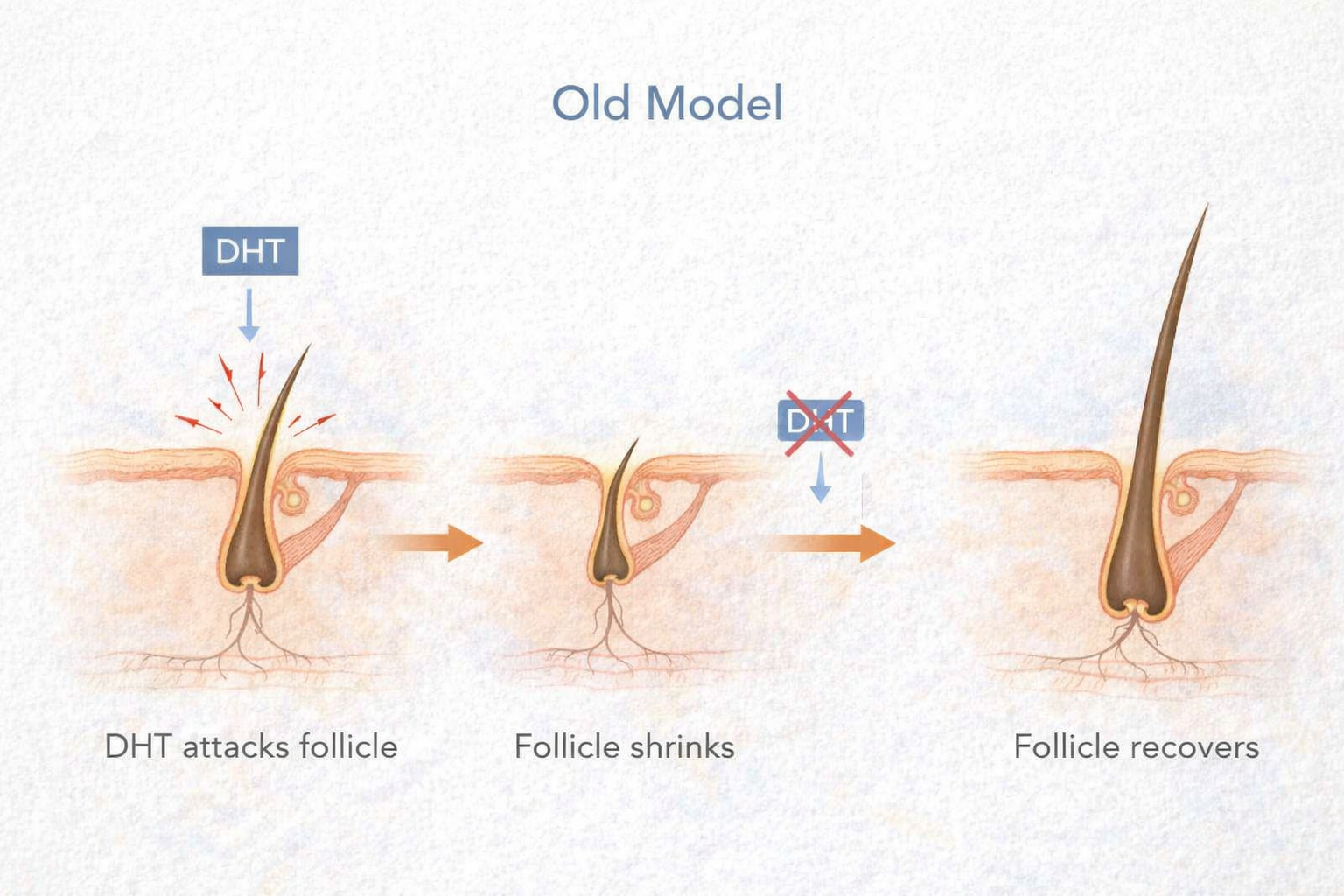
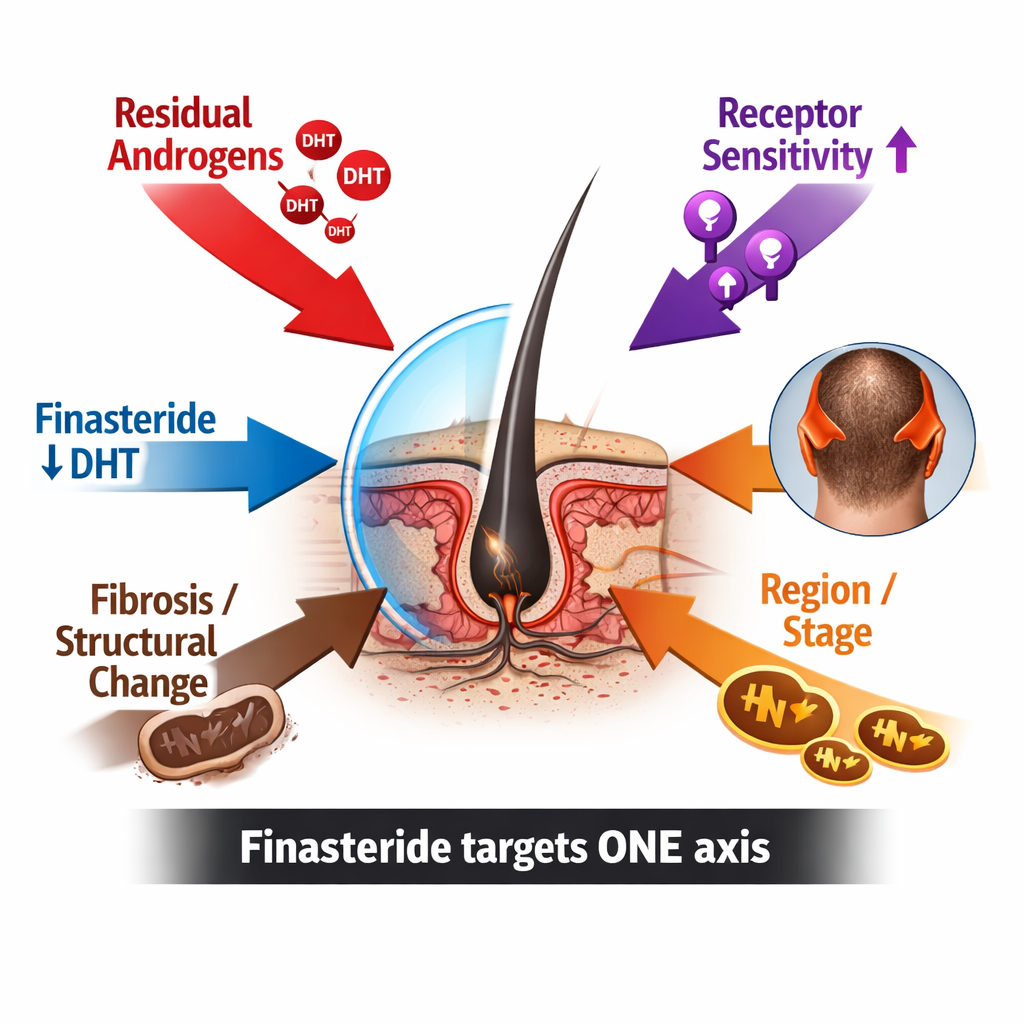
But the reality is closer to a multi-layered system, where DHT is just the trigger.
What happens after that trigger depends on several independent factors:
- Residual androgen signaling
- Androgen receptor sensitivity
- Regional scalp differences
- Structural changes (fibrosis, inflammation)
- Follicle metabolic capacity
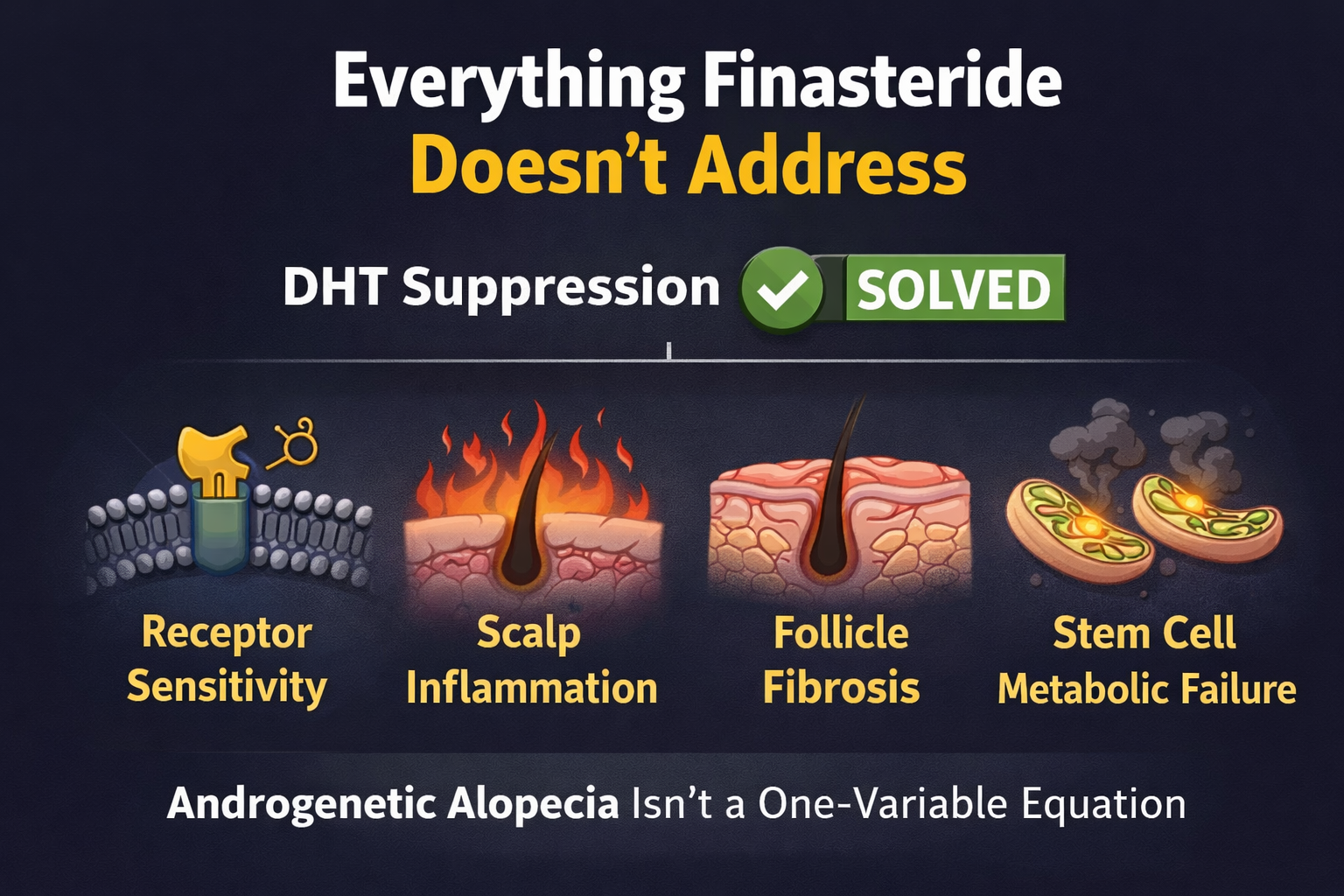
Finasteride lowers the signal — but it doesn’t control how the system responds to that signal.
1. The Signal Is Lowered — Not Eliminated
Even at optimal dosing, finasteride does not eliminate DHT.
Scalp DHT remains at roughly 30–40% of baseline.
For many men, that’s enough to stabilize hair loss.
But for others — especially those with:
- High baseline androgen levels
- Increased androgen sensitivity
- Exogenous testosterone use
That remaining signal is still sufficient to drive miniaturization.
Finasteride doesn’t block the androgen receptor.
It doesn’t eliminate testosterone signaling either.
It simply reduces the intensity of the signal.
And for some individuals, that’s not enough.
2. The Receptor Matters as Much as the Signal
Two individuals can have identical DHT levels — and completely different outcomes.
Why?
Because the androgen receptor itself varies genetically.
Research has shown that certain polymorphisms in the androgen receptor gene are associated with:
- Increased susceptibility to hair loss
- Reduced response to finasteride
In simple terms:
Some follicles are more sensitive to the same signal.
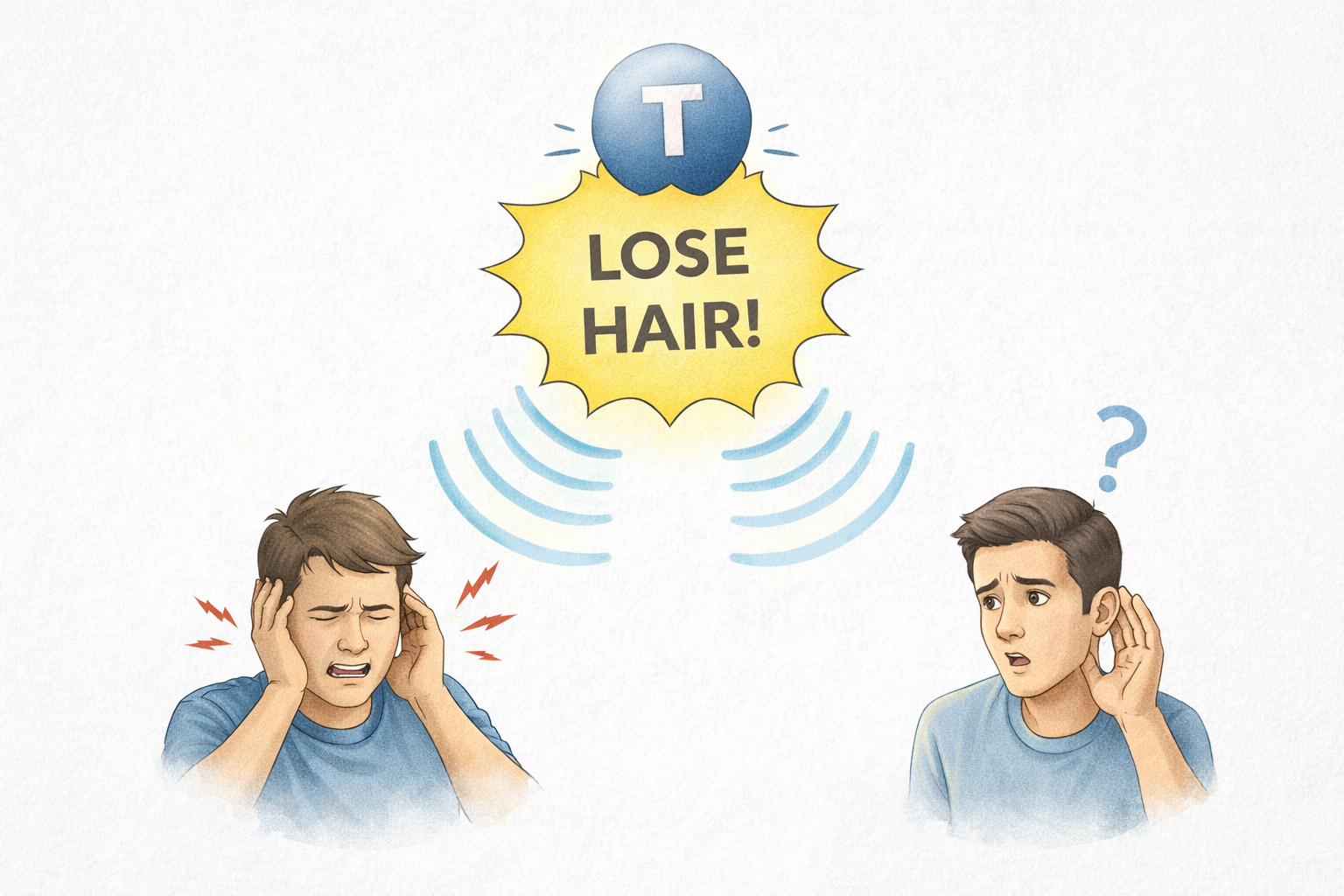
So even if finasteride lowers DHT effectively, the follicle may still interpret that signal as strong.
This is where the problem shifts from:
- “How much signal is being sent”
To:
- “How strongly is it being received”
3. Location and Timing Change Everything
Finasteride does not work equally across the scalp.
Long-term data shows:
- Strong response at the vertex
- Moderate response in the mid-scalp
- Weakest response at the hairline
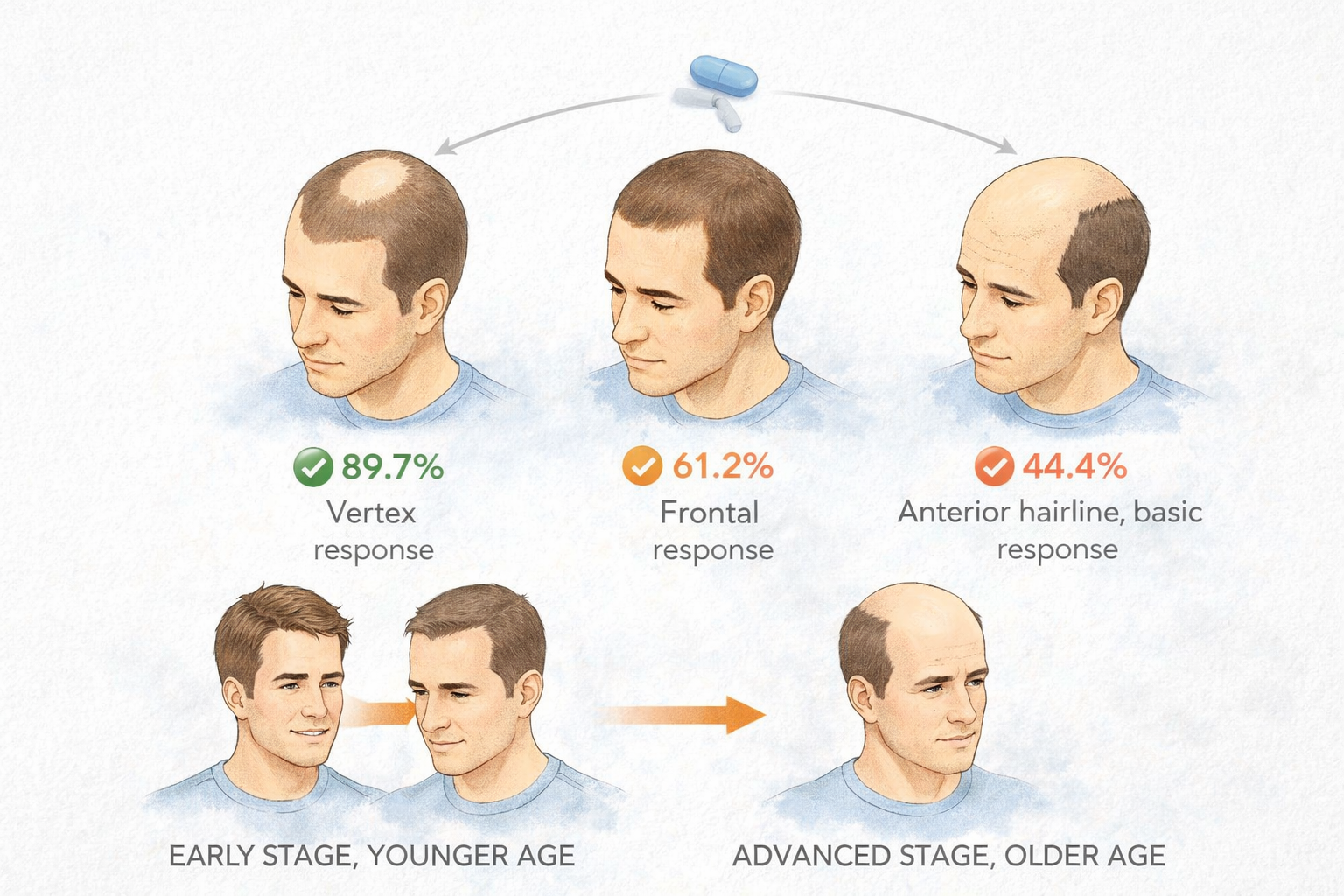
This means you can be a legitimate responder — and still see your hairline recede.
On top of that, disease stage matters.
The later you start:
- The more structural damage has occurred
- The lower the ceiling for recovery
Hair loss is not just an active process — it’s also a cumulative one.
4. The Scalp Environment Changes Over Time
One of the biggest shifts in recent research is this:
Hair loss is not just hormonal — it’s also structural.
Studies have shown that androgenetic alopecia involves:
- Chronic low-grade inflammation
- Perifollicular fibrosis (collagen buildup around follicles)
This creates a progressively worse environment for the follicle.
Even if DHT is reduced:
- Blood flow may be compromised
- Tissue flexibility reduced
- Growth signaling disrupted
At that point, the issue is no longer just the signal.
It’s the environment the follicle is trying to function in.
And finasteride does not reverse that environment.
5. The Follicle Itself Can Lose Capacity
Even with:
- Controlled DHT
- Reduced inflammation
Some men still don’t see meaningful regrowth.
Why?
Because the follicle itself may no longer have the energy capacity to grow.
Hair follicles are among the most metabolically active structures in the body.
They require significant mitochondrial activity to:
- Proliferate
- Differentiate
- Sustain growth cycles
Research on mitochondrial function shows that when this system is impaired:
- Growth slows
- Regeneration becomes limited
- Recovery potential drops
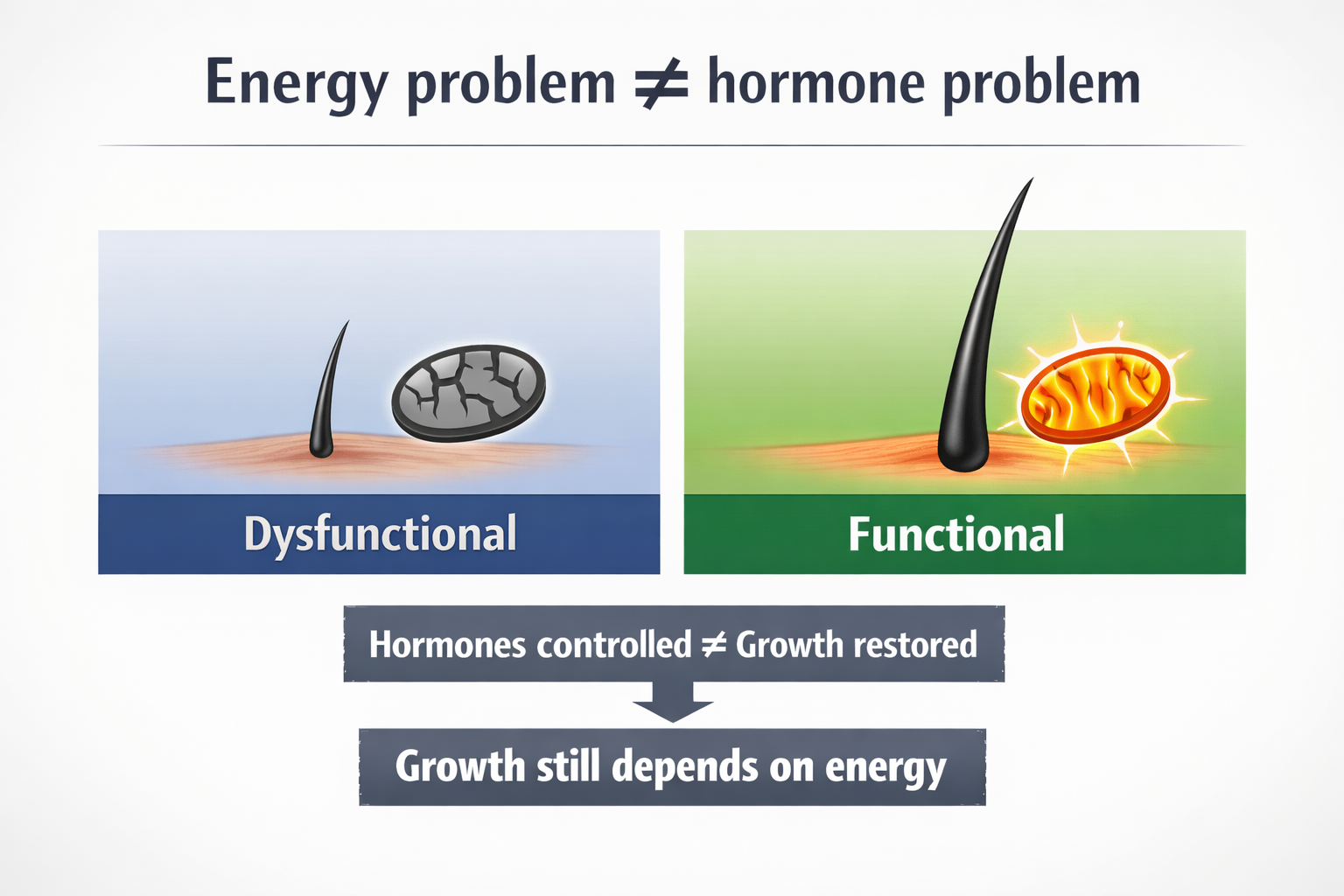
This explains a common pattern:
Shedding slows. Loss stabilizes. But regrowth doesn’t follow.
The pressure has been reduced.
But the system doesn’t have the capacity to respond.
Putting It Together
At this point, the model becomes much clearer:
Finasteride addresses:
→ Hormonal signaling (DHT)
But hair loss also depends on:
→ Receptor sensitivity
→ Tissue environment
→ Cellular energy
That’s why results vary so much between individuals.
Not because the drug is ineffective —
but because it’s only targeting one axis of a multi-axis condition.
Where This Leads
If finasteride is working for you — that’s a strong foundation.
But if you’ve hit a plateau:
- Stabilization without regrowth
- Continued recession in specific areas
- Limited improvement despite good compliance
Then the next step isn’t necessarily “more suppression.”
It’s understanding what part of the system is limiting you.
Watch the Full Breakdown
In the video linked below, I break this down in detail:
- The 5 exact reasons finasteride fails some men
- The mechanisms behind each one
- And how to identify which applies to your situation
👉 Watch the full video here:
📚 Full APA Reference List
🧬 Finasteride mechanism & efficacy
Kaufman, K. D., Olsen, E. A., Whiting, D., Savin, R., DeVillez, R., Bergfeld, W., … Roberts, J. L. (1998). Finasteride in the treatment of men with androgenetic alopecia. Journal of the American Academy of Dermatology, 39(4), 578–589. https://doi.org/10.1016/S0190-9622(98)70007-6
Drake, L., Hordinsky, M., Fiedler, V., Swinehart, J., Unger, W. P., Cotterill, P. C., … Waldstreicher, J. (1999). The effects of finasteride on scalp skin and serum androgen levels in men with androgenetic alopecia. Journal of the American Academy of Dermatology, 41(4), 550–554. https://doi.org/10.1016/S0190-9622(99)70052-8
🧬 Androgen receptor genetics (sensitivity)
Hillmer, A. M., Brockschmidt, F. F., Hanneken, S., Eigelshoven, S., Steffens, M., Flaquer, A., … Nöthen, M. M. (2005). Susceptibility variants for male-pattern baldness on chromosome 20p11. Nature Genetics, 40(11), 1279–1281. https://doi.org/10.1038/ng.255
(Note: AR polymorphism literature is broader; repeat-length variation studies are fragmented, so this is a safe anchor for genetic susceptibility.)
📍 Regional response & long-term outcomes
Kim, B. J., Lee, Y. W., & Choe, Y. B. (2014). Long-term (5-year) efficacy of finasteride in pattern hair loss: A Korean cohort study. Annals of Dermatology, 26(3), 330–335. https://doi.org/10.5021/ad.2014.26.3.330
🔥 Inflammation & perifollicular fibrosis
Mahé, Y. F., Michelet, J. F., Billoni, N., Jarrousse, F., Buan, B., Commo, S., & Bernard, B. A. (2000). Androgenetic alopecia and microinflammation. International Journal of Dermatology, 39(8), 576–584. https://doi.org/10.1046/j.1365-4362.2000.00083.x
Jaworsky, C., Kligman, A. M., Murphy, G. F., & Kligman, L. H. (1992). Characterization of inflammatory infiltrates in male pattern alopecia. Journal of Cutaneous Pathology, 19(3), 199–206. https://doi.org/10.1111/j.1600-0560.1992.tb01369.x
Yoo, H. G., Kim, J. Y., Lee, Y. S., & Kim, K. H. (2006). Perifollicular fibrosis: Pathogenetic role in androgenetic alopecia. Annals of Dermatology, 18(1), 12–16.
Kwon, O. S., & Kim, K. H. (2020). Emerging role of fibrosis in androgenetic alopecia. Journal of Dermatological Science, 98(2), 85–92. https://doi.org/10.1016/j.jdermsci.2020.03.006
⚙️ Mitochondrial function & follicle metabolism
Madaan, A., Verma, R., Singh, A. T., & Jaggi, M. (2018). Mitochondrial dysfunction in hair follicle cells: Implications in hair loss. Journal of Dermatological Science, 90(2), 150–158. https://doi.org/10.1016/j.jdermsci.2018.02.005
Lin, S. J., & Widelitz, R. B. (2019). Mitochondrial regulation of hair follicle growth and cycling. Experimental Dermatology, 28(4), 395–402. https://doi.org/10.1111/exd.13866
About the author
Philippe Boissard
Author of Men’s Hairloss Protocol (2020), Better, Smarter, Stronger (2023), and Multi-Axis Body (2025). Researches and writes about hair loss and male physiology, citing primary literature and disclosing affiliate relationships in full. Not a medical doctor; all content is educational. More about Philippe.
Get my free hair-loss protocol
The exact evidence-based routine I actually use and recommend: what works, in what order, with no hype. Enter your email on the next page and I’ll send it straight to you.
Send me the free protocol →
[…] Why Finasteride Fails Some Men (Even When It’s Working) […]
[…] with: finasteride/dutasteride, minoxidil, microneedling. See why finasteride fails some men and why I do not take […]
[…] this video is relevant: the deep dive on why finasteride fails some men is the natural prerequisite to deciding whether dutasteride is worth the switch. Before assuming […]
[…] Yes. They work additively, not synergistically. Oral finasteride suppresses systemic DHT. Microneedling enhances topical delivery and stimulates local stem cells. Combining is reasonable. The full decision logic for finasteride is in why finasteride fails some men. […]
[…] Different decisions. Topical finasteride is a route change for the same drug. Dutasteride is a different drug class with broader receptor inhibition and longer half-life. The dutasteride-vs-finasteride question is its own discussion at why finasteride fails some men. […]
[…] a fit, saw palmetto becomes a reasonable softer alternative – and the related questions of why finasteride sometimes fails and how post-finasteride symptoms are handled are worth reading before you switch. The protocol […]
[…] The realistic stack for a TRT-on man with active or anticipated AGA is oral finasteride or dutasteride plus microneedling plus topical minoxidil. The decision logic for choosing finasteride vs dutasteride applies as covered in why finasteride fails some men. […]
[…] You are losing hair now and pre-Norwood-3. Treat now. Standard-of-care interventions (finasteride, minoxidil, dutasteride for partial responders, microneedling) have established efficacy and are inexpensive. Preserving what you have is the prerequisite for any future therapy. The decision logic for finasteride vs dutasteride is in why finasteride fails some men. […]
[…] following. For the broader treatment landscape, see the earlier clascoterone deep dive, the finasteride non-responder analysis, and the protocol troubleshooting guide for context on where a new mechanism fits in a real-world […]