
Saw Palmetto vs Finasteride: What the Evidence Shows
Saw palmetto inhibits 5-alpha reductase weakly. Finasteride inhibits it strongly. When the natural alternative actually fits the protocol, and when it does not.

Saw palmetto is the most common “natural alternative” to finasteride – and the comparison is honest only if you accept what the math actually says. Saw palmetto inhibits 5-alpha reductase weakly. Finasteride inhibits it strongly. Both technically work through the same pathway. The effect sizes are not in the same league. Treating them as interchangeable is how people lose years of preservable density chasing a softer-sounding option.
Quick answer: weaker mechanism, smaller effect, narrow use case
Saw palmetto (Serenoa repens) is a plant extract that inhibits 5-alpha reductase, the enzyme that converts testosterone to dihydrotestosterone (DHT). Finasteride targets the same enzyme. The difference is potency. Finasteride at 1 mg/day reduces serum DHT by roughly 60-70 percent. Saw palmetto, even at the high end of dosing studied, reduces DHT by a fraction of that – and the human hair-density evidence is much thinner.
The narrow case where saw palmetto is reasonable: mild androgenetic alopecia in someone who cannot or will not take finasteride, used as one piece of a broader stack rather than a stand-alone protocol. The wide case where it fails: anyone with active progression who is choosing saw palmetto instead of finasteride. The biology is the same; the magnitude is not.
What saw palmetto actually does to 5-alpha reductase
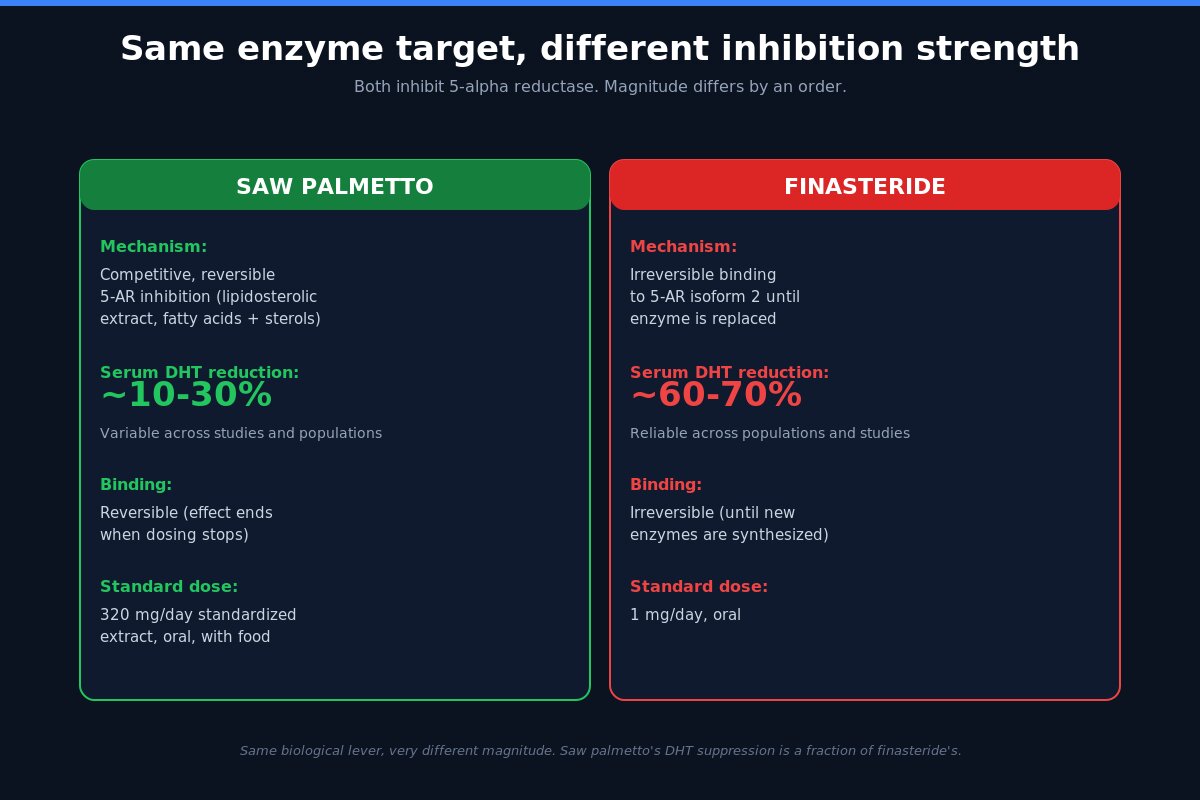
Saw palmetto contains fatty acids and sterols that competitively inhibit 5-alpha reductase. Most of the lab work was done in the context of benign prostatic hyperplasia (BPH), where elevated DHT drives prostate enlargement. The same mechanism that makes saw palmetto a candidate for BPH symptom management makes it a candidate for hair loss – same enzyme, same downstream effect.
The strength of inhibition is the issue. In vitro studies (Iehle et al., 1995; Raynaud et al., 2002) show saw palmetto’s lipidosterolic extract inhibits 5-AR isoform 1 and 2 at concentrations that are achievable orally, but the inhibition curves are markedly less steep than finasteride’s. In practical terms, a typical saw palmetto dose (320 mg/day of standardized extract) produces a small reduction in serum DHT – reported in studies as anywhere from negligible to roughly 30 percent depending on the population and methodology. Finasteride 1 mg/day reliably hits 60-70 percent serum DHT reduction.
The two are not equivalent at the receptor either. Finasteride binds 5-AR irreversibly until the enzyme is replaced. Saw palmetto’s inhibition is reversible and competitive. The biological lever exists in both cases; one moves the lever an inch, the other moves it most of the way.
The clinical evidence for hair loss specifically
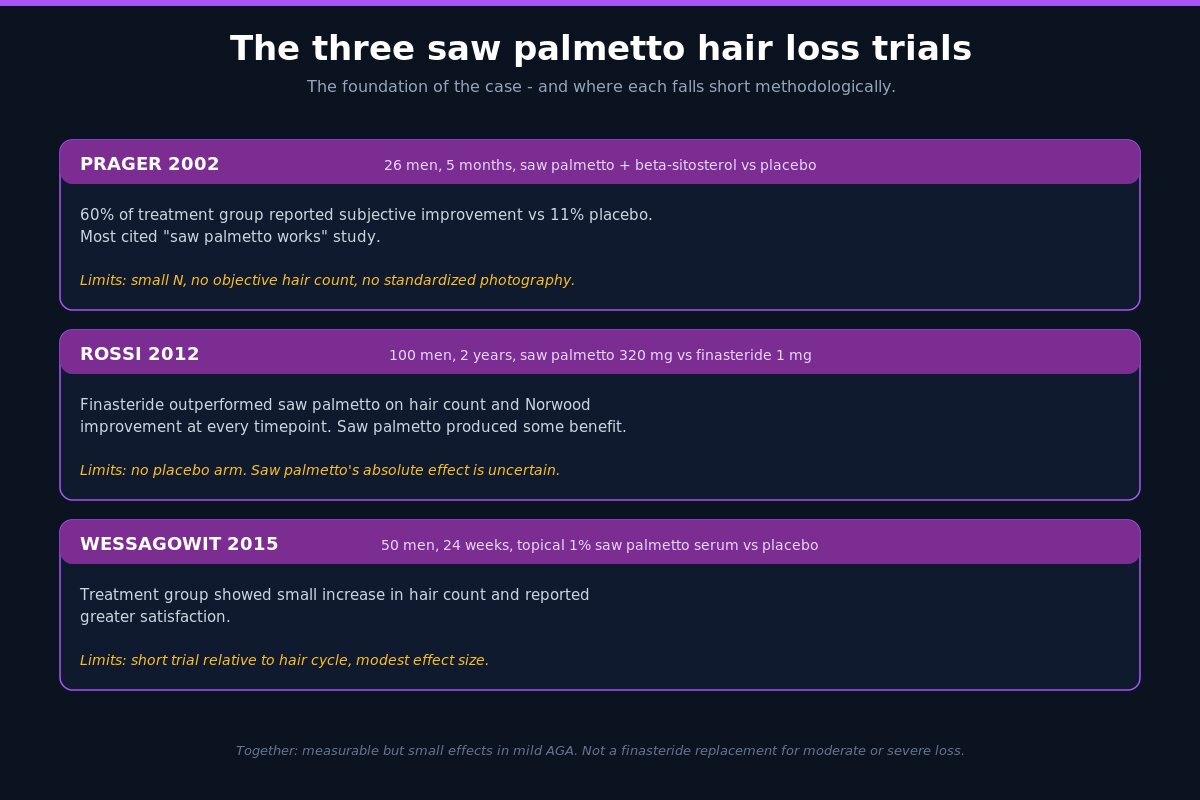
Three trials get cited most often. They are the foundation of the saw palmetto hair loss case, and reading them in detail is what makes the limits clear.
Prager et al. (2002). A 5-month study of 26 men aged 23-64 with mild to moderate androgenetic alopecia. Saw palmetto + beta-sitosterol versus placebo. Sixty percent of the treatment group reported subjective improvement; only 11 percent of placebo reported improvement. There was no objective hair count, no standardized photography, and the sample was small. This is the most-cited “saw palmetto works” study and it is methodologically thin.
Rossi et al. (2012). A 2-year study comparing saw palmetto 320 mg/day to finasteride 1 mg/day in 100 men. Finasteride outperformed saw palmetto on hair count and Norwood improvement at every measured timepoint. Saw palmetto produced some improvement; finasteride produced more. The study did not include a placebo arm, so the absolute effect of saw palmetto is uncertain.
Wessagowit et al. (2015). Topical 1 percent saw palmetto serum versus placebo in 50 men with androgenetic alopecia, 24 weeks. The treatment group showed a small increase in hair count and reported greater satisfaction. Effect size was modest and the trial was short relative to the hair cycle.
None of these are bad studies, but together they support a narrow conclusion: saw palmetto produces measurable but small effects in mild androgenetic alopecia. They do not support saw palmetto as a finasteride replacement for moderate or severe loss.
Effect sizes side by side
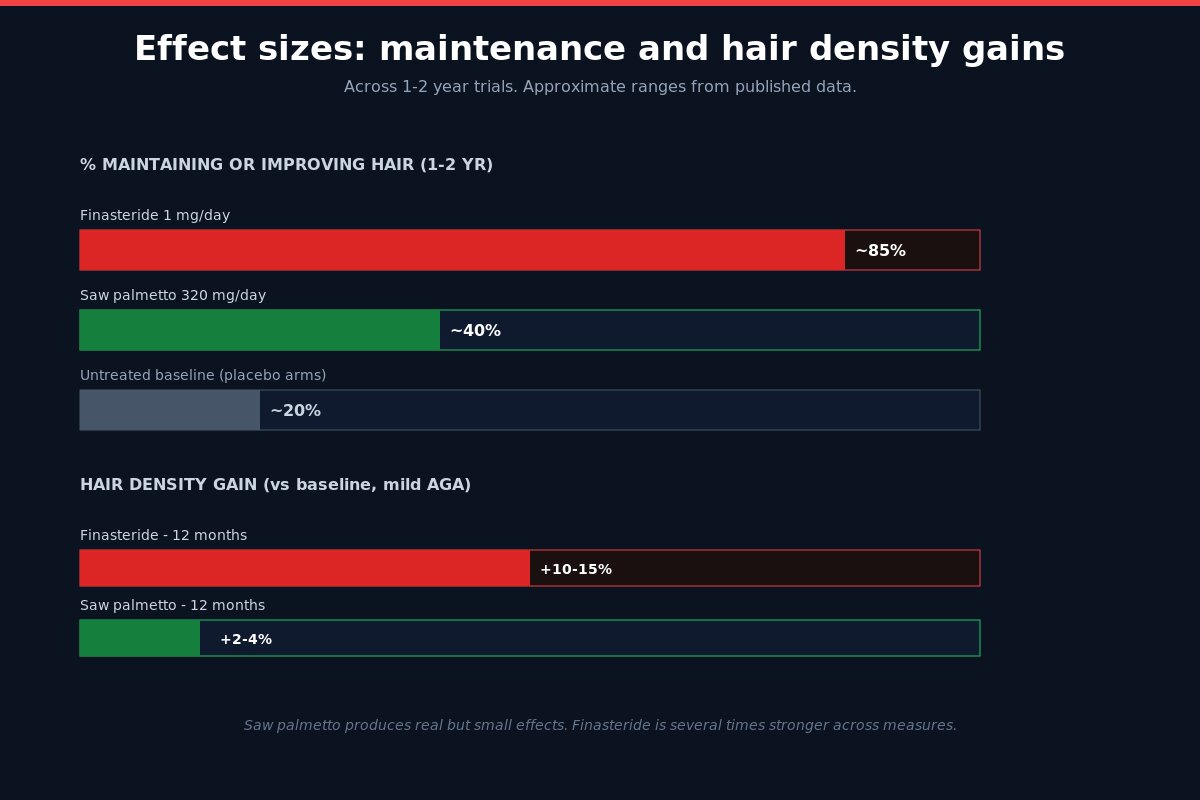
The honest comparison looks like this. Finasteride trials of 1-2 years duration consistently show roughly 65-90 percent of men maintain or improve hair count, with measurable hair density gains in the 8-15 percent range over the treatment period. Dutasteride does somewhat better. Saw palmetto trials show subjective improvement in roughly half the treated population, with quantitative hair count gains that are mostly small or unclear. The treatment effect of finasteride is several times larger than saw palmetto across the comparable measures.
“Several times larger” is the key phrase. If you have active androgenetic alopecia and a real preservation goal, the choice between an intervention that gets you to 80 percent maintenance and one that gets you to 30 percent maintenance is not close. The label “natural” does not change the magnitude of the underlying mechanism.
The post-finasteride-syndrome and side-effect framing
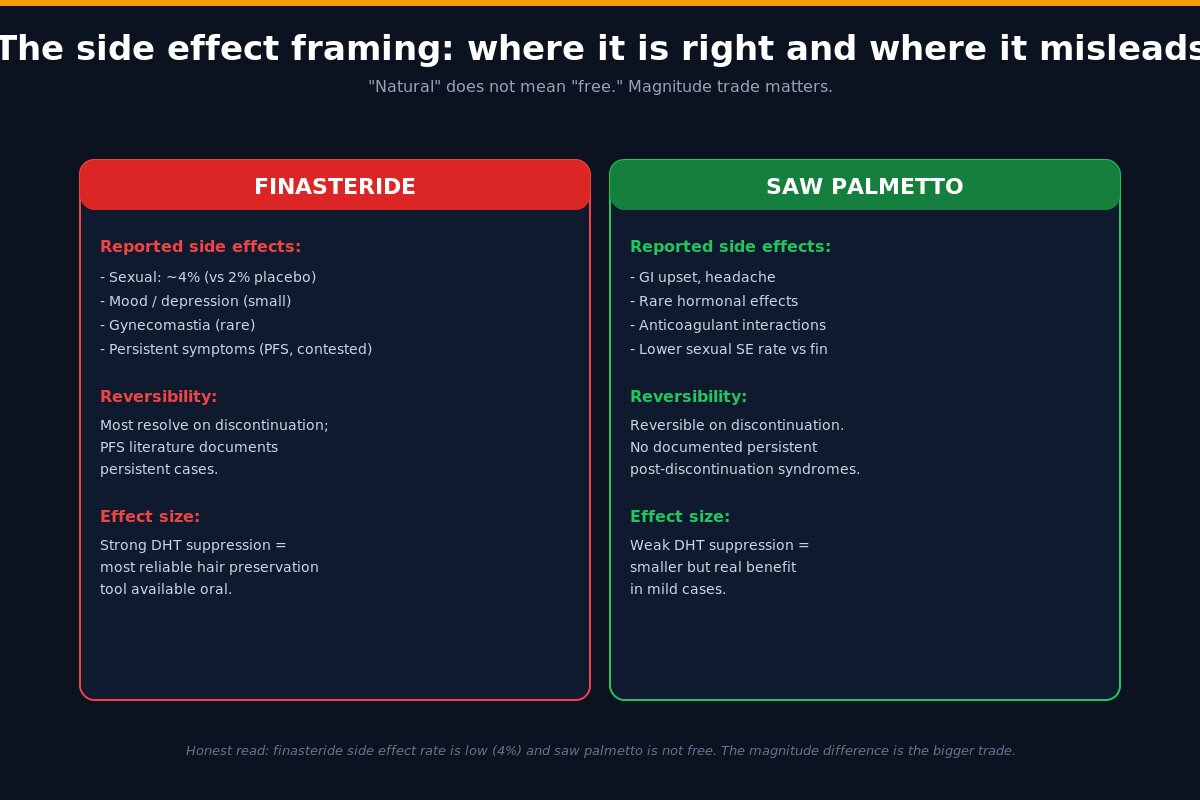
The genuine reason most men consider saw palmetto is fear of finasteride’s reported side effects: sexual dysfunction, mood effects, and the contested but real concern of post-finasteride syndrome (PFS). The argument runs: saw palmetto inhibits the same enzyme more weakly, so it should produce milder side effects, so it is the safer option.
That argument is partially correct and partially misleading. Partially correct because saw palmetto’s milder DHT suppression does, on average, produce fewer reported sexual side effects in trials. Partially misleading because the side-effect rate of finasteride is itself low (in the original Merck trials, sexual side effects occurred in roughly 4 percent of men on finasteride versus 2 percent on placebo) and because saw palmetto is not free of side effects – GI upset, headache, and rare reports of hormonal changes do occur.
The cleaner framing: if you are a finasteride non-responder or have had documented side effects from finasteride, saw palmetto is a reasonable alternative for mild loss. If you have not tried finasteride and are choosing saw palmetto preemptively because of fear of side effects, you are likely trading a known intervention with a strong evidence base for a weaker intervention with a thinner evidence base. The decision should be informed by your specific situation, not by which option sounds gentler.
Watch this if you are weighing the trade-off
This video covers the responder-versus-non-responder framing that determines whether finasteride is the right choice in the first place. The same framing applies in reverse to saw palmetto: if finasteride is not working for you, the question is not “switch to saw palmetto” but “what is the most likely reason finasteride is failing, and what is the next escalation step?” The video walks through the diagnostic logic.
When saw palmetto fits the protocol
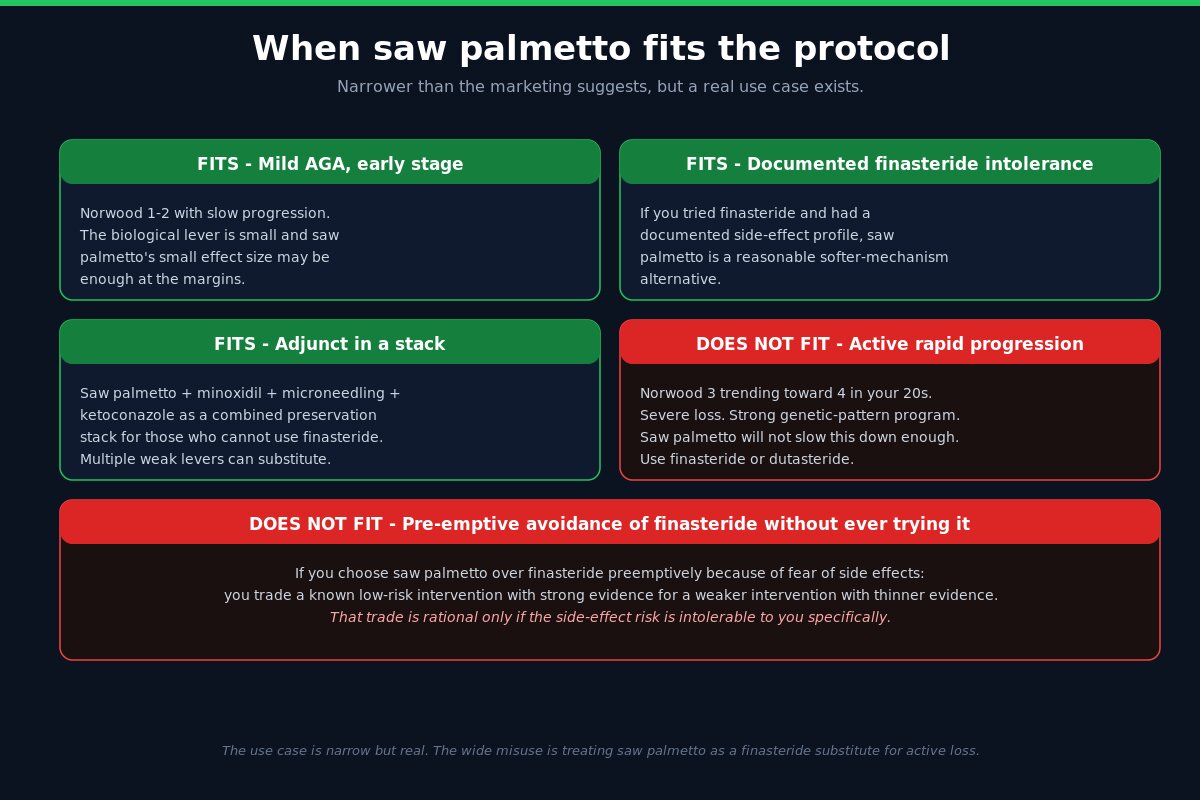
There is a reasonable use case. It is narrower than the marketing suggests.
Mild androgenetic alopecia, early stage. Norwood 1-2 with slow progression. The biological lever is small and saw palmetto’s small effect size may be enough at the margins.
Documented finasteride intolerance. If you tried finasteride and had a documented side-effect profile, saw palmetto is a reasonable softer-mechanism alternative. It is not equivalent in efficacy but it gives you something on the AR pathway without finasteride’s pharmacology.
Adjunct in a stack, not a replacement. Saw palmetto plus minoxidil, microneedling, and ketoconazole shampoo is a reasonable hair preservation stack for someone who cannot take finasteride. The combination compensates somewhat for any single component being weaker than finasteride monotherapy.
Patient preference with informed consent. Some men strongly prefer plant-based options regardless of the magnitude trade-off. Provided they understand the smaller effect size, that preference is reasonable.
Where it does not fit. Active rapid progression in a young man (Norwood 3 trending toward 4 in his twenties), severe loss, or any case where the trajectory needs to be slowed substantially. Saw palmetto will not stop a strong genetic-pattern program. Finasteride or dutasteride is the appropriate intervention there.
Dosing, formulation, and what to actually buy
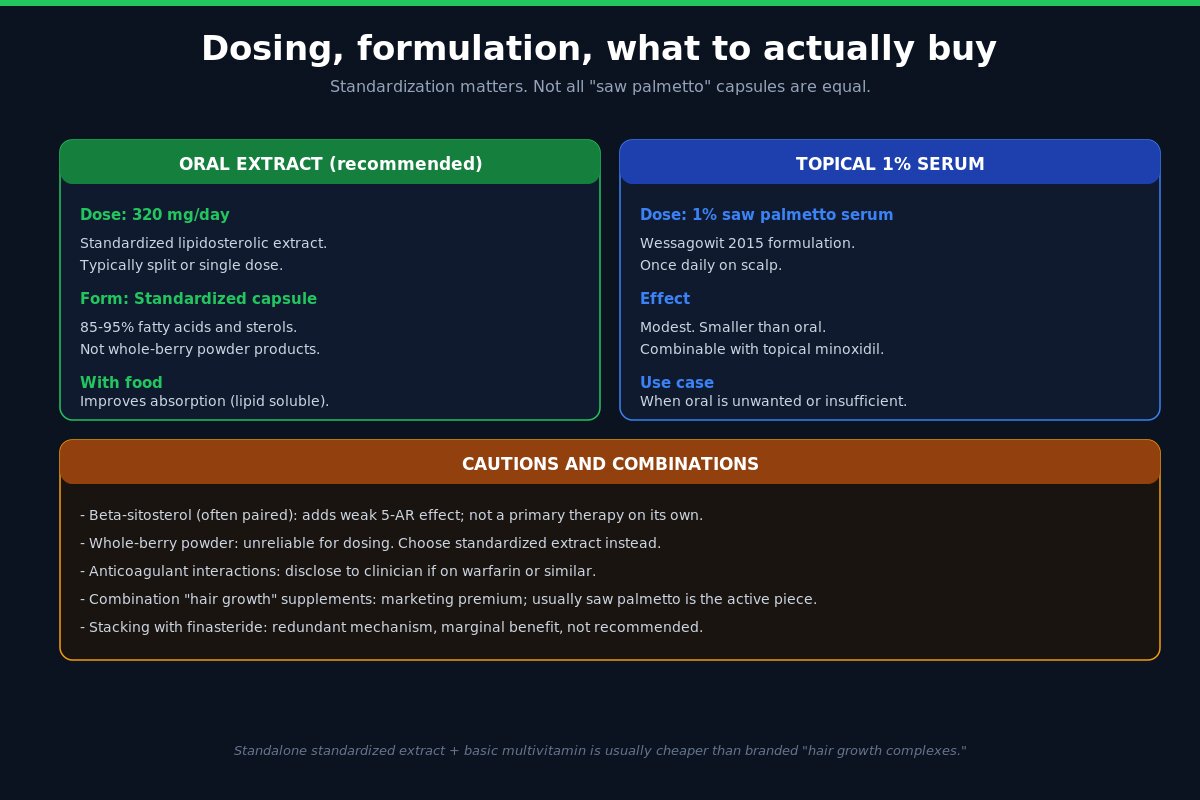
Most saw palmetto hair loss trials use 320 mg/day of a standardized lipidosterolic extract, taken with food to improve absorption. The active fraction is the lipid soluble portion, so capsules of standardized extract (typically 85-95 percent fatty acids and sterols) are the right form. Whole-berry powder products contain less active extract per capsule and are unreliable for dosing.
Topical 1 percent saw palmetto serum (the formulation Wessagowit used) is sold as a finished product by a few cosmetic brands. Effect size in the trial was modest. It can be combined with topical minoxidil for an additive scalp-applied stack.
Beta-sitosterol, a phytosterol that often appears alongside saw palmetto in supplement formulas (as in the Prager study), has its own weak 5-AR inhibitory effect. Combination capsules are reasonable but the evidence does not support beta-sitosterol as a strong primary therapy on its own.
What saw palmetto does not do
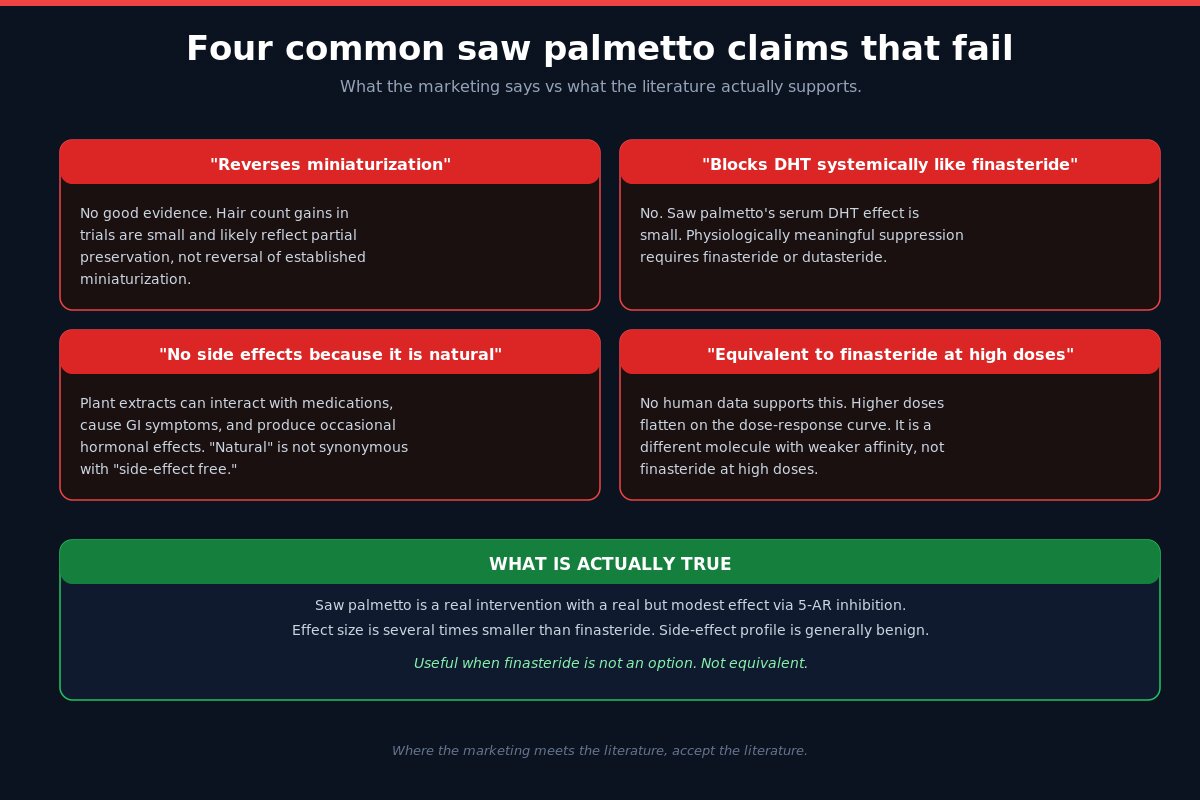
Several adjacent claims are common in marketing and weak in literature.
“Reverses miniaturization.” No good evidence. The few hair count gains observed are small and likely reflect partial preservation rather than reversal of established miniaturization. For reversal, finasteride and dutasteride have stronger evidence (and even those are partial reversers, not full restorers).
“Blocks DHT systemically the way finasteride does.” No. Saw palmetto’s serum DHT effect is small. The physiologically meaningful suppression of DHT requires finasteride or dutasteride.
“Has no side effects because it is natural.” Plant extracts can interact with medications, cause GI symptoms, and produce occasional hormonal effects. The side effect rate is low but not zero. “Natural” is not synonymous with “side-effect free.”
“Equivalent to finasteride at high enough doses.” No human data supports this. Higher doses of saw palmetto have been tried for BPH; the dose-response curve flattens. It is not finasteride at high doses; it is a different molecule with a fundamentally weaker affinity profile.
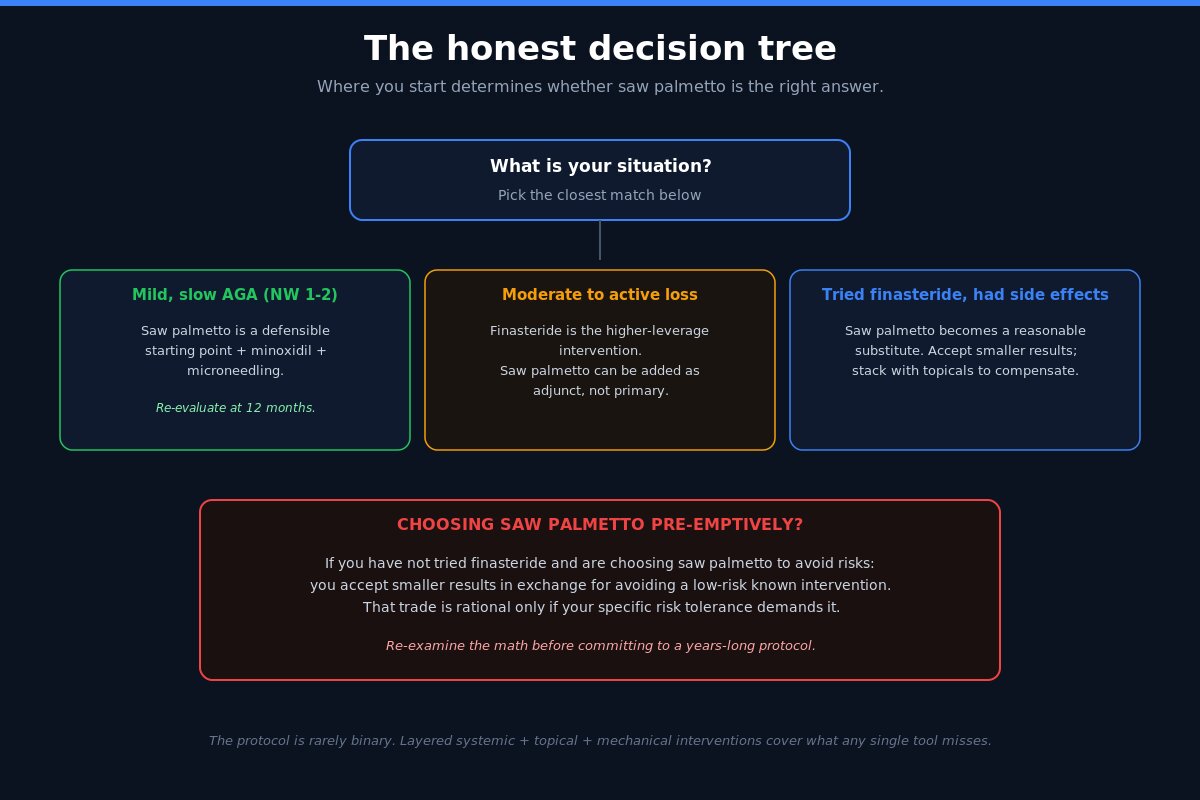
The honest decision tree
If you have early, slow androgenetic alopecia and are willing to accept a smaller effect for a softer pharmacology: saw palmetto is a defensible starting point, ideally combined with minoxidil and possibly microneedling.
If you have moderate to active loss: finasteride is the higher-leverage intervention. Saw palmetto can be added as an adjunct but should not be the primary therapy.
If you have tried finasteride and could not tolerate it: saw palmetto becomes a reasonable substitute, with the understanding that you are accepting smaller results than the finasteride alternative would have produced.
If you are choosing saw palmetto preemptively to avoid finasteride risks without ever trying finasteride: you are making a probability bet against a low absolute risk while accepting a high probability of substantially weaker results. That trade is rational only if the side-effect risk feels intolerable to you personally – which is a value judgment, not a medical one.
Combining with the rest of your protocol
Saw palmetto fits cleanly into a multi-pronged stack. The biology is on the systemic AR/DHT pathway, so it pairs with topical interventions (minoxidil, ketoconazole) and mechanical interventions (microneedling) without overlap. It does not replace anything in those categories.
The pillar protocol most men with mild to moderate AGA build looks like: a primary AR/DHT intervention (finasteride for most, saw palmetto for the narrow cases above), plus a topical growth stimulator (minoxidil or its alternatives), plus a scalp-environment intervention (ketoconazole), plus possibly microneedling at appropriate frequency. Substituting saw palmetto for finasteride in this stack reduces the systemic lever’s strength but keeps the rest of the structure intact. That is the right way to think about it.
Frequently asked questions about saw palmetto for hair loss
How much saw palmetto should I take?
The dose used in most hair loss trials is 320 mg/day of standardized lipidosterolic extract, taken with food. Higher doses have been studied for BPH without proportional increases in benefit. Capsule form with standardized extract content is the reliable formulation.
How long until I know if it is working?
Hair cycle changes show up over months, not weeks. Allow 6-12 months of consistent dosing before judging the effect. Standardized photography under consistent lighting is the most reliable way to track. Subjective impressions in the mirror lag behind measurable changes in either direction.
Can I take saw palmetto with finasteride?
Stacking is possible but has not been well studied. The redundant mechanism (both target 5-AR) makes additive benefit unlikely; finasteride’s stronger inhibition probably overrides any added effect from saw palmetto. Most clinicians do not recommend stacking. If you are already on finasteride and adding saw palmetto, the marginal benefit is likely small and the marginal cost is added supplement load.
Are there side effects?
The reported side effect rate is low. Possible: GI upset, headache, occasional rare hormonal effects (gynecomastia, libido changes). Saw palmetto can interact with anticoagulants and hormonal medications, so disclose to your clinician.
Does saw palmetto cause post-finasteride-syndrome-like symptoms?
The PFS literature is specifically about finasteride and dutasteride. Saw palmetto produces a much weaker DHT suppression and there are no documented saw-palmetto-specific persistent post-discontinuation syndromes. Some people who stop saw palmetto report transient mood or sexual changes, which is not the same as PFS.
Topical or oral – which is better?
Oral has more trial data and is the better-supported option for mild AGA. Topical 1 percent saw palmetto has one decent trial (Wessagowit 2015) showing modest improvement. Topical can be combined with minoxidil topically. Oral is the higher-confidence choice if you pick one.
Will it grow my hair back?
Saw palmetto is a preservation tool, not a regrowth tool. It can slow loss in mild cases and produce small density gains in some men. It will not regrow significant hair on bald or heavily miniaturized areas. For regrowth potential at all, finasteride plus minoxidil plus microneedling is a better combination, with realistic expectations even there.
Is it safe long term?
Long-term safety data for saw palmetto comes mostly from BPH literature, where it has been used for decades with a generally favorable side-effect profile. Long-term hair loss-specific data is limited. The pharmacology suggests it should be safe long term but this is an inference rather than a proven trial result.
Can women take saw palmetto for hair loss?
Limited data. Saw palmetto is sometimes used for female pattern hair loss in cases where finasteride or spironolactone are not appropriate. Effect size is small; results are similar in pattern to male trials but the evidence base is thinner.
What about combination products marketed for hair loss?
Most contain saw palmetto plus a multi-vitamin plus biotin plus various phytosterols. The active piece is usually the saw palmetto. The marketing premium reflects branding more than additional active content. A standalone saw palmetto extract plus a separate basic multivitamin is usually cheaper and at least as effective.
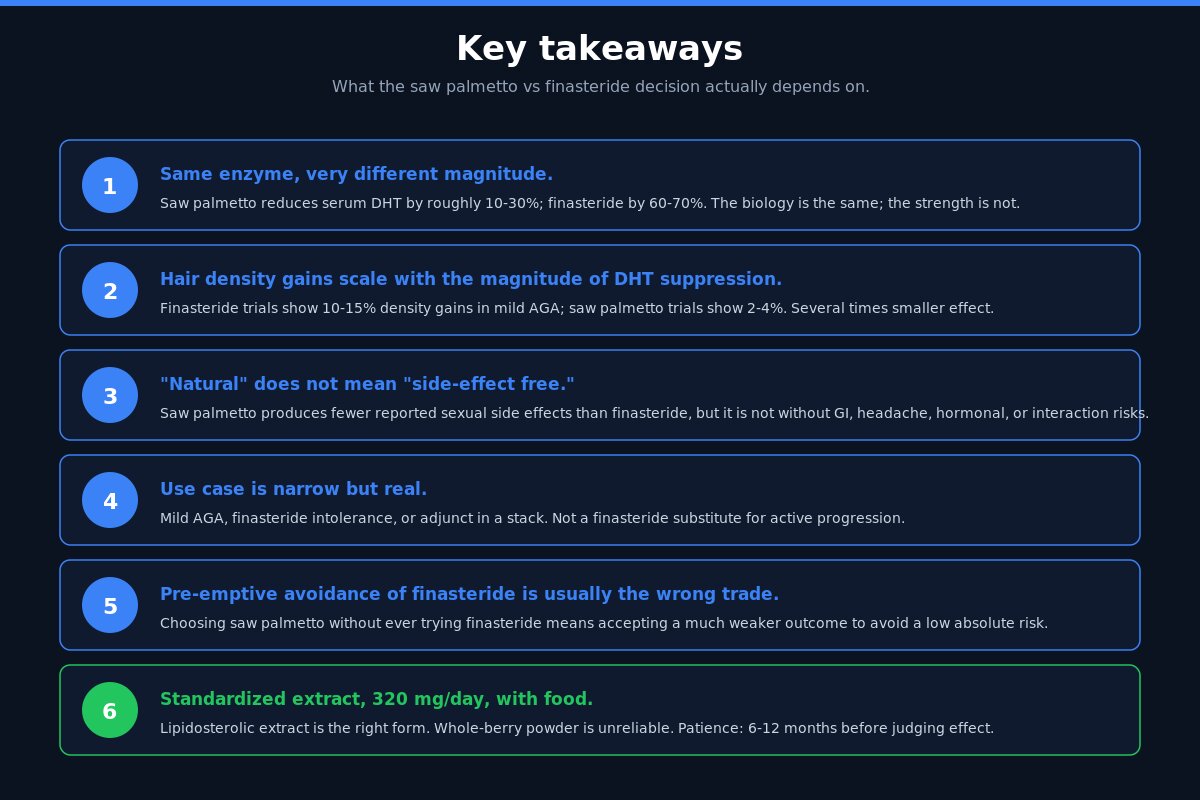
Bringing it together
Saw palmetto is a real intervention with a real but modest effect. The mechanism is correct – 5-alpha reductase inhibition – but the magnitude is several times smaller than finasteride. The honest framing is: a defensible option for mild loss in finasteride-intolerant patients or for adjunct stacking, not a primary therapy for active progression. The biology of androgenetic alopecia is the same whether you intervene with a strong pharmacology or a weak one; the difference shows up in how much you preserve.
If finasteride is on the table for you, the math says it is the higher-leverage choice. If you have already tried finasteride and it was not a fit, saw palmetto becomes a reasonable softer alternative – and the related questions of why finasteride sometimes fails and how post-finasteride symptoms are handled are worth reading before you switch. The protocol decision is rarely binary; it is usually about what your stack looks like across the systemic, topical, mechanical, and adjunct layers, and saw palmetto has a place in some stacks and not in others.
This article is for educational purposes only and does not constitute medical advice. Hair loss has multiple potential causes and the right approach depends on your individual history, examination, and bloodwork. Speak with a qualified clinician before starting or stopping any treatment. See the full disclaimer.
About the author
Philippe Boissard
Author of Men’s Hairloss Protocol (2020), Better, Smarter, Stronger (2023), and Multi-Axis Body (2025). Researches and writes about hair loss and male physiology, citing primary literature and disclosing affiliate relationships in full. Not a medical doctor; all content is educational. More about Philippe.
Related reading
Get my free hair-loss protocol
The exact evidence-based routine I actually use and recommend: what works, in what order, with no hype. Enter your email on the next page and I’ll send it straight to you.
Send me the free protocol →
[…] Saw Palmetto vs Finasteride: What the Evidence Shows […]
[…] Saw Palmetto vs Finasteride: What the Evidence Shows […]