
Pumpkin Seed Oil for Hair Loss: Cho 2014 and What Happened in the 11 Years Since
Pumpkin seed oil for hair has one positive trial (Cho 2014) and a thin replication record. Honest read on what the literature supports, where it fits, and the dose that matters.

Pumpkin seed oil shows up on most “natural hair loss” lists with one citation: Cho et al. 2014, a small Korean trial that reported visible hair count gains in men taking 400 mg of pumpkin seed oil daily for 24 weeks. The result was real, the effect size was modest, and the study has been used to anchor a supplement category that has expanded far beyond what the underlying data supports. Eleven years later, the replication record is thin. There are mechanism-level studies, observational reports, and a handful of derivative trials, but no large multi-center confirmation of the original Korean result. This article walks through what Cho 2014 actually showed, what the replication and follow-up literature looks like, and where pumpkin seed oil fits as a supplement in a real hair-loss strategy.
Quick answer: does pumpkin seed oil work for hair loss?
Probably some effect, in some men, with a substantially smaller magnitude than minoxidil or finasteride. The Cho 2014 trial is the strongest evidence and showed approximately 30 percent improvement in hair count over baseline at 24 weeks, somewhat lower than typical minoxidil response. The mechanism is plausible (mild 5-alpha reductase inhibition through phytosterols and zinc) but the trial base is thin and replication has been limited. As an adjunct stacked on established therapy, pumpkin seed oil is reasonable. As a substitute for finasteride or minoxidil in men with progressing AGA, it is wishful thinking dressed up in citation.
What Cho 2014 actually showed
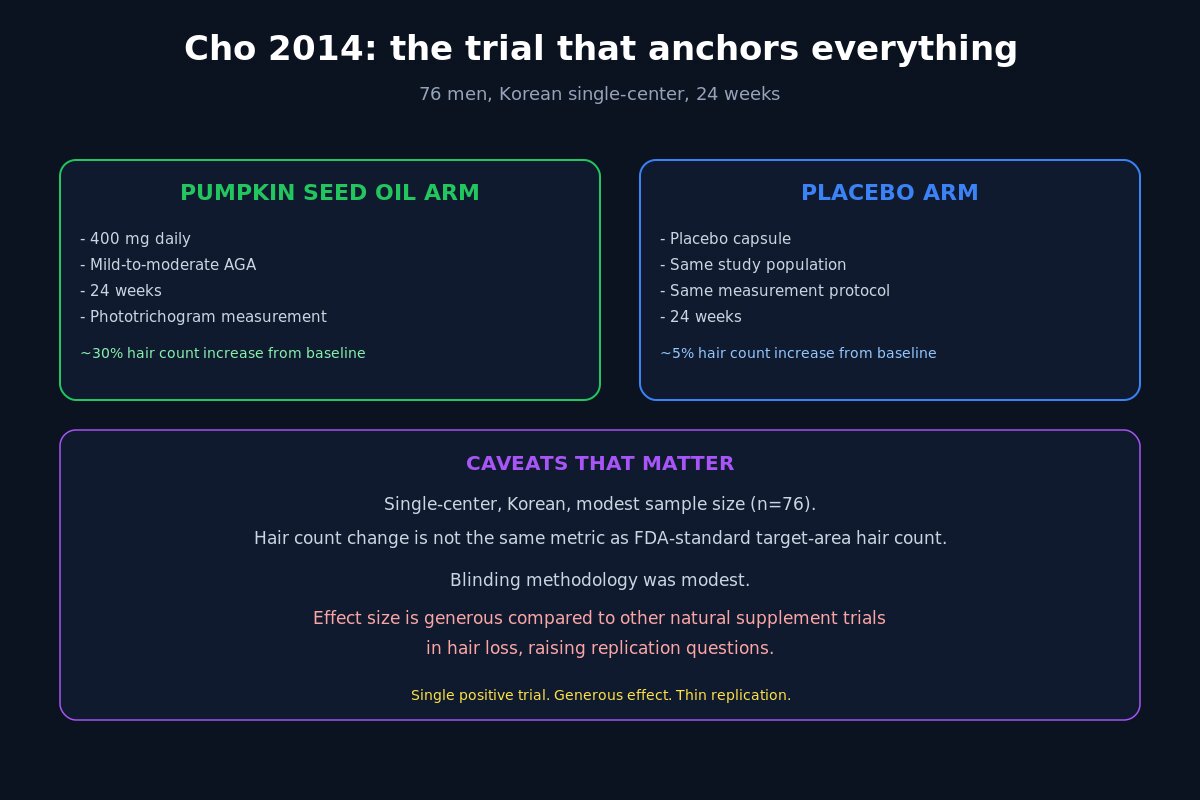
The Cho et al. 2014 trial randomized 76 men with mild-to-moderate androgenetic alopecia to either 400 mg of pumpkin seed oil daily or placebo for 24 weeks. The primary outcome was hair count measured by phototrichogram. The reported result was a roughly 30 percent increase in hair count in the pumpkin seed oil group versus a 5 percent increase in the placebo group. Both groups showed some improvement, which is typical of placebo arms in hair trials, but the pumpkin seed group showed a meaningfully larger increase.
The study had limitations. It was single-center and Korean. The 30 percent figure is hair count change, not the same metric as the FDA-standard target-area hair count (TAHC). The blinding methodology was modest. Concurrent therapy was excluded, but lifestyle factors were not controlled. The effect size is generous compared to other natural-supplement trials in hair, raising at least a question about how much of the magnitude transfers to real-world use outside the trial setting.

The mechanism that supports it
Pumpkin seed oil contains a complex mixture of phytosterols (notably beta-sitosterol), unsaturated fatty acids, zinc, and various phenolic compounds. The mechanistic argument for hair-loss effect rests primarily on phytosterol-mediated 5-alpha reductase inhibition. Beta-sitosterol has been shown in vitro to inhibit 5-AR activity at high concentrations. Zinc independently has weak 5-AR inhibition properties. The fatty acid profile supports skin barrier and follicle health in general ways that are plausible but not well-quantified.
Whether the in vitro 5-AR inhibition translates to clinically meaningful systemic DHT suppression at typical 400 mg supplement doses is less clear. Pumpkin seed oil does not produce the magnitude of DHT suppression that finasteride or even saw palmetto extract produces in clinical trials, but the Cho 2014 hair count gains suggest some pathway is being engaged.
Replication and follow-up evidence
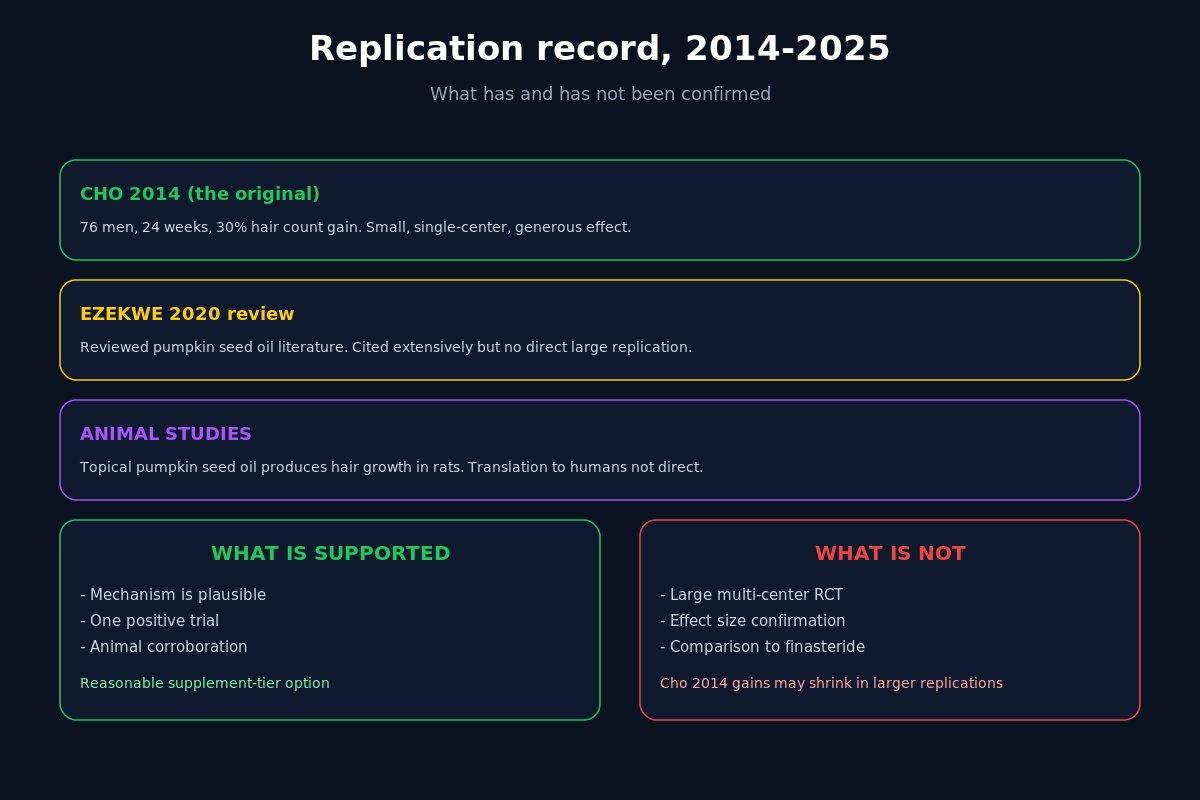
The replication record is thin. Ezekwe et al. 2020 reviewed the broader literature on pumpkin seed oil for various indications including hair, finding the Cho 2014 result has been cited extensively but not directly replicated in a comparable trial. Several smaller trials have looked at pumpkin seed oil in combination with other supplements, making the standalone effect harder to isolate. Animal studies in rats have shown topical pumpkin seed oil produces hair growth effects, but the translation to human trials is not direct.
The honest read is: one positive trial with a generous effect size, a plausible mechanism, and an absence of contradictory evidence. The same data could support either “this is a real effect deserving wider study” or “the original effect size will shrink in larger replications, as often happens with single-center trials of modest size.” Without the larger replications, both interpretations are live.
Watch this for context
This Hair Loss Compound Works Differently – frames why mechanism matters less than effect size and why single-trial evidence should be weighted carefully when used to anchor a supplement category.
Pumpkin seed oil vs saw palmetto vs other natural options
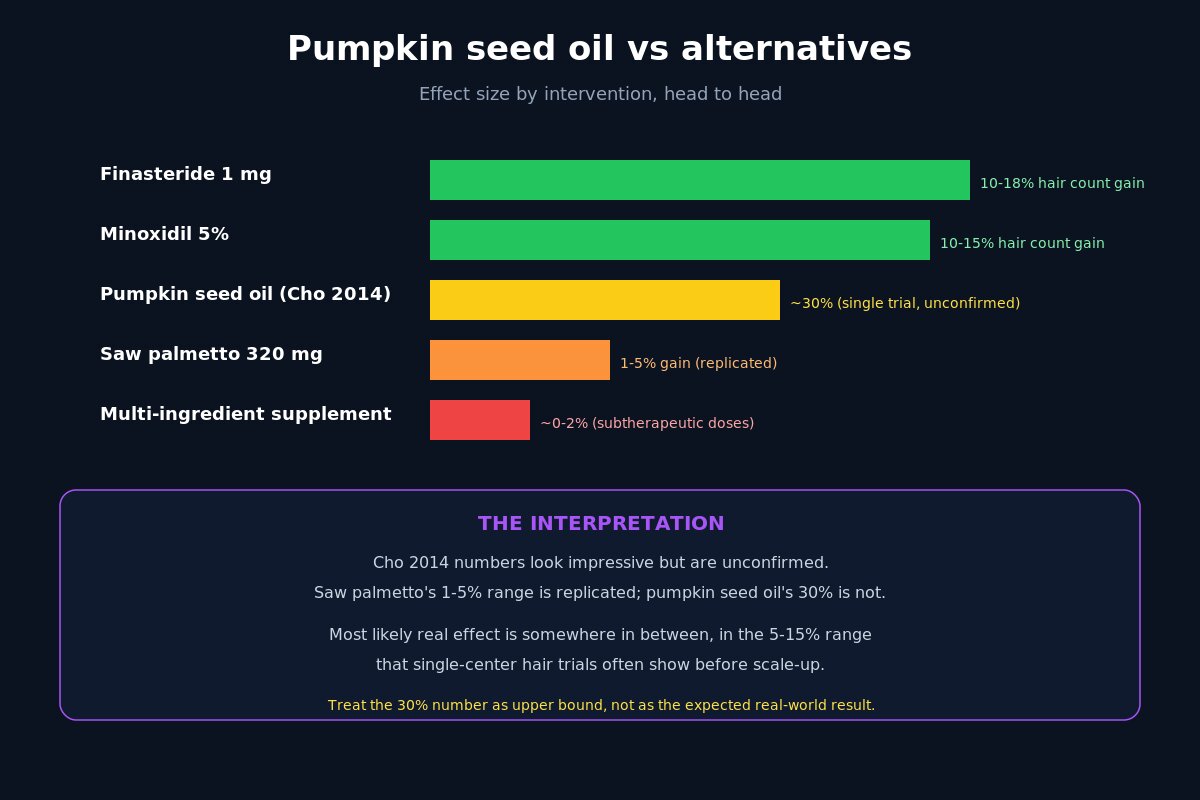
Both pumpkin seed oil and saw palmetto are natural-tier supplements with weak 5-alpha reductase inhibition mechanisms and modest clinical evidence. Saw palmetto has slightly more replication: Prager 2002, Wessagowit 2015, and several other trials have reported hair-count effects in the 1-5 percent range. Pumpkin seed oil has the larger reported effect from Cho 2014 (about 30 percent) but with thinner replication.
The honest interpretation is that both are reasonable adjuncts at the supplement tier, both have effect sizes dramatically smaller than finasteride, and the choice between them is mostly preference and tolerability. Some men respond to one and not the other; the literature does not provide a clear winner. Stacking both is reasonable for a man wanting to maximize the supplement-tier intervention before committing to prescription therapy, though the combined effect size is still small.
How to choose a pumpkin seed oil supplement
The Cho 2014 trial used 400 mg of pumpkin seed oil per day. Most consumer supplements deliver doses in the range of 500-2000 mg, so achieving the trial dose is not difficult. Look for cold-pressed unrefined pumpkin seed oil rather than refined or capsule fillers, since the active phytosterols are concentrated in the unrefined form. Verify the product specifies pumpkin seed oil rather than just “pumpkin seed extract,” which can be a different formulation.
The bottle should disclose the seed oil milligrams per capsule, not hide them in a proprietary blend. Brands that bundle pumpkin seed oil with a dozen other ingredients dilute the headline ingredient to subtherapeutic doses. Single-ingredient pumpkin seed oil at 400-800 mg daily is the cleanest approach if you want to give the supplement a fair test based on the trial protocol.
Where pumpkin seed oil fits in a strategy
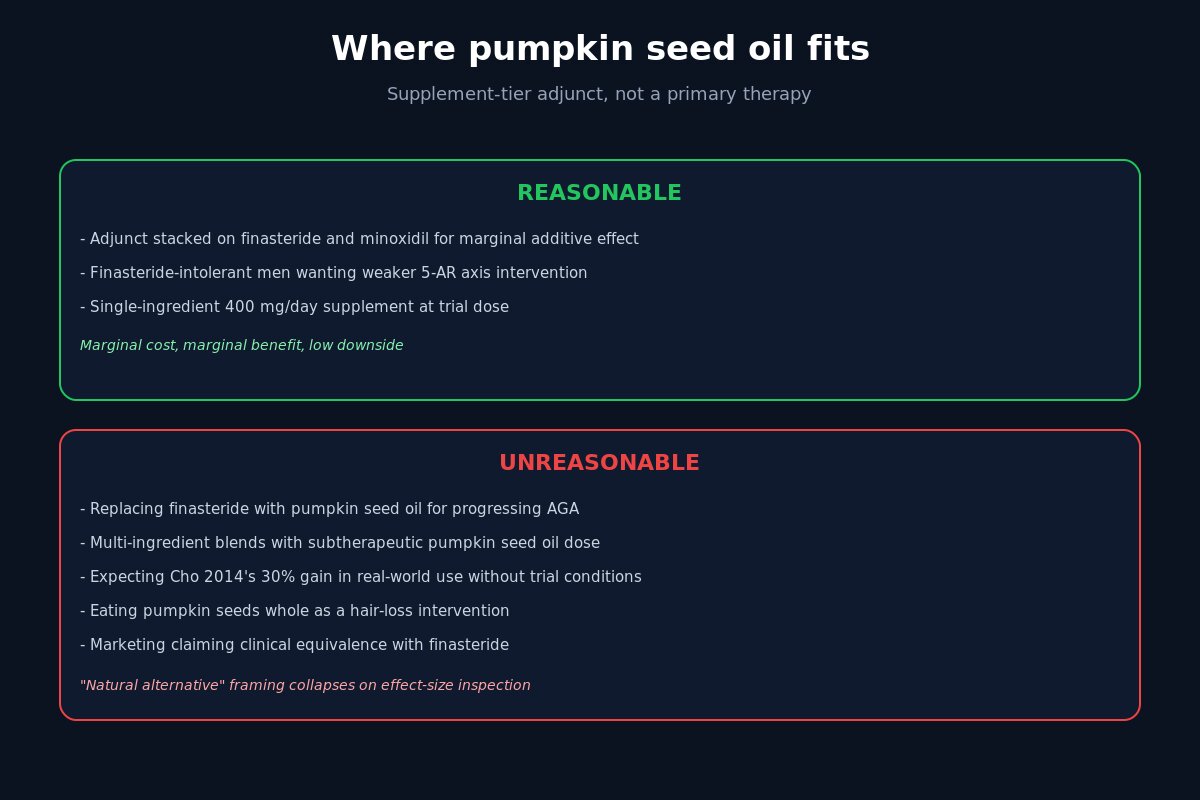
The reasonable role for pumpkin seed oil is as an oral supplement adjunct for men who are either intolerant of finasteride or want to layer on additional 5-AR pathway intervention beyond established therapy. It does not replace finasteride or minoxidil in men with progressing AGA. It is not a primary intervention. The 24-week timeline of Cho 2014 means a 6-month evaluation window is reasonable; if no visible improvement by then, continuing is unlikely to produce dramatic gains.
Pumpkin seed oil also has a downside-that-is-not: cost. A bottle of single-ingredient pumpkin seed oil supplement is roughly USD 15-30 per month. Stacking it on top of established therapy adds modest cost without meaningful side-effect risk. The marginal-benefit, marginal-cost calculation is favorable for men already on the established stack.
Common myths about pumpkin seed oil and hair
The myth that the Cho 2014 result has been “widely replicated” is incorrect; the replication record is thin. The myth that pumpkin seed oil rivals finasteride at the right dose ignores the magnitude difference in effect sizes. The myth that drinking pumpkin seed oil topically applied to scalp produces growth conflates oral supplementation with topical use; the trials with positive results were oral. The myth that “natural supplements have no side effects” overlooks rare GI effects from oral seed oil. The myth that pumpkin seed oil is uniquely effective compared to other phytosterol-rich oils probably overstates the specificity of pumpkin; the active ingredient is beta-sitosterol class, which is also present in saw palmetto, beta-sitosterol supplements, and other plant oils.
Frequently asked questions about pumpkin seed oil for hair
How much pumpkin seed oil should I take?
The Cho 2014 trial used 400 mg per day. Higher doses (up to 1000 mg) are common in consumer supplements without clear evidence of additional benefit. Lower doses are likely subtherapeutic.
How long until I see results?
The trial measured at 24 weeks. Most evaluations should run 6 months minimum. Earlier evaluation produces false-negative readings consistent with the hair-cycle physiology that constrains all hair interventions.
Can I use pumpkin seed oil topically?
Animal studies suggest topical effects may exist; human trials with positive results used oral supplementation. The case for topical use rests on weaker evidence than the case for oral.
Should I combine pumpkin seed oil with finasteride?
Reasonable. The mechanisms are partially overlapping (both target 5-AR activity), so the marginal benefit is small but the cost is also small. As long as you are not using pumpkin seed oil to replace finasteride, stacking is fine.
Does pumpkin seed oil have side effects?
Rare. Some users report mild GI effects (oily stool, mild stomach upset). The supplement is generally well tolerated. Allergic reactions are uncommon but possible.
Is pumpkin seed oil better than saw palmetto?
Cho 2014 reported larger gains than typical saw palmetto trials, but with thinner replication. The honest answer is “comparable in mechanism, both reasonable supplement-tier options, neither rivals finasteride.”
Can I just eat pumpkin seeds instead of taking the oil?
Whole pumpkin seeds contain pumpkin seed oil but achieving the trial dose of 400 mg of oil through whole seeds requires eating substantial volumes daily. The oil supplement is more practical for consistent dosing.
Does pumpkin seed oil affect testosterone?
Oral pumpkin seed oil at 400 mg daily produces minimal effect on serum testosterone. The 5-AR inhibition is mild and the systemic exposure is low compared to prescription 5-AR inhibitors.

Bringing it together
Pumpkin seed oil for hair loss has one positive trial with a generous effect size and a thin replication record over the eleven years since. The mechanism is plausible: beta-sitosterol-mediated 5-alpha reductase inhibition plus zinc and fatty acid contributions. The reasonable role is as a supplement-tier adjunct stacked on top of established therapy, not as a replacement for finasteride or minoxidil. The trial dose is 400 mg daily, the evaluation window is 24 weeks minimum, single-ingredient supplements at trial dose are the cleanest test. Treat it like saw palmetto: low evidence, low downside, marginal upside, fine to include in a stack but never to anchor the strategy. Marketing claims that pumpkin seed oil rivals finasteride are running far ahead of what Cho 2014 actually demonstrated.
About the author
Philippe Boissard
Author of Men’s Hairloss Protocol (2020), Better, Smarter, Stronger (2023), and Multi-Axis Body (2025). Researches and writes about hair loss and male physiology, citing primary literature and disclosing affiliate relationships in full. Not a medical doctor; all content is educational. More about Philippe.
Related reading
Get my free hair-loss protocol
The exact evidence-based routine I actually use and recommend: what works, in what order, with no hype. Enter your email on the next page and I’ll send it straight to you.
Send me the free protocol →