
Clascoterone 5% (CB-0301): The Phase 3 Hair Loss Study Explained, and What It Actually Means


If you’ve been anywhere near the hair loss space recently, you’ve probably seen the claim:
“539% better than placebo.”

It’s one of those numbers that immediately grabs attention. It sounds massive. Almost too massive. And naturally, the first reaction most people have is either excitement… or skepticism.
So instead of just repeating the headline, let’s slow this down and actually understand what’s behind it — what the Phase 3 data for Clascoterone (also known as CB-0301 or Breezula) really shows, how it works, and where it actually fits in a real-world protocol.
Because once you understand the mechanism, the numbers start to make a lot more sense.
First — What Kind of Treatment Is This, Really?
When we talk about hair loss treatments, most people think in terms of products. But the more useful way to think about it is in terms of mechanisms — what the treatment is actually doing inside the follicle.
At a high level, there are three ways we currently approach androgenetic alopecia.
You either try to stimulate growth, like with Minoxidil.
You try to reduce the hormonal signal itself, like with Finasteride or Dutasteride.
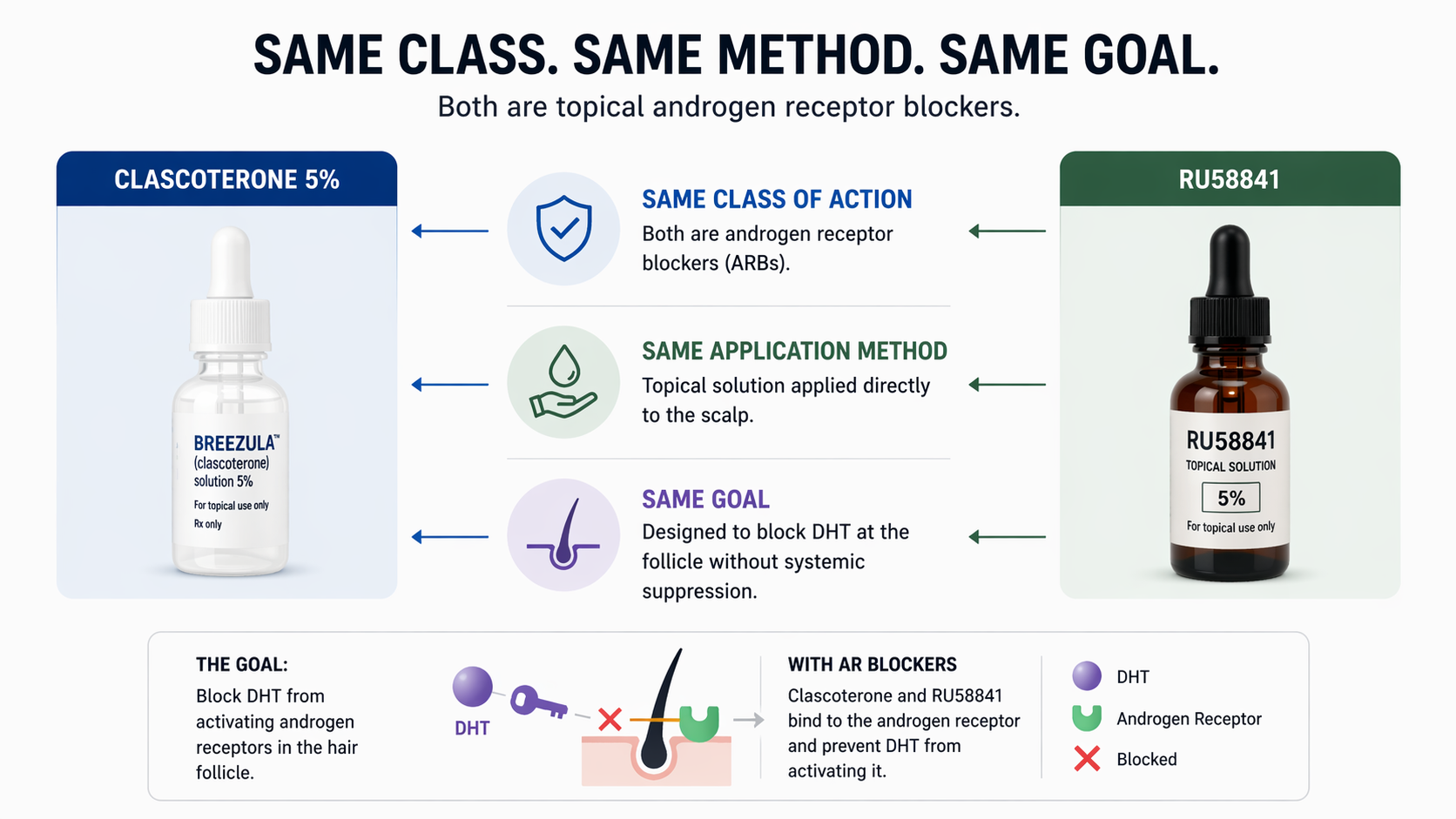
Or — and this is where clascoterone comes in — you block the signal at the point where it actually matters: the receptor inside the follicle.
That third category is fundamentally different.
Clascoterone doesn’t lower DHT. It doesn’t try to change your systemic hormone profile. Instead, it sits locally at the follicle and competes with DHT at the androgen receptor, essentially preventing the signal that drives miniaturisation from being transmitted.
That’s why you’ll often hear it described as a topical anti-androgen. But more precisely, it’s a topical androgen receptor antagonist.
And that distinction matters — because it explains both the effect and the safety profile we see in the trials.
But a clean mechanism is one thing. The real question is always the same:
Does it actually work when you test it properly?
The Phase 3 Trials — What Was Actually Done
The data comes from two large Phase 3 trials conducted by Cosmo Pharmaceuticals. Together, these studies included around 1,400–1,500 men with androgenetic alopecia.
This wasn’t a small exploratory study. This was a full randomized, double-blind, placebo-controlled setup — the kind of design you need if you want to separate real effects from noise.
Participants were split into two groups:
- One group used clascoterone 5% solution
- The other used a vehicle (placebo)
They applied the treatment twice daily, and researchers tracked changes using something called Target Area Hair Count (TAHC) — essentially a standardized way of measuring how many hairs are growing in a defined patch of scalp.
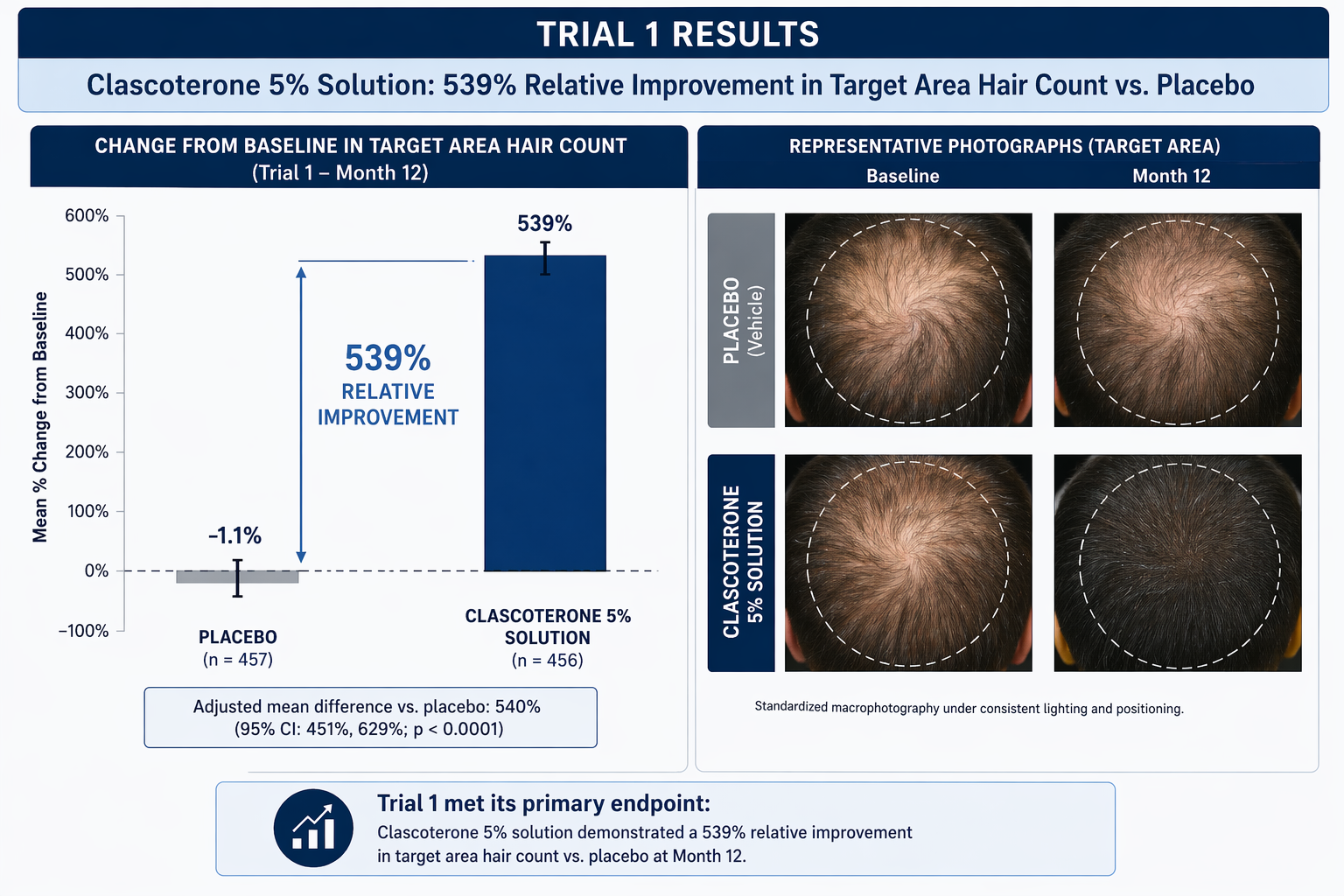
And importantly, they didn’t just look at short-term changes. The trials ran long enough to capture both initial response and sustained effect, with follow-up extending toward 12 months.
So structurally, this is about as solid as it gets in dermatology research.
The 539% Claim — Interpreted Properly
Let’s address it directly.
In one of the two trials, clascoterone showed a 539% relative improvement vs placebo. In the other, it was 168%.
Now, if you take that at face value, it sounds like one study worked dramatically better than the other. But that’s not actually what’s happening.
These numbers are relative improvements, not absolute ones.
What that means is this:
The placebo group doesn’t stay perfectly flat. Even without treatment, you’ll see small fluctuations in hair count — measurement variation, seasonal changes, natural cycling.
If placebo increases slightly, and the treatment increases more, the difference between those two numbers can be expressed as a percentage.
And when the placebo baseline is small, that percentage can look very large.
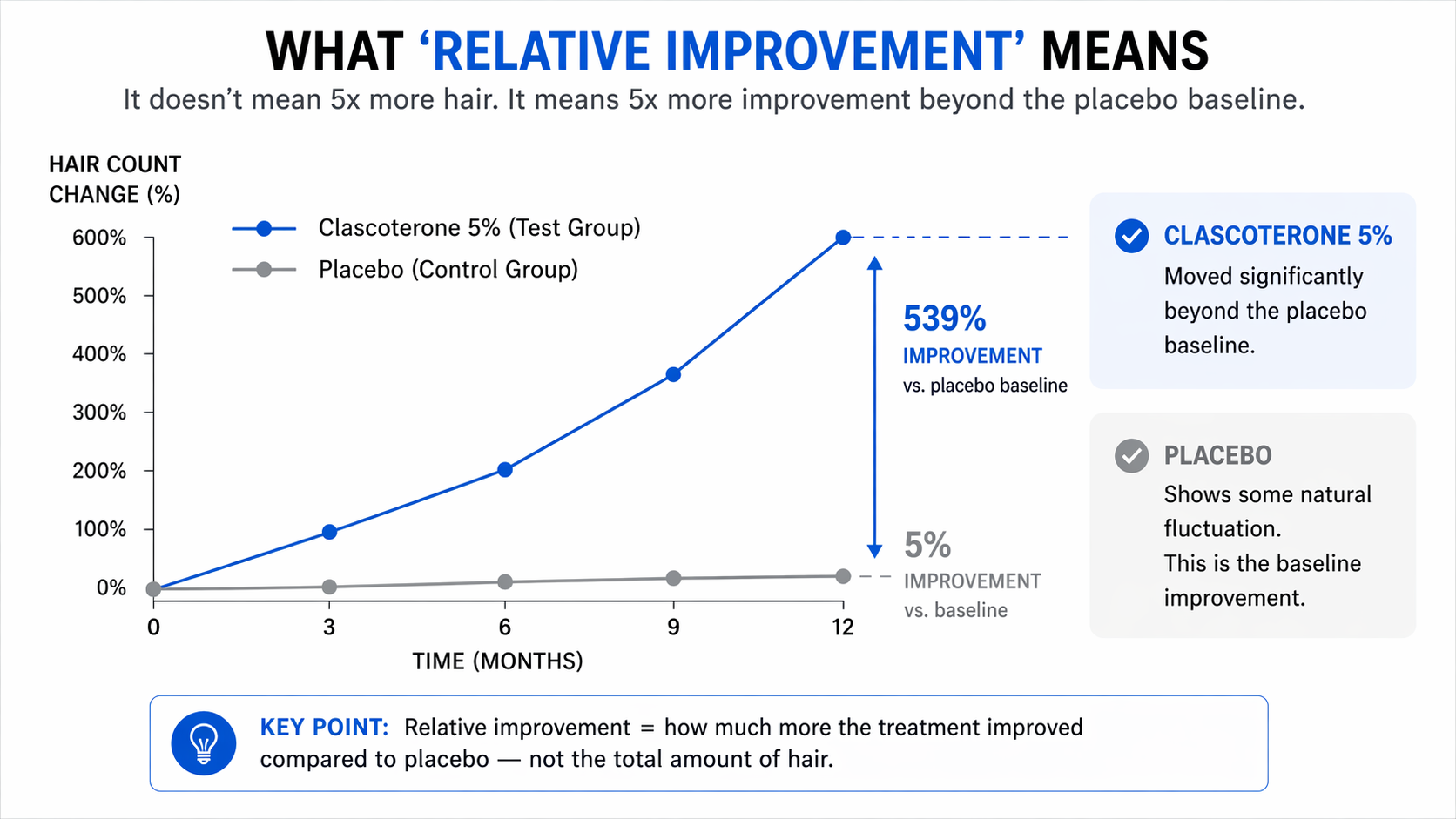
So the 539% number is real — but it’s a mathematical amplification of a difference, not a literal multiplication of hair growth.
What matters more is this:
Which brings us back to that headline number.
👉 Both trials showed a statistically significant improvement vs placebo
👉 The direction of effect was consistent
👉 The signal is real, even if the framing varies
And from a clinical perspective, that’s the part that actually counts.
Safety — Why This Compound Stands Out
One of the most interesting parts of the clascoterone data isn’t just the efficacy — it’s how clean the safety profile looks.
Across the Phase 3 program:
- Side effects were similar to placebo
- No meaningful systemic hormonal changes were detected
- Most reported issues were mild, like minor scalp irritation
And this ties directly back to the mechanism.
Because clascoterone is acting locally at the follicle, very little of it ends up circulating in the bloodstream. It gets metabolized quickly in the skin.
That’s fundamentally different from systemic treatments, where you’re altering hormone levels throughout the entire body.
So what you end up with is something that targets one specific part of the system — without broadly modifying everything else.
And that’s exactly why people are paying attention to it.
How It Compares to RU58841
If you’ve been following this space for a while, the obvious comparison is RU58841.
And on a purely mechanistic level, the comparison is fair.
Both compounds:
- Block the androgen receptor locally
- Are applied topically
- Aim to stop DHT signaling at the follicle
So biologically, they’re operating in the same lane.
Where they differ is in something more practical:
👉 Data vs history
Clascoterone now has Phase 3 clinical data behind it.
RU58841 has years of community use, but no formal late-stage trials.
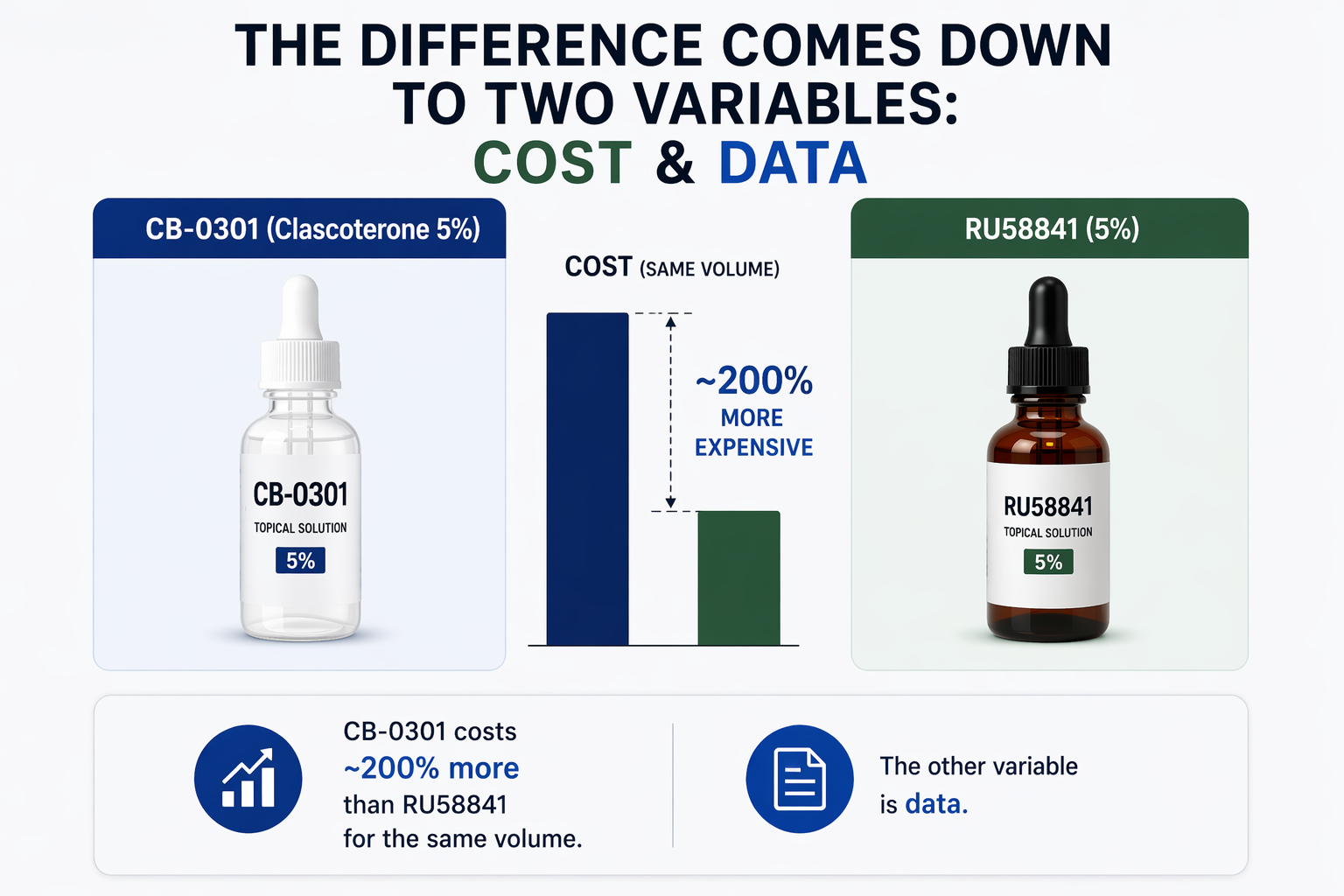
That doesn’t automatically make one “better” than the other. It just changes the nature of the decision.
Some people will prioritise cost and familiarity. Others will prioritise having controlled human trial data.
And that’s really the trade-off.
Access — And the Reality of Where We Are Right Now
Here’s where things get more practical.
Clascoterone is not yet widely available as a prescription for hair loss. That’s still moving through the regulatory process.
But the compound itself — CB-0301 — is already accessible in raw form.
If you want to look into it, this is the source I personally use:
👉 https://anageninc.com/product/cb0301-powder/?ref=26
You can use the code BLUEPRINT at checkout for:
- 10% off CB-0301 (Breezula)
- Discount on KB solution, which is the standard carrier used for scalp applications
The typical formulation used in trials was a 5% solution, which can be replicated by dissolving:
- 1.5 grams CB-0301
- Into 30 ml of KB solution
That gives you the same concentration that was studied.
And if you’ve ever worked with RU58841, the process will feel very familiar — weigh, dissolve, apply.
So Where Does This Actually Fit?
The biggest mistake people make is trying to treat hair loss as a single-variable problem.
It isn’t.
You’re dealing with multiple overlapping factors:
- Androgen signaling
- Follicle sensitivity
- Inflammation
- Structural changes over time
Clascoterone targets one of those axes — the androgen receptor itself.
And that’s why it’s not really a “replacement” for everything else.
It’s an additional tool.
A different way of interacting with the same underlying biology.
If You Want the Full Breakdown
This article gives you the structure and the context.
But if you want to actually see how this all fits together — the mechanism, the data, the comparison to RU, and how to think about using it — I break it down step by step in the video:
That’s where everything comes together visually.
Final Thought
Clascoterone isn’t hype. But it’s also not magic.
It’s something more interesting than that.
It’s the first time in decades we’ve seen a new pathway in hair loss treatment actually make it through Phase 3 with a clean safety profile and a real efficacy signal.
And whether you decide to use it or not, understanding how it works will make you better at evaluating everything else in this space.
Because once you start thinking in mechanisms instead of products, the entire field starts to make a lot more sense.
About the author
Philippe Boissard
Author of Men’s Hairloss Protocol (2020), Better, Smarter, Stronger (2023), and Multi-Axis Body (2025). Researches and writes about hair loss and male physiology, citing primary literature and disclosing affiliate relationships in full. Not a medical doctor; all content is educational. More about Philippe.
Get my free hair-loss protocol
The exact evidence-based routine I actually use and recommend: what works, in what order, with no hype. Enter your email on the next page and I’ll send it straight to you.
Send me the free protocol →
[…] the androgen receptor directly – RU58841, pyrilutamide, and clascoterone (CB-0301), whose Phase 3 trial I broke down separately. This is the closest mechanism to the actual disease site and one of the most active research […]
[…] anti-androgens. Compounds that work at the receptor rather than upstream of it. Clascoterone (CB-0301), originally FDA-approved for acne and now in late-stage trials for hair loss, is the most […]
[…] Clascoterone 5% (CB-0301): The Phase 3 Hair Loss Study Explained — And What It Actually Means […]
[…] Clascoterone 5% (CB-0301): The Phase 3 Hair Loss Study Explained — And What It Actually Means […]
[…] Clascoterone 5% (CB-0301): The Phase 3 Hair Loss Study Explained […]