
Pyrilutamide (KX-826) Deep Dive: What the Phase 3 Data Actually Shows
Pyrilutamide is the most-watched topical hair-loss compound in years, but the Phase 3 results were not what the early hype implied. Here is the honest read on KX-826 trial data, mechanism, and where it fits.

Pyrilutamide is the most-watched topical hair-loss compound in years. It is a topical androgen-receptor antagonist designed to block DHT at the follicle without dropping serum DHT, which is the side-effect lever that makes many men quit finasteride. The Phase 3 results out of China told a more complicated story than the Phase 2 hype implied, and most of what gets repeated online about KX-826 is a partial reading of that story. This article walks through what pyrilutamide actually is, what each trial showed, where the evidence is strong, and where it is genuinely weak.
Quick answer: does pyrilutamide work?
Pyrilutamide (KX-826) is a topical androgen receptor antagonist developed by Kintor Pharma. In Phase 2 trials it produced a hair-count benefit over placebo at 24 weeks at the 0.5 percent twice-daily dose. In the larger Phase 3 trial in Chinese men, the primary endpoint of non-vellus hair count change versus placebo was missed, although secondary endpoints favored the drug and the safety profile remained clean. Phase 3 in women separately missed its primary endpoint as well. The compound is approvable in some markets if Kintor pursues it, but it is not the finasteride-grade efficacy the early write-ups suggested.
For a man who cannot tolerate oral finasteride and is willing to test a compound with mixed-but-real signal and a clean safety record, pyrilutamide is reasonable to consider once available. For a man who tolerates finasteride or dutasteride well, switching to pyrilutamide as a primary therapy is not supported by the data. It is better understood as a possible adjunct or rescue option, not a replacement.
What pyrilutamide actually is
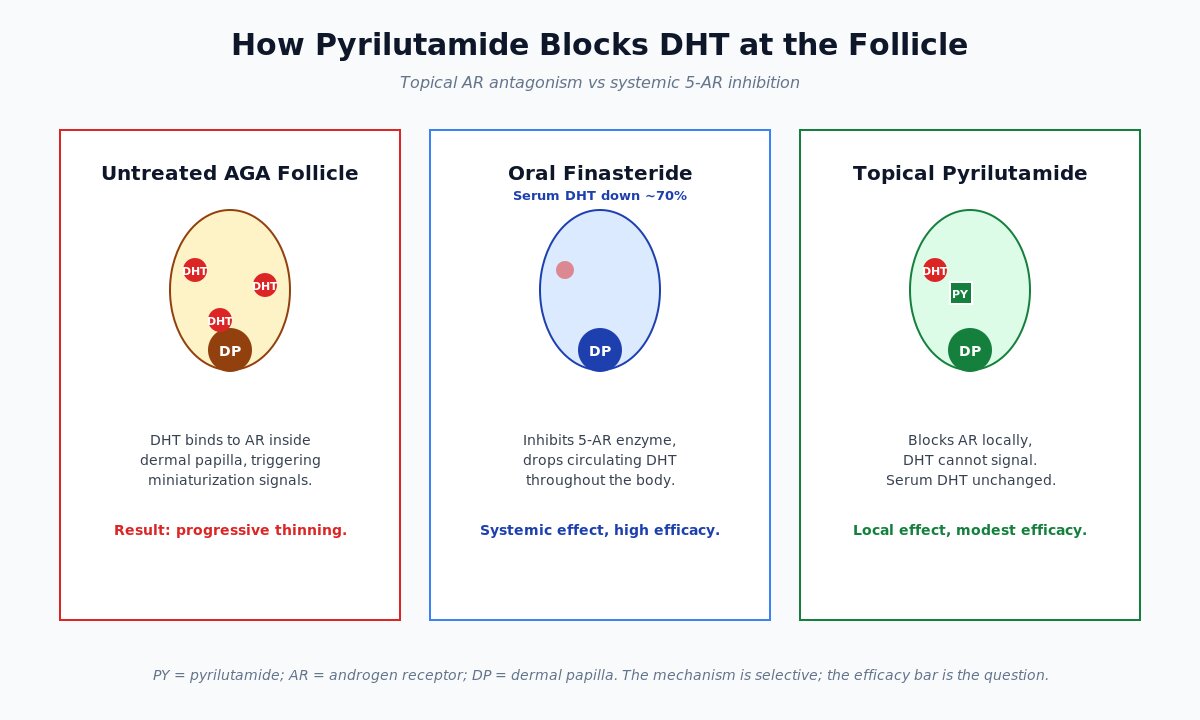
Pyrilutamide, also called KX-826, is a non-steroidal androgen receptor (AR) antagonist designed for topical application to the scalp. It binds to the androgen receptor inside the dermal papilla and blocks dihydrotestosterone (DHT) from triggering the miniaturization cascade that drives androgenetic alopecia (AGA). Critically, pyrilutamide is intended to act locally without producing meaningful systemic AR blockade. That positioning matters because the dose-limiting issues with systemic anti-androgens, such as bicalutamide or spironolactone, are exactly the side-effect categories men want to avoid: libido drop, mood changes, sexual function, and gynecomastia.
Mechanistically pyrilutamide sits in the same category as RU58841, clascoterone (CB-03-01), and the now-defunct fluridil. None of these compounds inhibit 5-alpha reductase, the enzyme that finasteride and dutasteride target. They do not lower DHT. They block DHT at the receptor in the tissue where it is being applied. That distinction is the entire reason topical AR antagonists exist as a category. If you want to read the basic biology behind why blocking DHT matters at all, the pillar article on how hair loss actually works walks through the mechanism in detail.
Where it sits next to RU58841 and clascoterone
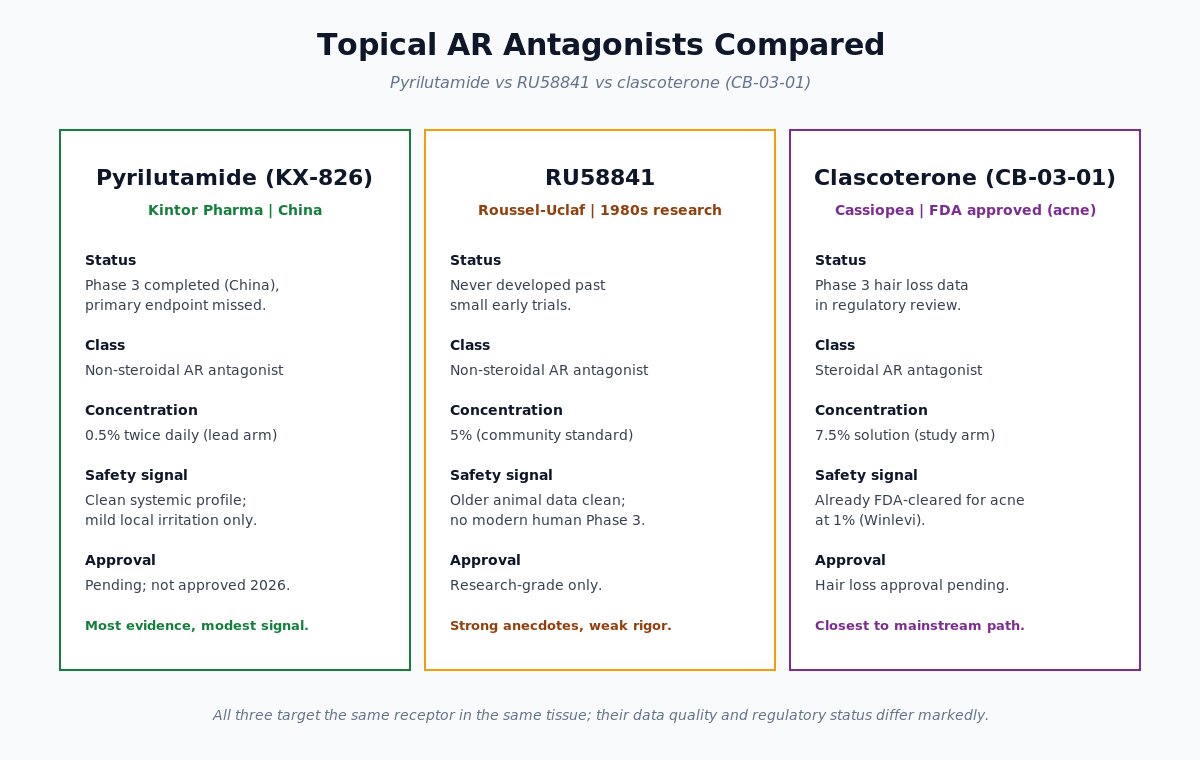
RU58841 is a research compound from 1980s French pharmaceutical work that was never developed into an approved product. It is widely used by gray-market consumers and has compelling preclinical and small clinical data, but no Phase 3 trial. Clascoterone (CB-03-01) is a steroidal AR antagonist already FDA-approved as Winlevi for acne, with hair-loss Phase 3 data being processed at the time of writing. Pyrilutamide is the only one of the three to have completed Phase 3 trials specifically for hair loss, with results released by Kintor in 2023. The honest framing is that pyrilutamide is the most regulated and tested of the three, but the trial outcomes were less clean than RU58841’s older small studies appeared to predict.
The Phase 2 data: where the optimism came from
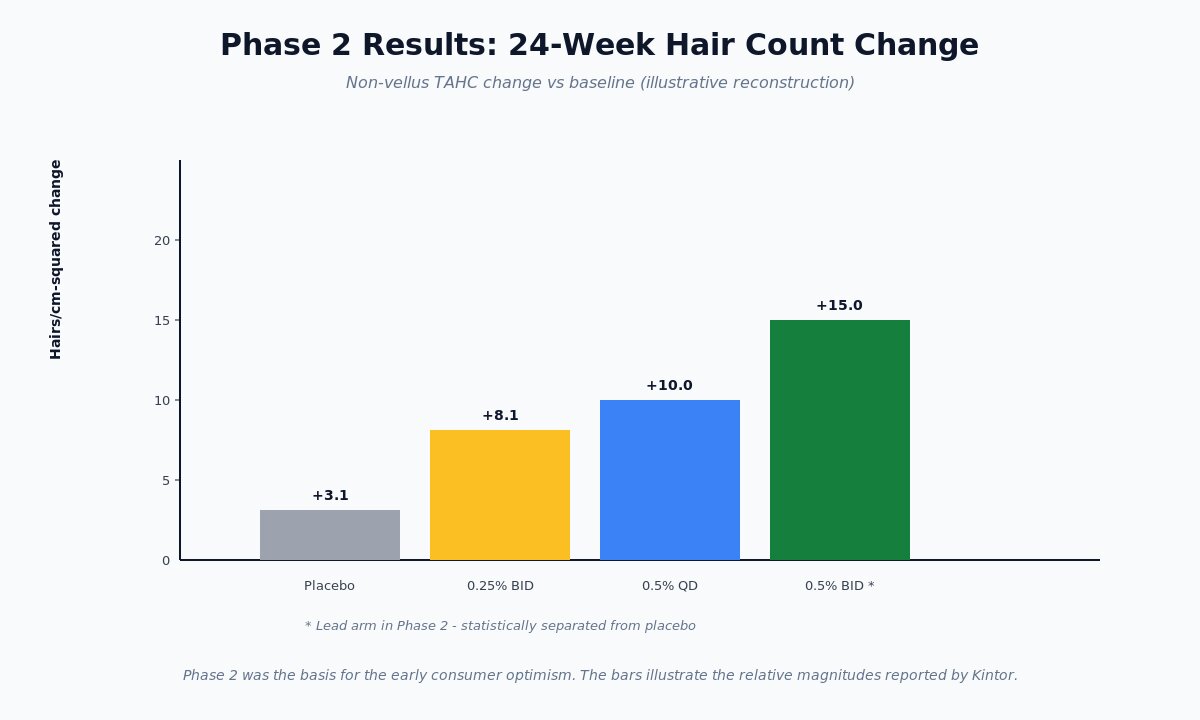
Kintor’s Phase 2 trial of pyrilutamide solution in Chinese men with AGA tested three concentrations (0.25 percent, 0.5 percent twice daily, and 0.5 percent once daily) against placebo for 24 weeks. The 0.5 percent twice-daily arm produced a non-vellus target area hair count (TAHC) increase of approximately 15.0 hairs/cm-squared above baseline, versus a small change in the placebo group. The differential between drug and placebo was statistically significant. There were no serious adverse events, no significant changes in serum testosterone or DHT, and the safety profile was indistinguishable from placebo for systemic markers.
That Phase 2 result is what generated the early consumer enthusiasm. A roughly 15 hair/cm-squared gain over placebo at 24 weeks is in the same ballpark as 5 percent topical minoxidil, which sets a real benchmark. Reasonable people read those numbers and concluded that a clean topical anti-androgen with finasteride-adjacent efficacy was about to land. The Phase 3 program was supposed to confirm and extend that signal at scale.
The Phase 3 data: what actually happened
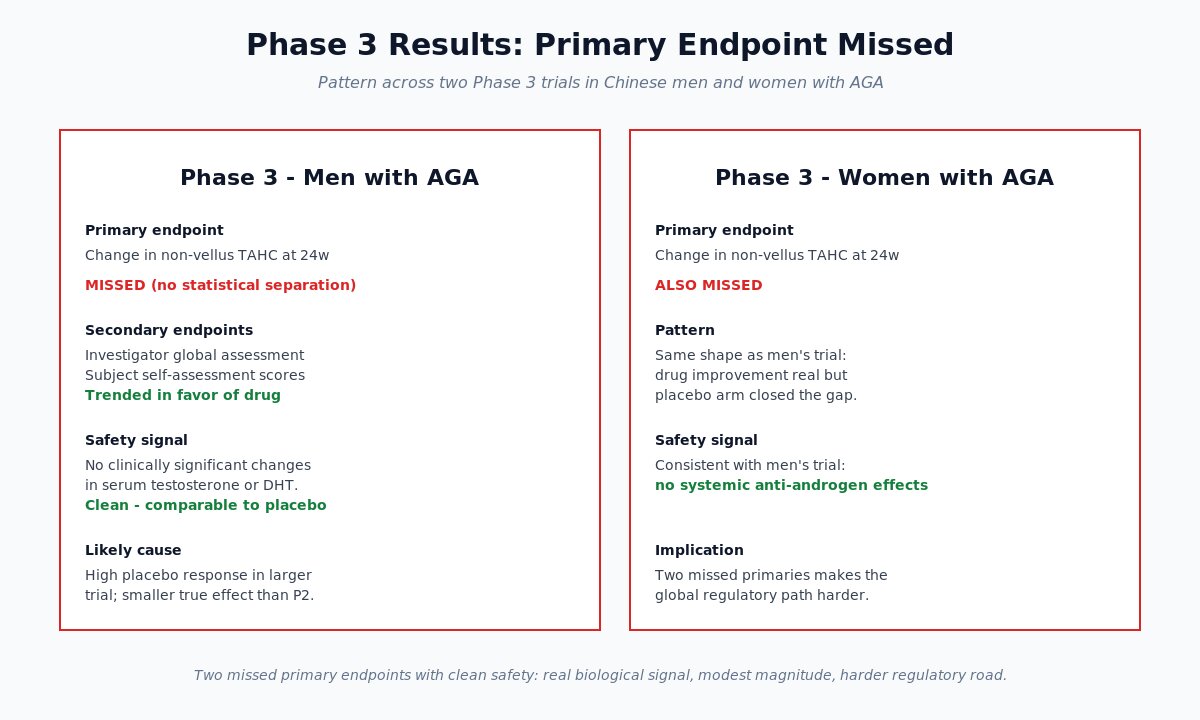
In June 2023 Kintor reported topline Phase 3 results for pyrilutamide in Chinese men with AGA. The trial enrolled hundreds of subjects and tested the 0.5 percent twice-daily formulation against placebo over 24 weeks. The primary endpoint was the change in non-vellus TAHC at 24 weeks. The trial missed that primary endpoint statistically. The drug arm showed numerical improvement over baseline, but the placebo group also improved, and the differential did not reach significance.
Importantly, several secondary endpoints did favor pyrilutamide. Investigator global assessment scores, subject self-assessment scores, and certain photographic readouts trended in the drug’s favor. The safety data remained clean: no clinically significant changes in serum hormones, no shift in sexual function questionnaires, and no concerning local reactions beyond mild scalp irritation comparable to placebo. Kintor framed the result as “primary endpoint not met but supportive secondary signals” and continued moving toward regulatory submission in China.
Then in late 2023 Kintor reported topline results from the Phase 3 trial in women with AGA, which also missed its primary endpoint. The pattern across both trials was similar: a placebo response that was higher than expected, drug-arm improvement that was real but smaller than Phase 2 predicted, and secondary endpoints that hinted at activity without crossing the statistical bar. This same pattern of plateau and disappointment after early enthusiasm is one of the recurring themes in this category, which is part of why the protocol-failure article on why your hair loss protocol isn’t working emphasizes setting expectations before starting.
Why a Phase 2 hit can become a Phase 3 miss
This pattern is common across drug development, not unique to pyrilutamide. Phase 2 trials are smaller, often run at fewer sites, and tend to enroll a more selected patient population. Placebo response is also less stable in smaller trials. When you scale to a larger Phase 3 program, the placebo arm often outperforms what was seen in Phase 2, and the drug-versus-placebo gap narrows. For a topical hair-loss product, the placebo response can be substantial because subjects in the placebo group are still receiving regular standardized scalp washing, photo capture under controlled lighting, and the implicit attention of a clinical trial. All of those factors can shift the measured TAHC even without an active drug.
Watch this on the channel
This video covers the broader category of topical AR antagonists and explains why the “delivery and dose matter” frame is more useful than asking which compound is “best.” Pyrilutamide is one specific entry in that category, and the framing in the video is the lens to apply when you read the trial data above.
How to read the trial outcome honestly
There are two opposing temptations when reading a Phase 3 result like this. The first is to declare the drug a failure and move on. The second is to dismiss the missed endpoint and treat the secondary signals as proof of efficacy. Neither is correct. The most accurate read is that pyrilutamide produces a real but modest topical anti-androgen effect that is clearly smaller than oral finasteride and probably smaller than what the Phase 2 trial suggested. It is a clean compound with a clean safety profile that did not deliver the magnitude of effect needed to clear a confirmatory primary endpoint.
For a man weighing pyrilutamide against finasteride or dutasteride, the comparison framework in the dutasteride vs finasteride decision article is more useful than picking between fin and pyrilutamide directly. The 5-alpha reductase inhibitors set a high efficacy bar that pyrilutamide does not appear to clear. The realistic positioning for pyrilutamide is as a tool for men who specifically cannot or will not take an oral 5-AR inhibitor and who have decided that the risk-benefit math of a topical AR antagonist with mixed Phase 3 data favors trying it.
Where pyrilutamide fits in a real protocol
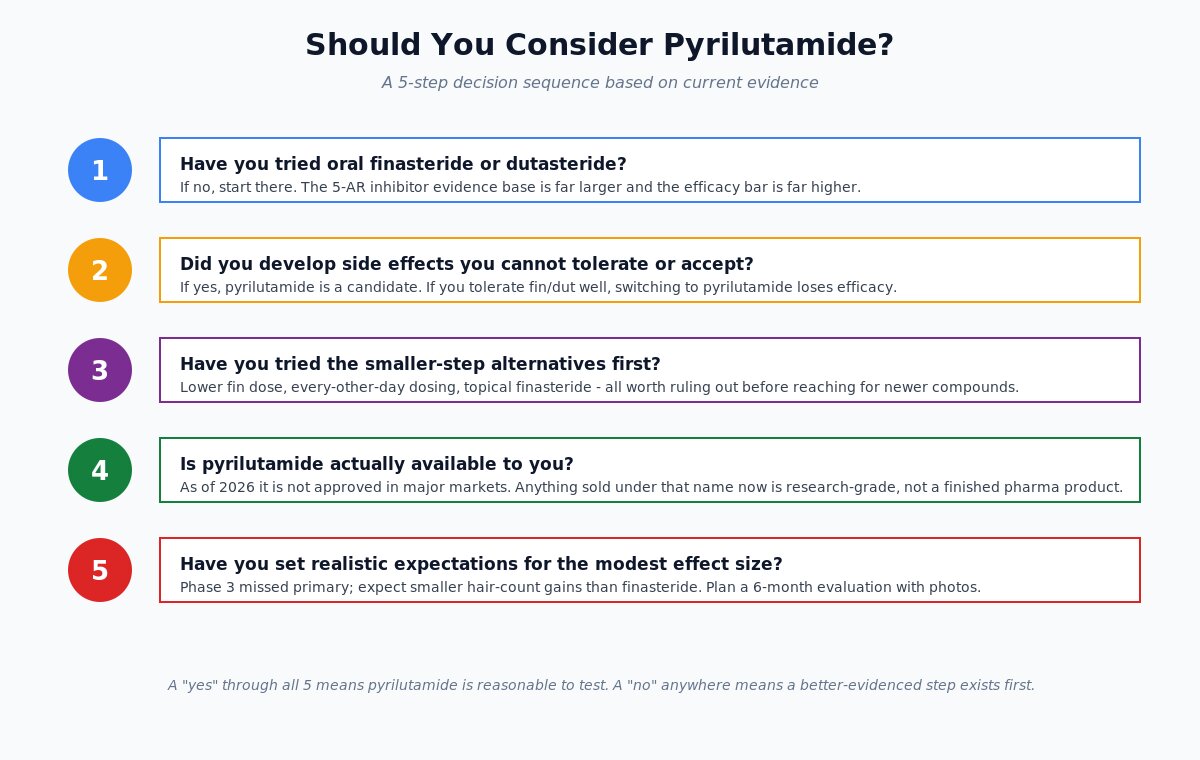
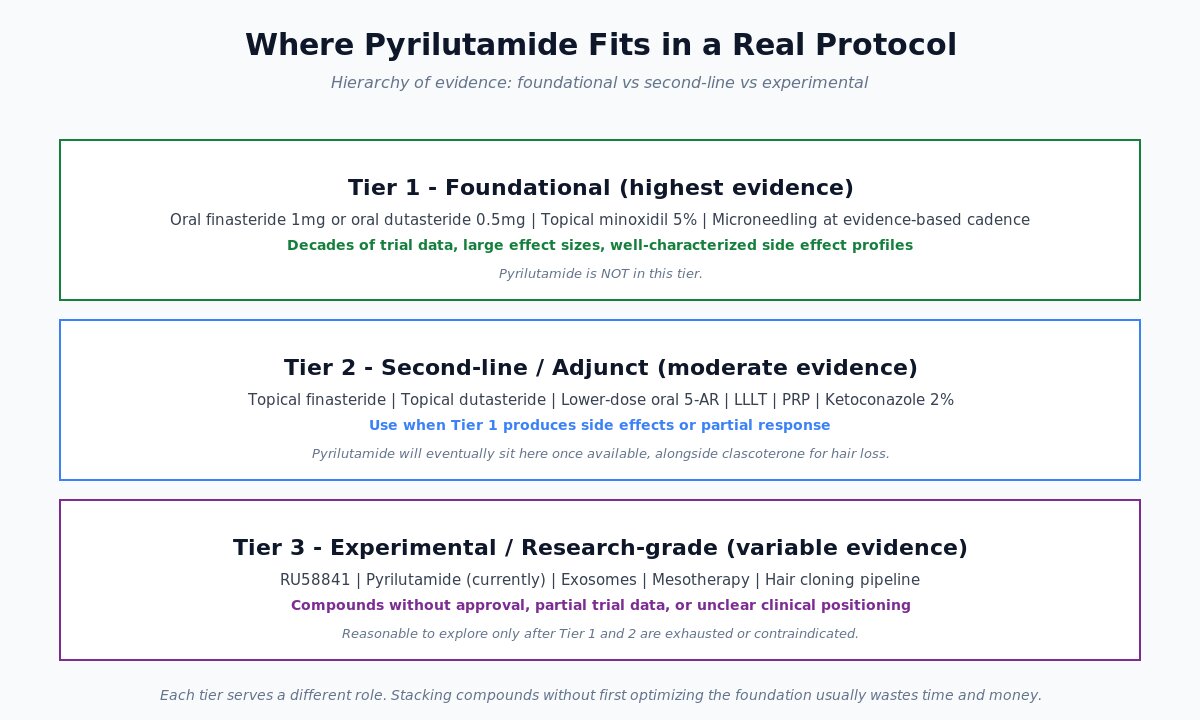
If pyrilutamide becomes commercially available in your market and you are choosing where it sits in your protocol, the honest framework is conditional. It belongs in the rotation if you have ruled out oral 5-AR inhibitors, if you have already optimized the foundational levers (consistent application of an evidence-backed topical, microneedling at the right cadence, sleep, ferritin and vitamin D in range), and if you accept that the drug-versus-placebo gap in Phase 3 was modest. It does not belong in the rotation as a replacement for finasteride in a man who tolerates finasteride well, because the efficacy data does not support that swap.
The men for whom pyrilutamide is most interesting are those who have either developed persistent side effects on finasteride, are dealing with the more chronic constellation described in the post-finasteride syndrome article, or who have philosophical objections to systemic 5-AR inhibition and are willing to accept lower efficacy in exchange. For everyone else, the evidence-based protocol still starts with oral 5-AR inhibition, with topical anti-androgens as adjuncts or alternatives only if the primary therapy is not viable.
Combining pyrilutamide with other therapies
There is no Phase 3 data on combining pyrilutamide with topical minoxidil, microneedling, or oral finasteride. Mechanistically, combining a topical AR antagonist with topical minoxidil makes biological sense (different pathways: AR blockade plus vasodilation/follicle stimulation), and combining a topical AR antagonist with microneedling could in principle improve drug delivery into the dermal compartment. But these are inferences from mechanism, not from clinical trials. The user-reported data on stacking is anecdotal, often based on RU58841 and minoxidil combinations rather than pyrilutamide specifically. The honest framing is “biologically reasonable to stack but evidence is thin,” not “synergistic.”
Common myths about pyrilutamide
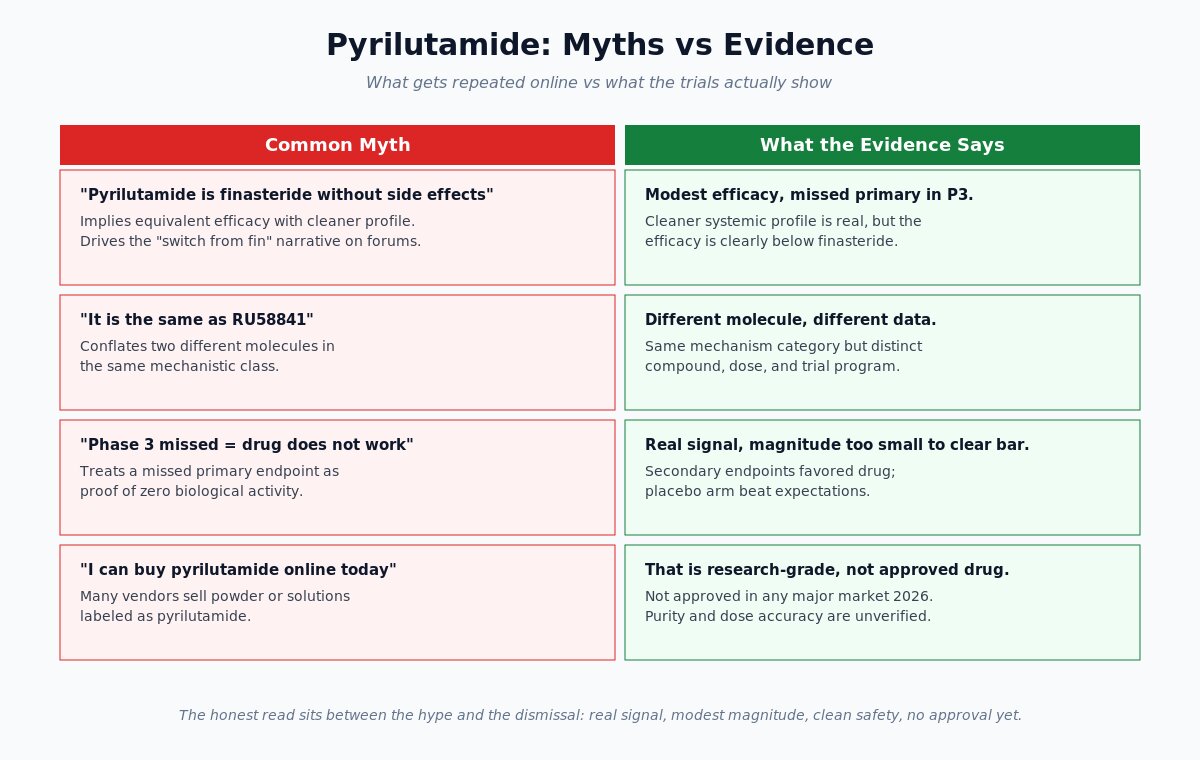
Because pyrilutamide is a relatively new compound at the consumer-discussion level, the myths around it follow predictable patterns. Most are partial-truths: a fact from one trial extrapolated past what the data supports.
Frequently asked questions about pyrilutamide
Is pyrilutamide approved anywhere?
As of early 2026 pyrilutamide has not received marketing approval for hair loss in any major market. Kintor has continued discussions with regulators in China after the Phase 3 program; the regulatory path in the United States and Europe is unclear given the missed primary endpoints. Any product currently sold under the pyrilutamide name outside a clinical trial setting is a research-grade compound, not an approved drug.
How does pyrilutamide compare to finasteride for hair loss?
Finasteride is a systemic 5-alpha reductase inhibitor that lowers serum DHT by approximately 70 percent at standard 1 mg dosing and has a large evidence base showing meaningful hair count gains and slowed progression. Pyrilutamide is a topical AR antagonist that does not lower serum DHT and has a more modest, mixed efficacy signal. They are not interchangeable. Pyrilutamide is a candidate alternative for men who cannot use finasteride, not a replacement for men who tolerate it.
Does pyrilutamide cause sexual side effects?
Across both Phase 2 and Phase 3 trials, pyrilutamide did not produce statistically significant changes in sexual function questionnaires or in serum testosterone and DHT levels compared to placebo. This is the central design intent of a topical AR antagonist: local activity without systemic AR blockade. The clean side-effect profile is one of the few unambiguously positive findings from the program.
Why did the Phase 3 trial miss its primary endpoint?
The most likely explanation is a combination of an unexpectedly high placebo response in Phase 3 and a smaller true effect size than Phase 2 estimated. This is a recurring pattern in dermatology trials and is not unique to pyrilutamide. It does not mean the drug has no biological effect; it means the magnitude of that effect was not large enough to consistently separate from placebo at the chosen sample size and primary endpoint definition.
Can pyrilutamide be combined with minoxidil?
There is no published Phase 3 trial of pyrilutamide plus minoxidil. Mechanistically, a topical AR antagonist plus a vasodilator like minoxidil targets different pathways and could plausibly add benefit, but the combination has not been formally tested in a regulatory program. Anecdotal user data exists for related combinations (especially RU58841 plus minoxidil) but is not equivalent to a controlled trial.
Is pyrilutamide safer than oral finasteride?
“Safer” depends on what you are weighting. Pyrilutamide does not appear to produce systemic anti-androgenic effects in trials, so the categories of side effects most associated with finasteride (sexual function, mood, libido) appear absent. Local scalp irritation is the main reported issue. If sexual side effects are the deciding factor and you accept the lower efficacy, pyrilutamide has a more favorable systemic safety profile. But “safer” with lower efficacy is a different value proposition than “safer with equal efficacy,” and the Phase 3 data does not support the latter.
How long does pyrilutamide take to work?
The Phase 2 and Phase 3 trials measured outcomes at 24 weeks (approximately 6 months). For any AR-targeting hair-loss therapy, the realistic evaluation window is 6 to 12 months because the hair cycle takes that long to reflect intervention. There is no published data showing a faster timeline for pyrilutamide compared to finasteride or other topical compounds.
Should I switch to pyrilutamide if I cannot tolerate finasteride?
If finasteride caused side effects you cannot tolerate, pyrilutamide is one of several reasonable next-step considerations once it becomes available, alongside dose reduction, every-other-day dosing, topical finasteride, or a dedicated topical anti-androgen like clascoterone. The decision depends on the severity of your hair loss, how aggressive your protocol needs to be, and your access to monitored clinical care. The article on why finasteride fails some men walks through the differential diagnosis that should happen before swapping compounds.
Bringing it together
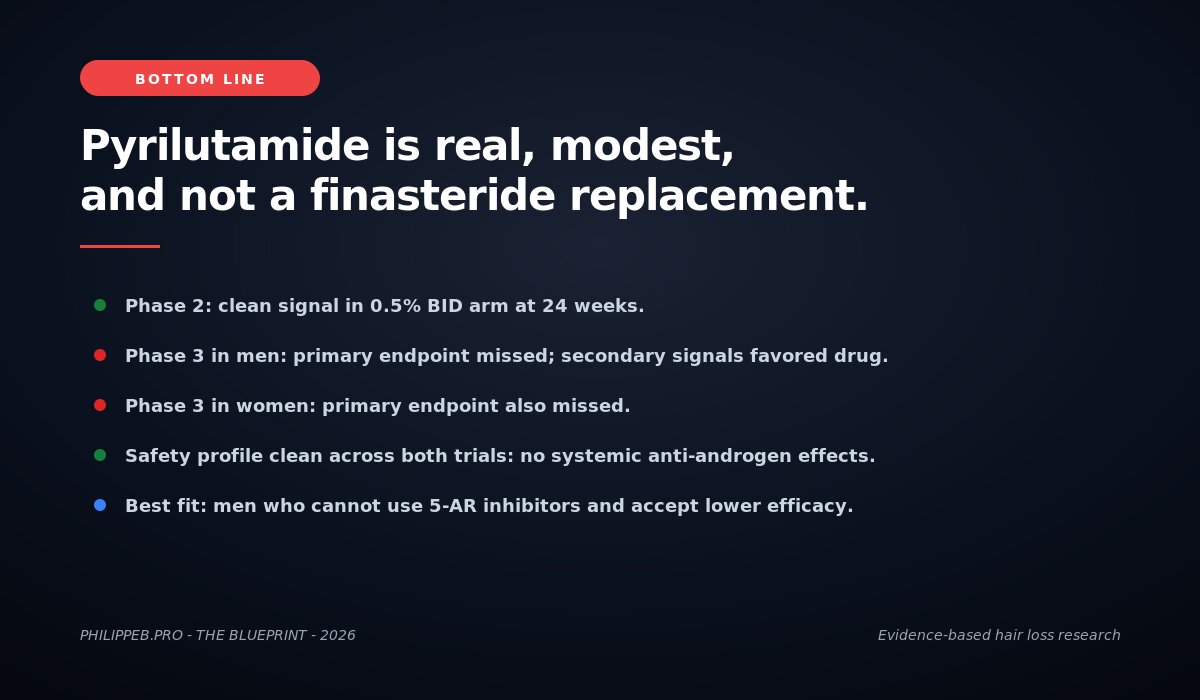
Pyrilutamide is the most rigorously studied topical androgen receptor antagonist for hair loss to date, and the honest read on the data is more sober than the early consumer write-ups suggested. Phase 2 produced a meaningful signal at 24 weeks. Phase 3 in men missed its primary endpoint with supportive but not confirmatory secondary signals, and Phase 3 in women missed primary as well. The safety profile remained excellent throughout. The compound is approvable in some markets and may eventually become available, but it is best understood as a clean topical option for men who cannot use 5-AR inhibitors, not as a finasteride replacement.
If you are building a protocol from scratch, start with the foundations: the biology of androgenetic alopecia, the actual evidence for finasteride and dutasteride, and the diagnostic differential in why finasteride fails some men. Topical AR antagonists like pyrilutamide are the second or third move in that hierarchy, not the first. For men who have already exhausted the standard pathway and need a compound with cleaner systemic profile, the watchlist (pyrilutamide, clascoterone for hair loss, gray-market RU58841) is real but should be entered with calibrated expectations and a willingness to discontinue if the response at 6 months is not measurable on standardized photos. The companion piece on post-finasteride syndrome covers the side-effect category that drives most of the demand for compounds in this class.
This article is for educational purposes and is not medical advice. The compounds and protocols discussed have varying regulatory status across countries. Pyrilutamide is not approved for hair loss in any major market as of publication. Consult a qualified clinician before starting, stopping, or modifying any treatment. See the full disclaimer.
About the author
Philippe Boissard
Author of Men’s Hairloss Protocol (2020), Better, Smarter, Stronger (2023), and Multi-Axis Body (2025). Researches and writes about hair loss and male physiology, citing primary literature and disclosing affiliate relationships in full. Not a medical doctor; all content is educational. More about Philippe.
Related reading
- RU58841: Legality, Sourcing, and the Honest Evidence Read for 2026
- Clascoterone 5% (CB-0301): The Phase 3 Hair Loss Study Explained — And What It Actually Means
- Dutasteride vs Finasteride: When the Switch Actually Makes Sense
- Why Your Hair Loss Protocol Isn’t Working: The 7 Hidden Reasons Most Men Miss
Get my free hair-loss protocol
The exact evidence-based routine I actually use and recommend: what works, in what order, with no hype. Enter your email on the next page and I’ll send it straight to you.
Send me the free protocol →
[…] Pyrilutamide (KX-826) Deep Dive: What the Phase 3 Data Actually Shows […]