
RU58841: Legality, Sourcing, and the Honest Evidence Read for 2026
RU58841 has thousands of user reports but no published Phase 2 or Phase 3 data. The honest read on the molecule, the legal landscape, the sourcing problem, and where it actually fits in 2026.

RU58841 sits in a strange gray zone of hair-loss treatment. It is one of the most-discussed topical compounds online, with thousands of user-reported cases on Reddit and YouTube, yet it has never been approved as a drug anywhere on earth. The original research is from the late 1980s and early 1990s. The compound was abandoned by its developer. Everything sold under the RU58841 name today is a research chemical produced outside any pharmaceutical regulatory framework. This article is the honest read: what RU58841 is, what the actual research showed, why it never reached approval, what the user-reported data does and does not tell us, and what the legal and sourcing landscape looks like in 2026.
Quick answer: should you take RU58841?
Probably not, and the reasoning is mostly about evidence quality and supply quality rather than mechanism. The compound itself is interesting and the user-reported results are not nothing. But the regulated pipeline has a successor (pyrilutamide) finishing trials, the supply chain is unregulated and historically inconsistent, and the original research stopped in animal models. Treating it as a primary therapy because Reddit photos look good is the kind of reasoning that gets people in trouble. Treating it as one option among several once you understand the trade-offs is more defensible.
What RU58841 actually is
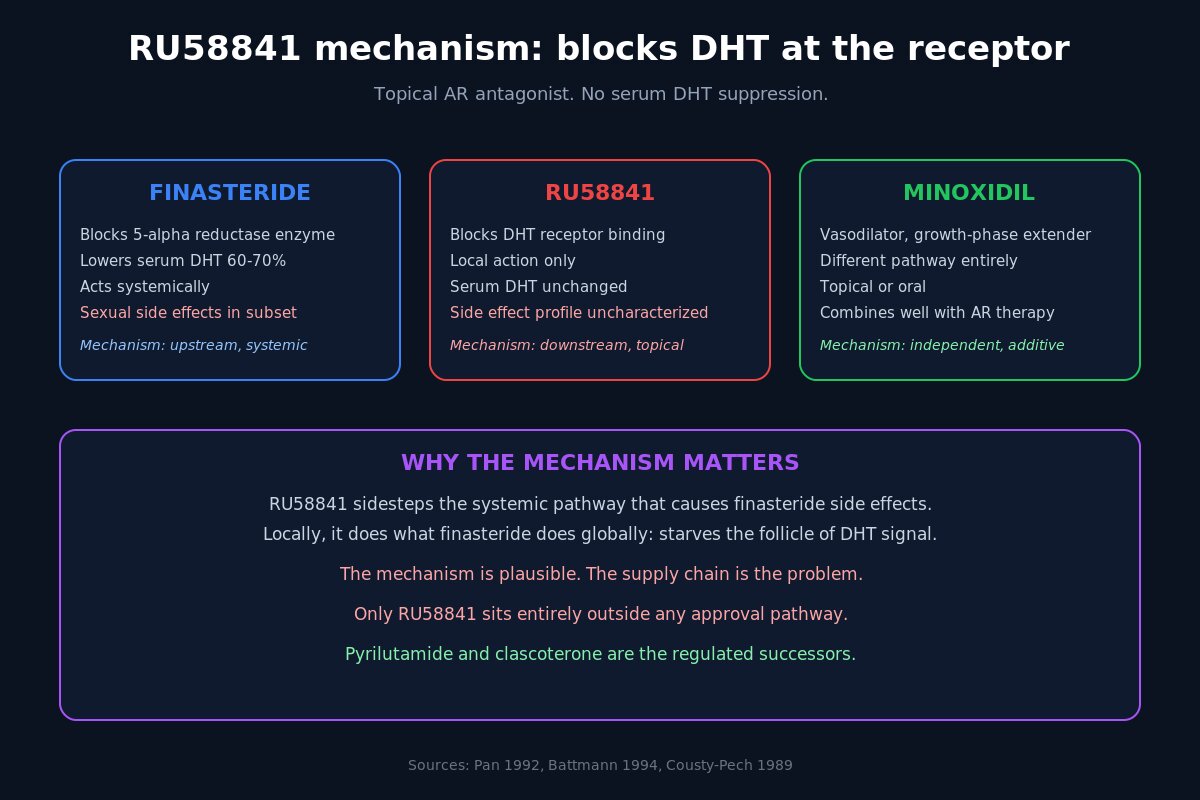
RU58841 is a non-steroidal androgen receptor antagonist developed by Roussel Uclaf in France in the late 1980s. The mechanism is straightforward: it binds to the androgen receptor in the scalp and blocks DHT from activating it locally. Crucially, when applied topically, it does not meaningfully suppress serum DHT or testosterone, which means it sidesteps the systemic pathway that drives finasteride and dutasteride side effects.
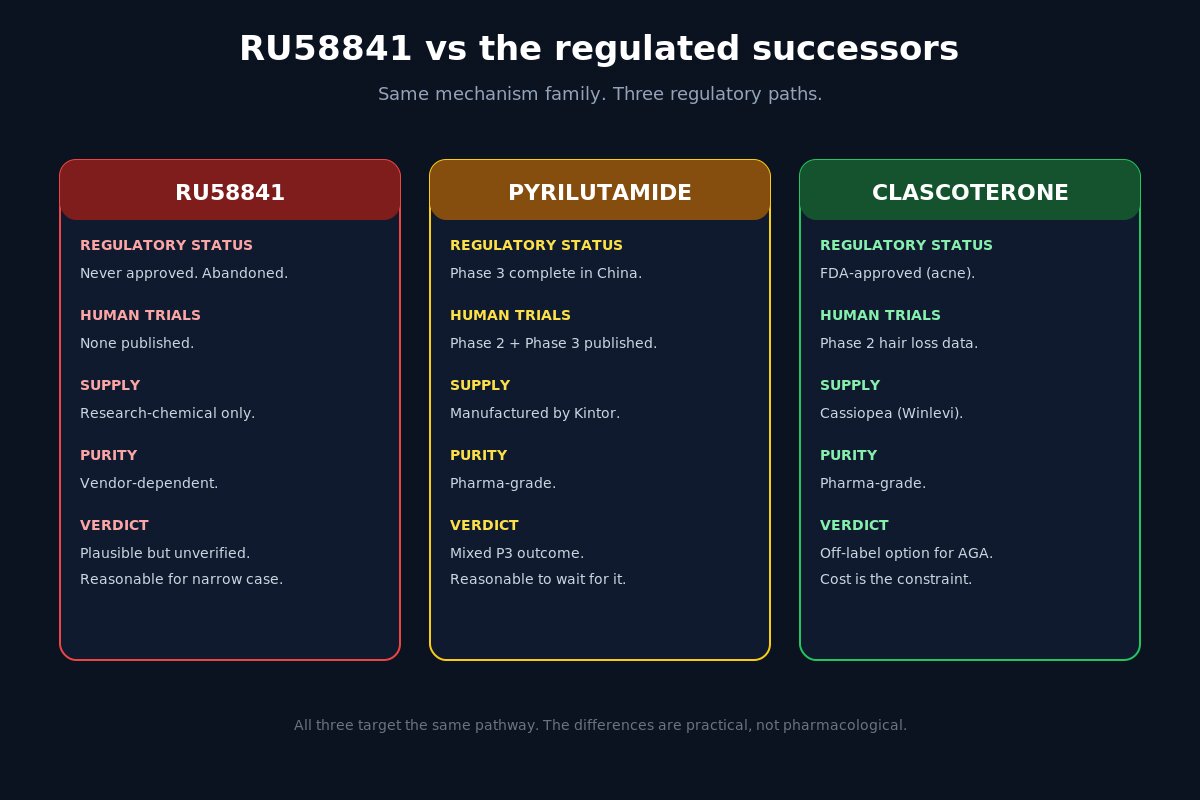
This is the same mechanistic family as pyrilutamide and clascoterone. All three are topical AR antagonists. The difference is regulatory status. RU58841 was abandoned. Clascoterone was approved for acne in 2020. Pyrilutamide is in late-stage trials for hair loss. Only RU58841 sits entirely outside any approval pathway, and that gap is what shapes everything downstream.
The original research, briefly
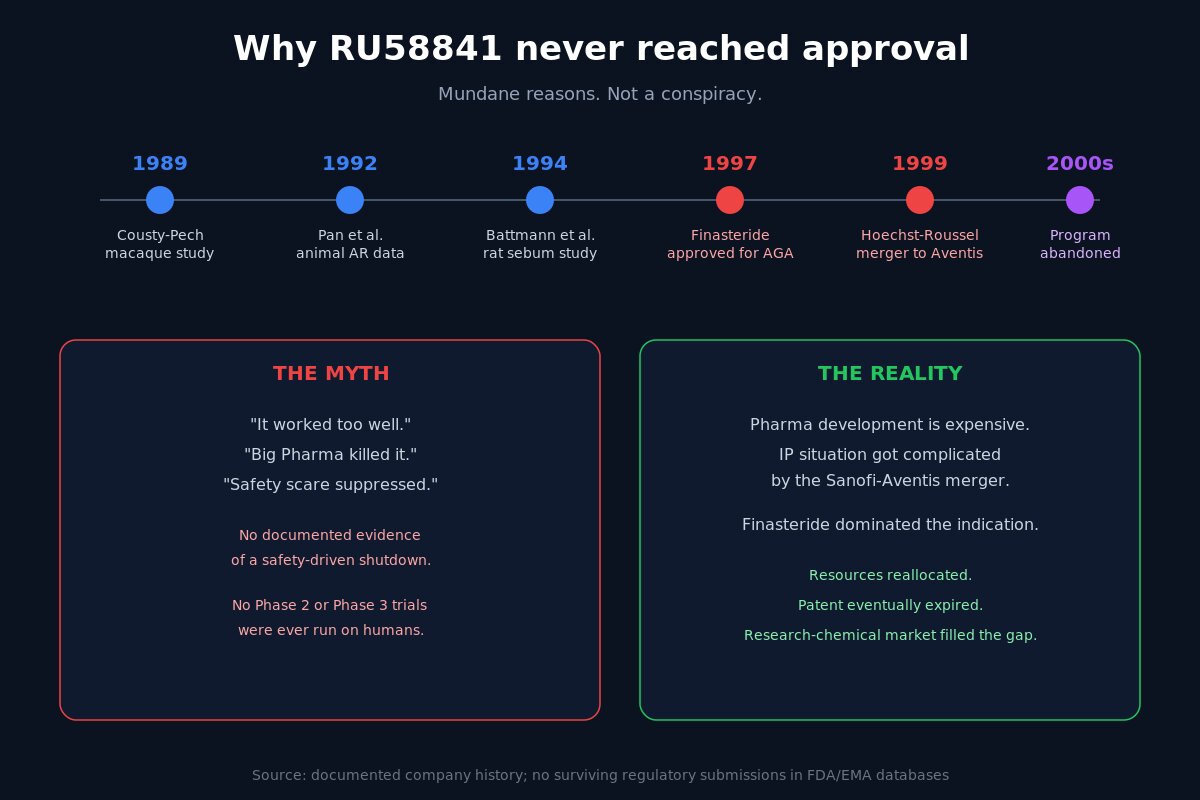
Pan et al. 1992 published one of the first key papers, showing RU58841 was a potent topical androgen receptor antagonist in animal models without systemic anti-androgenic effects. Battmann et al. 1994 followed up with rat studies showing the compound reduced sebum production and androgen-dependent tissue weights when applied topically. Cousty-Pech in 1989 worked on stump-tail macaque hair growth, which became the most-cited primate result.
What is striking about reading these papers in 2026 is how thin the human data is. There were small early-stage human trials, but no proper Phase 2 or Phase 3 program ever ran. The compound was set aside before clinical development could mature. The publicly available evidence base for human hair regrowth from RU58841 is essentially zero controlled-trial data. Everything else is animal models, mechanistic studies, and decades of forum-reported personal use.
Why RU58841 never reached approval
This is the single most-misunderstood part of the RU58841 story online. The dominant narrative is that the compound worked too well, scared the manufacturer, or was suppressed for commercial reasons. The mundane reality is that pharmaceutical development is expensive, the compound’s IP situation was complicated by the merger that created Sanofi-Aventis, finasteride got approved for hair loss in 1997 and dominated the indication, and the original developer chose to allocate resources elsewhere. There is no documented evidence of safety concerns killing the program. There is also no documented Phase 2 or Phase 3 trial data, because those programs never ran.
The intellectual property eventually expired. Once it expired, anyone could synthesize the molecule, and the research-chemical supply chain that produces compounds like RU58841 today is the same supply chain that produces SARMs and other gray-market actives. That is the legal-and-sourcing reality.
The legal landscape in 2026
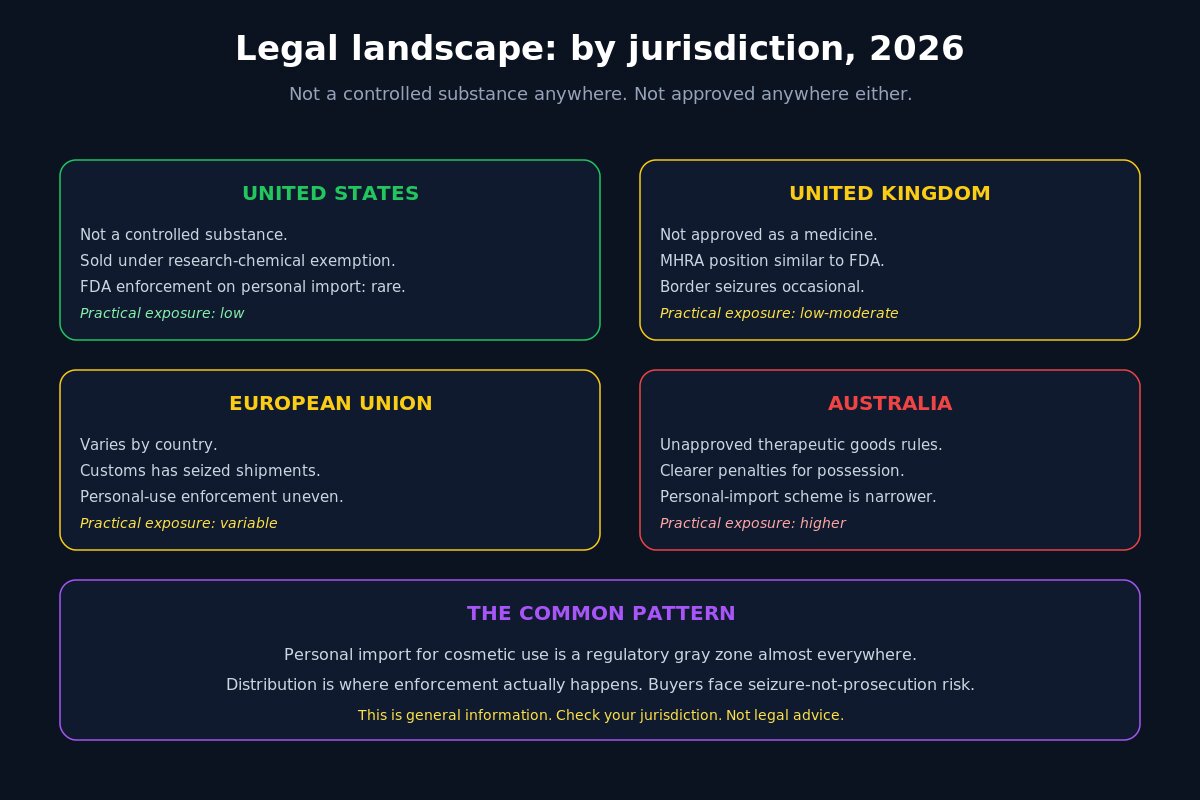
RU58841 is not approved as a drug anywhere. In most jurisdictions it is sold under a research-chemical exemption, which means vendors are required to label it “not for human consumption” and customers are technically buying a laboratory reagent. This exemption is what allows the compound to be distributed at all, and it is also what removes the manufacturer from any liability if the product is impure, mislabeled, or contaminated.
In the United States, RU58841 is not a controlled substance, but importing or possessing it for personal cosmetic use is a regulatory gray area that the FDA has occasionally enforced and mostly ignored. In the United Kingdom, the Medicines and Healthcare products Regulatory Agency takes a similar position. In some EU countries, customs has seized shipments. In Australia, possession of unapproved therapeutic goods carries clearer penalties. The practical answer for anyone reading this is that the legal exposure is non-zero but historically low, and that varies by country, by year, and by whether the customer is a private individual or a redistributor.
The sourcing problem
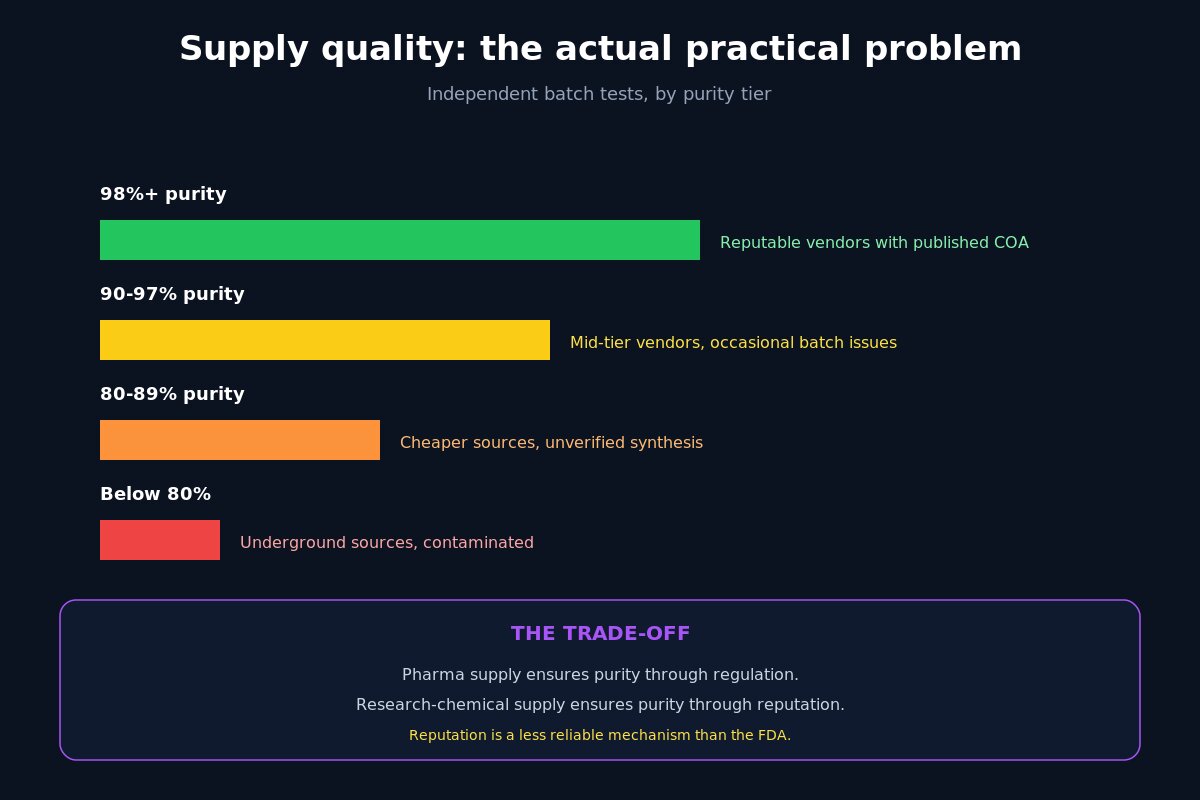
The single most important practical issue with RU58841 is supply quality. Several independent third-party tests over the years have shown that material sold under the RU58841 name varies widely in purity. Some batches test at 98 percent or higher. Some batches test at substantially less, sometimes below 80 percent. The non-RU58841 fraction in a lower-purity batch is whatever solvents, byproducts, or related compounds the synthesis left behind, and there is no way for a private customer to know what those are without paying for an independent assay.
The vendors that have built reputations for higher-purity material publish certificates of analysis, and the vendors that have not built that reputation tend to move stock without third-party verification. This is the core trade-off: the regulated pharmaceutical world ensures purity through oversight; the research-chemical world ensures purity through reputation, and reputation is a less reliable mechanism than the FDA. Pricing tiers tend to track quality, but not perfectly.
Watch this for context
This Hair Loss Compound Works Differently — frames why mechanism matters less than people think and why supply integrity matters more than people think.
What user-reported data actually shows
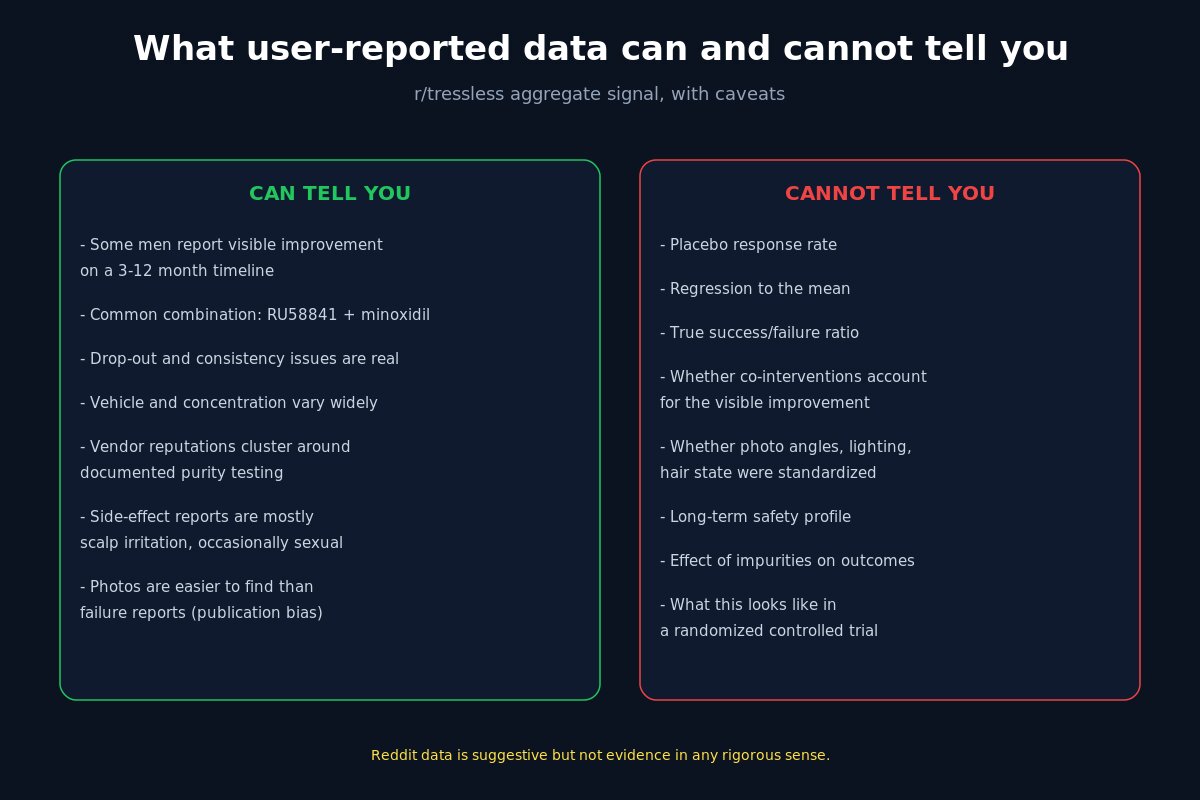
The Reddit community r/tressless has accumulated thousands of user reports on RU58841 over the past decade. Reading them in aggregate is informative, with significant caveats. The aggregate signal is that some men report visible improvement on a 3 to 12 month timeline, often combined with minoxidil. Some men report nothing. Some men report shedding followed by regrowth. The drop-out rate is high, both because of consistency problems and because many users layer it on top of finasteride, which makes attribution hard.
What Reddit data cannot tell you is the placebo rate, the regression-to-the-mean rate, the publication-bias rate (men who quit and got worse rarely post follow-ups), or the impact of co-interventions. It also cannot tell you whether a given user was photographing the same scalp area under the same lighting, or whether they had progressed in their AGA timeline regardless of the compound. The honest read of user-reported data is that it is suggestive but not evidence in any rigorous sense.
How RU58841 compares to its successors
The mechanism of action of RU58841 is functionally similar to pyrilutamide and clascoterone. The differences are practical, not pharmacological. Pyrilutamide has finished a Phase 3 trial and has actual human-trial data, even if that data is mixed. Clascoterone is approved for acne and is being studied off-label for hair. Both have manufactured purity and known dosing.
If the goal is a topical AR antagonist that does not require entering the gray-market supply chain, the answer in 2026 is to wait for pyrilutamide approval, use clascoterone off-label if a clinician will write it, or stay on finasteride or dutasteride. RU58841 only really makes sense if those options are unavailable for some reason and the user is willing to accept supply-chain uncertainty as the cost of admission.
Common myths about RU58841
The myth that RU58841 was suppressed for being too effective has no documentary support. The myth that it has zero side effects ignores user-reported scalp irritation, occasional sexual side effects (rare but reported), and the unknown impact of impurities. The myth that RU58841 is “just like finasteride but topical” misstates the mechanism: finasteride blocks DHT production, RU58841 blocks DHT receptor binding, and the consequences for the rest of the body are different. The myth that older user reports validate current product is the most subtle: the molecule that ran through Pan 1992 and the white powder shipping from a Chinese vendor in 2026 are nominally the same compound but produced under completely different quality regimes.
Frequently asked questions about RU58841
Is RU58841 legal to buy?
It is sold under research-chemical exemptions in most jurisdictions and is not a controlled substance in the United States or most of Europe. Personal-import enforcement varies by country and has been inconsistent. It is not approved as a drug anywhere, which means there is no regulated supply chain.
Does RU58841 work?
The mechanism is plausible and animal data exists. Human controlled-trial data does not exist. User-reported data is mixed and confounded by co-interventions. The honest answer is “probably some effect for some men, but the evidence base is weaker than for finasteride or minoxidil and the supply quality is not guaranteed.”
Is RU58841 safer than finasteride?
Mechanistically it is reasonable to expect fewer systemic side effects because topical AR antagonism does not lower serum DHT. In practice, the lack of regulated trials means the side-effect profile is poorly characterized, and impurity-driven side effects are a wildcard. Topical clascoterone has better-characterized safety than RU58841.
What about post-finasteride syndrome — would RU58841 avoid that?
Mechanistically yes, since RU58841 does not inhibit 5-alpha reductase or meaningfully suppress serum DHT. The argument for it as an alternative for finasteride-intolerant men is the strongest argument for it. The counter-argument is that pyrilutamide and clascoterone offer similar mechanistic logic with regulated supply.
How do I check if a vendor’s RU58841 is real?
The only rigorous way is third-party HPLC or NMR analysis on the specific batch. Vendor-published certificates of analysis are useful but only as good as the vendor’s reputation. Several Reddit users have run independent tests over the years; those threads are worth reading before choosing a vendor. The cheapest source is almost never the highest-purity source.
Can I combine RU58841 with finasteride or minoxidil?
Most user reports involve combination with minoxidil. There is no rigorous interaction data. Stacking with oral finasteride is mechanistically redundant since both target the AGA pathway, and the marginal benefit is unclear. Stacking with minoxidil is mechanistically additive and is the most common combination in user-reported protocols.
How long until RU58841 works?
User reports cluster around 3 to 6 months for first visible effects and 9 to 12 months for stabilization, similar to other AR-axis interventions. Hair-cycle physiology constrains the timeline regardless of the compound. Anyone reporting visible regrowth at 4 weeks is reporting placebo or hair-state variability, not pharmacology.
Should I just wait for pyrilutamide?
If you have time and your AGA is progressing slowly, this is the most defensible position. Pyrilutamide has actual trial data and will have a regulated supply chain when (if) it reaches approval. The men who reasonably choose RU58841 instead are typically dealing with rapid AGA progression and finasteride intolerance simultaneously, which is a narrower group than the online discussion would suggest.
Bringing it together
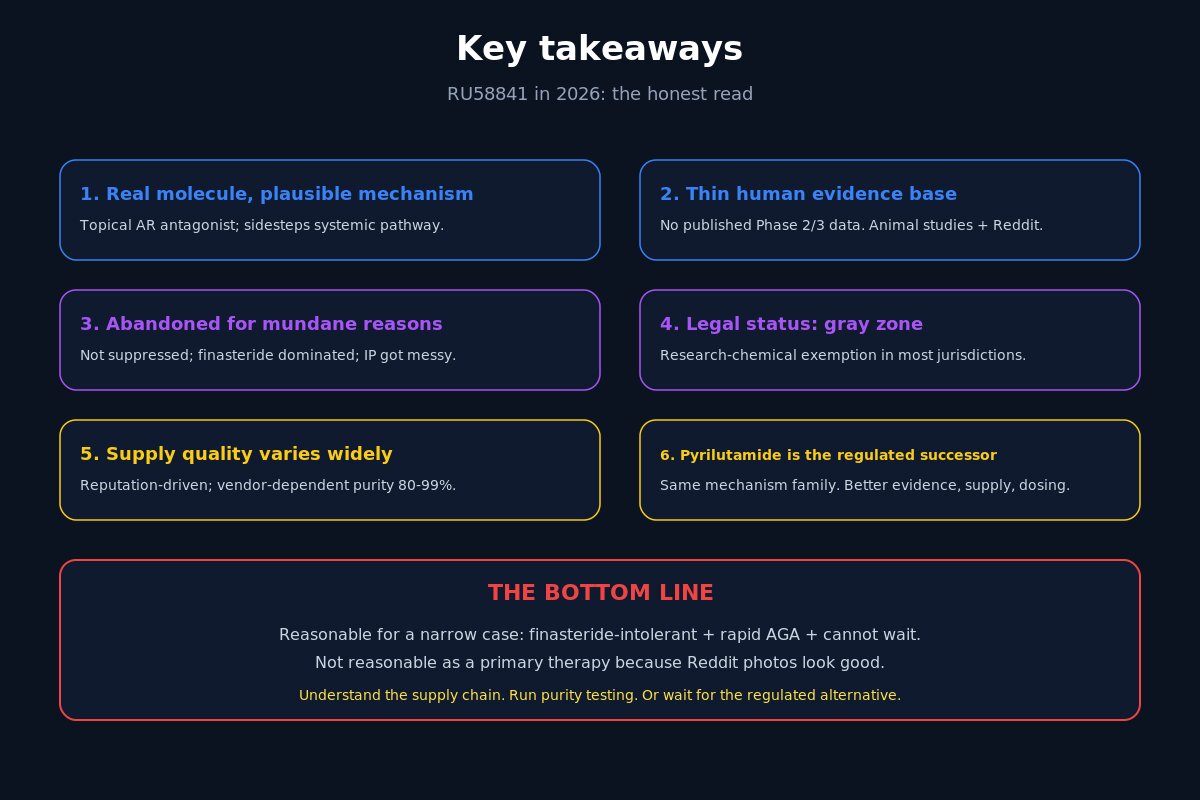
RU58841 is a real molecule with a plausible mechanism and a thin evidence base. The legality landscape is tolerant but ambiguous. The sourcing landscape is reputation-driven and historically uneven. The mechanism is mostly served by other compounds with better supply integrity, and the regulated pipeline is finally producing a successor in pyrilutamide. The men who reasonably choose RU58841 in 2026 understand all three of those facts and have decided that the trade-offs work for their specific situation. The men who choose RU58841 because Reddit photos look good are making a worse decision than they think they are.
About the author
Philippe Boissard
Author of Men’s Hairloss Protocol (2020), Better, Smarter, Stronger (2023), and Multi-Axis Body (2025). Researches and writes about hair loss and male physiology, citing primary literature and disclosing affiliate relationships in full. Not a medical doctor; all content is educational. More about Philippe.
Related reading
- Pyrilutamide (KX-826) Deep Dive: What the Phase 3 Data Actually Shows
- Dutasteride vs Finasteride: When the Switch Actually Makes Sense
- Clascoterone 5% (CB-0301): The Phase 3 Hair Loss Study Explained — And What It Actually Means
- Why Your Hair Loss Protocol Isn’t Working: The 7 Hidden Reasons Most Men Miss
Get my free hair-loss protocol
The exact evidence-based routine I actually use and recommend: what works, in what order, with no hype. Enter your email on the next page and I’ll send it straight to you.
Send me the free protocol →
[…] See my full RU58841 sourcing and legality guide (Disclaimer: This article is for informational and research purposes only. I am not a doctor. RU58841 is a research compound and is not FDA approved for human consumption.) […]
[…] All three are topical androgen receptor antagonists. The differences matter for sourcing, evidence, and regulatory status. RU58841 is the oldest of the three. It was developed by Roussel Uclaf in the 1980s as a non-steroidal anti-androgen, was tested in animal hair-loss models, and was abandoned by the original developer before reaching late-stage human trials. It has been available on the gray market for two decades and has substantial user-reported data but no published modern Phase 3 trial in any indication. The supply chain is unregulated, purity varies by source, and there is no FDA path for it. For a deeper read on legality and sourcing, see the RU58841 evidence and sourcing piece. […]