
Dutasteride vs Finasteride: When the Switch Actually Makes Sense
Dutasteride suppresses DHT more aggressively than finasteride, but its 4-5 week half-life and broader receptor inhibition reshape the entire risk-benefit conversation. Evidence-based guide on when switching actually makes sense.

Most men who switch from finasteride to dutasteride do it for the wrong reason. They assume “stronger” means “better.” It does not. Dutasteride suppresses DHT more aggressively, but it stays in the body for weeks rather than hours, and that single fact reshapes the entire risk-benefit conversation.
Quick answer: which one is “better” for hair loss?
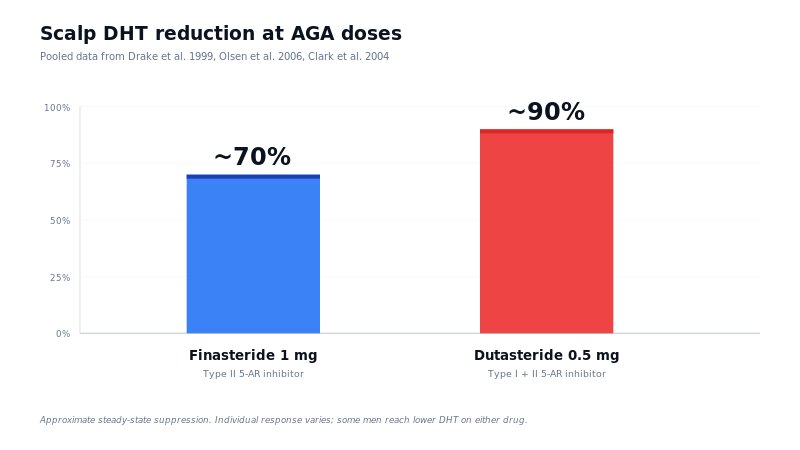
For raw efficacy on the scalp, dutasteride beats finasteride. Three head-to-head trials (Olsen et al. 2006, Eun et al. 2010, Harcha et al. 2014) all showed greater hair count gains with dutasteride 0.5 mg versus finasteride 1 mg over 24 weeks. The mechanism is straightforward: dutasteride inhibits both type I and type II 5-alpha reductase, finasteride inhibits only type II. Scalp DHT drops roughly 90 percent on dutasteride versus roughly 70 percent on finasteride.
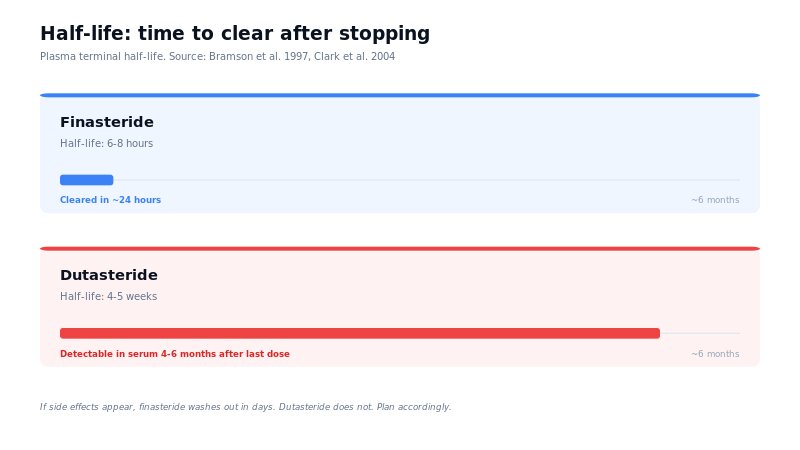
The catch is that dutasteride has a terminal half-life of 4 to 5 weeks. Finasteride clears in 6 to 8 hours. If side effects appear, finasteride washes out in days. Dutasteride does not. That asymmetry is the entire reason the answer to “should I switch” is not just “yes, it works better.”
The mechanism difference: type I and type II 5-alpha reductase
5-alpha reductase is the enzyme that converts testosterone to dihydrotestosterone (DHT). It exists as two main isoenzymes. Type II dominates in the scalp follicle, the prostate, and the genital skin. Type I dominates in sebaceous glands, the liver, and parts of the central nervous system. Both contribute to circulating DHT, but the proportion differs by tissue. The full mechanism is laid out in the pillar guide on how hair loss actually works.
Finasteride is a selective type II inhibitor. Dutasteride hits both isoenzymes with high affinity. That broader inhibition is why dutasteride pulls serum DHT down more steeply (roughly 90 percent at 0.5 mg/day versus roughly 70 percent for finasteride 1 mg/day in pooled data, Clark et al. 2004). It is also why dutasteride may produce a different side-effect signature: type I inhibition affects tissues finasteride mostly leaves alone, including sebaceous activity and certain neurosteroid pathways studied in the post-finasteride syndrome literature (Melcangi et al. 2013, Caruso et al. 2015).
The half-life problem
This is the part most “dutasteride is just stronger” arguments skip. Pharmacokinetic half-life is the time it takes for the body to reduce drug concentration by half.
- Finasteride: terminal half-life 6 to 8 hours. Effectively cleared from plasma within 24 hours of stopping.
- Dutasteride: terminal half-life 4 to 5 weeks. Detectable in serum 4 to 6 months after the last dose (Clark et al. 2004, Bramson et al. 1997).
Why this matters: if you start finasteride and feel something is wrong at week three, you stop, and the drug is gone in days. If you start dutasteride and feel something is wrong at week three, you stop, and the drug is still suppressing your enzyme system months later. That is not a fatal flaw, but it is a real one. Anyone considering dutasteride should accept up front that “I will just stop if I do not like it” works very differently than it does with finasteride.
The side-effect picture: incidence vs persistence
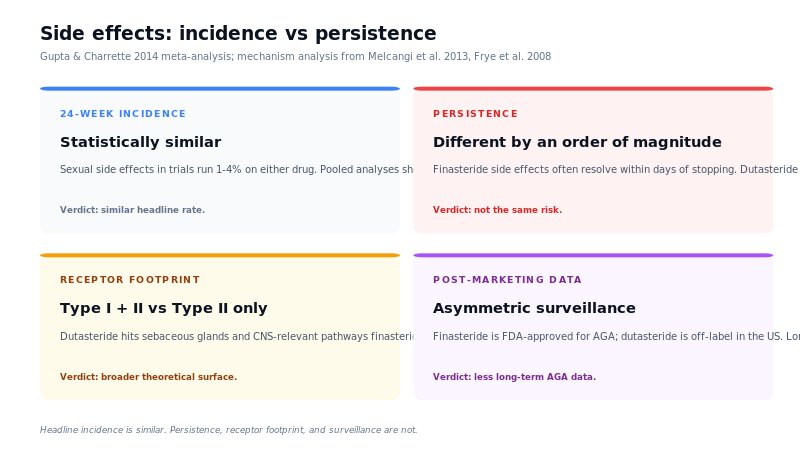
In randomized trials, the headline incidence of sexual side effects (decreased libido, erectile dysfunction, ejaculatory disorders) is broadly similar between the two drugs at AGA doses. Gupta and Charrette (2014) meta-analyzed dutasteride 0.5 mg versus finasteride 1 mg and found no statistically significant difference in adverse-event rates over 24 weeks. Reported incidence is roughly 1 to 4 percent on either drug, varying by study and definition.
That clean comparison hides three things worth understanding before switching. The neutral coverage of post-finasteride syndrome is the most relevant background if tolerance is a concern.
1. Trial duration is short
The pivotal head-to-head trials ran 24 weeks. Side effects that emerge slowly, or that persist after discontinuation, are not well captured in 24-week studies. The post-finasteride syndrome (PFS) literature (Irwig 2012, Traish et al. 2015, Kiguradze et al. 2017) is built largely on cases that emerged outside the original trial windows. Whether a parallel post-dutasteride pattern exists at the same rate is poorly characterized, partly because dutasteride is not FDA-approved for AGA in the United States and so case reporting structures are weaker.
2. Type I inhibition affects neurosteroids
5-alpha reductase type I converts progesterone and other steroids into neuroactive metabolites such as allopregnanolone, which acts on GABA-A receptors. Finasteride inhibits this pathway weakly. Dutasteride inhibits it strongly. Animal models (Frye et al. 2008) and small human studies (Melcangi et al. 2013) show measurable changes in neurosteroid profiles with type I inhibition. This is the biological basis for why some clinicians treat dutasteride as carrying a higher theoretical risk for mood- and cognition-related side effects, even when 24-week trial data does not pick up the signal.
3. Persistence is the variable, not just incidence
If 3 percent of men on finasteride get a side effect that resolves within two weeks of stopping, and 3 percent of men on dutasteride get the same side effect but it takes six months to resolve, those are not the same risk profile. The half-life math forces a longer washout regardless of whether the underlying biology is identical.
Hair count results: what the head-to-head trials actually show
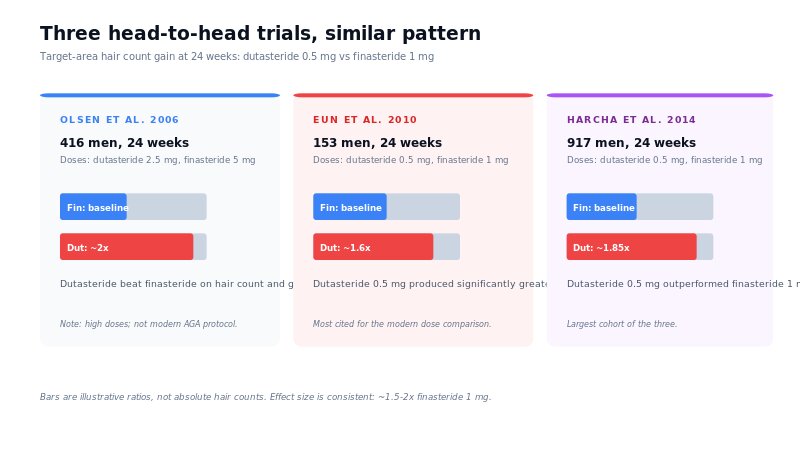
Three randomized trials directly compared dutasteride and finasteride at AGA doses.
- Olsen et al. 2006: 416 men, 24 weeks. Dutasteride 2.5 mg outperformed finasteride 5 mg on hair count and global photographic assessment. Note this used much higher doses than typical AGA protocols.
- Eun et al. 2010 (Korean cohort): 153 men, 24 weeks. Dutasteride 0.5 mg/day produced significantly greater hair counts at the vertex than finasteride 1 mg/day. This is the trial most often cited for the modern dose comparison.
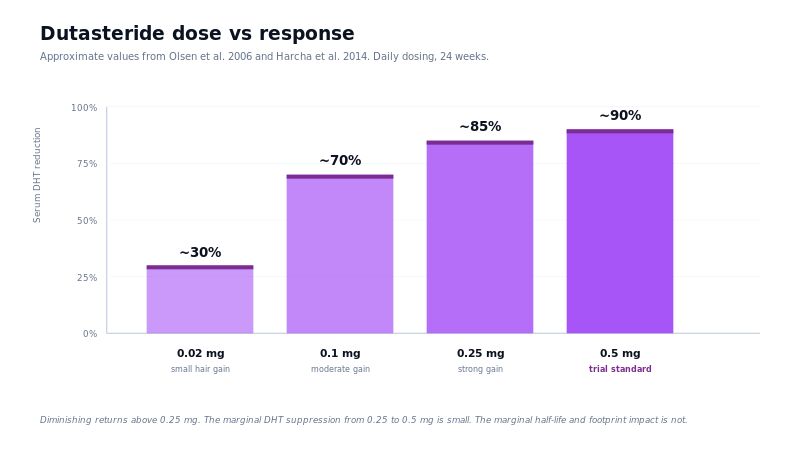
- Harcha et al. 2014: 917 men, 24 weeks. Dutasteride 0.5 mg outperformed finasteride 1 mg on target-area hair count. Lower doses of dutasteride (0.02, 0.1, 0.25 mg) showed dose-response.
Pattern: at the same trial endpoint, dutasteride 0.5 mg produces a hair count gain roughly 1.5 to 2 times that of finasteride 1 mg. The effect size is real and reproducible. It is not enormous, but it is consistent. For men who plateau on finasteride or whose response is borderline, that delta is meaningful.
Why this video is relevant: the deep dive on why finasteride fails some men is the natural prerequisite to deciding whether dutasteride is worth the switch. Before assuming you need a stronger drug, this video walks through the failure modes that are actually adherence, dose timing, and concurrent dermatologic factors rather than insufficient DHT suppression. If any of those apply, the switch will not solve the problem.
When the switch actually makes sense
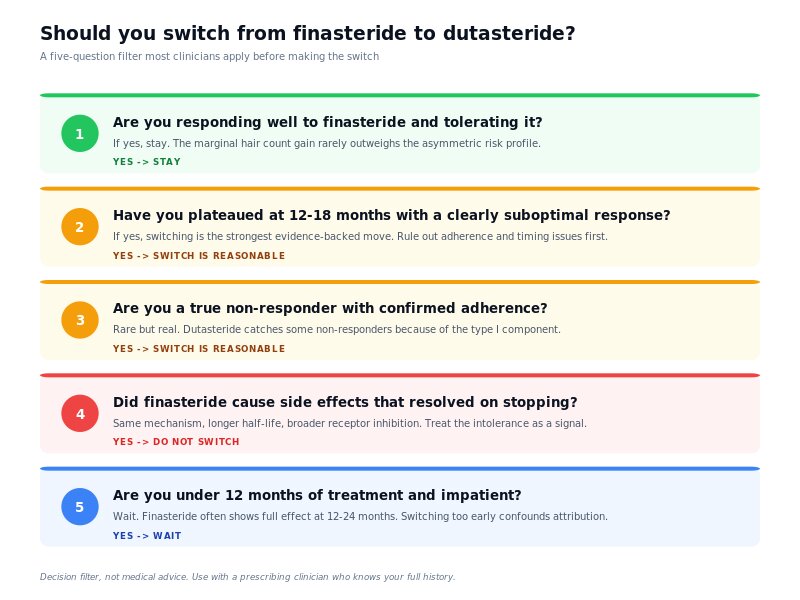
The trial data does not say “everyone should be on dutasteride.” It says dutasteride is more effective on average, with a wider biological footprint and a much longer washout. Translated into a decision rule:
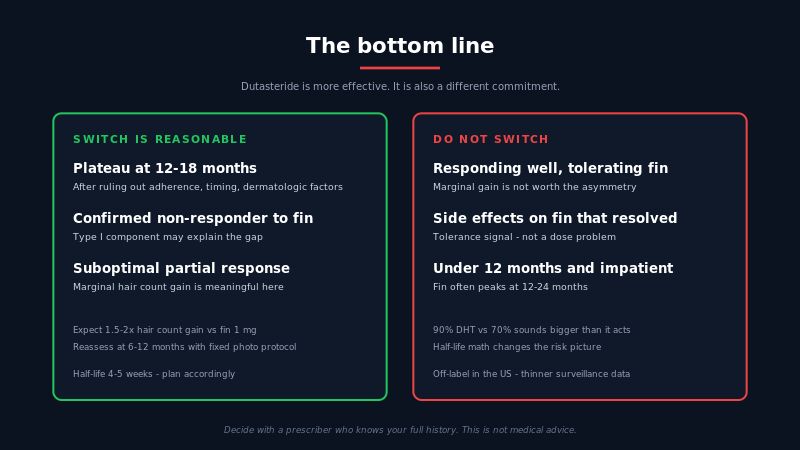
- You are responding well to finasteride and tolerating it. Stay. The marginal hair count gain from switching is unlikely to outweigh the asymmetric risk profile.
- You have plateaued on finasteride after 12 to 18 months and your response is clearly suboptimal. The switch is the strongest evidence-backed move, especially after you have ruled out the failure modes covered in why your hair loss protocol isn’t working.
- You are a non-responder to finasteride. True non-response is rare but real (Sato & Takeda 2012). Dutasteride catches some of these men because of the type I component. Switching is reasonable.
- You are intolerant to finasteride. If you got side effects on finasteride that resolved on discontinuation, dutasteride is not a safer choice. It is the same mechanism with a longer half-life and broader receptor inhibition. Treat the intolerance as a signal, not a dose problem.
- You are early in treatment (under 12 months) and impatient. Wait. Finasteride often shows its full effect at 12 to 24 months. Switching too early means you cannot tell whether the next phase of improvement was the dutasteride or just the time.
The dose-response question: is 0.5 mg the right dutasteride dose?
Dutasteride 0.5 mg/day is the dose used in the modern AGA trials and the dose approved for AGA in South Korea and Japan. It is also higher than required to reach near-maximal serum DHT suppression. Olsen et al. (2006) and Harcha et al. (2014) both showed that doses below 0.5 mg still produce substantial DHT reduction, just with smaller hair count gains at 24 weeks.
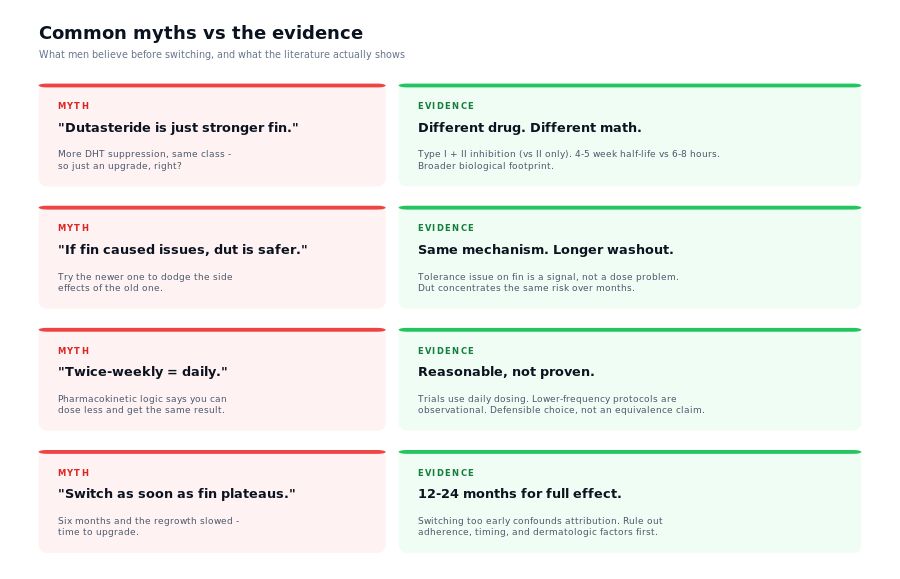
Some clinicians and patients use lower-dose protocols (0.5 mg twice weekly, 0.5 mg every other day) to balance efficacy against the half-life and side-effect concerns. The literature on these protocols is observational rather than randomized, so claims about equivalent efficacy at lower frequency are not strongly evidence-backed. They are reasonable as a personal risk-management strategy. They are not a proven substitute for the daily dose used in trials.
Frequently asked questions about dutasteride vs finasteride
Is dutasteride safer than finasteride for hair loss?
No. The 24-week trial incidence of sexual side effects is similar between the two, and dutasteride has a 4 to 5 week half-life versus finasteride’s 6 to 8 hours. If side effects emerge, dutasteride takes much longer to clear. The broader receptor inhibition (type I and type II) also expands the theoretical side-effect surface compared to finasteride’s type II selectivity.
How much more hair will I grow on dutasteride versus finasteride?
In head-to-head trials at 24 weeks, dutasteride 0.5 mg produced roughly 1.5 to 2 times the hair count gain of finasteride 1 mg in the target area. For an individual man, the realized difference depends on baseline density, scalp DHT contribution to the miniaturization process, and adherence. Plateaued finasteride responders see the largest relative benefit.
Can I switch from finasteride to dutasteride directly?
Yes. There is no required washout. Most clinicians stop finasteride and start dutasteride the next day. Because finasteride clears in hours and dutasteride takes weeks to reach steady state, you do not stack DHT suppression abruptly.
Is dutasteride approved by the FDA for hair loss?
Not in the United States. Dutasteride is FDA-approved only for benign prostatic hyperplasia (BPH) under the brand Avodart. AGA use is off-label. Dutasteride is approved for AGA in South Korea (since 2009) and Japan (since 2015) under the brand Zagallo. Off-label prescribing is legal and common in the US, but it affects coverage and pharmacovigilance.
Does dutasteride cause more side effects than finasteride?
Within 24-week trial windows, the incidence is statistically similar. Outside that window, the longer half-life and broader receptor inhibition create a different risk profile, but the data to quantify “different” is thinner than people imply on either side. The honest answer is “incidence comparable, persistence longer, theoretical biological footprint larger.”
Should I take dutasteride if finasteride gave me side effects?
No. The mechanism is the same and broader. If finasteride caused issues that resolved on discontinuation, treating that as a “dose problem” and escalating to dutasteride is not supported by the mechanism or the trial data. Treat the intolerance as a signal that 5-alpha reductase inhibition does not fit your physiology, and look at non-AR-pathway interventions.
Can dutasteride regrow hair finasteride did not?
Sometimes. The men most likely to benefit are partial responders to finasteride whose miniaturization process appears to involve a meaningful type I component, or men with high scalp DHT contribution at baseline. There is no reliable predictor before the switch, so the answer is functionally “try it and reassess at 6 to 12 months with a fixed photo protocol.”
Is twice-weekly dutasteride as effective as daily?
Possibly, in steady state, because of the long half-life. The trials that establish efficacy used daily dosing. Lower-frequency protocols are based on pharmacokinetic reasoning, not randomized comparison. They are a defensible personal choice. They are not equivalent to “proven.”
Bringing it together
Dutasteride is more effective than finasteride at the doses studied, and that fact alone makes it the right move for the right man. The right man is not “anyone who wants more hair.” It is the partial responder who has given finasteride enough time, the non-responder with confirmed adherence, or the patient whose miniaturization profile and dermatologic context point at a meaningful type I contribution. For everyone else, the half-life math, the broader receptor inhibition, and the smaller post-marketing surveillance footprint mean the marginal hair count gain is bought at a real cost.
If you are still figuring out where you sit in that picture, the prerequisite is understanding what is actually driving your miniaturization. The mechanism guide on how hair loss actually works walks through the DHT pathway and follicular miniaturization in depth, and the deep dive on why finasteride fails some men covers the failure modes that should be ruled out before any switch. If you are weighing this decision against tolerance concerns, the neutral coverage of post-finasteride syndrome is the most relevant background. And if you are stacking interventions to push response further, why your hair loss protocol isn’t working covers the seven failure modes most men miss.
This article is not medical advice. It is a synthesis of peer-reviewed literature aimed at informing your conversation with a qualified clinician. Drug therapy decisions for AGA should be made with a prescriber who can evaluate your full medical history, contraindications, and individual risk profile. See the full disclaimer.
Related reading
About the author
Philippe Boissard
Author of Men’s Hairloss Protocol (2020), Better, Smarter, Stronger (2023), and Multi-Axis Body (2025). Researches and writes about hair loss and male physiology, citing primary literature and disclosing affiliate relationships in full. Not a medical doctor; all content is educational. More about Philippe.
Get my free hair-loss protocol
The exact evidence-based routine I actually use and recommend: what works, in what order, with no hype. Enter your email on the next page and I’ll send it straight to you.
Send me the free protocol →
[…] Dutasteride vs Finasteride: When the Switch Actually Makes Sense […]
[…] Dutasteride vs Finasteride: When the Switch Actually Makes Sense […]
[…] Dutasteride vs Finasteride: When the Switch Actually Makes Sense […]
[…] The case for clascoterone over finasteride is that it does not carry post-finasteride concerns, does not affect systemic hormone levels, and works through a complementary mechanism that can stack on top of finasteride. The case for finasteride over clascoterone is that finasteride has 28 years of post-marketing data, predictable response rates, and a generic price under $10 per month at most pharmacies. Clascoterone for hair loss will be branded, expensive at launch, and will require twice-daily application for the foreseeable future. For men who are responding to finasteride and tolerating it, clascoterone will be most useful as an add-on for incremental gains, not as a switch. For background on switching mechanisms, see when to switch from finasteride to dutasteride. […]
[…] Dutasteride vs Finasteride: When the Switch Actually Makes Sense […]
[…] Dutasteride vs Finasteride: When the Switch Actually Makes Sense […]
[…] Dutasteride vs Finasteride: When the Switch Actually Makes Sense […]
[…] Second, if you’ve had a modest response to finasteride, the scalp column is the mechanistic reason a switch to dutasteride can add hair. You’re not “resistant.” You’re carrying a type 1 enzyme load the drug was never built to touch. Whether that trade is worth it depends on side effect tolerance, cost and your doctor, and dutasteride’s longer half-life changes the rhythm of stopping, which I cover in the switching guide. […]