
Why Finasteride Works for Some Men and Not Others: The Responder Question
Finasteride works for 85-90% of men, but a meaningful subset see little benefit. The diagnostic question is stabilization, not regrowth. The evaluation window is 24 months, not 6. Here is the responder framework.

Finasteride works for most men with androgenetic alopecia, but a meaningful subset see little or no benefit even at full dose for full duration. The men who are not responding go through a predictable cycle: doubt the drug, blame the brand, increase the dose, add adjuncts, switch to dutasteride, or quit entirely. Most of the time they are doing this without understanding why they are not responding, which means they are also not making the decisions a true non-responder should make. This article walks through what the responder vs non-responder distinction actually means, why it happens biologically, how to tell the difference between non-response and slow response, and what the framework looks like for men who suspect they are in the non-responder category.
Quick answer: how do I know if finasteride is working?
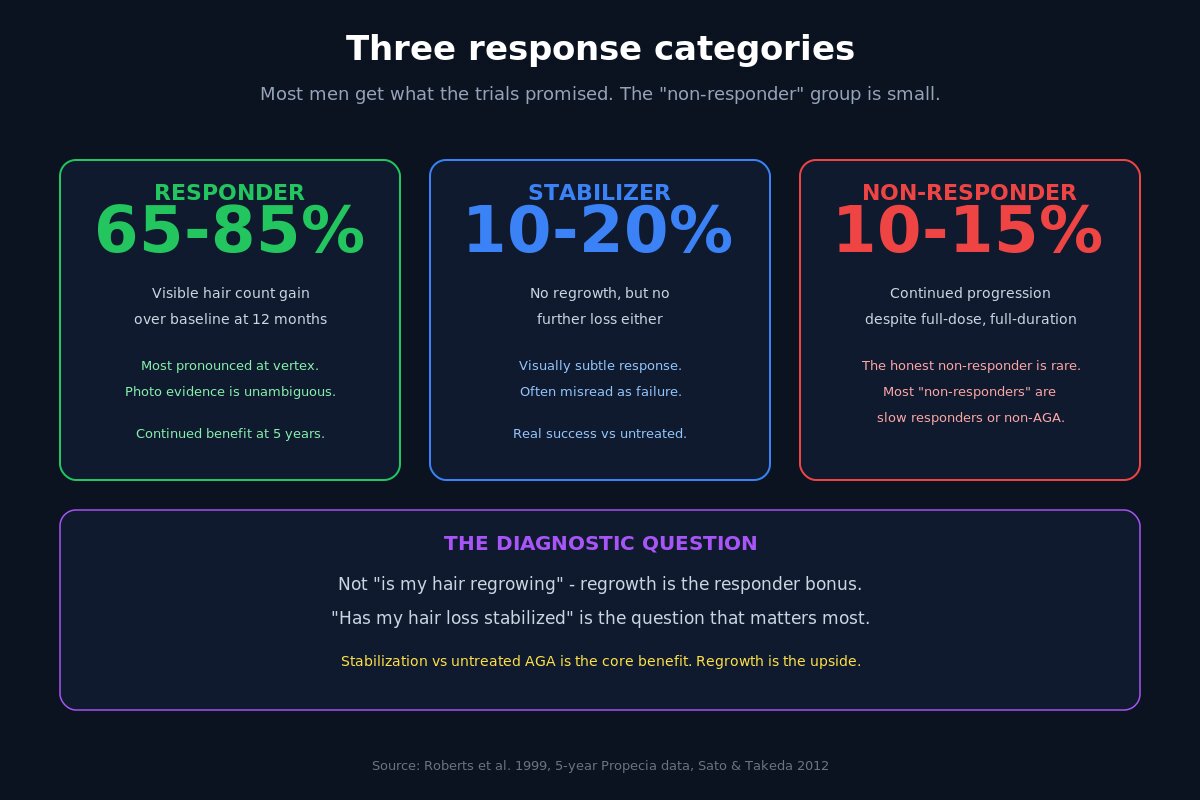
The diagnostic question is not “is my hair growing back” – the diagnostic question is “has my hair loss stabilized.” Finasteride at 1 mg daily produces hair-count gains in roughly 65 to 85 percent of men over 12 months, and produces stabilization (no further loss) in another 10 to 20 percent. The combined response rate is high. The men who are clearly not responding represent maybe 10 to 15 percent of the treated population, and identifying them requires a 24-month evaluation window with proper photo tracking, not a 6-month window of subjective scalp inspection.
What “responder” actually means
The clinical literature uses three categories. A responder shows hair-count improvement over baseline, typically measured at the vertex by target-area hair count. A stabilizer shows no improvement but no further loss compared to a placebo arm that lost hair. A non-responder shows progression despite full-dose, full-duration therapy. The relevant comparison for any individual man is not “did my hair regrow” but “did my hair loss stop progressing relative to what would have happened without treatment.” This is the distinction that makes self-evaluation hard, because the absence of progression is not visually obvious in the way regrowth is.
Roberts et al. 1999 and the original 5-year Propecia data established the responder distribution: roughly 90 percent achieve at least stabilization, with hair count gains occurring in the bulk of those. The 10 percent who progress despite treatment are the population this article addresses.
Why some men do not respond
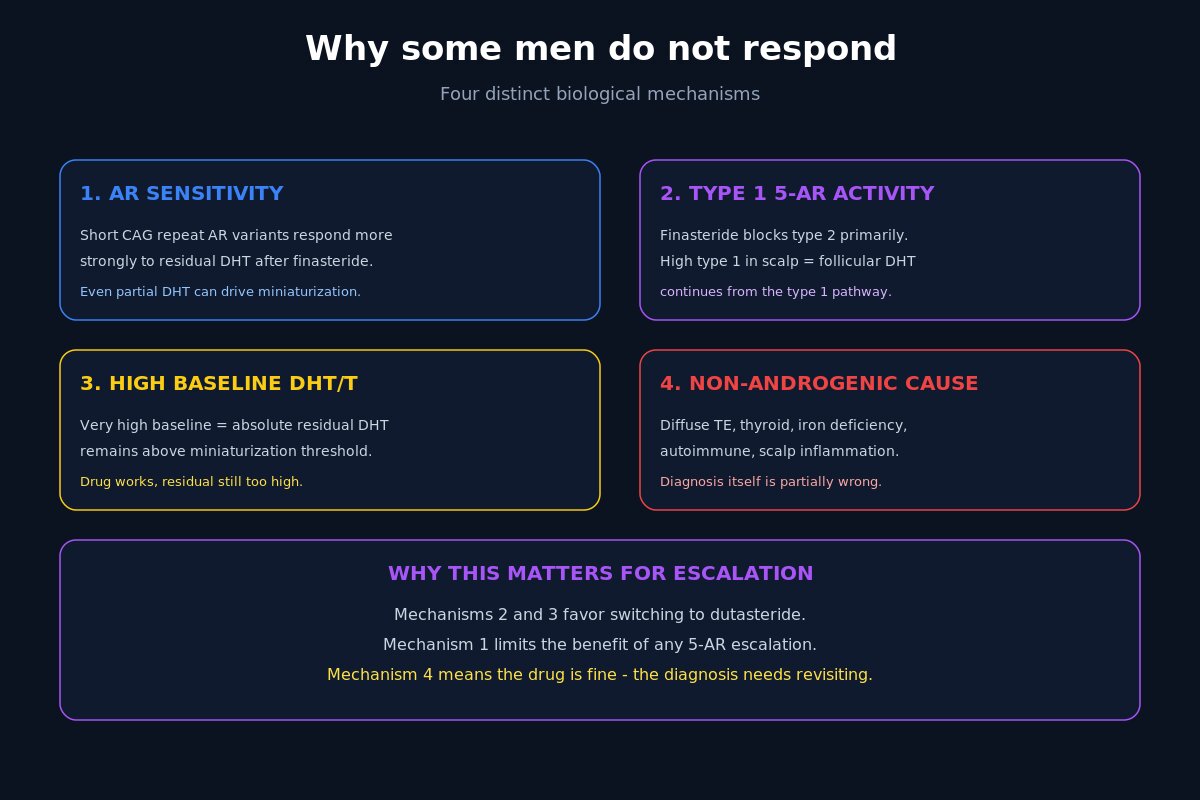
The biology of non-response splits into a few distinct mechanisms. The first is androgen receptor sensitivity. Some men have AR variants that respond more strongly to whatever DHT remains after 5-alpha reductase inhibition. Sato and Takeda 2012 showed associations between AR CAG repeat length and finasteride response rates, with shorter CAG repeats predicting weaker response. The biology is plausible: shorter CAG repeats correlate with higher AR transactivation activity, which means even partial DHT remaining at the follicle can drive miniaturization.
The second mechanism is 5-alpha reductase activity at the scalp. Finasteride inhibits the type 2 isoenzyme primarily, with weaker effects on type 1. Some men have higher relative type 1 activity in scalp tissue, meaning a meaningful fraction of follicular DHT continues to be produced via the type 1 pathway despite finasteride therapy. This is the mechanistic case for switching to dutasteride, which inhibits both isoenzymes.
The third mechanism is baseline DHT and testosterone levels. Men with very high baseline serum testosterone or DHT can have absolute residual DHT levels after finasteride that remain above the threshold for follicular miniaturization. This is the case where finasteride is doing pharmacologically what it is supposed to do (reducing DHT by ~70 percent) but the residual is still high enough to drive AGA.
The fourth mechanism is non-androgenic contributors. AGA is the dominant cause of male pattern hair loss, but it is not the only one. Diffuse telogen effluvium, undiagnosed thyroid dysfunction, iron deficiency, autoimmune contribution, or chronic inflammatory scalp conditions can cause hair loss that finasteride cannot address because it is not androgenic. This is the case where the diagnosis itself is partially wrong, not the drug.

How to distinguish non-response from slow response
The single biggest mistake men make is evaluating finasteride at the 6 or 12 month mark. The drug works on a hair-cycle timeline, not a calendar timeline. The first observable effects come from existing follicles in the catagen-telogen transition completing their cycle and growing back as terminal hair, which takes 3 to 6 months. The second wave comes from previously miniaturized follicles producing thicker shafts as DHT exposure drops, which takes 9 to 18 months. The third wave, if it happens, comes from very late-stage follicles that re-enter productive growth, which can take up to 24 months.
The honest evaluation window is therefore 18 to 24 months of consistent use with consistent photo tracking under matched conditions. A man who has been on finasteride for 9 months and thinks it is not working is making the same mistake as a man who plants a tree in spring and decides it is dead by summer because he sees no fruit. The biology has not had time to express itself.
The proper evaluation protocol
Take baseline photos from the same five angles (front, both sides, vertex, back) under controlled lighting, with the same hair length and styling, before starting therapy. Repeat at 3 months, 6 months, 12 months, 18 months, and 24 months. Compare side-by-side, not from memory. The visual change at 12 months is often subtle even in responders. The visual change at 24 months is typically unambiguous.
For men who want quantitative data, target-area hair count using a trichoscope or trichogram at 12 and 24 months provides the most defensible measurement. Most men will not do this, and most clinicians will not order it without a compelling reason, which means most non-response decisions will be made on photo evidence alone. That is acceptable as long as the photos are actually compared rather than recalled.
Watch this on the channel
Finasteride Isn’t Working? Here’s Why – frames the responder question in the context of expectation management and timeline misjudgment.
What to do if you suspect non-response
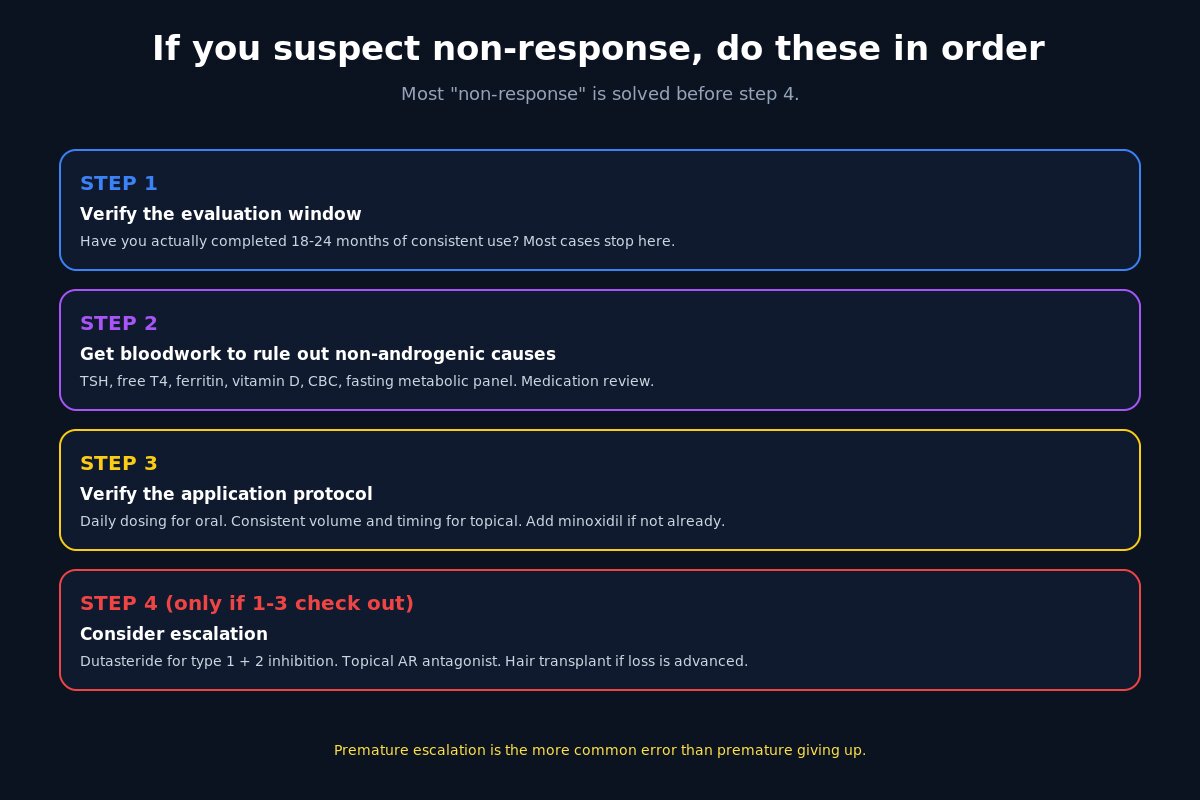
The first move is to verify that you have actually given the drug 18 to 24 months of consistent use, not a 9-month evaluation followed by adjustments. Most “non-responders” by self-report turn out to be slow responders by the time the proper window closes.
The second move is to verify that nothing else is driving hair loss. Get bloodwork: TSH, free T4, ferritin, vitamin D, complete blood count, fasting metabolic panel. Rule out thyroid dysfunction, iron deficiency, undiagnosed metabolic disease, and chronic inflammation. Rule out medication-induced hair loss by reviewing your medication list with a pharmacist or clinician.
The third move is to verify the application protocol. For oral finasteride, this means actually taking it daily at the prescribed dose, not skipping doses. For topical finasteride, this means consistent application volume and timing. For combination therapy with minoxidil, this means actually applying the minoxidil and not abandoning it after the initial shedding phase.
The fourth move, only if all three of the above check out, is to consider escalation: dutasteride for type 1 + type 2 inhibition, or topical AR antagonists like clascoterone or pyrilutamide for additional follicular blockade, or hair transplantation if the loss has progressed sufficiently to make medical therapy a holding pattern rather than a treatment.
The dutasteride question
Dutasteride is the most common escalation step. The mechanistic argument is straightforward: dutasteride blocks both 5-AR isoenzymes and reduces serum DHT by roughly 90 percent versus finasteride’s 70 percent. For men whose non-response is driven by type 1 5-AR activity in scalp tissue or by high baseline DHT, dutasteride often produces visible response where finasteride did not.
The argument against immediate escalation is that some non-response is driven by AR sensitivity, where the residual DHT after either finasteride or dutasteride is still high enough to activate sensitive receptors. In that case, dutasteride helps marginally but does not produce the dramatic switch the man was hoping for. Identifying which mechanism is driving an individual case is not currently possible without research-grade testing.

Common myths about finasteride non-response
The myth that 6 months is enough to evaluate is the most consequential and the most common. The myth that “finasteride simply does not work for some people” without specifying the biology is unfalsifiable and usually wrong about the timeline. The myth that brand-name Propecia works better than generic finasteride is not supported by bioequivalence data. The myth that splitting Proscar 5 mg into quarters underdoses you is also not supported – the dose-response curve flattens above 1 mg, so 1.25 mg from a quarter is functionally equivalent. The myth that “if it does not work in 12 months it never will” is the symmetric error to the previous myth: many men cross from non-responder to responder between months 12 and 18 as deeper follicle waves enter productive growth.
Frequently asked questions about finasteride non-response
How long should I give finasteride before deciding it is not working?
18 to 24 months. The hair cycle takes that long to fully express the response. Earlier evaluation produces false-negative conclusions in slow responders.
What percentage of men do not respond to finasteride?
Roughly 10 to 15 percent if you require visible regrowth. If you accept stabilization (no further loss) as response, the non-responder rate drops to under 10 percent.
Can I get tested to predict if I will respond?
AR CAG repeat testing is available through some research labs but is not clinically standardized for hair-loss prediction. The predictive value is too modest to inform individual decisions reliably.
Should I switch to dutasteride if finasteride is not working?
Maybe, after the 24-month evaluation window has closed and after non-androgenic causes have been ruled out. Premature switching is the more common mistake than premature giving up.
Will increasing the finasteride dose help?
Probably not. The dose-response curve for serum DHT suppression flattens above 1 mg daily. Going to 2.5 or 5 mg of finasteride does not produce meaningfully more DHT suppression. Dutasteride is the dose-equivalent escalation, not higher-dose finasteride.
Is brand-name Propecia better than generic finasteride?
No. Bioequivalence data shows generic finasteride is therapeutically equivalent to Propecia. Brand-name pricing reflects marketing, not pharmacology.
Could my hair loss be something other than AGA?
Yes, especially if the pattern is diffuse rather than concentrated at the vertex and temples. Diffuse thinning, telogen effluvium, thyroid dysfunction, and iron deficiency can all produce hair loss that finasteride cannot address. This is the most-missed cause of “non-response.”
Will adding minoxidil rescue a finasteride non-responder?
Sometimes, partially. Minoxidil works through a different mechanism (vasodilation and growth-phase extension), so a man who is not responding to finasteride for AR-driven reasons may still respond to minoxidil. Adding minoxidil before declaring finasteride a failure is reasonable.
Bringing it together
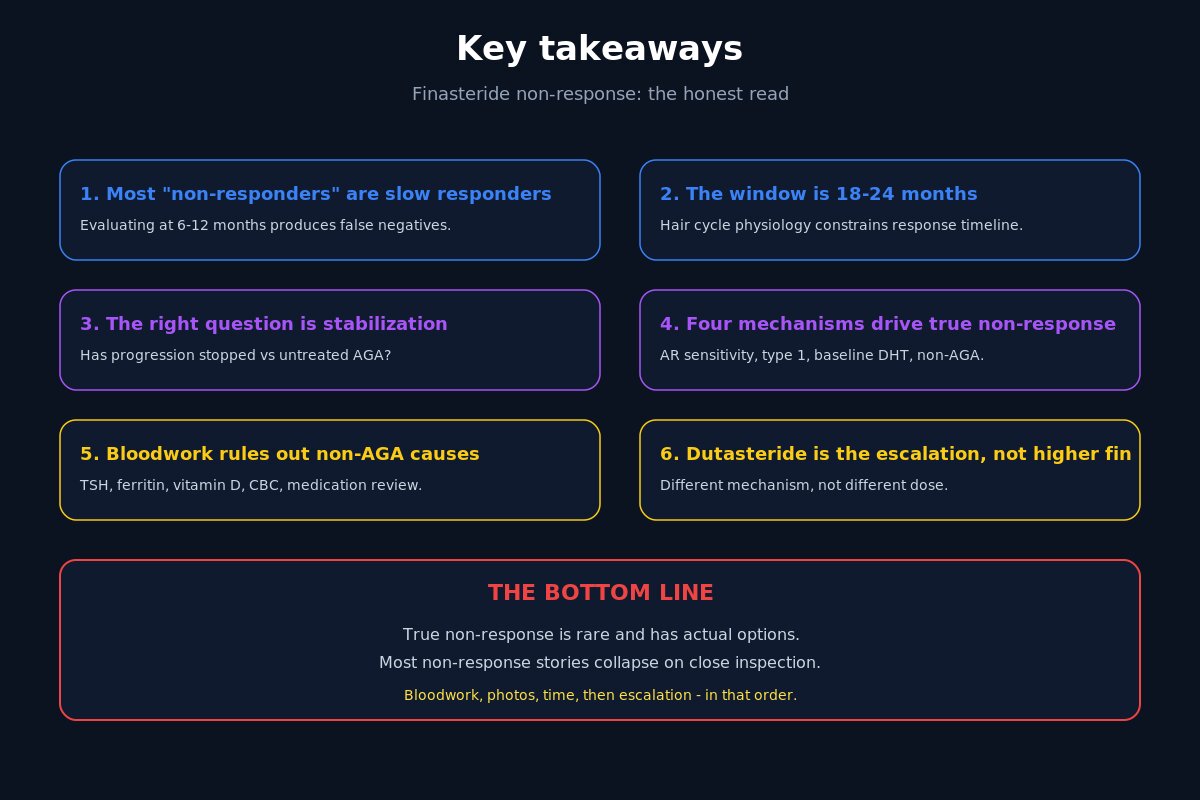
Most men who think they are finasteride non-responders are actually evaluating too early, evaluating without proper photo comparison, missing a non-androgenic contributor to their hair loss, or making compliance errors. The true non-responder population is real but small, and the right response to true non-response is bloodwork, dutasteride consideration, and possibly hair transplantation – not abandonment of all therapy. The diagnostic question is “has progression stopped” rather than “has regrowth occurred.” The evaluation window is 18 to 24 months, not 6 to 12. The evidence-based escalation path is finasteride to dutasteride, with topical AR antagonists as adjuncts. Most non-response stories collapse on close inspection. The ones that do not have actual options.
About the author
Philippe Boissard
Author of Men’s Hairloss Protocol (2020), Better, Smarter, Stronger (2023), and Multi-Axis Body (2025). Researches and writes about hair loss and male physiology, citing primary literature and disclosing affiliate relationships in full. Not a medical doctor; all content is educational. More about Philippe.
Related reading
Get my free hair-loss protocol
The exact evidence-based routine I actually use and recommend: what works, in what order, with no hype. Enter your email on the next page and I’ll send it straight to you.
Send me the free protocol →
[…] Why Finasteride Works for Some Men and Not Others: The Responder Question […]
[…] Why Finasteride Works for Some Men and Not Others: The Responder Question […]