
The Hair Loss Reset Protocol: When You Have Tried Everything
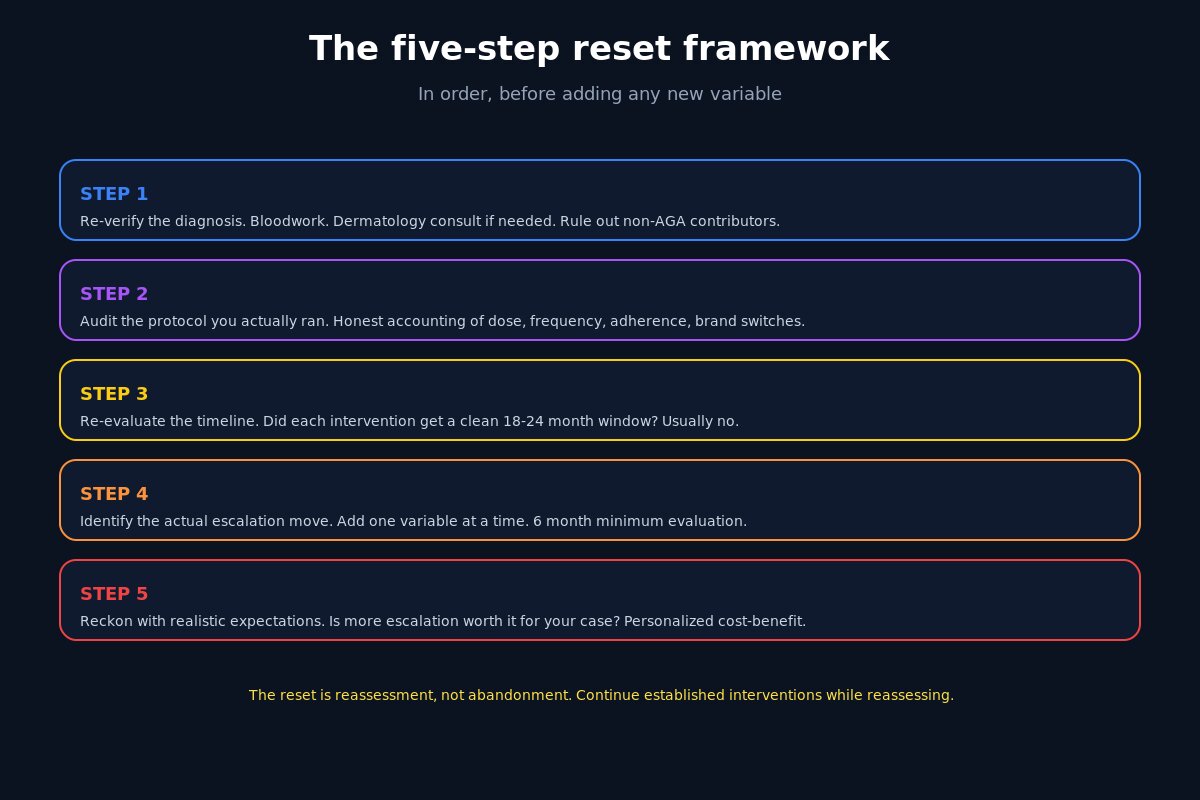
A reset is systematic reassessment, not abandonment. Five steps: re-verify diagnosis, audit protocol, evaluate timeline, identify escalation move, reckon with realistic expectations.

You have tried everything. Finasteride for two years. Minoxidil twice daily. Dutasteride after the finasteride plateau. Microneedling. Ketoconazole. Saw palmetto. Pumpkin seed oil. Maybe RU58841 or pyrilutamide for a stretch. The hair is still going. Photos at month 24 show progression that looks similar to the trajectory before treatment. The natural impulse at this point is to either give up entirely or stack three more interventions on top of what is already there. Both are usually wrong. The right move is a systematic reset: a structured reassessment of diagnosis, protocol, adherence, and timeline before adding any new variable. This article walks through the reset framework.
Quick answer: when to reset and what it means
A reset is warranted when you have run a multi-component protocol for 18-24 months with consistent adherence and good photo evidence, and the trajectory is clearly continuing rather than stabilizing. Reset does not mean stopping everything. It means systematically re-checking what you actually know vs what you assumed: is this AGA, is the dose right, is adherence what you think it is, are non-androgenic factors driving residual loss, is the evaluation timeline really long enough, and is escalation or stabilization the right next move.
Step 1: Re-verify the diagnosis
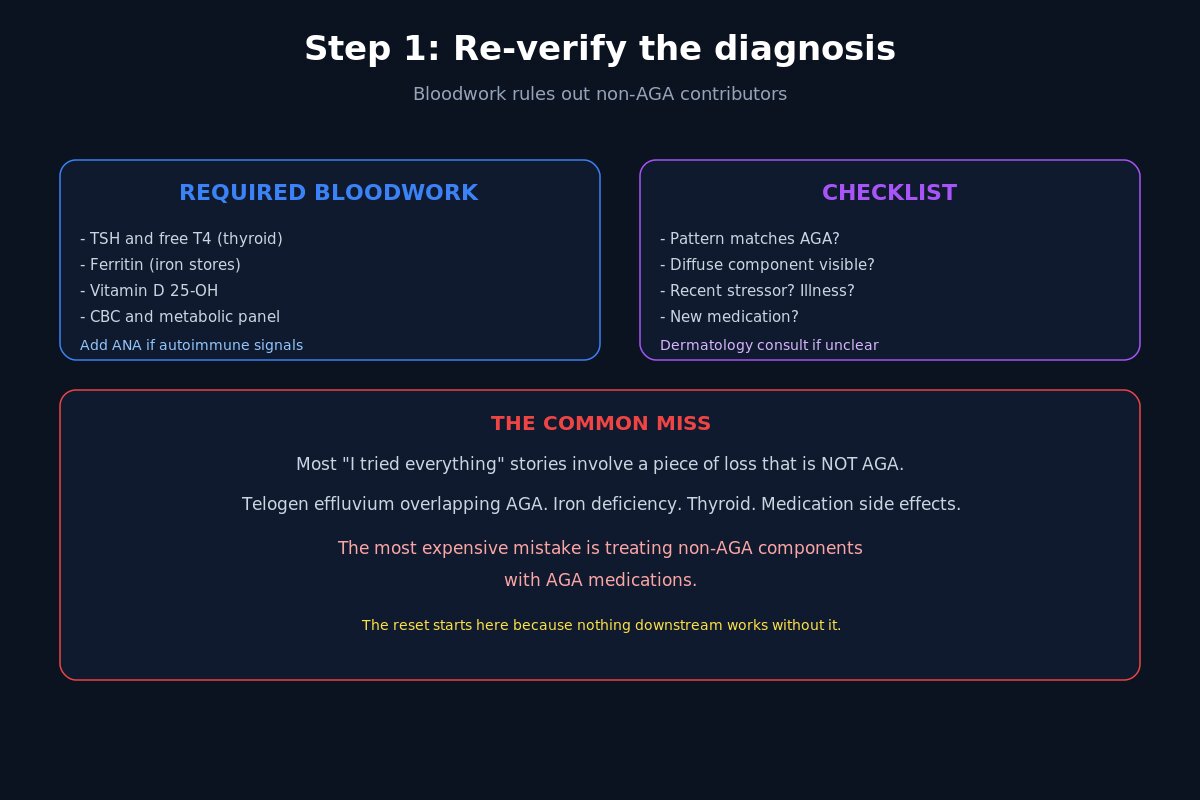
Most “I tried everything and nothing works” stories turn out, on inspection, to involve a piece of the loss that is not androgenetic alopecia. Diffuse thinning rather than patterned recession is a clue. Telogen effluvium overlapping AGA is another. Thyroid dysfunction, iron deficiency, autoimmune contribution, scalp inflammatory conditions, medication side effects, and post-COVID TE all show up regularly in the “treatment failure” category.
The reset protocol starts here because the most expensive mistake in hair loss is treating non-AGA components with AGA medications. The check is bloodwork (TSH, free T4, ferritin, vitamin D, CBC, fasting metabolic panel, plus consideration of an ANA if any autoimmune signals are present), a fresh medication review with a pharmacist or clinician, and a dermatology consult if the pattern is anything other than classic male pattern. If something else has been driving a meaningful fraction of the loss, no AGA treatment will fix it.
Step 2: Audit the protocol you actually ran
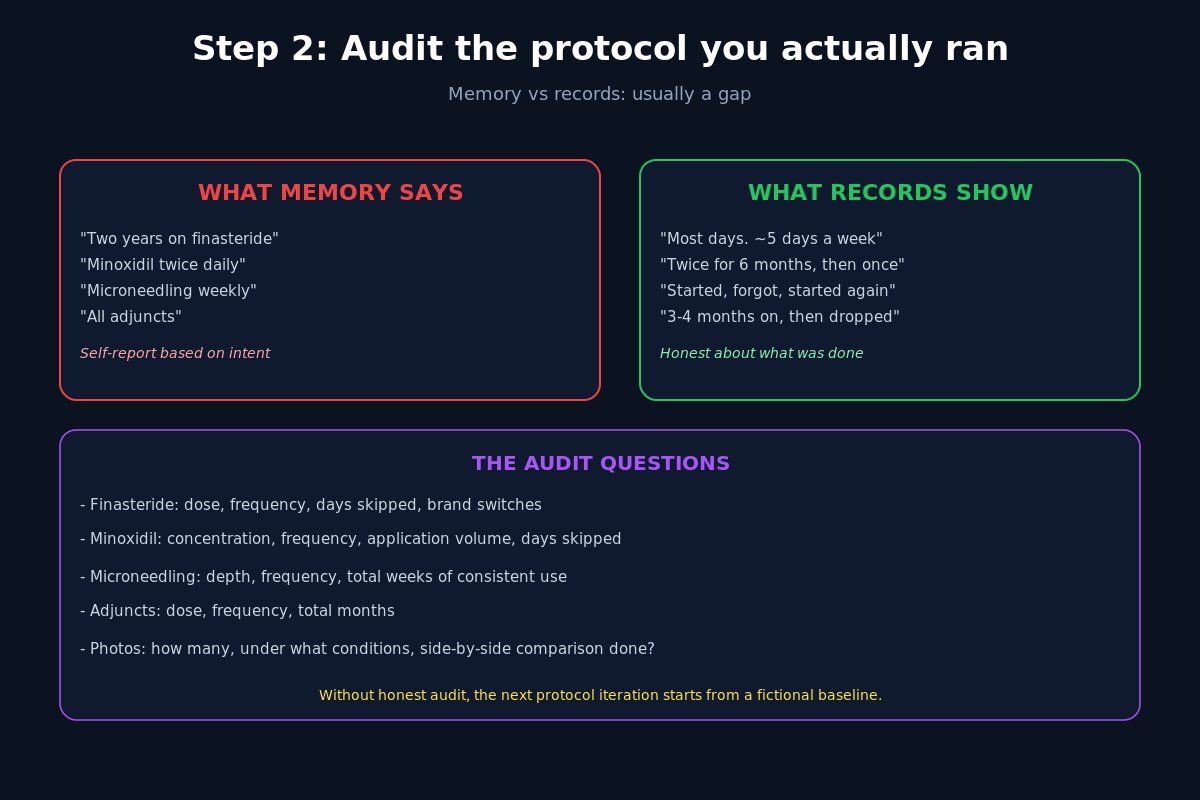
Most “I tried everything” claims are based on memory rather than records. Sit down and write the actual protocol. What dose of finasteride. How often you took it. How many weeks you skipped. What concentration of minoxidil and how often you applied it. Whether you switched between brands. When you started microneedling and at what depth. What dose and frequency of any adjunct supplements. What your photos at each milestone actually show, side by side.
The audit usually surfaces gaps. Finasteride taken “most days” is not finasteride taken daily. Minoxidil twice daily for the first 6 months and once daily thereafter is not the protocol that produced the trial results. Microneedling done weekly for two months and then forgotten is not the intervention that has evidence. The reset is honest about what was actually done, not what was intended. Without this honesty, the next protocol iteration starts from a fictional baseline.
Step 3: Re-evaluate the timeline
The hair cycle takes 18-24 months to fully express response to medication. Most “I tried everything” timelines compress this. Six months of finasteride, then dutasteride for nine months, then a topical for a year, then microneedling for six months. Each individual intervention may not have been given a fair window even if total time was substantial. The reset asks: of the interventions in the protocol, which ones were actually given the 18-24 month window with consistent dose and adherence? Often none.
This matters because the right reset for “two years on a clean finasteride plus minoxidil protocol with confirmed adherence and no improvement” is different from the right reset for “I jumped between four interventions over two years and never gave any of them a clean 18-month window.” The first calls for genuine escalation; the second calls for picking the most-evidenced protocol and running it cleanly for 18 months before further iteration.
Watch this on the channel
Finasteride Isn’t Working? Here’s Why – frames why “treatment failure” is most often a timeline or adherence issue rather than a true biological non-response, and why the reset begins with that recognition.
Step 4: Identify the actual escalation move
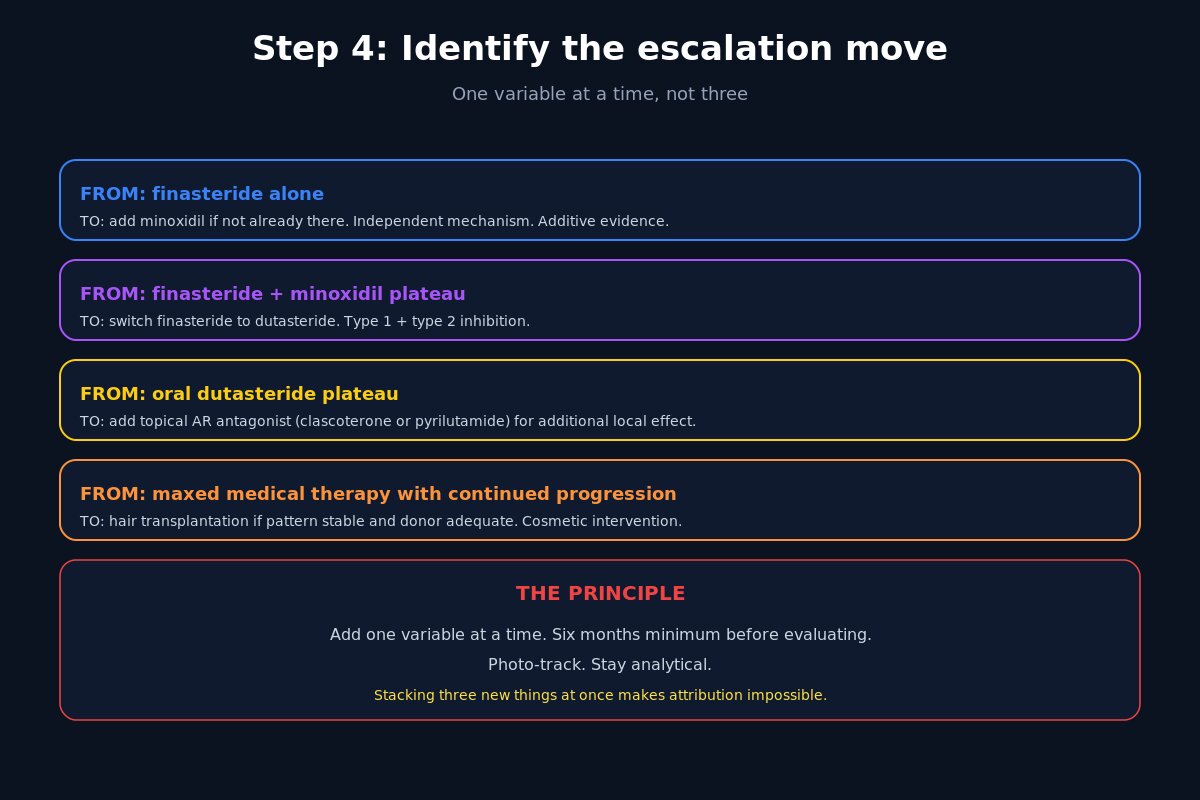
If diagnosis is confirmed, adherence was real, and timeline was sufficient, escalation is the right next step. The escalation has a logical order. From finasteride alone, the move is to add minoxidil if not already there. From finasteride plus minoxidil, the move is to escalate finasteride to dutasteride. From oral dutasteride, the move is to add a topical AR antagonist (clascoterone or pyrilutamide) for additional local effect. From maxed-out medical therapy with continued progression, the move is to consider hair transplantation as a cosmetic intervention rather than continuing to chase medical-only optimization.
The escalation is not “stack three new things at once.” That makes attribution impossible if anything works and impossible if nothing works. Add one variable at a time. Give it 6 months minimum before evaluating. Photo-track. Stay analytical.
Step 5: Reckon with realistic expectations
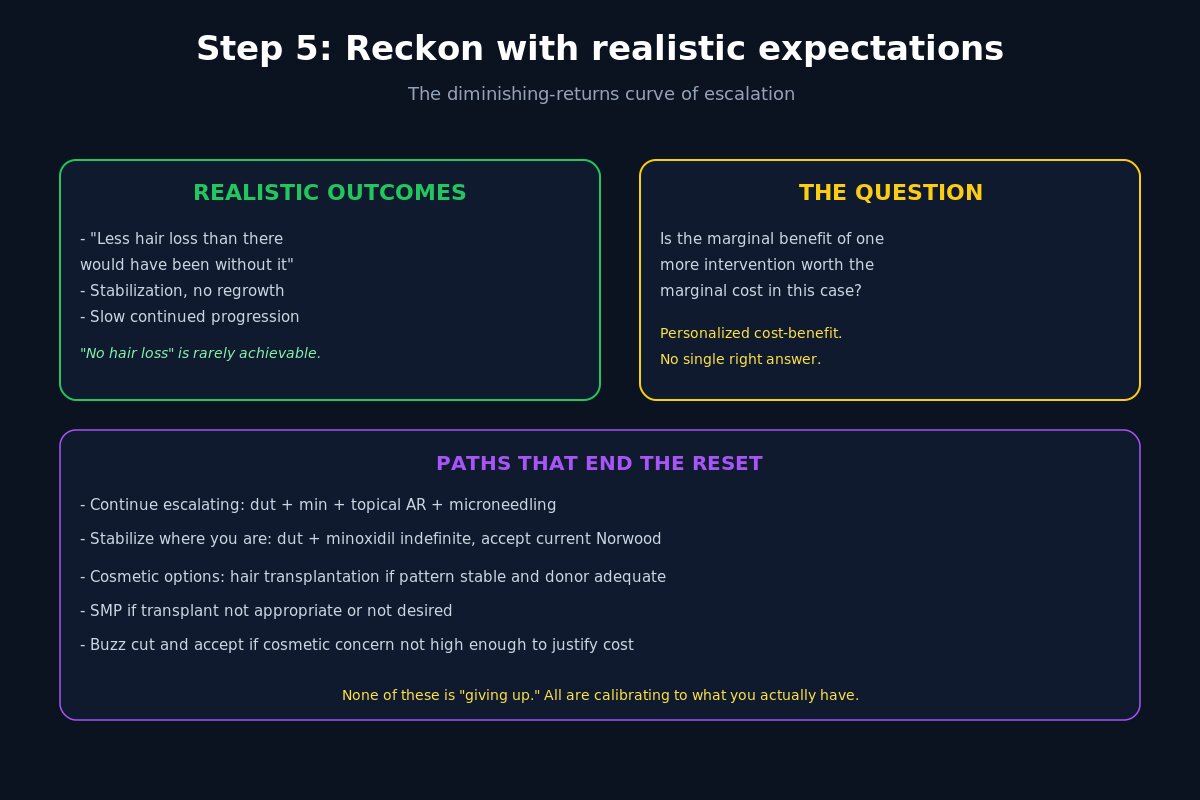
Some men have aggressive AGA where even maximal therapy slows but does not stop progression. The realistic outcome for these men is “less hair loss than there would have been without treatment” rather than “no hair loss.” Recognizing this is not giving up; it is calibrating to biology. Continued aggressive escalation in someone who is already on dutasteride plus minoxidil plus topical AR antagonist may produce diminishing returns at substantial cost and side-effect risk.
The reset includes the question “is the marginal benefit of one more intervention worth the marginal cost in this case.” For some men the answer is yes and they should escalate further. For others the answer is no and they should stabilize on what is working, accept the current trajectory, and consider cosmetic options like hair transplantation or scalp micropigmentation if the cosmetic concern is meaningful. There is no single correct answer; there is a personalized cost-benefit analysis.
What a reset looks like in practice
Month 0: stop adding new interventions. Get bloodwork. Schedule a dermatology consult if not already done. Take fresh five-angle baseline photos under controlled conditions. Write the actual protocol audit honestly.
Month 1-2: review bloodwork. Identify any non-AGA contributors. Address them specifically (iron deficiency gets iron, thyroid dysfunction gets thyroid management, etc.). Decide on the cleanest protocol going forward: usually finasteride 1 mg daily, minoxidil 5 percent twice daily, microneedling 1.5 mm weekly. Drop other interventions until you can attribute effects.
Month 3-18: run the protocol clean. No additions. Photo every 3 months. Compare side by side, not from memory. Maintain consistent dose and frequency. If TE-component was driving visible loss and underlying causes are addressed, expect the visible portion to improve over months 3-9. Beyond that, the AGA component drives the trajectory.
Month 18-24: evaluation. If clear improvement, continue. If clear stabilization (no further progression), continue. If clear continued progression, this is the genuine non-responder population and escalation is now appropriate. Add dutasteride if not already on it; add topical AR antagonist if dutasteride is not enough; consider hair transplantation if the loss has progressed sufficiently for cosmetic improvement to matter.
What to NOT do during a reset
Do not stop finasteride or minoxidil during the reset. The reset is about systematic reassessment, not abandoning the established interventions. Stopping them produces months of accelerated loss as the protected hair re-enters AGA progression, which has no purpose and produces a worse baseline for evaluating any next steps.
Do not add three new interventions at once because you feel impatient. The reset is a discipline of one variable at a time, with adequate evaluation windows, and clean photo documentation. Stacking everything makes the next two years uninterpretable.
Do not consult a hair transplant clinic in the middle of the reset. Premature transplants on patterns that are not stable lead to needing another transplant 3-5 years later. The reset is the time to confirm whether your medical baseline is actually stable, which is the prerequisite for transplant timing.
When the reset says “stop”
For some men the right answer at the end of the reset is to stop active escalation and accept the current trajectory. This is not failure. It is recognizing that your biology has a particular shape and that more interventions on top of an already-maxed protocol produce diminishing returns. The realistic path may be: stay on dutasteride plus minoxidil indefinitely for stabilization, accept the Norwood stage you are at, consider hair transplantation if cosmetic improvement matters, otherwise live with it. None of these is giving up; they are calibrating to what you actually have.
The men who reset successfully usually do not end up with dramatic regrowth. They end up with confidence that they have actually understood their case, ruled out reversible contributors, run the right protocol cleanly, and made informed decisions about whether further escalation is worth it. That clarity is the actual outcome of a reset, not regrowth.
Common myths about hair loss resets
The myth that you should “give your body a break” from finasteride is incorrect; pausing finasteride produces accelerated loss without benefit. The myth that “if it has not worked in two years, nothing will” inverts the responder timeline; some men are genuine slow responders. The myth that the answer to plateau is always more aggressive escalation ignores the diminishing-returns curve of the AGA pathway. The myth that hair transplantation rescues failed medical therapy ignores the donor hair budget reality. The myth that a reset means stopping everything and starting over confuses reset with reset-from-zero; the goal is reassessment, not abandonment.
Frequently asked questions about the reset
Should I stop my current protocol during a reset?
No. Continue established interventions. The reset is about adding bloodwork, audit, and timeline analysis on top of what is working, not stopping what is working.
How long should a reset take?
The active reassessment phase is 1-2 months. The evaluation phase that follows is 18-24 months on the cleaned-up protocol. The full reset cycle is roughly 2 years.
What bloodwork should I get?
TSH, free T4, ferritin, vitamin D, CBC, fasting metabolic panel. Add ANA if autoimmune signals exist. Add serum DHT and testosterone if you want pathway data, though these rarely change clinical decisions.
How do I know if my AGA is genuinely treatment-resistant?
By running a clean 18-24 month evaluation on a maximal medical protocol with confirmed adherence and no other contributors. Most “treatment-resistant” claims do not survive that test.
Should I get a transplant if my reset shows continued loss?
Possibly. If the loss is stable at the post-reset stage, the man is in his late 30s or beyond, and donor hair is adequate, transplantation becomes reasonable. The reset is the prerequisite for confidence in stability.
When is it time to give up rather than escalate?
When you are on maximal medical therapy, have ruled out non-AGA contributors, the trajectory continues to progress slowly, and the marginal benefit of further escalation does not justify the cost or side-effect risk. There is no formula; it is a personalized cost-benefit decision.
Is reset just doing the same things again?
No. Reset is doing them clean for the first time. Most men who run a reset find that their previous “everything” was actually a fragmented, inconsistent set of interventions. Reset means actually completing what was started.
Should I document my reset?
Yes. Photos every 3 months, dose log, medication review log, bloodwork results. The documentation is what allows the next round of analysis to be honest. Reset without documentation is fragile.
Bringing it together
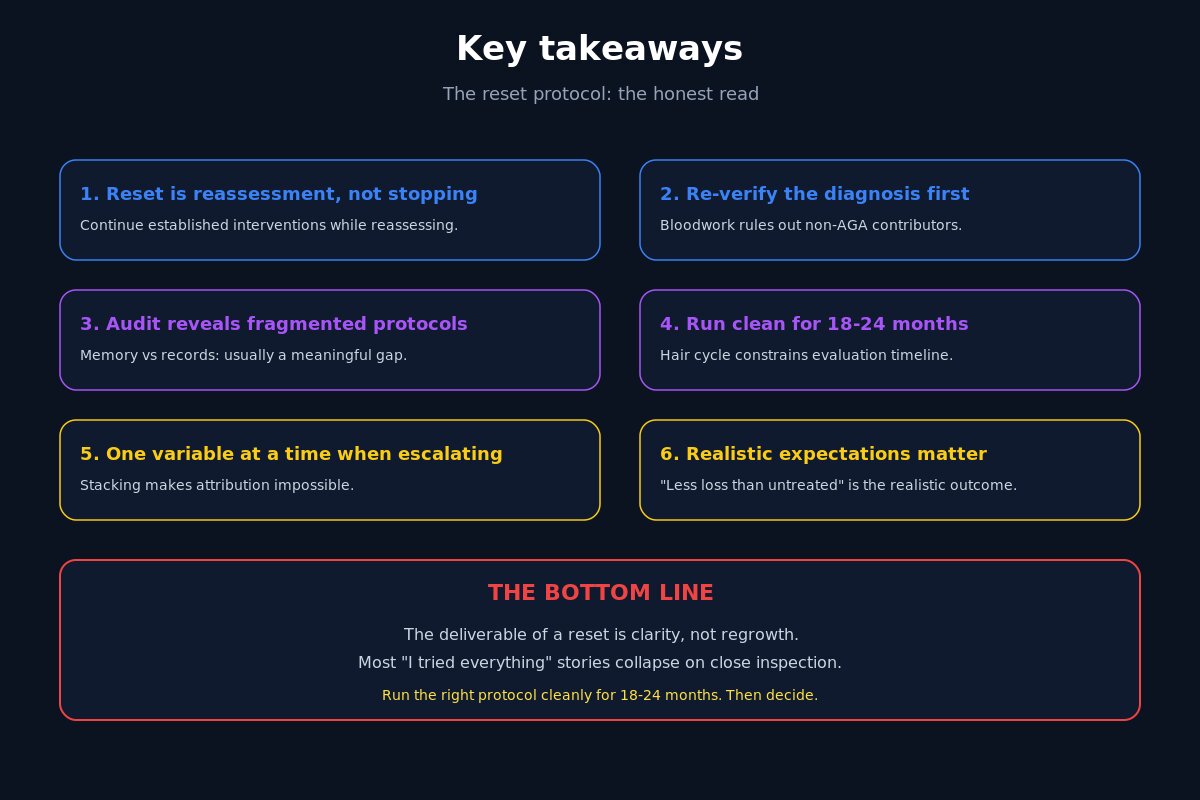
The reset is the discipline of systematically reassessing what you actually know about your case before adding new interventions. Re-verify the diagnosis. Audit the protocol you actually ran. Re-evaluate the timeline. Identify the right escalation move. Reckon with realistic expectations. The reset is not stopping; it is starting again with clarity. Most men who run a reset find that their previous “everything” was less complete than they thought, that giving the right protocol a clean 18-24 month window often produces the result that fragmented attempts did not, and that escalation when warranted produces meaningful results in cases that initially looked like failure. The men who genuinely have run the reset cleanly and still see continued loss have a different conversation, but it is one made with information rather than panic. That clarity is the actual deliverable of a reset.
About the author
Philippe Boissard
Author of Men’s Hairloss Protocol (2020), Better, Smarter, Stronger (2023), and Multi-Axis Body (2025). Researches and writes about hair loss and male physiology, citing primary literature and disclosing affiliate relationships in full. Not a medical doctor; all content is educational. More about Philippe.
Related reading
Get my free hair-loss protocol
The exact evidence-based routine I actually use and recommend: what works, in what order, with no hype. Enter your email on the next page and I’ll send it straight to you.
Send me the free protocol →