
The 6-Month Plateau: What to Do When Treatment Stops Improving
The 6-month plateau is a gap, not the ceiling. Two waves of visible response with a quiet gap between them. Here is the diagnostic and what to do if the plateau is real at 24 months.


The story is familiar. A man starts finasteride and minoxidil, sees obvious improvement at three to six months, gets excited, takes new photos at nine months, and notices nothing has changed since the six-month photos. Then the same thing at twelve months. The improvement plateaued. The natural conclusion is that the drugs stopped working. The natural response is to add things, escalate, switch, or quit. This article walks through what plateau actually means at the cellular level, why most plateaus are not what they look like, and what the actual decision tree looks like for men in this situation.
Quick answer: did treatment stop working?
Probably not. The visible improvement from finasteride and minoxidil typically happens in two waves: a first wave from existing follicles completing their cycle and growing back as terminal hair (3-6 months), and a second wave from previously miniaturized follicles thickening their shafts (9-18 months). Between these two waves there is a visual plateau where nothing dramatic is happening even though biology is still working. The plateau is not failure. It is the gap between waves. Most men confuse the two and quit prematurely.

What “plateau” actually means at the cellular level
The hair cycle has three phases: anagen (growth), catagen (transition), and telogen (rest). Finasteride works by reducing DHT, which lengthens anagen and shortens telogen for follicles that were being miniaturized. The visible effect of this lengthening takes time to express because each individual follicle is on its own cycle, and the cycle length is months not weeks.
When you see visible improvement at three to six months, you are seeing the cohort of follicles that happened to be near the end of their cycle when you started treatment. They reset, completed catagen and telogen faster than they would have, and re-entered anagen with a normalized growth phase. The improvement looks dramatic because a large fraction of cycle-aligned follicles all entered the visible-growth phase simultaneously.
After this first wave, the next cohort of follicles needs to enter the same biological process. But they were further from the end of their cycle when treatment started, so they take longer to reach the visible-effect threshold. The plateau between months six and twelve is the time during which this second cohort is doing biological work that is not yet visible.
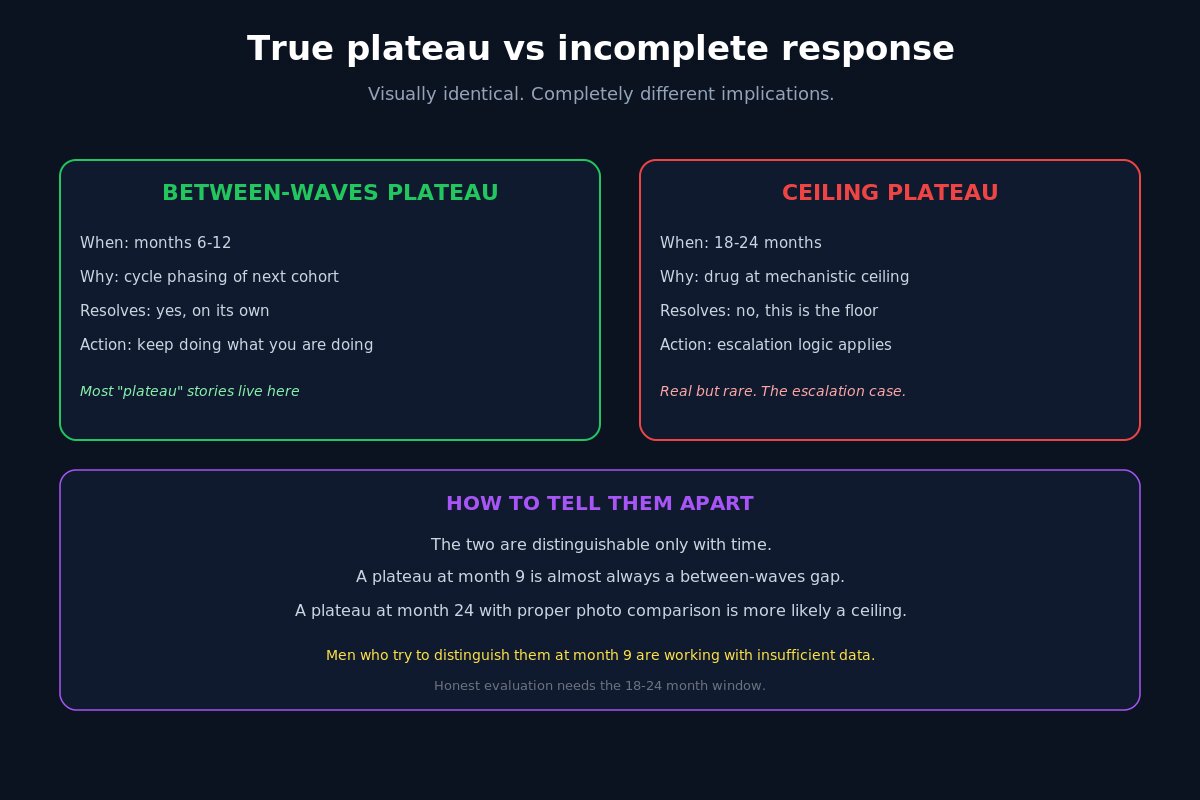
True plateau vs incomplete response
The diagnostic question for any plateau is whether you are in a between-waves gap or whether the drug has reached its ceiling. The two look identical visually but have completely different implications.
A between-waves plateau resolves itself if you wait. The second wave arrives somewhere between months 12 and 18, sometimes as late as 24 months. If you are at month 9 and not seeing change, you are probably in this category, and the right action is to keep doing what you are doing.
An incomplete-response plateau is when the drug is working at its mechanistic ceiling but the underlying disease is still progressing slightly faster than the drug can hold. This is the situation where the photos at 18 months look exactly like the photos at 12 months, the photos at 24 months look the same, and the photos at 30 months might be slightly worse. The plateau is real but it is the floor of the drug’s effect. This is the situation that warrants escalation.
The two are distinguishable only with time. Men who try to distinguish them at month 9 are working with insufficient data. The honest evaluation needs the 18-24 month window from the responder question article.

Why “shedding came back” is usually a misread
A common variant of the plateau story is the man who was on finasteride and minoxidil, was doing well at six months, then noticed shedding returning at month nine. He concludes the drugs stopped working. The actual mechanism is usually different. The original shedding-stop happened because of the first-wave cycle reset. Once those follicles completed their normalized cycle, they entered telogen on a different schedule than the second-wave cohort, which means at month nine some follicles are now in their natural shedding phase even though the underlying disease is being treated.
The hair you are losing at month 9 is not the same hair that was being saved at month 6. It is the next cohort moving through its own normal cycle. Treatment is still working; the cycle is just visible because the follicles are out of phase.
Watch this for context
Finasteride Isn’t Working? Here’s Why – frames why most “treatment failure” claims are timeline misjudgments and how to evaluate properly.

The five-question plateau diagnostic
Before deciding the drug is failing, run through this checklist. First: have you actually completed 18-24 months of consistent use? If the answer is “I’m at month 9,” you are not in plateau territory yet. Second: have you been comparing photos under matched conditions, or comparing month-9 hair to a memory of month-3 hair? Memory is unreliable for hair density. Third: have you been consistent with the protocol? Skipped doses, gaps in minoxidil application, or switching brands all confound evaluation. Fourth: has anything changed in your underlying health – thyroid, iron, stress, sleep, weight – that could be driving incremental loss independent of the drug? Fifth: are you using objective measurement (hair count via trichoscope) or subjective inspection? Subjective inspection has poor reproducibility.
If you answer the first four questions favorably and have proper photo comparison, plateau is probably real. If you answer any of them unfavorably, your evaluation is unreliable and the plateau may be artifactual.
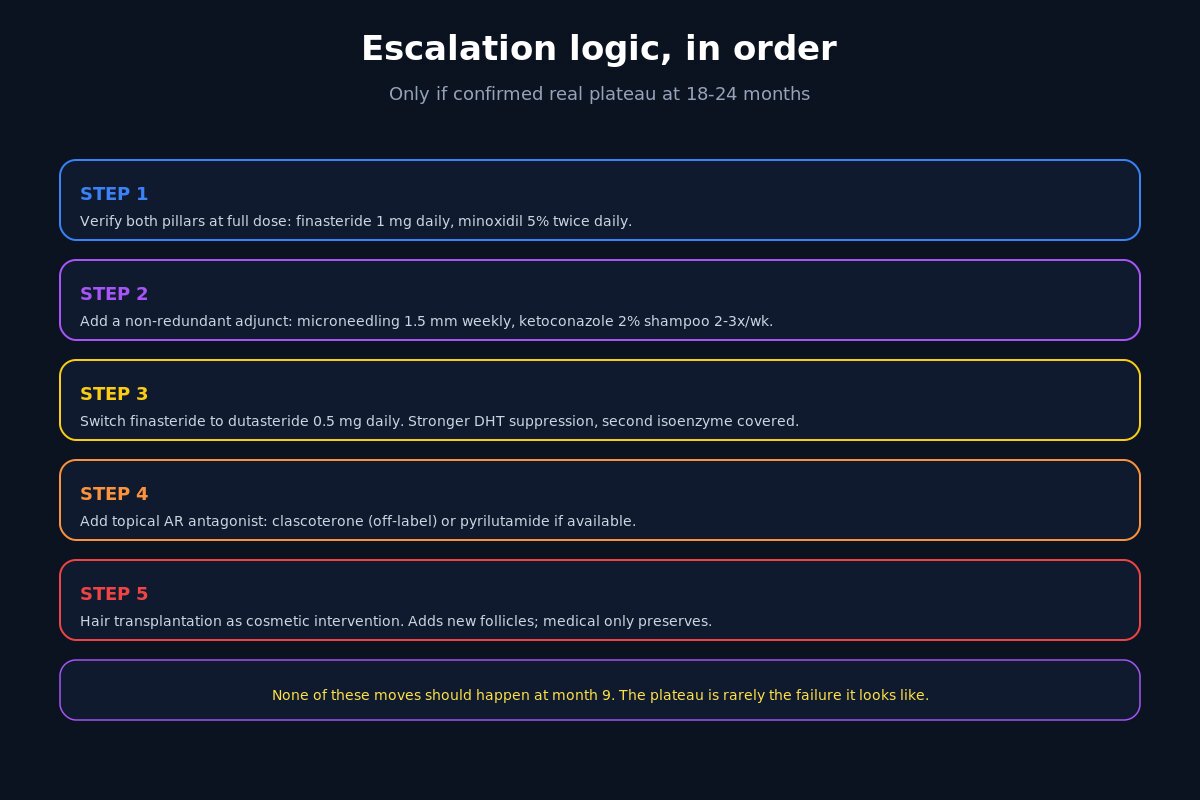
Escalation logic, in order
Once you have confirmed a real plateau at the 18-24 month mark, escalation has a logical order. The first move is to verify both pillars are at full dose. Finasteride 1 mg daily is the dose that matters; less is less. Minoxidil should be at 5 percent topical applied twice daily, or 2.5-5 mg oral if the topical is causing irritation or compliance issues.
The second move is to add an adjunct that does not duplicate existing mechanisms. Microneedling at the right depth (1.5 mm, weekly) is mechanistically additive and has a small but real evidence base. Ketoconazole 2 percent shampoo, used 2-3 times per week, has weak adjunct evidence with low downside.
The third move is escalation of the AR-axis intervention. Switching from finasteride to dutasteride 0.5 mg daily produces stronger DHT suppression (~90% vs ~70%) and adds a second 5-AR isoenzyme. This is the most-studied escalation step and works for men whose plateau was driven by residual DHT after finasteride.
The fourth move, if dutasteride is not enough or not tolerated, is adding a topical AR antagonist – clascoterone (off-label) or pyrilutamide if available. These work downstream of DHT at the receptor and provide a separate point of intervention.
The fifth move, if all the above plateau, is to consider hair transplantation as the cosmetic intervention rather than continuing to chase medical-only optimization. Hair transplantation is the only intervention that adds new follicles to thinning areas; medical therapy can only preserve what is there.
What not to do at plateau
Do not double the finasteride dose. The dose-response curve flattens above 1 mg, so 2 or 5 mg of finasteride is not stronger than 1 mg in any meaningful way. Do not stack three different supplements hoping one will help; the marginal benefit is small and you will not be able to identify which is doing what. Do not switch brands of finasteride hoping for a different result; bioequivalence data does not support brand differences. Do not stop finasteride to “give your body a break”; AGA progression resumes within weeks once DHT recovers, and the gains achieved during treatment will be lost over the following months. Do not consult a hair transplant clinic at month 9; the conversation is premature and the financial incentive is structural.
The 24-month verdict framework
At the 24-month mark, with proper photo comparison, the verdict on response is one of three things. First: clear continued improvement, in which case the plateau was a between-waves gap and the right action is to continue without changes. Second: clear stabilization with no further loss but no further regrowth, in which case the drug is working and the question is whether you want to add more for marginal upside or accept the current state. Third: continued slow progression despite drug, in which case the escalation logic in the previous section applies.
Stabilization is success. A man on finasteride who has not lost any further hair over 24 months has avoided the natural progression that would have happened without the drug. The drug is working. The fact that the photos look the same is not evidence of failure; the photos of the placebo arm at the same point would look noticeably worse.
Common myths about hair loss treatment plateau
The myth that 6-month plateau means the drug stopped working misjudges hair-cycle physiology. The myth that “shedding returning” means the drug stopped working misreads cycle phase progression. The myth that switching brands or doses will rescue a plateau ignores the fact that bioequivalence and dose-response curves are well-characterized. The myth that more is always better leads to over-stacking that is hard to evaluate. The myth that plateau means transplant time conflates medical optimization with cosmetic intervention; they are different decisions made on different timelines.
Frequently asked questions about plateau
How long should I wait before deciding I have plateaued?
18 to 24 months. The hair cycle has multiple waves of response and the second wave often does not become visible until month 12-18. Earlier evaluation produces false-plateau readings.
Should I add minoxidil if I plateau on finasteride?
If you are not already on minoxidil, yes. The mechanisms are independent and additive, and combination therapy produces better results than either alone in trials. If you are already on both, this is not the move.
Will switching from finasteride to dutasteride help at plateau?
Often, especially if the plateau was driven by residual DHT after finasteride. Dutasteride suppresses DHT roughly 90% vs finasteride’s 70% and inhibits both 5-AR isoenzymes. This is the most-studied escalation step.
Is doubling finasteride helpful?
No. The dose-response curve for serum DHT suppression flattens above 1 mg. Going to 2 or 5 mg does not produce more suppression. Dutasteride is the proper dose-equivalent escalation, not higher-dose finasteride.
Should I add microneedling?
Reasonable adjunct. The mechanism is mostly minoxidil-amplification (better penetration and growth-factor signaling). Use 1.5 mm depth, weekly, on dry scalp. Evidence base is small but the downside is small.
Does shedding at month 9 mean treatment failure?
No. Different cohorts of follicles are on different cycle phases. The follicles shedding at month 9 are not the ones that were saved at month 6. Treatment is still working; the cycle is visible because the follicles are out of phase.
Should I switch brands at plateau?
No. Generic finasteride is bioequivalent to brand-name Propecia. Brand switching does not change clinical outcomes.
What if I plateau even after escalating to dutasteride?
Add a topical AR antagonist (clascoterone off-label or pyrilutamide if available) for downstream blockade. If still plateaued, hair transplantation becomes the cosmetic option to consider.

Bringing it together
The 6-month plateau is rarely the failure it looks like. The biology of hair regrowth runs in waves, the gap between waves is visually identical to genuine plateau, and the only way to tell them apart is time. Most men who quit at the gap miss the second wave. The men who actually plateau at 18-24 months have a logical escalation path: verify dose, add adjuncts, escalate to dutasteride, add topical AR antagonists, consider transplantation. None of these moves should happen at month 9. The single most useful intervention at the visible plateau is patience plus consistent photo evidence. The single most common error is mistaking the gap for the ceiling.
About the author
Philippe Boissard
Author of Men’s Hairloss Protocol (2020), Better, Smarter, Stronger (2023), and Multi-Axis Body (2025). Researches and writes about hair loss and male physiology, citing primary literature and disclosing affiliate relationships in full. Not a medical doctor; all content is educational. More about Philippe.
Related reading
Get my free hair-loss protocol
The exact evidence-based routine I actually use and recommend: what works, in what order, with no hype. Enter your email on the next page and I’ll send it straight to you.
Send me the free protocol →
[…] The 6-Month Plateau: What to Do When Treatment Stops Improving […]
[…] The 6-Month Plateau: What to Do When Treatment Stops Improving […]
[…] The 6-Month Plateau: What to Do When Treatment Stops Improving […]