
Hair Shedding: How Much Is Normal and When to Worry
50-100 hairs a day is normal. Dread shed is a positive signal. Telogen effluvium has a discoverable cause. Here is the full diagnostic for shedding vs progression.


Find a hair on your pillow, see a few in the shower drain, notice some on the back of your shirt, and the panic spiral starts. Is this normal? Is this the beginning? Is the treatment failing? The honest answer is that everyone sheds hair every day, including the men who never lose any density, and the volume of normal shedding is much higher than most people imagine. The diagnostic question is not “am I shedding” but “is my shedding outside the normal range, and is it happening for a reason that requires attention.” This article walks through what the actual normal range is, how to count vs how to estimate, when shedding becomes a real signal, and the specific shedding patterns that mean something different from baseline noise.
Quick answer: how much shedding is normal?
Roughly 50 to 100 hairs per day for a typical scalp. The exact number varies with hair length (longer hairs are more visible when shed), washing frequency (loose hairs accumulate between washes and shed all at once on wash day), and individual hair-cycle physiology. The 50-to-100 range is what hair-loss research consistently cites, with Headington 1993 establishing the baseline and Rebora 2016 confirming it across larger samples. This is not a target you should hit. It is the noise floor below which your shedding is normal.

Why daily shedding exists at all
Every hair on your scalp is on its own cycle. The cycle has three phases: anagen (active growth, ~2-7 years), catagen (transition, ~2-3 weeks), and telogen (rest, ~3 months). At the end of telogen, the hair shaft releases from the follicle and falls out, and a new anagen-phase hair starts growing in its place. Because the average scalp has roughly 100,000 follicles and roughly 10 percent are in telogen at any moment, simple math says you have roughly 10,000 hairs in shedding-eligible phase at any time. Distributed across the 90-day telogen period, that produces about 110 hairs released per day on average. The 50-100 number reflects the lower end because not every released hair gets noticed.
This means: a man who sheds zero hairs in a day is statistically unusual and probably just missing them. A man who sheds 80-100 hairs in a day is on the high end of normal. A man who sheds 200+ hairs per day for several weeks is likely outside the normal range and has something to investigate.

The shedding categories that matter
Baseline shedding (50-100/day) is the noise floor. No clinical significance. Should be ignored.
Treatment-initiation shedding (“dread shed”) happens 2 to 8 weeks after starting finasteride, minoxidil, or microneedling. This is the cycle-reset phenomenon: dormant follicles that were stuck in late telogen are pushed back into anagen, releasing the old shaft as a side effect. Counts often hit 150-250/day for 2-6 weeks. This is a positive signal even though it looks alarming. It is the precondition for the regrowth wave that arrives 3-6 months later.
Telogen effluvium (TE) is a discrete diffuse shedding event triggered by stress, fever, surgery, post-pregnancy hormonal shift, severe weight loss, thyroid disturbance, or a few specific medications. Counts hit 200-400/day starting 2-3 months after the trigger and last 6-12 weeks. Resolves spontaneously once the trigger is gone.
Chronic telogen effluvium is TE that has not resolved at 6 months. Investigate underlying cause: ongoing thyroid dysfunction, persistent iron deficiency, chronic stress or sleep deprivation, ongoing autoimmune contribution, or unidentified medication effect.
AGA-driven shedding is qualitatively different. The hairs released look thinner, finer, shorter than the previous cycle. Counts may not be elevated; the shedding pattern just shows progressive miniaturization. This is the slow grinding of the AGA process, not an acute event.
How to count vs how to estimate
Counting hair manually is unreliable for everyday use. The “wash test” – washing your hair into a sink with a stopper for one week then counting the strands – is the most-cited reproducible method, but most men will not do this with the consistency needed for the data to be useful. The cruder alternative is to estimate ranges: very few (under 30), moderate (30-100), heavy (100-200), very heavy (200+). Estimation is not precise but is reproducible enough for the diagnostic question, which is whether shedding is in the normal range or outside it.
The single most useful tool is photo evidence over time, not daily shedding counts. Daily counts are subject to wash schedule, hair length, and observer bias. Monthly photos under matched conditions show density changes that the count data cannot. The honest framing is: count when you suspect TE and want to confirm, photograph for everything else.
Watch this on the channel
No Before & After Yet – frames the patience required when the shedding feels alarming and you are still in the early phase of treatment.

The “dread shed” on starting treatment
The most common question among men starting finasteride or minoxidil is “should I be shedding more after starting the drug.” Yes, often. The mechanism is straightforward: minoxidil pushes follicles from telogen back into anagen, which releases the existing telogen shafts. Finasteride changes the hormonal environment, prompting some follicles to reset their cycle. Either way, the visible result is increased shedding in weeks 2-8 of treatment.
This is not the drug failing. It is the drug working. The hairs you are losing are old telogen-phase hairs being released to make room for new anagen growth. The new growth becomes visible 3-6 months later. Men who panic and quit during the dread shed are quitting at the worst possible moment – they get all of the visible cost without any of the future benefit.
The dread shed typically resolves by week 8-12. If shedding remains heavy at month 4-5, this is no longer dread shed and should be evaluated for other causes: incorrect dose, comorbid TE, or a separate underlying issue.

Telogen effluvium: the diagnostic checklist
If your shedding has been 200+ hairs per day for several weeks and you are not in the dread-shed window from a new treatment, run through this checklist. First: any major stressor in the past 2-3 months? Severe illness, surgery, divorce, job loss, family crisis. TE has a 2-3 month delay between trigger and shedding peak. Second: any recent medication changes? Antidepressants, beta-blockers, anticonvulsants, retinoids, and several other categories can trigger TE. Third: any postpartum, post-surgery, or post-fever event? Fourth: any rapid weight loss, severely restricted diet, or eating disorder pattern? Fifth: any thyroid symptoms – cold intolerance, fatigue, weight changes, mood changes? Sixth: when was your last bloodwork? Ferritin under 30, TSH out of range, vitamin D under 30, all common contributors.
If any of these check positive, the shedding is more likely TE than progressing AGA, and the treatment is to address the underlying cause rather than to add hair-loss medications. TE resolves spontaneously in most cases once the trigger is removed.
When to actually worry
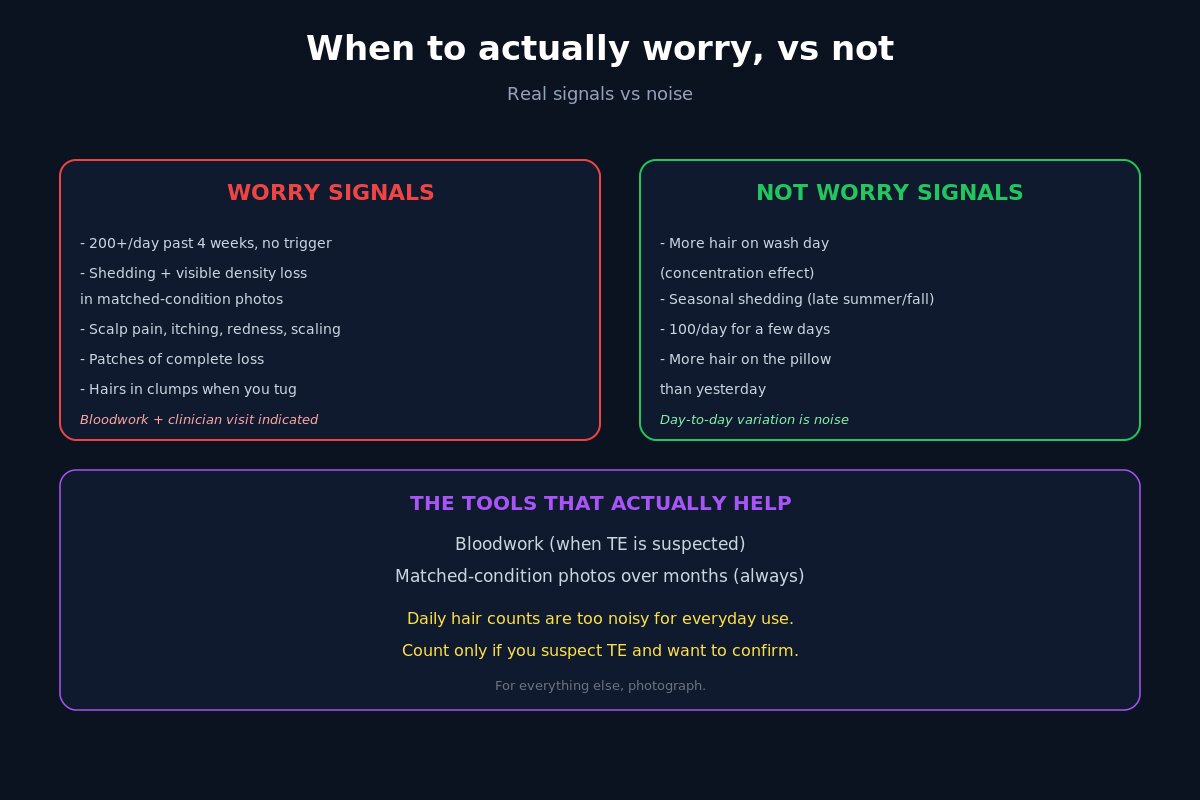
Worry threshold one: shedding 200+/day for more than 4 weeks with no obvious trigger. This warrants bloodwork (TSH, free T4, ferritin, vitamin D, complete blood count, fasting metabolic panel) and ideally a clinician visit.
Worry threshold two: shedding plus visible density loss in matched-condition photos at 6-month intervals. The combination of high counts plus visual progression is more diagnostic than either alone.
Worry threshold three: shedding with associated symptoms – scalp pain, itching, redness, scaling, patches of complete loss. This points away from AGA or simple TE and toward dermatological conditions: alopecia areata, scarring alopecia, scalp psoriasis, lichen planopilaris. These need a dermatologist, not a hair-loss protocol.
Worry threshold four: shedding hairs that look qualitatively different – very fine, very short, with no root bulb, or in clumps when you tug. The hair quality is part of the diagnostic picture.
What is NOT a worry signal
Seeing more hairs on wash day is not a worry signal. The hairs that have been ready to shed all week are released at once when you actually wash. The total weekly count is the same; you just see it concentrated.
Seasonal shedding is not a worry signal. Many men shed more in late summer and early fall, less in winter. The total annual count balances out. Hair-cycle research has documented this seasonal pattern across multiple populations.
Shedding 100/day for a few days is not a worry signal even if it feels like a lot when you are looking. The denominator (total scalp hair count, ~100,000) is so large that 100/day is 0.1 percent. Visible density does not change at this rate.
“More hair on the pillow than yesterday” is not a worry signal because pillow hair count varies wildly with sleep duration, sleep position, and bedding texture. Day-to-day variation is noise.
Common myths about hair shedding
The myth that any visible shedding means hair loss confuses turnover with progression. The myth that “I shed more in the shower so my hair is falling out” misreads the wash-day concentration effect. The myth that the dread shed proves treatment is failing inverts the actual signal. The myth that counting hairs daily is a useful diagnostic ignores how variable the day-to-day data is. The myth that shedding always corresponds to hair count loss misses that AGA is primarily about miniaturization, not shedding rate.
Frequently asked questions about hair shedding
How many hairs per day is too many?
200+/day for more than a few weeks, with no obvious trigger, is the threshold for investigation. 100-200/day for short periods is often within normal variance.
How long does the dread shed last?
Typically 2-6 weeks, peaking around weeks 4-6 of new treatment. Resolves by week 8-12. If shedding remains heavy at month 4-5, evaluate for other causes.
Is wash-day shedding bad?
No. Hairs that have been releasing all week accumulate in your hair until you wash, at which point they all come out at once. Total weekly shedding is the same; just visible all at once.
Should I count my shed hairs every day?
Probably not. Daily counts have too much noise for everyday use. Photo evidence over months is more diagnostic. Count only if you suspect TE and want to confirm, or if your clinician asks for the data.
Is shedding worse than miniaturization?
For AGA progression, miniaturization is the more important process. Shedding rate is a noisy proxy. The actual driver of visible thinning is shafts becoming progressively finer cycle by cycle.
Does seasonal shedding mean I am losing my hair?
No. Many men shed more in late summer and early fall. The annual count balances out. Seasonal pattern is documented across multiple populations.
What does a hair with a small white bulb at the end mean?
That is a normal telogen-phase hair with the keratin bulb attached. It is what a normally-shed hair looks like. Hairs with no bulb (broken at the shaft) suggest mechanical damage or breakage rather than shedding.
If shedding looks the same, can I still be losing hair?
Yes. AGA progresses through miniaturization, not necessarily through increased shedding. The hairs being shed are progressively finer. Photo comparison shows the density change that the shedding count would not.

Bringing it together
Daily shedding of 50-100 hairs is normal and expected. Treatment-initiation shedding of 150-250 hairs/day for a few weeks is a positive signal. Telogen effluvium of 200-400/day for 6-12 weeks is a discrete event with a discoverable cause. Chronic shedding of 200+/day with visible density loss is the worry threshold. The diagnostic tools that matter are bloodwork (when TE is suspected) and matched-condition photos over months (always). Daily hair counts are a noisy data source for most purposes. The men who get the best outcomes are the ones who learn to ignore short-term shedding noise, take consistent photos, and act only when the data crosses a real threshold.
About the author
Philippe Boissard
Author of Men’s Hairloss Protocol (2020), Better, Smarter, Stronger (2023), and Multi-Axis Body (2025). Researches and writes about hair loss and male physiology, citing primary literature and disclosing affiliate relationships in full. Not a medical doctor; all content is educational. More about Philippe.
Related reading
Get my free hair-loss protocol
The exact evidence-based routine I actually use and recommend: what works, in what order, with no hype. Enter your email on the next page and I’ll send it straight to you.
Send me the free protocol →