
Stress, Cortisol, and Hair Loss: Telogen Effluvium vs Pattern Baldness

Stress does cause hair loss, but almost never the kind men think it does. The shedding panic after a stressful month is telogen effluvium – a temporary, recoverable shift in the hair cycle. The slow loss of density at your crown across years is androgenetic alopecia – a genetic, hormonal program that stress can amplify but did not start. The two get treated as one thing in popular advice, and that conflation is why people meditate while their hairline keeps moving.
Quick answer: stress causes telogen effluvium, not pattern baldness
Acute or chronic stress can push a large fraction of hairs from the growing phase into the resting phase. Two to four months later those resting hairs shed at once, producing the dramatic shower-drain handfuls that drive most “stress hair loss” Google searches. This is telogen effluvium (TE), described in detail by Trueb (2003) and Hadshiew et al. (2004). It is by definition diffuse, time-limited, and reversible if the trigger resolves.
Pattern hair loss – androgenetic alopecia (AGA) – is a different mechanism. It is driven by genetic susceptibility to dihydrotestosterone, follows the Hamilton-Norwood pattern, miniaturizes follicles over years, and does not reverse on its own. Stress can speed it up at the margins. Stress is not the cause.
The hair cycle in 60 seconds
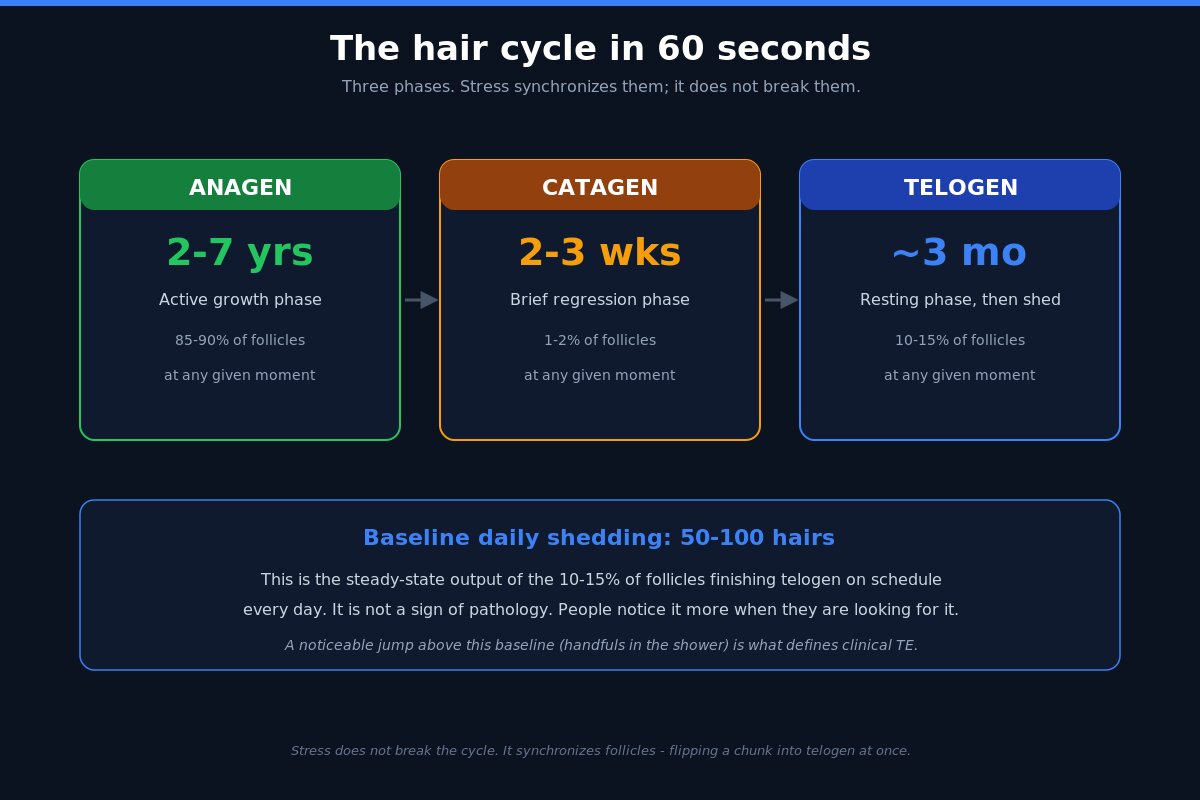
Each follicle cycles between three phases. Anagen is the growth phase (2-7 years on the scalp). Catagen is a brief regression phase (~2-3 weeks). Telogen is the resting phase (~3 months), at the end of which the hair sheds and a new anagen cycle begins. At any moment about 85-90 percent of scalp follicles are in anagen, 1-2 percent in catagen, and 10-15 percent in telogen. Daily shedding of 50-100 hairs is the steady-state output of that 10-15 percent finishing telogen on schedule.
Stress does not break this system. It synchronizes it. A large stressor flips a chunk of anagen follicles into telogen prematurely. They then shed together two to four months later. The hair count drops, but the follicles are intact and waiting to start a new anagen.
What actually triggers telogen effluvium
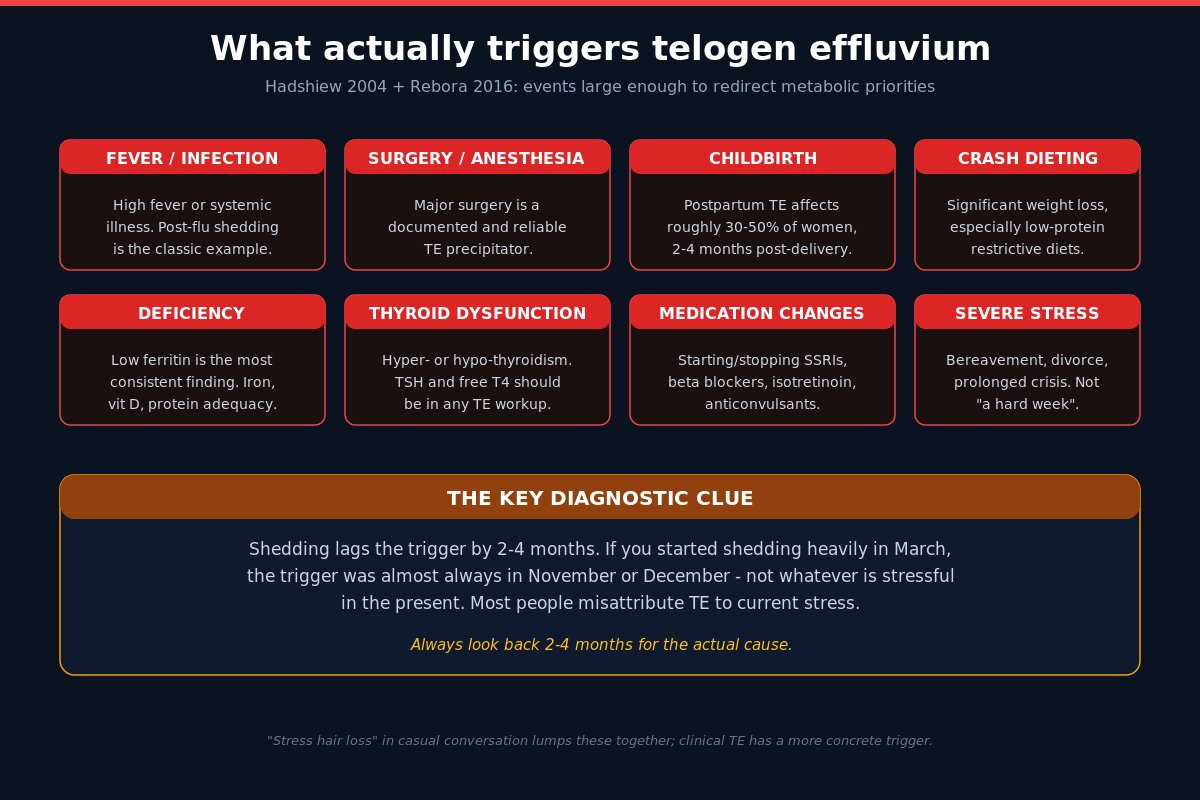
The classic TE triggers in the dermatology literature are not “I had a hard week at work.” They are events large enough to redirect the body’s metabolic priorities away from non-essential functions like growing hair. Hadshiew et al. (2004) and Rebora (2016) list the consistent ones:
- High fever or systemic infection (post-flu shedding is classic)
- Major surgery or general anesthesia
- Childbirth (postpartum TE affects roughly 30-50 percent of women)
- Significant weight loss, especially low-protein crash diets
- Iron deficiency or other nutrient deficits (low ferritin is the most consistent finding)
- Thyroid dysfunction, hyper or hypo
- Major medication changes (starting or stopping SSRIs, beta blockers, isotretinoin)
- Severe and sustained psychological stress (bereavement, divorce, prolonged job crisis)
“Stress hair loss” in casual conversation lumps all of these together. The implication is that any unpleasant week can shed your hair. The clinical reality is that most TE has a more concrete trigger, and identifying it is the entire point of the diagnostic workup.
Why the lag matters
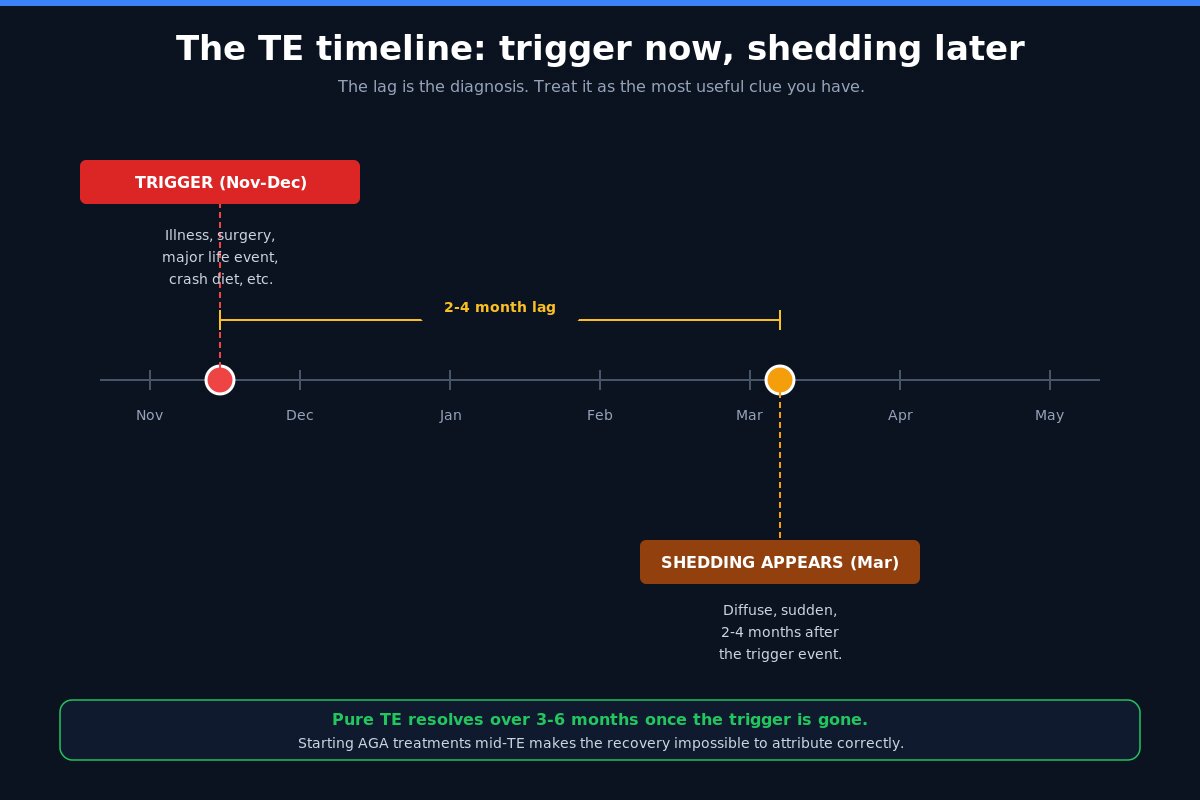
The two-to-four month delay between trigger and shedding is the single most useful diagnostic clue. If you started shedding heavily in March, the trigger was almost always in November or December. People consistently misattribute TE to whatever is stressful in the present, when the actual cause is something they have already moved past.
This matters because the treatment for TE is “remove the trigger and wait.” If the trigger is already gone, the shedding will resolve on its own over three to six months. If you start a hair loss treatment in the middle of a TE episode, you will credit that treatment for the recovery your scalp was going to do anyway.

The cortisol question
The biological story most articles tell about stress hair loss is about cortisol. Chronic stress raises cortisol. Cortisol disrupts the hair follicle. Therefore stress causes hair loss. This is true in pieces and misleading as a whole.
Choi et al. (2021) showed in a mouse model that corticosterone (the rodent equivalent of cortisol) suppresses hair follicle stem cell activation by blocking GAS6 signaling in the follicle dermal papilla. Removing the adrenal glands accelerated hair regrowth. This is mechanism-level confirmation that high circulating glucocorticoids can hold follicles in extended telogen. It is a real pathway. It is also a mouse pathway demonstrated under sustained, supraphysiological glucocorticoid levels.
Peters et al. (2017) built the parallel case for substance P, a stress-released neuropeptide that drives premature catagen entry through mast cell activation and neurogenic inflammation around the follicle. Again real, again mechanism-level, again most relevant under sustained stress states rather than ordinary daily ups and downs.
The translation to humans: chronic, high-amplitude stress states (months of severe sleep deprivation, untreated depression, prolonged grief, ongoing trauma) can plausibly contribute to TE through these pathways. Brief, normal-amplitude stress (a hard week, a stressful project deadline) does not appear to meaningfully shift hair density in either direction. Cortisol is not a switch you can flip with one bad day.
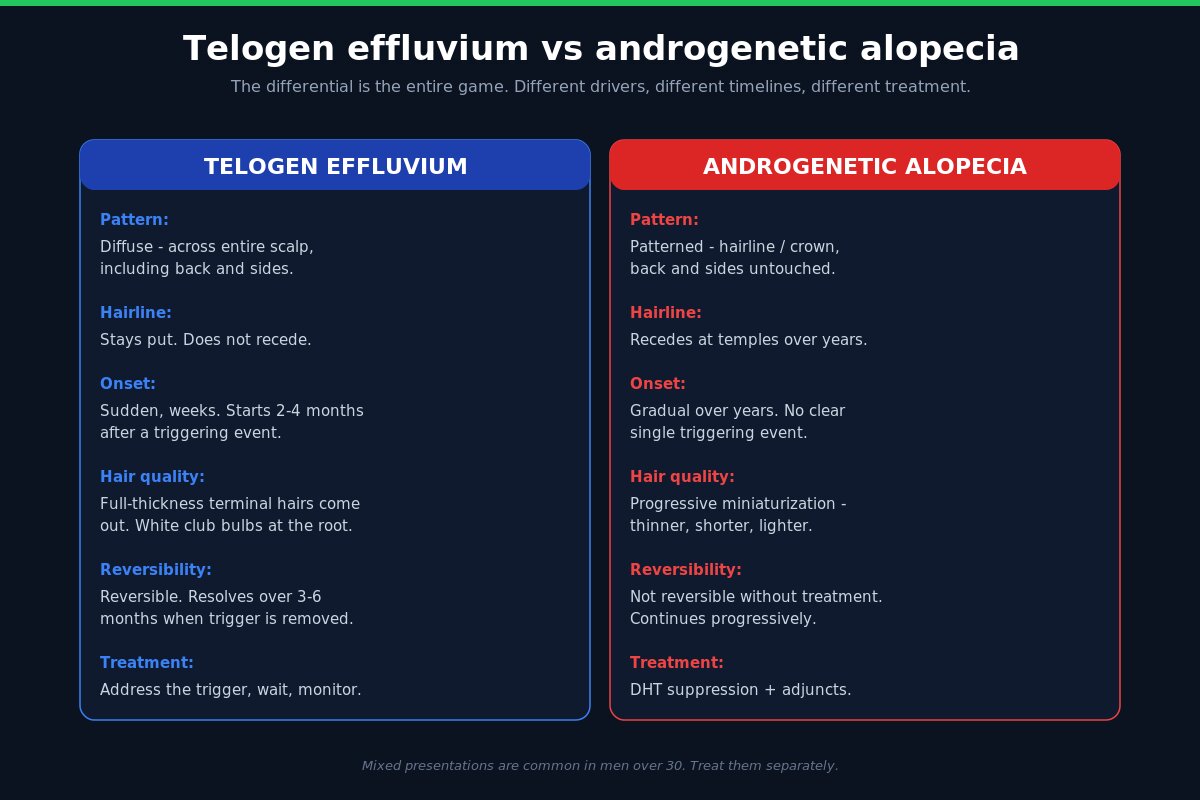
Telogen effluvium vs androgenetic alopecia: how to tell them apart
The differential is the entire game. The two conditions need different responses, and treating one as the other wastes years.
TE is diffuse. Hairs come out from across the whole scalp, including the back and sides. The hairline does not recede. The crown does not thin into a visible bald spot. The scalp does not become visible through the remaining hair, because the follicles are not miniaturizing – they are just temporarily in resting phase. Pulled hairs come out as full-thickness terminal hairs with intact roots, often with a club-shaped white bulb at the end.
AGA is patterned. The hairline retreats at the temples and the crown thins, while the back and sides stay full (the donor area in transplant terminology). Hairs progressively miniaturize – they get thinner, shorter, lighter in color before disappearing entirely. Density loss is gradual over years, not sudden over weeks. The Norwood scale exists because the pattern is so consistent.
Mixed presentations are common, especially in men over 30. A man can have underlying AGA that he is partially compensating for, then a TE episode strips out a year’s worth of would-be miniaturization in one go and reveals the underlying pattern. The TE component recovers; the AGA component does not. The shedding stops; the lower density on top stays. People misread this as “the stress permanently damaged my hair” when the correct read is “the stress unmasked AGA that was already in motion.”

Why the “stress caused my hair loss” framing fails most men
Two failure modes show up in clinic and in inbox messages:
Failure mode 1: AGA misdiagnosed as stress. A man in his late twenties notices his hairline is higher than five years ago. He recently had a stressful work period. He concludes stress caused it, focuses on meditation, sleep, and adaptogens, and avoids medical treatment. Five years later the hairline is significantly worse, because AGA is what was happening the whole time and AGA does not stop on its own.
Failure mode 2: TE treated with finasteride. Someone has a real TE episode after surgery, illness, or a major life event. They start finasteride during the recovery. Three to six months later the shedding stops and density rebuilds. They credit finasteride for a recovery that would have happened without it. They now think they need to be on finasteride forever to maintain that result, when in reality they may not have AGA at all.
The diagnostic order matters. If shedding is sudden, diffuse, and traceable to a recent triggering event, the working diagnosis is TE. If thinning is gradual, patterned, and progressive across years, the working diagnosis is AGA. Many men have both, in which case both need addressing – but addressing them as one thing is a strategic mistake.
What chronic stress does and does not do to the AGA timeline
Stress probably accelerates AGA somewhat in susceptible men. The mechanism candidates are real – elevated cortisol, sympathetic activation, sleep disruption, inflammatory tone, downstream metabolic effects. But the magnitude of the acceleration is small compared to the magnitude of the underlying genetic program. A man genetically destined for Norwood 5 by age 50 is not going to end up Norwood 2 by avoiding stress, and a man genetically Norwood 1 at 60 is not going to develop Norwood 5 from a hard year.
The honest framing is that stress is on the list of modifiers, but it is not at the top of the list. Genetic susceptibility, age, and time on or off DHT-suppressing therapy explain most of what happens to a man’s hair over decades. Stress management is a reasonable adjunct, not a primary intervention.
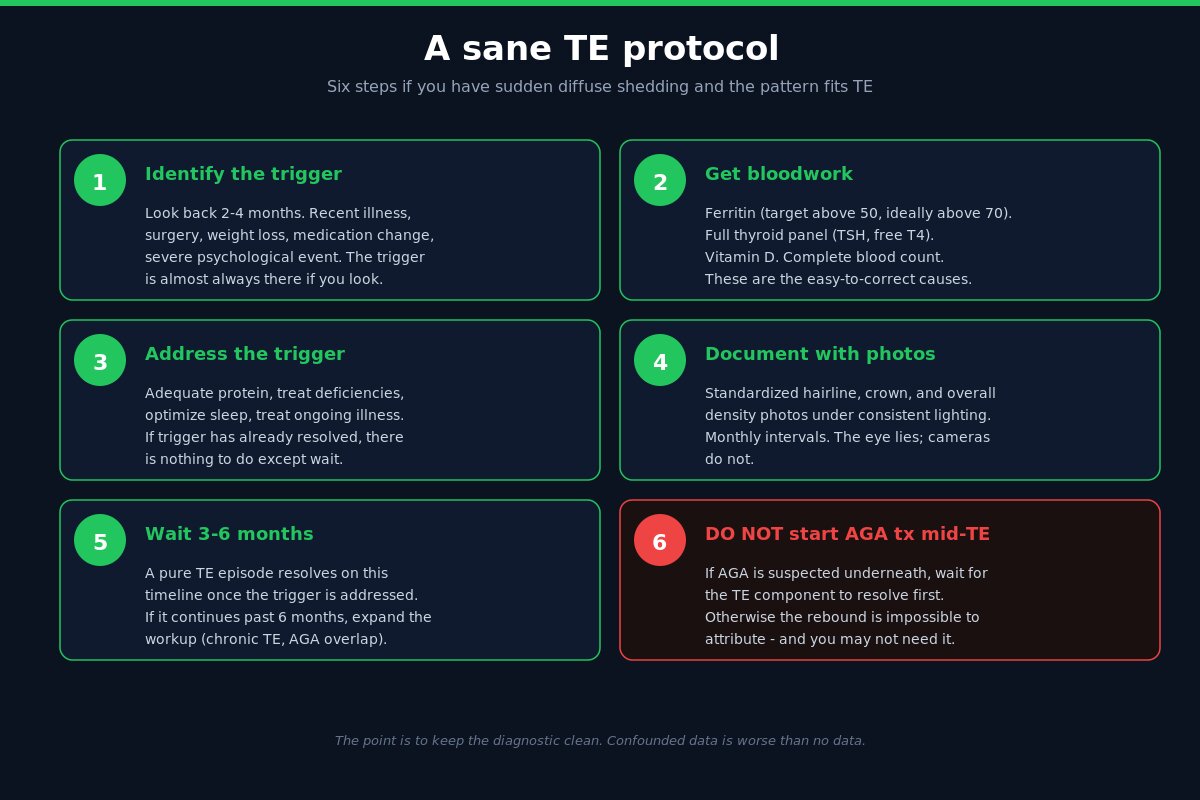
Working through a TE episode: a sane protocol
If you have a sudden onset of diffuse shedding and the pattern fits TE, the steps are:
1. Identify the trigger. Look back two to four months. Recent illness, surgery, weight loss, medication change, severe psychological event. The trigger is almost always there if you look carefully.
2. Get basic bloodwork. Ferritin (target above 50 ng/mL, ideally above 70 for hair purposes), full thyroid panel including TSH and free T4, vitamin D, and a CBC. These are the deficiencies that cause or extend TE and are easy to correct.
3. Address the trigger. Adequate protein intake, treat any deficiencies, optimize sleep, treat ongoing illness. If the trigger has already resolved (the surgery is in the past, the crisis is over), there is nothing to do except wait.
4. Document with photos. Standardized hairline, crown, and overall density photos under consistent lighting at the start of shedding and monthly afterward. The eye lies; cameras do not.
5. Wait three to six months. A pure TE episode resolves on this timeline once the trigger is addressed. If shedding continues past six months without a clearly ongoing trigger, you are looking at chronic TE or a TE-AGA overlap and the workup expands.
6. Do not start AGA treatment in the middle of TE. If you suspect AGA underneath, wait for the TE component to resolve before starting finasteride or minoxidil. Otherwise you cannot tell what your baseline is, and any rebound will be impossible to attribute.
When stress matters most: chronic states
The literature is clear that brief stress does not meaningfully impact hair density. The relevant question is what counts as chronic. The clinical answer is something like: ongoing for months, severe enough to disrupt sleep and appetite, accompanied by either depression, anxiety disorder, or significant ongoing life crisis. In those states the cortisol pathway and the substance P pathway plausibly contribute to chronic TE. The intervention is treating the underlying state, not adding a hair treatment on top.
For a man with otherwise stable life, normal sleep, and no untreated mental health condition, “stress” is not the explanation for his hair loss, and stress reduction is not going to bring his hair back. It is a useful background variable to keep in good shape; it is not the lever that moves the needle on AGA.
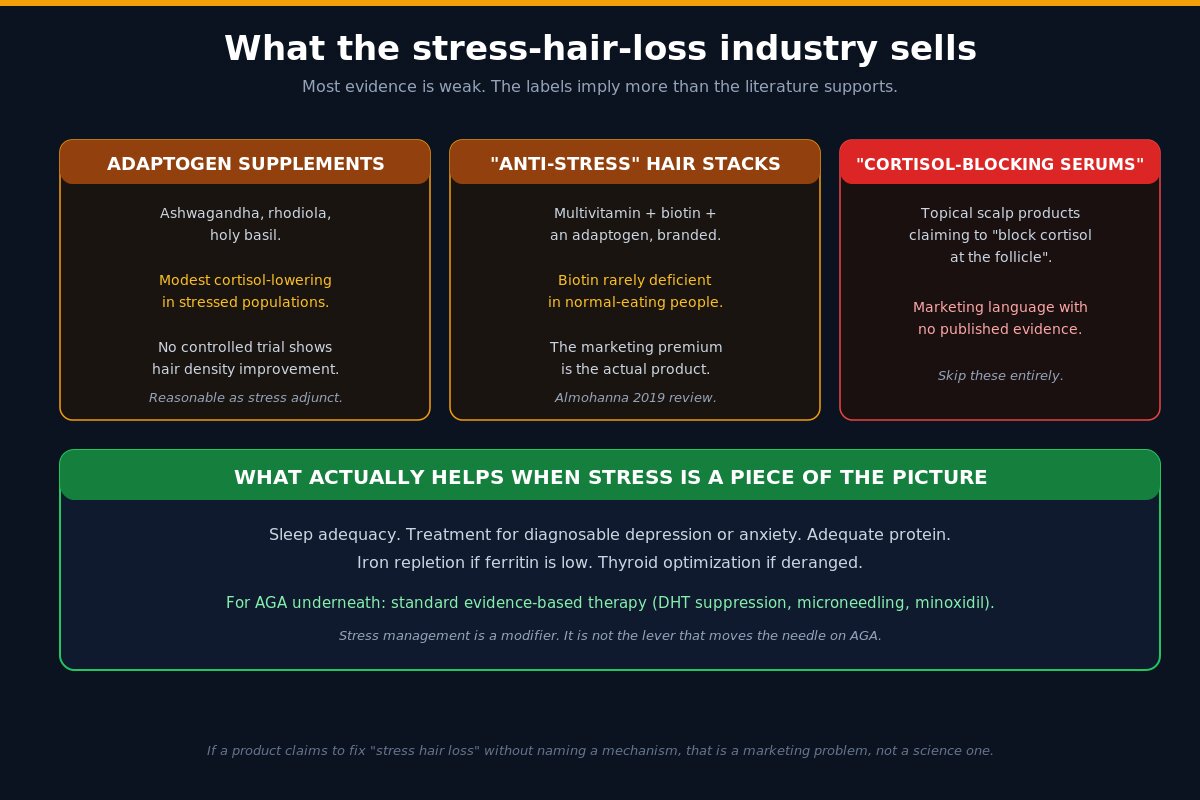
What the stress-hair-loss industry sells that does not work
Several categories of products are marketed for stress-related hair loss. Most of the evidence is weak.
Adaptogen supplements (ashwagandha, rhodiola, holy basil) have some modest cortisol-lowering effects in stressed populations, but no controlled trial demonstrates hair density improvements from taking them. They are not unreasonable as general stress adjuncts; they are not hair treatments.
“Anti-stress” hair supplement stacks are usually a multivitamin plus biotin plus a mood adaptogen. The biotin is rarely deficient in people eating a normal diet (Almohanna et al., 2019). The multivitamin is reasonable but cheap. The marketing premium is not.
Scalp serums claiming to “block cortisol at the follicle” are marketing language with no published clinical evidence. Topical agents that affect hair follicles in any meaningful way (minoxidil, finasteride, ketoconazole, the AR antagonists) all have their effects through other mechanisms.
None of this is to say stress management is worthless. Sleep, exercise, meaningful social connection, and treatment for diagnosable mental health conditions are all good for hair the same way they are good for everything else. They are not a substitute for evidence-based hair therapy when AGA is what is happening.
Watch this if you are early in a shedding panic
This video walks through the timeline reality that most men get wrong on their first encounter with shedding – that hair changes resolve over months, not weeks, and that the photos people share online compress that timeline in misleading ways. If you are in the middle of a TE episode, the patience framing in the video matters more than any product recommendation.
Frequently asked questions about stress and hair loss
Can a single stressful week cause hair loss?
No. The TE-triggering events documented in the literature are large enough to shift the body’s metabolic priorities for weeks at a time – high fever, surgery, childbirth, severe weight loss, prolonged psychological crisis. A single bad week is not enough to noticeably synchronize the hair cycle.
If I see hair on my pillow during stressful times, is that stress or something else?
Probably normal variation. Daily shedding of 50-100 hairs is baseline. People notice their shed more when they are looking for it. If the shedding is dramatically above baseline (handfuls in the shower, visible thinning) and traces back to a real trigger two to four months prior, then it is likely TE.
Does cortisol cause permanent hair loss?
The mouse data (Choi et al., 2021) shows that sustained high glucocorticoids can extend telogen, but the effect reverses when glucocorticoid levels normalize. There is no good human evidence that cortisol causes permanent miniaturization of follicles independent of AGA.
Can stress make my androgenetic alopecia worse?
Plausibly, at the margins. Chronic stress likely accelerates AGA somewhat through inflammatory and metabolic pathways, but the magnitude is small relative to genetic susceptibility and DHT exposure. Stress reduction is a reasonable adjunct, not a treatment.
How long does stress-related hair loss last?
Acute TE typically resolves over three to six months once the trigger is addressed. Chronic TE (lasting longer than six months) suggests the trigger is still ongoing or there is an underlying issue (deficiency, thyroid, AGA component) that needs addressing.
Should I get a blood test?
Yes, if shedding is significant or persistent. The standard panel: ferritin, TSH and free T4, vitamin D, CBC. These cover the easily-correctable causes of TE. Add a basic metabolic panel if other systemic symptoms are present.
Will minoxidil help with telogen effluvium?
It can shorten the recovery somewhat by accelerating the next anagen entry, but the TE will resolve without it. The problem with starting minoxidil during TE is that it produces its own initial shedding phase, which compounds the panic and makes the timeline harder to read. If you start it, expect a confusing 2-3 months before any benefit becomes clear.
Can I have stress hair loss and pattern baldness at the same time?
Yes, and this is common in men over 30. The TE component is what produced the sudden shedding; the AGA component is the slower, patterned thinning underneath. They need to be addressed separately. Treat the TE trigger, wait for the diffuse component to resolve, then evaluate what AGA work remains.
Are there foods or supplements that help?
Adequate protein (~0.8-1.0 g per kg body weight minimum), iron-rich foods if ferritin is low, and a multivitamin to cover any minor deficiencies are reasonable. There is no single hair-growth supplement with strong evidence. Biotin is overhyped unless actually deficient (Almohanna et al., 2019).
When should I see a dermatologist?
If shedding has lasted more than six months without a clear triggering event, if you cannot tell whether the pattern is TE or AGA, or if your bloodwork came back abnormal in a way you cannot interpret. A dermatologist can perform a pull test, hair pull microscopy, and if needed a scalp biopsy to make the call.
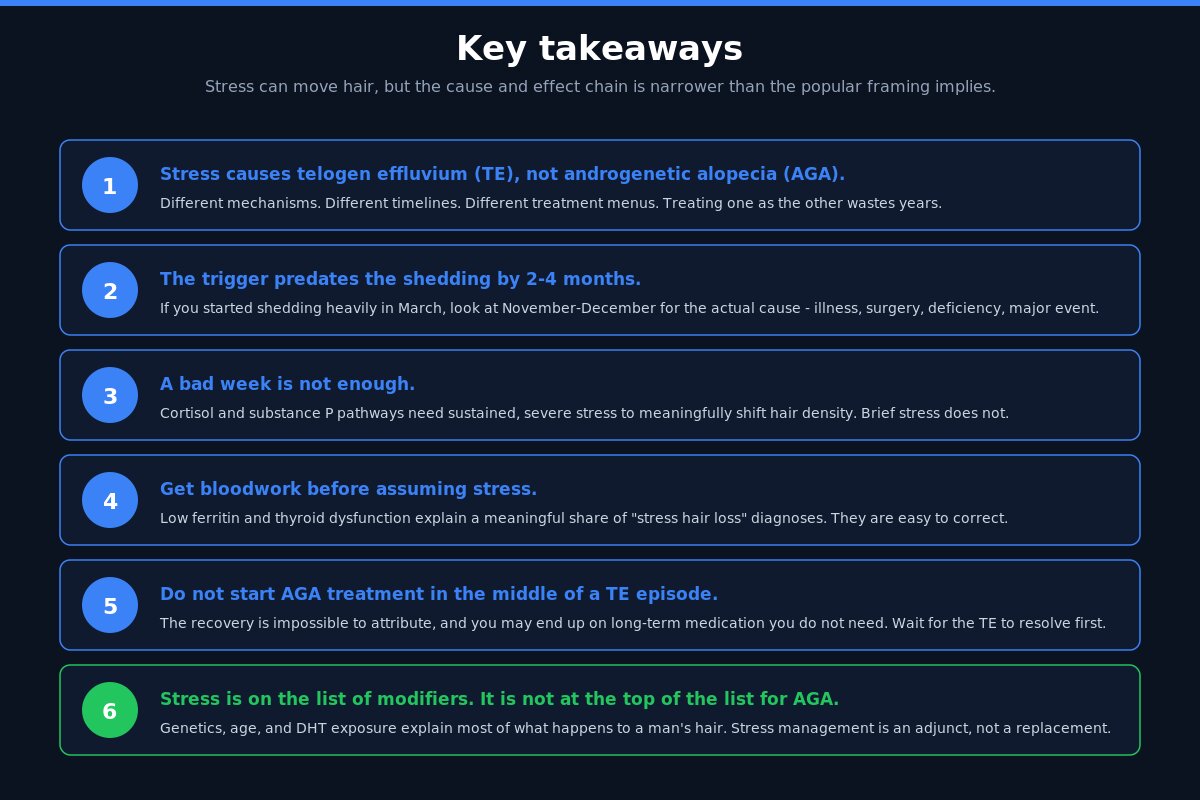
Bringing it together
Stress is real and stress can move hair, but the chain of cause and effect is narrower and more specific than the popular framing implies. Telogen effluvium is the relevant mechanism, the trigger usually predates the shedding by months, and the recovery happens on its own once the trigger is addressed. Pattern baldness is a different program with different drivers and a different treatment menu – the underlying biology is genetic and hormonal, not psychological.
The practical move when you start shedding heavily is to look backward two to four months for the actual cause, get bloodwork, document with photos, and avoid starting AGA treatments in the middle of a TE episode that will resolve on its own. If shedding does not resolve, or if the pattern looks more like progressive thinning than diffuse shedding, the differential shifts and you can find the framework for that in why your protocol may not be working. And if you are still in the middle of a panic about whether what you are seeing is permanent, the timeline reality covered in how recovery actually unfolds for hair conditions is worth reading before making any decisions you cannot easily reverse.
This article is for educational purposes only and does not constitute medical advice. Hair loss has multiple potential causes and the right approach depends on your individual history, examination, and bloodwork. Speak with a qualified clinician before starting or stopping any treatment. See the full disclaimer.
About the author
Philippe Boissard
Author of Men’s Hairloss Protocol (2020), Better, Smarter, Stronger (2023), and Multi-Axis Body (2025). Researches and writes about hair loss and male physiology, citing primary literature and disclosing affiliate relationships in full. Not a medical doctor; all content is educational. More about Philippe.
Related reading
Get my free hair-loss protocol
The exact evidence-based routine I actually use and recommend: what works, in what order, with no hype. Enter your email on the next page and I’ll send it straight to you.
Send me the free protocol →
[…] Stress, Cortisol, and Hair Loss: Telogen Effluvium vs Pattern Baldness […]
[…] Stress, Cortisol, and Hair Loss: Telogen Effluvium vs Pattern Baldness […]
[…] the nutrient deficiency analysis, and the stress-versus-AGA differential gets its own treatment in the stress and cortisol piece. When standard AGA treatment is failing, the diagnostic recheck framework is in why your protocol […]