
Sleep, Sleep Position, and Hair Loss: Real or Folklore?
Sleep affects hair indirectly through cortisol and TE. Sleep position and pillowcase do not. The honest read on what the evidence supports vs what is folklore dressed up as science.

Sleep gets blamed for a lot of hair-loss problems on the internet. There are claims that sleeping on your back protects hair, that silk pillowcases prevent shedding, that staying up late accelerates baldness, that “beauty sleep” is real for follicles. Some of these claims have biological basis. Most do not. The honest read of the literature is that chronic sleep deprivation has a real but indirect effect on hair through cortisol and telogen effluvium, while sleep position and pillowcase choice have no meaningful effect on AGA. This article walks through what the evidence supports, what folklore looks like dressed up as science, and where sleep actually fits in a hair-loss strategy.
Quick answer: does sleep affect hair loss?
Indirectly, yes. Chronically poor sleep raises cortisol, disturbs the hypothalamic-pituitary-adrenal axis, and increases the rate of telogen effluvium. None of this addresses androgenetic alopecia directly, but the overlap matters: a man with both AGA and chronic sleep deprivation is shedding more total hair than a man with AGA alone, and the part of the shedding driven by TE will resolve when sleep improves while the AGA part will not. Sleep position, pillowcase material, and most internet folklore about hair-and-sleep have essentially zero published evidence.
The biology connecting sleep and hair
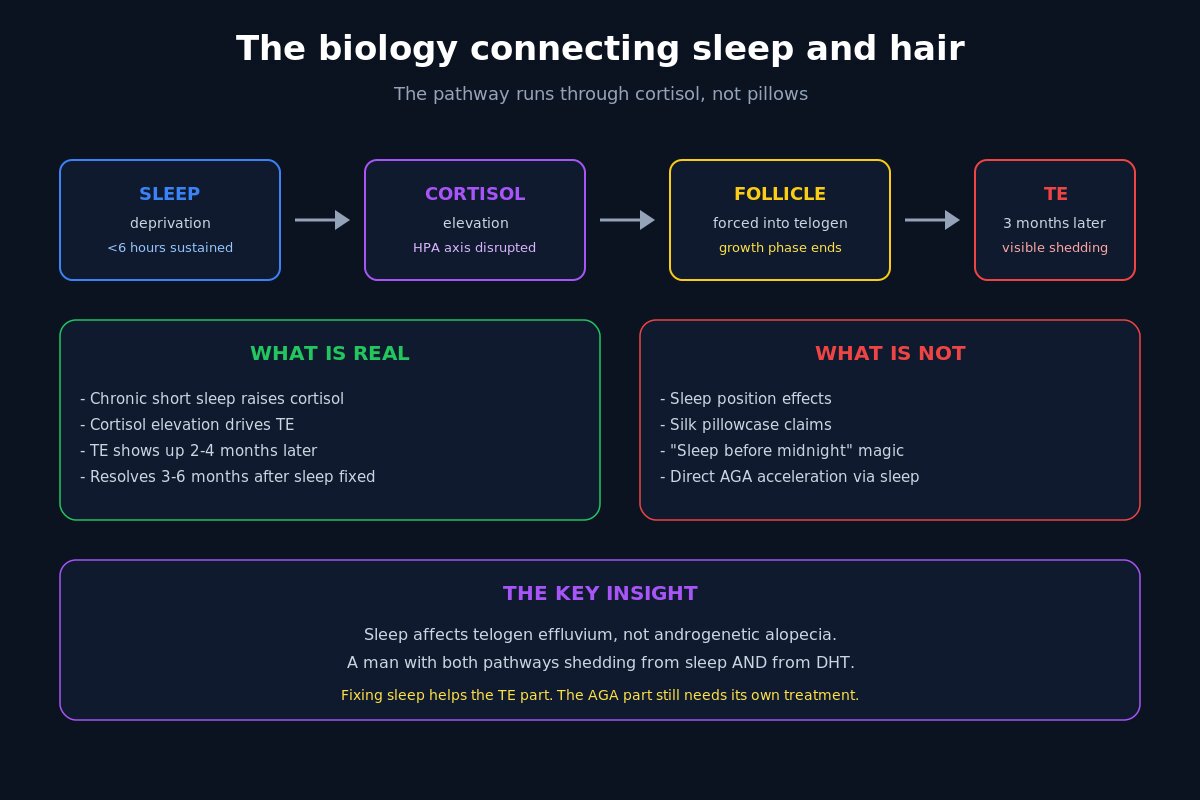
The relevant pathway runs through cortisol. Sleep deprivation, particularly when chronic, elevates cortisol and disrupts the normal diurnal rhythm of cortisol secretion. Elevated cortisol pushes hair follicles out of anagen (active growth) and into telogen (resting), which expresses about 3 months later as visibly increased shedding. This is the same mechanism by which acute psychological stress causes telogen effluvium – it just runs on a slower timeline because the cortisol elevation from sleep is less acute than from a major stressor.
Choi et al. 2017 reported associations between short sleep duration and increased hair shedding in cross-sectional data, with the effect concentrated in people sleeping less than 6 hours a night. The mechanism plausibly runs through cortisol but the data does not directly prove the chain. What the data does establish is that the correlation exists at the population level. Whether any individual man’s hair loss is driven by sleep is harder to say from outside the case.
What sleep deprivation actually does to hair
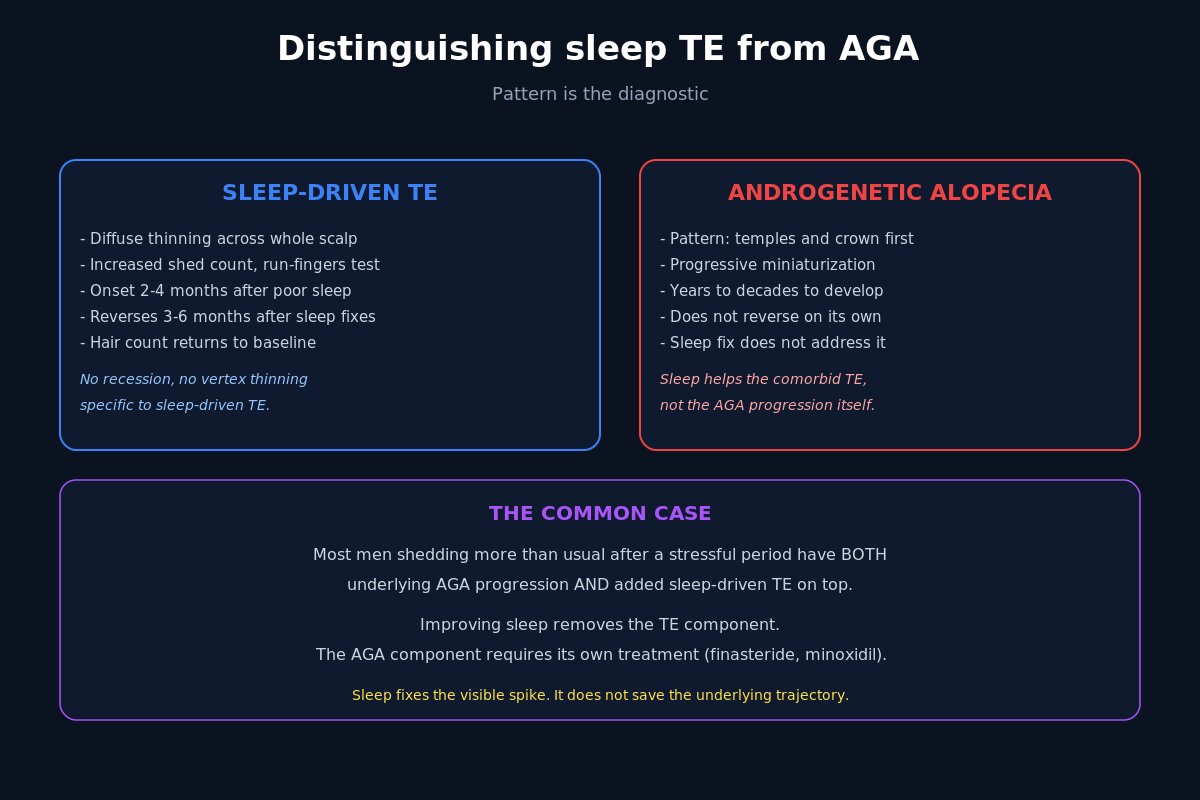
The clinical picture of sleep-driven hair loss looks like diffuse telogen effluvium: thinning across the whole scalp rather than concentrated at the temples and crown, increased shed count when running fingers through hair, and onset 2-4 months after the period of poor sleep. The pattern matters because it distinguishes sleep-driven shedding from AGA, which has the characteristic recession-and-vertex pattern that sleep does not produce.
The reversibility also matters. Sleep-driven TE typically resolves 3-6 months after sleep improves. Hair count returns to where it would have been. AGA progression, in contrast, does not reverse on its own. A man whose AGA has progressed during a period of sleep deprivation will not see the AGA portion reverse when sleep improves, even though the TE portion will.
What does NOT have evidence
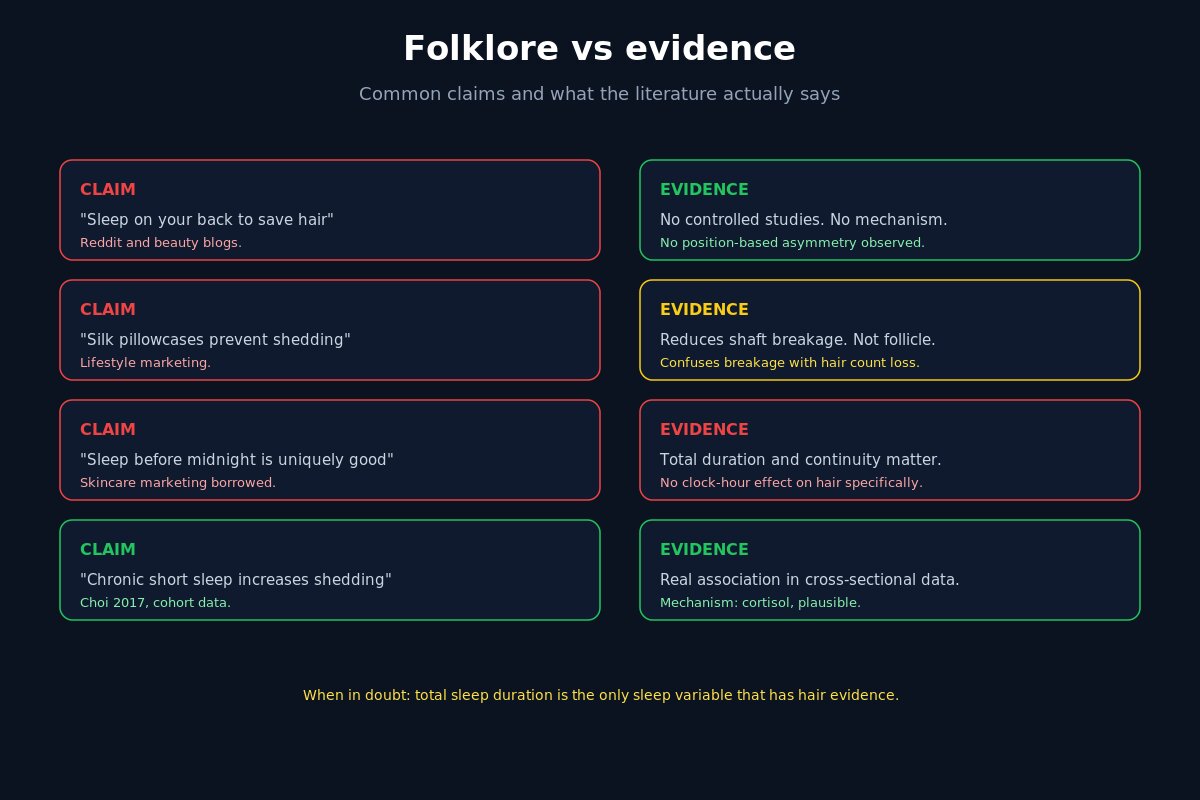
Sleep position and hair loss is the most-discussed claim with the least support. The argument goes that sleeping on your front presses follicles, sleeping on your back protects them, side sleeping wears down certain areas. There are no controlled studies showing position affects hair density. There is no plausible mechanism by which the modest pressure of a pillow during sleep miniaturizes follicles or accelerates AGA. The empirical absence of position-based pattern asymmetry in observational AGA progression also speaks against the claim.
Pillowcase material – silk vs cotton vs satin – is a related claim. The argument is that smoother pillowcases reduce friction and prevent breakage. Hair breakage from friction is real but is largely confined to the hair shaft length, not the follicle. The follicle is what AGA affects. Reducing breakage from pillowcase friction can make existing hair look slightly fuller but does nothing for AGA progression or hair count. Marketing for silk pillowcases conflates these. The “studies” cited are usually marketing-funded and small.
Sleep before midnight and other circadian-rhythm claims sometimes appear in hair-care marketing. There is no published evidence that sleeping at specific clock hours has different effects on hair compared to total sleep duration and sleep continuity. The claim borrows from the broader “beauty sleep” tradition without evidence specific to follicles.
Watch this on the channel
No Before & After Yet – frames the patience and timeline framing for distinguishing real changes from confounding factors like sleep variability.
How sleep ties to other AGA factors
Sleep does not exist in isolation. Chronically poor sleep correlates with elevated baseline cortisol, increased systemic inflammation, suppressed testosterone production, and impaired insulin sensitivity. Each of these has a possible link to hair, though the strength varies. The cortisol-TE pathway is the cleanest. The testosterone-AGA relationship runs in the opposite direction from what most men assume – lower testosterone means less DHT to drive AGA, so chronic sleep deprivation that lowers testosterone might actually slow AGA modestly while accelerating TE substantially.
The net effect on a man with both pathways operating is that AGA progression continues while TE adds visible shedding on top. The math does not give “sleep less to keep hair.” Both pathways favor adequate sleep.
How much sleep matters for hair
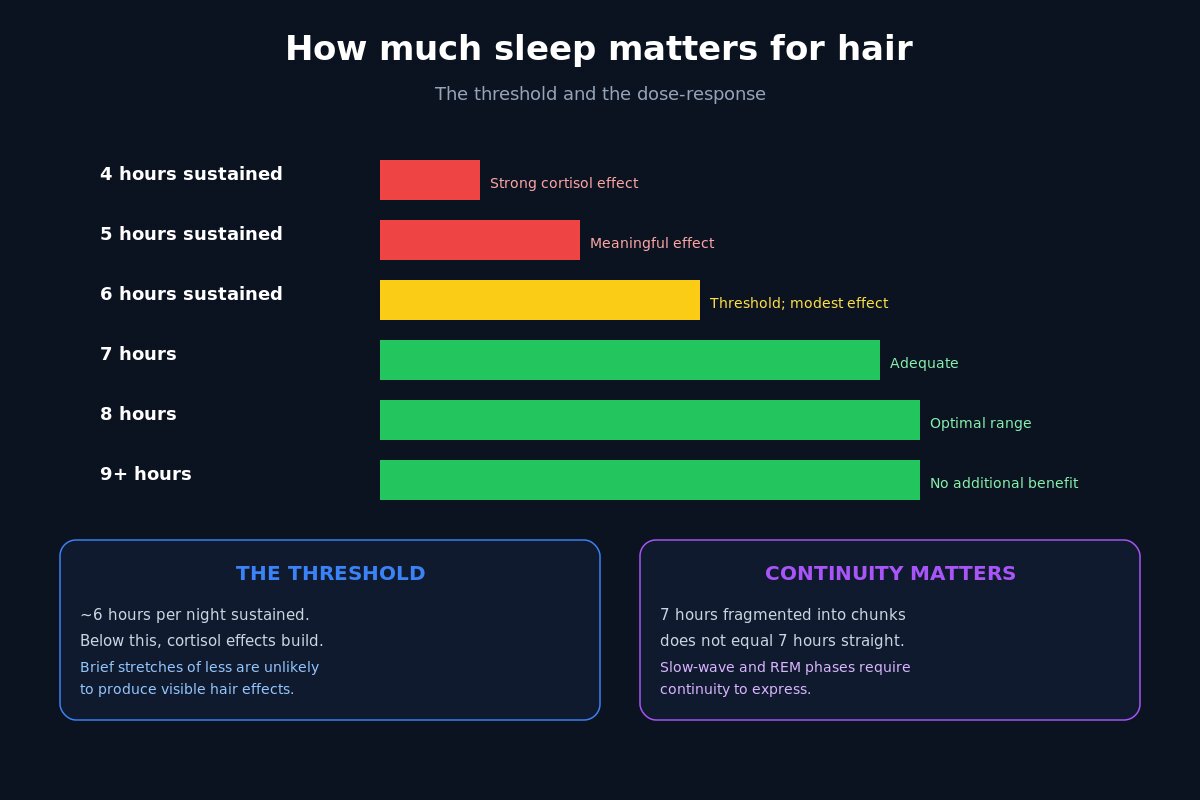
The threshold below which sleep starts measurably affecting cortisol and hair is roughly 6 hours per night sustained. Brief stretches of 5-hour sleep are unlikely to produce visible hair effects. Months of 4-5 hour sleep often do. The improvement comes from getting back into the 7-9 hour range, not from chasing 9+ hours. The dose-response is not linear; the meaningful jump is from chronically inadequate to adequate.
Sleep continuity matters as well. A man who sleeps 7 hours fragmented into 3 wakeful interruptions does not get the same restorative effect as a man who sleeps 7 hours straight. Slow-wave and REM phases require continuity to express, and the cortisol-suppressing effects of deep sleep are sensitive to fragmentation.
What to actually do
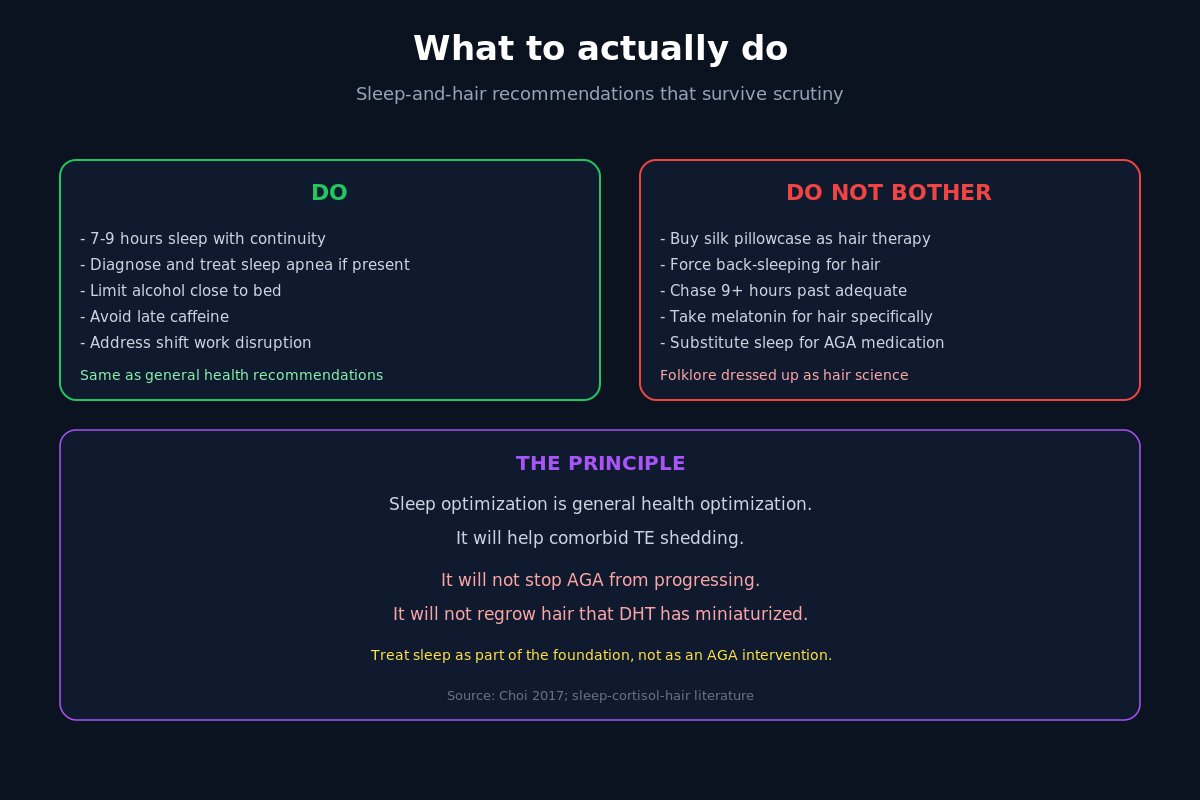
The realistic sleep-and-hair recommendations match the realistic sleep-and-everything-else recommendations. Aim for 7-9 hours per night with reasonable continuity. Address sleep apnea if you have it, because untreated apnea creates the chronic-cortisol-elevation profile that drives TE. Limit alcohol close to bed, which fragments sleep architecture. Avoid late caffeine. Address shift work where possible because rotating schedules are particularly hard on the cortisol axis.
Skip the silk pillowcase as a hair intervention. Skip the sleep-position adjustments. They will not affect AGA. They will not meaningfully reverse TE. They are at best a marginal cosmetic intervention to reduce already-grown hair breakage, which is unrelated to the follicle dynamics that determine hair count.
Common myths about sleep and hair loss
The myth that sleeping on your back prevents hair loss has no evidence and no mechanism. The myth that silk pillowcases stop shedding conflates breakage with follicle loss. The myth that sleep before midnight is uniquely beneficial is folklore borrowed from skincare marketing. The myth that 8 hours is a magic threshold ignores individual variation – the relevant range is 7-9 with continuity. The myth that supplements like melatonin grow hair through sleep is unsupported; melatonin’s hair effects in animal studies do not reliably transfer to humans at supplement doses. The myth that “you cannot lose hair if you sleep enough” inverts the actual relationship – sleep affects TE, not AGA, and AGA is the dominant cause of male pattern hair loss.
Frequently asked questions about sleep and hair loss
Does sleep deprivation cause hair loss?
Chronic sleep deprivation can cause telogen effluvium through cortisol elevation. It does not cause androgenetic alopecia. The two often coexist, and improving sleep helps the TE component while leaving the AGA component to be addressed separately.
Will sleeping on my back save my hair?
No. There is no controlled evidence that sleep position affects hair density. The mechanism by which pillow pressure would miniaturize follicles is not biologically plausible at the pressures involved.
Are silk pillowcases worth it for hair?
Modestly, for reducing already-grown hair breakage from friction. Not at all for AGA or follicle health. The marketing conflates these to sell pillowcases. If you like silk for other reasons, fine. As a hair-loss intervention, it is not one.
How long does sleep-related hair loss take to recover?
3 to 6 months after sleep improves. The hair cycle constrains the recovery timeline; individual follicles need to complete their telogen phase and re-enter anagen.
Is melatonin good for hair?
Mechanistically interesting; clinically unclear. Topical melatonin has small studies suggesting some hair-density benefit. Oral melatonin’s effect on hair via sleep improvement is plausible but not directly demonstrated. As a hair intervention specifically, the evidence is too thin to recommend over established options.
How does sleep apnea fit?
Untreated obstructive sleep apnea produces chronic cortisol elevation, oxygen desaturation, and sleep fragmentation – all of which can drive TE. Treating apnea (CPAP or otherwise) often improves shedding rate. Worth diagnosing if you snore heavily, wake gasping, or have daytime fatigue out of proportion to sleep duration.
Does poor sleep accelerate male pattern baldness specifically?
Indirectly and modestly. Poor sleep can increase cortisol-driven TE that adds to the visible thinning of AGA. Whether sleep affects the AGA pathway directly through DHT or testosterone is unclear and probably small.
Is “beauty sleep” real for hair?
The skin-care side of “beauty sleep” has some support through growth-hormone secretion patterns. The hair side is less developed in the literature. Adequate total sleep matters; specific clock-hour effects on hair are not established.
Bringing it together
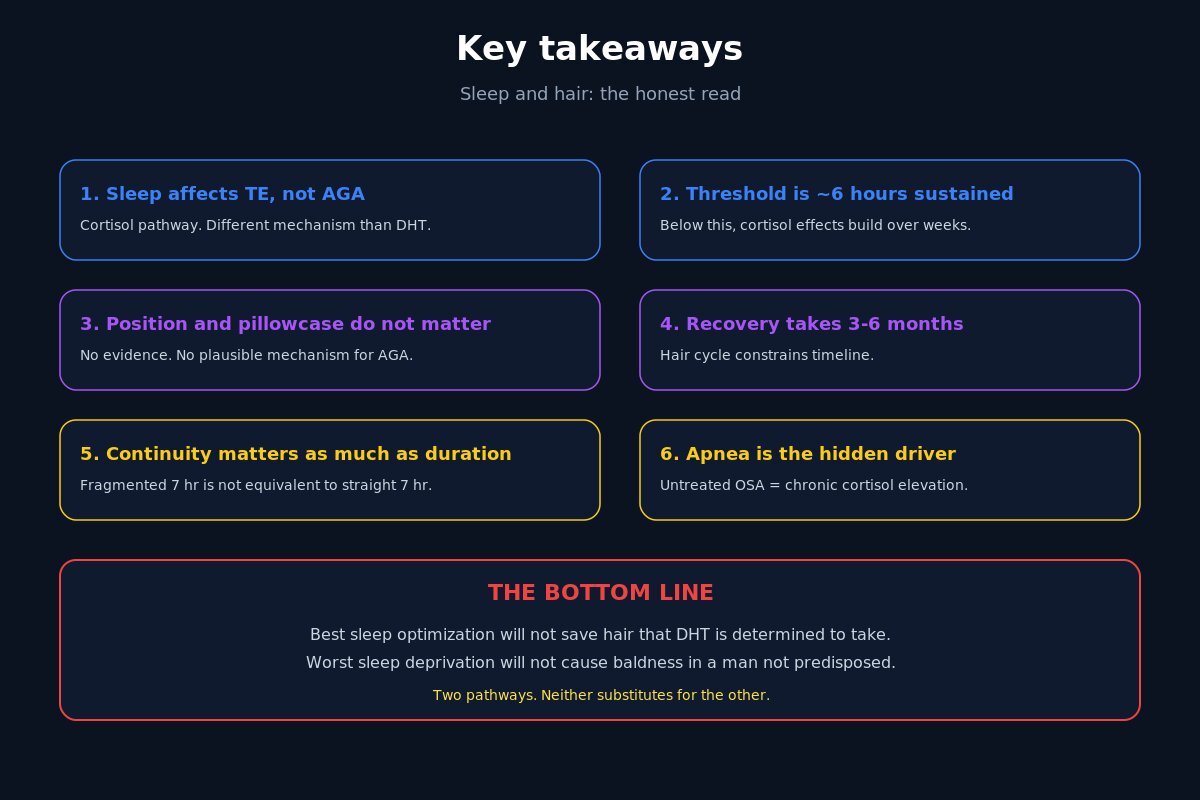
Sleep affects hair indirectly through cortisol and telogen effluvium. Chronic deprivation produces visible shedding 2-4 months later that resolves 3-6 months after sleep improves. AGA, the dominant cause of male pattern hair loss, is not reliably affected by sleep. Sleep position, pillowcase material, and most internet folklore are unsupported by evidence. The realistic recommendation is the same as for general health: 7-9 hours per night with reasonable continuity, address apnea if present, limit late alcohol and caffeine, accept that the AGA pathway needs its own treatment regardless of sleep quality. The best sleep optimization will not save hair that DHT is determined to take. The worst sleep deprivation will not cause baldness in a man who is not predisposed to it. The two pathways operate together; neither substitutes for the other.
About the author
Philippe Boissard
Author of Men’s Hairloss Protocol (2020), Better, Smarter, Stronger (2023), and Multi-Axis Body (2025). Researches and writes about hair loss and male physiology, citing primary literature and disclosing affiliate relationships in full. Not a medical doctor; all content is educational. More about Philippe.
Related reading
Get my free hair-loss protocol
The exact evidence-based routine I actually use and recommend: what works, in what order, with no hype. Enter your email on the next page and I’ll send it straight to you.
Send me the free protocol →
[…] Sleep, Sleep Position, and Hair Loss: Real or Folklore? […]
[…] Sleep, Sleep Position, and Hair Loss: Real or Folklore? […]