
Why Your Hair Loss Protocol Isn’t Working: The 7 Hidden Reasons Most Men Miss

You’ve done everything right.
You started finasteride early. You added minoxidil. You maybe layered in microneedling, ketoconazole shampoo, maybe even dutasteride or an anti-androgen like RU58841. At first, things stabilized. Maybe you even saw some regrowth.
Then — nothing.
The shedding slowed. The hairline held. But the density never came back. Or worse: you started losing ground again despite perfect compliance.
If that sounds familiar, you’re not alone, and you’re not doing anything obviously wrong. The problem isn’t your discipline. It’s the mental model almost every hair loss guide still uses.
Most content online treats hair loss as a single-variable problem: DHT is high → block DHT → hair grows back. That framing is simple, shareable, and wrong in the ways that matter most. It explains why two men on the exact same protocol can have completely different outcomes. It explains why you can be a “responder” on paper and still watch your hairline recede. It explains why, past a certain point, adding more of the same thing stops helping.
Hair loss isn’t one problem. It’s a chain of problems. Finasteride addresses one link. Minoxidil addresses another. Microneedling touches a third. If the link that’s actually failing in your scalp isn’t being addressed by anything in your stack, your hair loss protocol will plateau — no matter how long you stay on it.
This article walks through the seven reasons protocols stall, in the order I’d actually investigate them. By the end, you should have a much better sense of which axis is limiting you — and what that means for your next move.
The Core Mistake: Treating Hair Loss as One Problem
Before getting into the seven reasons, it’s worth spending a minute on the model, because everything downstream depends on it.
The standard story goes like this:
Testosterone converts to DHT via 5-alpha-reductase. DHT binds to androgen receptors on scalp follicles. Follicles miniaturize. You go bald.
It’s accurate as far as it goes. The problem is it stops there — and the actual biology doesn’t.
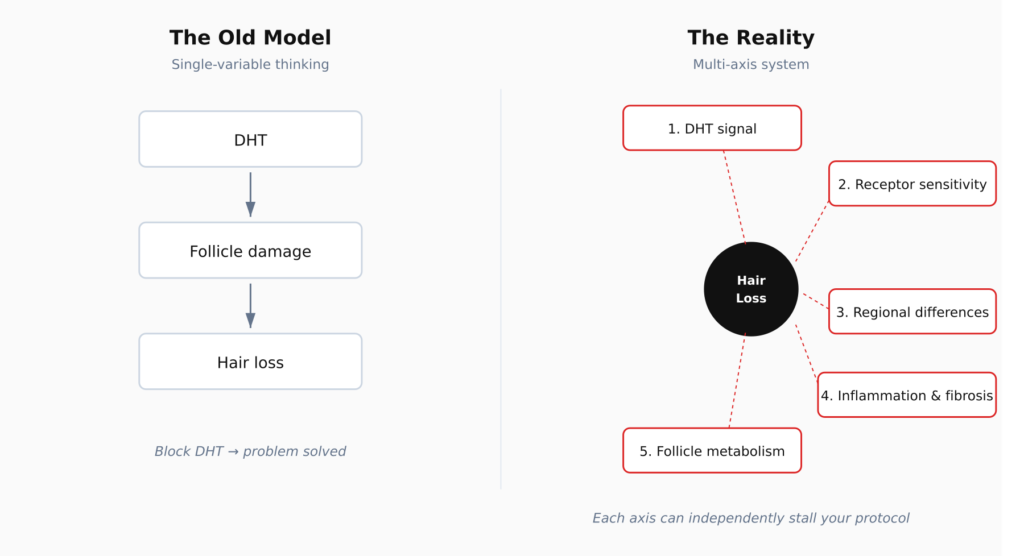
A more honest version looks something like this:
- A hormonal signal (DHT) arrives at the follicle.
- That signal is received by an androgen receptor — whose sensitivity varies person to person and region to region.
- The follicle sits in a local tissue environment that can either buffer or amplify the signal (inflammation, fibrosis, blood flow, lymphatic drainage).
- The follicle itself has a metabolic capacity — mitochondrial output, energy availability — that determines whether it can mount a growth response at all.
- And all of this happens against a cumulative timeline. What worked at year two of hair loss doesn’t necessarily work at year ten.
Finasteride, minoxidil, dutasteride, RU58841, pyrilutamide, microneedling, LLLT — each of these touches one or two of those layers. None touches all of them. So when a protocol plateaus, what’s usually happened is simple: the layer you’re not addressing has become the rate-limiting step.
With that in mind, here are the seven places your protocol is most likely getting stuck.
Reason 1: DHT Is Lowered — Not Eliminated
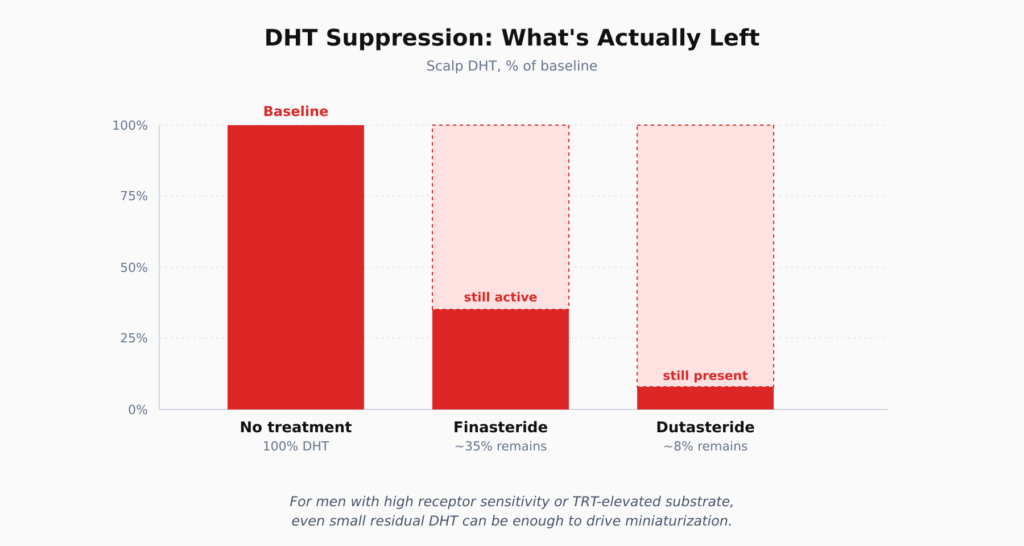
Finasteride is a genuinely effective drug. At 1mg daily, it reduces serum DHT by roughly 60–70%, and scalp DHT by a similar margin. That’s not marketing — it’s what the original Merck trials and subsequent long-term data show.
But “reduced” is not “eliminated.” Scalp DHT on finasteride sits at roughly 30–40% of baseline. For most men, that’s low enough to halt miniaturization. For a meaningful minority, it isn’t.
The men who tend to hit this ceiling share a few features:
- High baseline androgens — they started with unusually high DHT, so even a 70% cut leaves them higher than average.
- Exogenous testosterone use — TRT raises the substrate available for conversion, so absolute DHT remains higher even with finasteride on board.
- Upregulated 5-alpha-reductase in scalp tissue — some men have more enzymatic activity locally, so more DHT is produced before finasteride suppresses it.
Dutasteride is the usual next step here, because it inhibits both type I and type II 5-alpha-reductase and drops serum DHT by roughly 90%+. But even dutasteride leaves residual androgen activity, because the system itself isn’t purely DHT-driven (more on that below).
If this is your limiter: you’ll typically see good stabilization, minimal side effects, but regrowth that never fully takes off — especially if you’re on TRT or naturally androgen-dominant. Moving to dutasteride or adding a topical anti-androgen (RU58841, pyrilutamide, or the newer clascoterone) directly at the follicle can unlock the next layer.
Reason 2: Your Androgen Receptor Is “Louder” Than Average
Here’s a frustrating reality: two men with identical DHT levels can have completely different rates of hair loss.
The reason is the androgen receptor itself. Variants in the AR gene — particularly on the X chromosome — affect how strongly the receptor responds to the same amount of DHT. Some people’s receptors are, metaphorically, turned up higher. The signal arrives at the same volume, but the follicle hears it louder.
This has two implications for protocols.
First, it explains why response to finasteride varies so widely between men with otherwise similar profiles. If your receptor is unusually sensitive, lowering DHT by 60% may still leave enough signal to drive miniaturization. You need either deeper suppression or — more effectively — to block the receptor itself.
Second, it’s the mechanistic argument for topical anti-androgens. Compounds like RU58841, pyrilutamide, and clascoterone don’t try to lower the signal; they occupy the receptor so the signal can’t land. For men with high receptor sensitivity, that’s often a more productive lever than pushing DHT even lower.
If this is your limiter: strong family history of aggressive early hair loss, poor response despite confirmed low DHT on bloodwork, and patterns that don’t match what you’d expect from your hormonal profile. Receptor-level intervention tends to be the move.
Reason 3: Finasteride Works on the Crown. Your Hairline Didn’t Get the Memo.
The long-term data here is consistent and under-discussed: finasteride is not equally effective across the scalp.
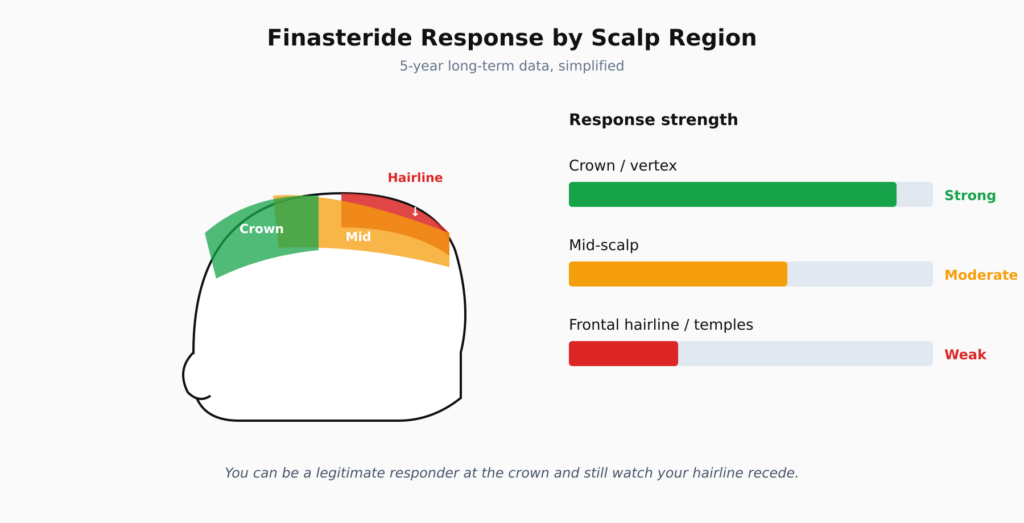
The 5-year Korean cohort study — along with the earlier Merck trials — shows:
- Strong response at the vertex (crown)
- Moderate response at the mid-scalp
- Weakest response at the frontal hairline and temples
This isn’t a dosing problem. It’s a tissue problem. Frontal follicles have different enzymatic profiles, different receptor density, and sit in a more structurally fragile region of scalp. They were the last to evolve, and they tend to be the first to go.
What this means in practice: you can be a completely legitimate finasteride responder — stable crown, measurable improvements on photographs — and still watch your hairline creep back. That’s not treatment failure in the clinical sense. It’s the drug doing exactly what it does best, in the region where it works best, while your frontal region continues to quietly lose ground.
If this is your limiter: solid crown results, ongoing temple or hairline recession despite compliance. This is where topicals that act directly at the hairline (anti-androgens, microneedling protocols, eventually something like clascoterone) tend to matter more than further systemic suppression.
Reason 4: The Scalp Environment Has Changed Underneath You
Here’s where the story stops being about hormones.
Androgenetic alopecia isn’t just a signaling disease. It’s also a structural one. Years of subclinical androgen activity produce two changes that don’t go away when you lower DHT:
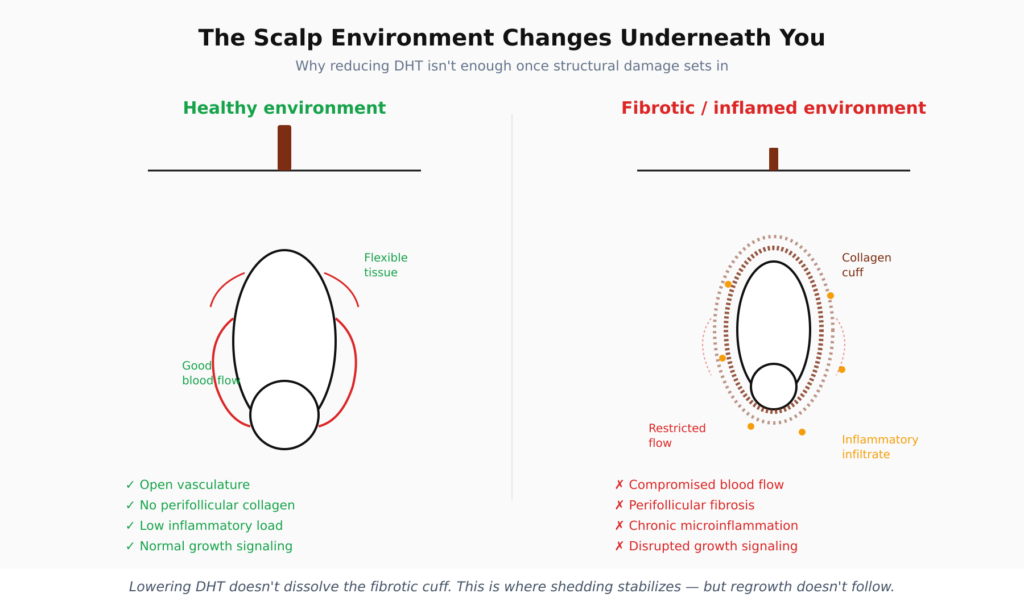
Chronic microinflammation. Biopsies of affected scalp consistently show low-grade inflammatory infiltrates around follicles — lymphocytes, mast cells, cytokine activity. It’s subtle. You don’t feel it. But it’s there, and it degrades the local environment.
Perifollicular fibrosis. Over time, that inflammation produces collagen deposition around the follicle. The follicle ends up encased in a sleeve of scar-like tissue. This compromises blood flow, restricts tissue flexibility, and physically interferes with the signaling needed for a normal growth cycle.
This is the part finasteride doesn’t fix. You can drop DHT to the floor, but the fibrotic cuff around your follicles doesn’t dissolve on its own. This is a major reason shedding can stabilize while regrowth refuses to follow.
It’s also the rationale for microneedling, which has actual RCT support for a reason: controlled micro-injury triggers a wound-healing cascade that can remodel fibrotic tissue, increase local blood flow, and re-sensitize dormant follicles. Same story for massage protocols, certain peptides, and some of the newer anti-fibrotic research compounds.
If this is your limiter: long disease duration, visible scalp tightness, perfect hormonal control but unresponsive follicles. Addressing the environment becomes more productive than further suppressing the signal.
Reason 5: The Follicle Itself Has Run Out of Energy
This is the newest part of the story, and in some ways the most important, because it explains a pattern that otherwise makes no sense: men who do everything right — low DHT, low inflammation, good scalp environment — and still get nothing back.
Hair follicles are among the most metabolically demanding structures in the human body. To cycle properly, they require continuous mitochondrial output to fuel proliferation, differentiation, and the active growth phase (anagen). When mitochondrial function in the follicle is compromised — whether from chronic androgen exposure, oxidative stress, aging, or underlying metabolic dysfunction — the follicle simply doesn’t have the energy to grow, even when the signal to grow is there.
This is why so many men see loss stabilize but regrowth never arrive. The brakes are off. The engine is dead.
This is also where compounds like PP405 and its research analogs (JXL069) are interesting. They aren’t working on the androgen axis at all. They target mitochondrial pyruvate metabolism — essentially trying to re-energize the follicle at a cellular level. Whether they pan out clinically is still being worked out, but the fact that the entire mechanism is orthogonal to DHT tells you something important: the field is finally acknowledging that hair loss isn’t just hormonal.
If this is your limiter: everything looks good on paper, the protocol “works” in the sense that you’re not losing ground, but the ceiling for regrowth feels artificially low. Metabolic-axis interventions (and honestly, broader metabolic health — body composition, insulin sensitivity, sleep, mitochondrial support) become the interesting lever.
Reason 6: You Started Later Than You Realize
There’s an uncomfortable truth buried in the long-term data: the earlier you intervene, the higher your ceiling for recovery.
Hair loss is cumulative. Each cycle a follicle spends under pressure produces a little more miniaturization, a little more structural damage, a little less recoverable tissue. By the time a follicle has been fully dormant for several years, the question isn’t whether your protocol is strong enough. It’s whether the follicle is still capable of responding to anything.
This is why two men on identical protocols, started five years apart, can have dramatically different results. It’s not about drug quality or compliance. It’s about what was recoverable when they started.
This is also why I’m generally blunt with people asking whether it’s “too late.” The honest answer is: some follicles will always come back with the right protocol, some won’t come back with anything, and the ratio is mostly determined by how long you waited to start. That’s not a pleasant message, but pretending otherwise sets people up for disappointment and false hope.
If this is your limiter: there isn’t a clean fix here. What tends to matter most is realistic expectations, focus on preserving what you have, and making peace with the fact that some regions may need to be addressed surgically rather than pharmacologically.
Reason 7: Stack Blind Spots — What Most Protocols Miss
This one is less about biology and more about how people actually build their stacks.
The typical progression I see is: finasteride → finasteride + minoxidil → add microneedling → add ketoconazole → maybe escalate to dutasteride or add an anti-androgen. Each step is reasonable in isolation. But the whole stack is still concentrated around one or two of the axes above, usually the hormonal and vascular ones.
The result is a stack that looks aggressive on paper but has structural blind spots. Common ones:
- No anti-inflammatory or anti-fibrotic lever at all — nothing addressing scalp environment.
- No metabolic support — the follicle’s energy capacity is ignored entirely.
- Redundant hormonal coverage — adding dutasteride when finasteride already controls your DHT, instead of covering a different axis.
- Treating compliance as a fix — adding frequency (more microneedling, twice-daily minoxidil) instead of asking whether the protocol is addressing the right layer.
- No measurement — no bloodwork, no standardized photos, no tracking. You genuinely can’t tell what’s working.
The fix isn’t usually “add another thing.” It’s to audit the stack against the five axes and see which one has no coverage. That’s almost always where the plateau is coming from.
If this is your limiter: you’re taking a lot of things, and things are “stable,” but you can’t clearly articulate which compound is addressing which layer. Simplify, map the stack against the axes, and fill the actual gap.
How to Diagnose Which Axis Is Limiting You
Here’s a rough decision tree I’d work through if I were plateauing:
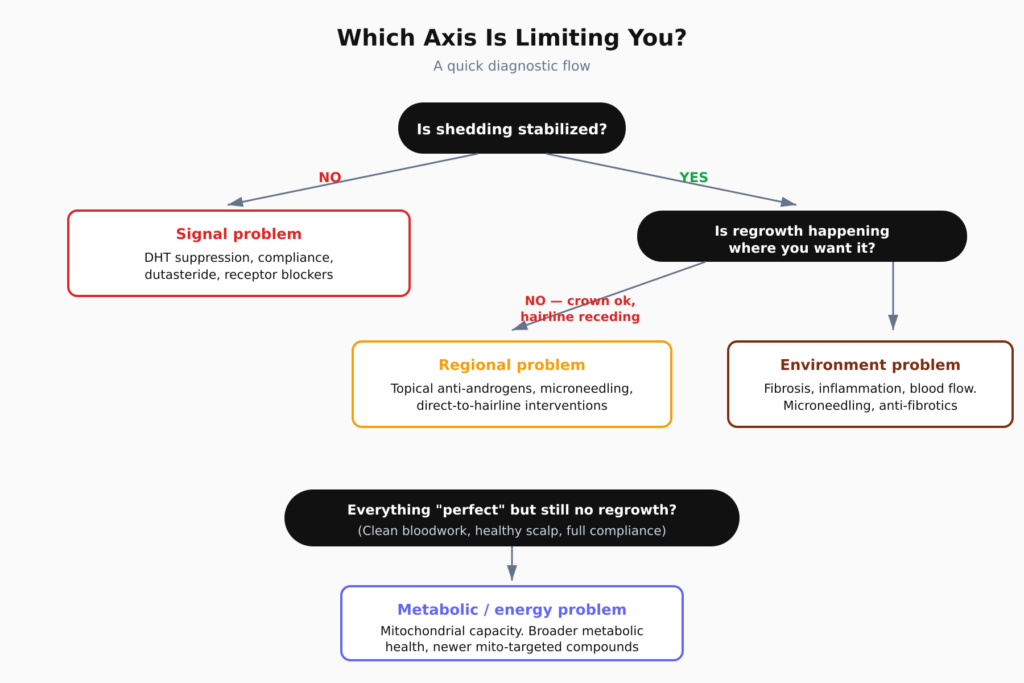
If shedding never fully stabilized: it’s probably still a signal problem. Look at DHT suppression, compliance, whether you need dutasteride, whether TRT is inflating substrate, whether receptor sensitivity is the real issue.
If shedding stabilized but regrowth never came, and your scalp is tight or has been affected for many years: it’s probably environmental. Microneedling, anti-inflammatory/anti-fibrotic work, blood flow.
If everything looks clean — bloodwork is good, scalp is healthy, compliance is perfect — and you’re still not getting regrowth: it’s probably metabolic. The follicle may not have the energy capacity. Broader metabolic health and mitochondrially-targeted interventions become the frontier.
If your crown is holding but the hairline is still going: it’s probably regional. Systemic drugs aren’t enough for the frontal zone. Topical, receptor-level, and mechanical interventions matter more.
If you’re on a big stack but can’t explain what each piece does: audit first, escalate second.
Most plateaus aren’t caused by weak protocols. They’re caused by protocols that are strong in the wrong places.
Watch the Full Breakdown
In the video linked below, I break this down in detail:
- The 5 exact reasons finasteride fails some men
- The mechanisms behind each one
- And how to identify which applies to your situation
👉 Watch the full video here:
Where to Go From Here
If you’ve been stuck, the point of this article isn’t to sell you on adding more compounds. It’s to shift the framing: hair loss is a multi-axis problem, your protocol is probably covering one or two of those axes well, and whichever axis is uncovered is what’s limiting you.
That reframe changes what “intensifying your protocol” actually means. Sometimes it means pushing the hormonal axis harder. Sometimes it means stepping off it entirely and addressing the environment or the metabolism instead. And sometimes it means accepting the ceiling you have and focusing on preservation rather than chasing regrowth.
I cover the specific protocols I use — and the reasoning behind each piece — in more depth on the Philippe’s Blueprint YouTube channel and in the related articles below.
Related reading
- Why Finasteride Fails Some Men (Even When It’s Working)
- The Multi-Axis Body: Why Everything Works—Until It Doesn’t
- Clascoterone 5% (CB-0301): The Phase 3 Hair Loss Study Explained
References
- Kaufman, K. D., Olsen, E. A., Whiting, D., Savin, R., DeVillez, R., Bergfeld, W., … Roberts, J. L. (1998). Finasteride in the treatment of men with androgenetic alopecia. Journal of the American Academy of Dermatology, 39(4), 578–589.
- Drake, L., Hordinsky, M., Fiedler, V., Swinehart, J., Unger, W. P., Cotterill, P. C., … Waldstreicher, J. (1999). The effects of finasteride on scalp skin and serum androgen levels in men with androgenetic alopecia. Journal of the American Academy of Dermatology, 41(4), 550–554.
- Hillmer, A. M., Brockschmidt, F. F., Hanneken, S., Eigelshoven, S., Steffens, M., Flaquer, A., … Nöthen, M. M. (2005). Susceptibility variants for male-pattern baldness on chromosome 20p11. Nature Genetics, 40(11), 1279–1281.
- Kim, B. J., Lee, Y. W., & Choe, Y. B. (2014). Long-term (5-year) efficacy of finasteride in pattern hair loss: A Korean cohort study. Annals of Dermatology, 26(3), 330–335.
- Mahé, Y. F., Michelet, J. F., Billoni, N., Jarrousse, F., Buan, B., Commo, S., & Bernard, B. A. (2000). Androgenetic alopecia and microinflammation. International Journal of Dermatology, 39(8), 576–584.
- Jaworsky, C., Kligman, A. M., Murphy, G. F., & Kligman, L. H. (1992). Characterization of inflammatory infiltrates in male pattern alopecia. Journal of Cutaneous Pathology, 19(3), 199–206.
- Yoo, H. G., Kim, J. Y., Lee, Y. S., & Kim, K. H. (2006). Perifollicular fibrosis: Pathogenetic role in androgenetic alopecia. Annals of Dermatology, 18(1), 12–16.
- Kwon, O. S., & Kim, K. H. (2020). Emerging role of fibrosis in androgenetic alopecia. Journal of Dermatological Science, 98(2), 85–92.
- Madaan, A., Verma, R., Singh, A. T., & Jaggi, M. (2018). Mitochondrial dysfunction in hair follicle cells: Implications in hair loss. Journal of Dermatological Science, 90(2), 150–158.
- Lin, S. J., & Widelitz, R. B. (2019). Mitochondrial regulation of hair follicle growth and cycling. Experimental Dermatology, 28(4), 395–402.
- Trüeb, R. M. (2002). Molecular mechanisms of androgenetic alopecia. Experimental Gerontology, 37(8–9), 981–990.
- Lueangarun, S., et al. (2021). A systematic review and meta-analysis of FDA-approved home-use low-level laser therapy devices for pattern hair loss. Journal of Clinical and Aesthetic Dermatology, 14(11), E64–E75.
This article is for educational purposes and is not medical advice. Decisions about hair loss treatment — especially involving prescription drugs or research compounds — should be made in consultation with a qualified clinician.
About the author
Philippe Boissard
Author of Men’s Hairloss Protocol (2020), Better, Smarter, Stronger (2023), and Multi-Axis Body (2025). Researches and writes about hair loss and male physiology, citing primary literature and disclosing affiliate relationships in full. Not a medical doctor; all content is educational. More about Philippe.
Get my free hair-loss protocol
The exact evidence-based routine I actually use and recommend: what works, in what order, with no hype. Enter your email on the next page and I’ll send it straight to you.
Send me the free protocol →
[…] Standalone primary therapy: wrong tool. See why your hair loss protocol isn’t working. […]
[…] thinning than diffuse shedding, the differential shifts and you can find the framework for that in why your protocol may not be working. And if you are still in the middle of a panic about whether what you are seeing is permanent, the […]
[…] the AGA component, deficiency correction for the TE component. The framework for that overlap is in why your protocol may not be working, and the specific stress-versus-AGA differential adds another layer covered in the stress and […]
[…] You want zero systemic effect. Topical does not deliver that. If avoiding any 5-alpha reductase inhibition is your goal, look at non-AR-pathway interventions and the failure modes covered in why your hair loss protocol isn’t working. […]
[…] You have plateaued on finasteride after 12 to 18 months and your response is clearly suboptimal. The switch is the strongest evidence-backed move, especially after you have ruled out the failure modes covered in why your hair loss protocol isn’t working. […]
[…] the most relevant background if you cannot use systemic treatment. And the failure-mode analysis in why your hair loss protocol isn’t working covers the seven traps most men fall into when stacking […]
[…] For anyone building a multi-pronged hair protocol, the right move is: primary therapy that targets the actual cause (DHT, deficiency, stress), local interventions that work directly at the follicle (microneedling, topicals), and zero-cost adjuncts like scalp massage layered through. The framework for what fails when those layers are missing or wrong is in why your protocol may not be working. […]
[…] or shifting from prescribed schedules to “when I remember” patterns. The article on why your hair loss protocol is not working covers adherence failure modes in detail and applies directly […]
[…] core protocol-design insight comes from why protocols fail: stacking interventions across systemic, topical, and procedural layers covers what any single tool […]
[…] Why Your Hair Loss Protocol Isn’t Working: The 7 Hidden Reasons Most Men Miss […]
[…] progression despite therapy, the protocol needs revisiting – the framework for that is in why your protocol may not be working. If you are using photos to evaluate progress on a specific intervention like microneedling or […]
[…] one of the recurring themes in this category, which is part of why the protocol-failure article on why your hair loss protocol isn’t working emphasizes setting expectations before […]
[…] Why Your Hair Loss Protocol Isn’t Working: The 7 Hidden Reasons Most Men Miss […]
[…] whether your protocol is actually working before deciding which concealer route to take, see the protocol troubleshooting guide and the underlying biology of androgenetic […]
[…] Why Your Hair Loss Protocol Isn’t Working: The 7 Hidden Reasons Most Men Miss […]
[…] makes sense. And when protocols stall at any stage, the seven hidden reasons map covered in why your protocol may not be working is the diagnostic to run before changing […]
[…] You have a non-AGA cause of loss. Pipeline therapies are mostly designed for AGA. Telogen effluvium, cicatricial alopecias, and chemo-induced loss have different mechanisms and may not benefit from these programs. The failure modes most men miss are covered in why your hair loss protocol isn’t working. […]
[…] covers that question. For the broader pattern of what stalls hair protocols, the framework is in why your protocol may not be working. Rosemary oil belongs as a topical adjunct – layered carefully, applied consistently, judged […]