
Hair Concealers in 2026: SMP, Fibers, and Sprays Compared
SMP, keratin fibers, and tinted sprays solve different cosmetic problems with different cost curves. Five-year math, decision flow, and where each fits relative to medical treatment.

Hair concealers solve a different problem than hair-loss drugs. Finasteride, dutasteride, minoxidil, and microneedling try to grow more hair. Concealers – scalp micropigmentation, keratin fibers, tinted sprays – try to make the hair you have look denser by darkening the scalp underneath. Both can be reasonable choices, but they answer different questions. This article walks through the three main concealer categories (SMP, fibers, sprays), what each costs across one year and five years, where each fits relative to medical treatment, and which combinations make sense. The honest read: concealers are powerful for cosmetic density but never replace medical treatment for active loss. Confusing the two is the most expensive mistake in this category.
Quick answer: which hair concealer makes sense for you?
If you want a permanent cosmetic fix and your loss is stable (Norwood 4 or above with the buzzed look), scalp micropigmentation is the best option. If you want a daily concealer for active loss, want to keep your hair long, or want to test the look before committing, keratin fibers are the better starting point. Tinted sprays are the cheapest option and work for thinning rather than visible scalp. None of these stop hair loss; they manage the cosmetics while medical treatment (or its absence) decides what is actually happening to the follicles.
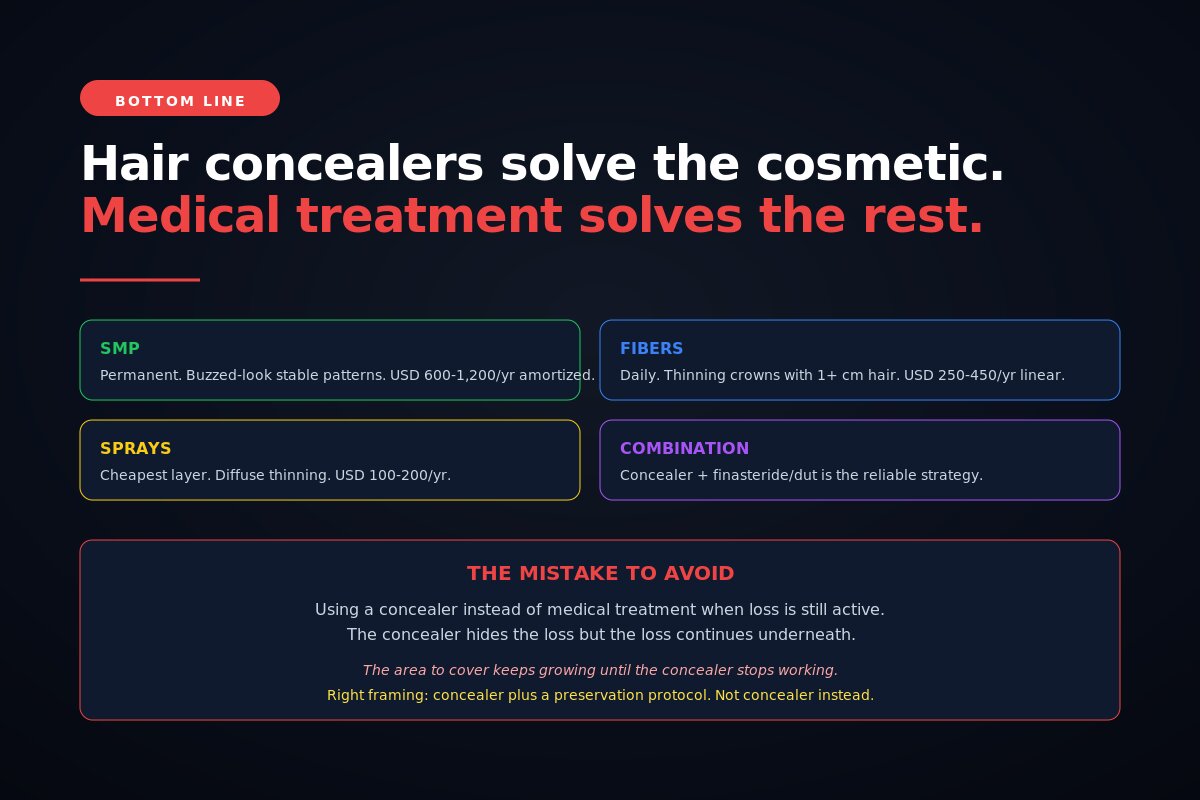
The most common mistake is using a concealer instead of medical treatment when the loss is still progressing. The concealer hides the loss but the loss continues underneath, which means the area to cover keeps growing and the cosmetic gap widens until concealers stop working. The right framing is concealer plus a hair-preservation protocol, not concealer instead of one.

The three concealer categories at a glance
The category includes three distinct technologies that solve overlapping but different problems. Scalp micropigmentation (SMP) is a tattooing procedure where a clinician deposits cosmetic pigment in the upper dermis to mimic the look of close-cut hair follicles. Keratin building fibers are loose protein fibers that adhere electrostatically to existing hair, fattening the visible strand and darkening the scalp gap underneath. Tinted sprays are colored powders or aerosols that coat the scalp directly to reduce contrast between scalp and hair. Each works on a different problem.
SMP is permanent (lasts years before fading), is suited to a buzzed or short-shaved look, and reads as real follicles to the casual eye when done well. Fibers are temporary (washed out at night), work best on hair longer than about 1 cm, and read as denser hair from normal viewing distance but can be detected up close. Sprays are the most temporary (rub off easily), are cheapest per use, and work best when there is meaningful hair coverage and the goal is reducing scalp glare rather than simulating hair.
Scalp micropigmentation (SMP): the permanent option
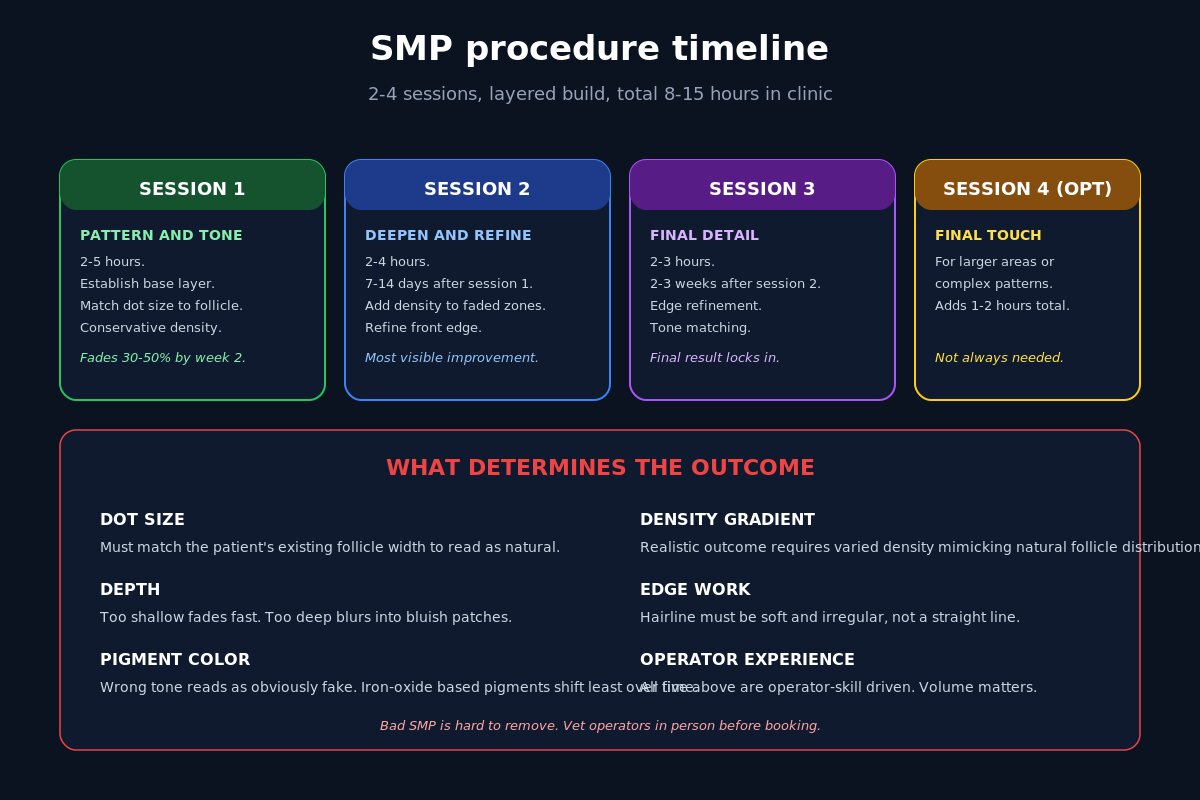
SMP delivers a permanent cosmetic outcome through 2-4 sessions spaced 1-3 weeks apart. Each session lasts 2-5 hours and uses a fine needle to deposit cosmetic-grade pigment at a controlled depth in the upper dermis. The pigment dots are deliberately matched in size and density to the follicular pattern of the patient’s existing hair, so the result reads as a uniform field of close-cropped follicles rather than as a tattoo. The sessions build the result in layers; the first session establishes pattern and tone, subsequent sessions deepen specific zones and refine edges.
The total cost in 2026 ranges roughly USD 2,500 to USD 6,000 depending on geography, scalp size, and the operator’s experience. The cost varies more by operator than by region; the difference between an experienced SMP technician and a beginner is the difference between an outcome that looks like real hair and one that looks like dot patterns. The procedure works best on Norwood 4-7 patterns where the patient has accepted a buzzed-style look. SMP can also be used to add density to thinning crowns or to fill scars, but full-scalp pattern work is where the technology shines.
Longevity and touch-ups
SMP fades over 4-8 years depending on skin type, sun exposure, and pigment used. Fading is gradual and uniform; the result does not suddenly disappear, it slowly lightens. A touch-up session every 4-6 years restores density and color. The total long-term cost is therefore the initial procedure plus an occasional refresh, putting SMP in the USD 600-1,200 per year range when amortized across a decade. That math beats daily fiber use for most patterns past Norwood 4, and is comparable in lifetime cost to a hair transplant for the buzzed-look use case.
Risks and downsides
The risk profile is dominated by operator quality, not by the procedure itself. Bad SMP – wrong pigment color, dots too large, depth wrong, density off – is hard to fix and even harder to remove. Pigment removal requires laser sessions that can cost as much as the original procedure and may not fully clear the residue. The standard caution applies: see in-person work from the specific technician you plan to use before booking, ideally healed work several months out rather than fresh work that has not yet faded into its final tone. Allergic reactions to pigment are rare but possible; reputable clinics offer patch testing.
Keratin fibers: the daily concealer

Keratin fibers are loose protein particles, usually keratin or cotton-derived, that carry a slight electrostatic charge so they cling to existing hair shafts. Sprinkled onto thinning areas, they fatten the visible hair and darken the scalp underneath, which optically reads as denser coverage. The most-recognized brands include Toppik, Caboki, Boldify, and a long tail of smaller competitors. The category has been mature for a decade plus; the formulations are similar across brands, with color matching and shaker-cap design being the main differentiators.
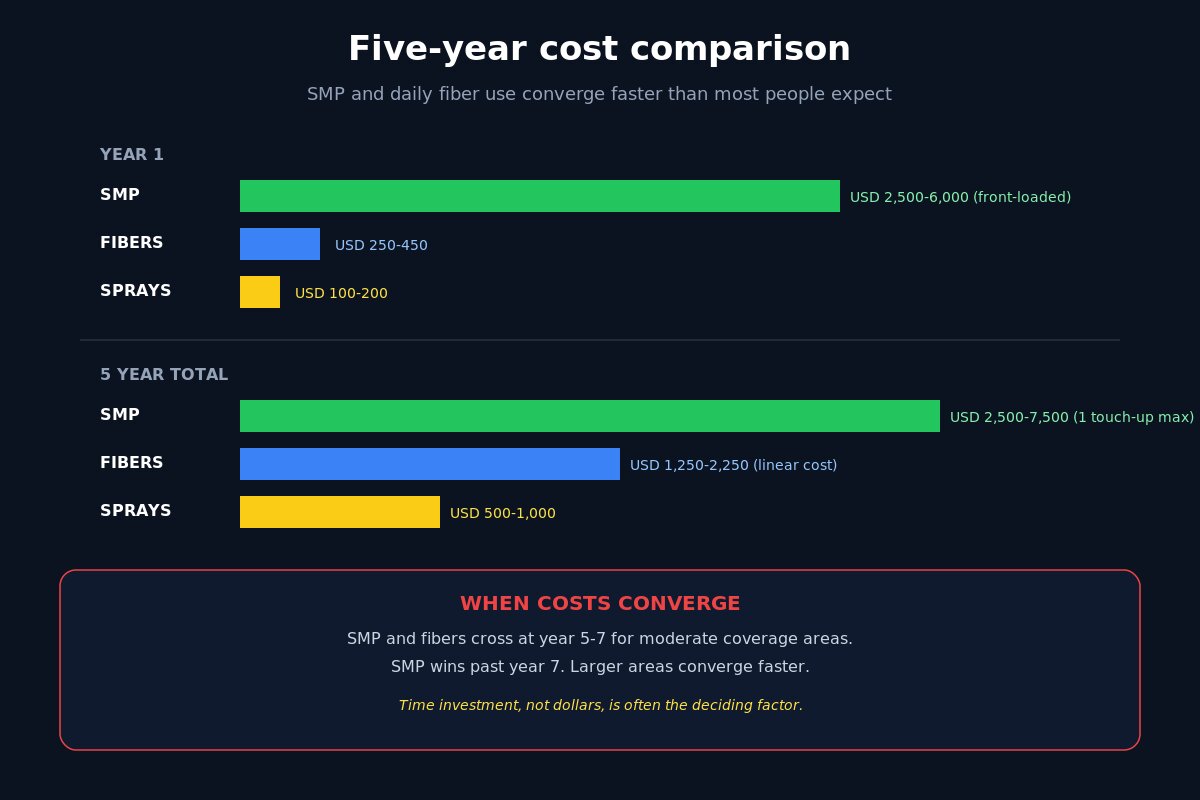
Per-application cost is small (a 25 g bottle at USD 25-35 lasts 30-60 days at moderate use), but daily use compounds quickly. A man using fibers daily for a moderately thinning crown spends roughly USD 250-450 per year. Across five years that is USD 1,250-2,250. The math closes the gap with SMP faster than most people expect, especially as the area to cover grows. Fibers work best on hair longer than 1 cm; on near-shaved scalps they have nothing to cling to and look obvious. They are sweat- and rain-vulnerable; a hair-spray topcoat helps but does not eliminate the issue. They wash out in the shower.
What fibers do and do not do well
Fibers excel at thinning crowns where existing hair is thin but present. They handle hairline thinning poorly because hairlines benefit from sharp edges and fibers tend to migrate forward. They cope poorly with humidity and rain. They give the best result under indoor or controlled lighting; bright direct sunlight reveals the powdery texture more clearly than diffuse light. They do not survive a swim. Touching them – by another person or by yourself – tends to leave fiber residue on the hand or pillow.
Tinted sprays and powders: the cheapest layer
Aerosol sprays and pressed powders are the lightest concealer category. They do not add the visual fiber bulk that keratin fibers do; they coat the scalp with pigment to reduce contrast between exposed scalp and hair. They work well for diffuse thinning where the scalp is becoming visible through still-present hair, and poorly for near-bald areas where there is no hair to provide visual structure. Per-application cost is roughly half that of fibers. Many men use sprays as a touch-up layer on top of fibers, with the spray locking the fibers in place and adding scalp tone.
The biggest advantage of sprays is speed; a 30-second application before leaving the house compares well to the 2-3 minute fiber routine. The biggest disadvantage is that they tend to look obviously cosmetic in close-up photographs and under direct overhead light, where the pigment shows as a uniform tinted shadow rather than as discrete hair-like points. They are best used as a finishing layer or as a quick touch-up rather than as a primary concealer for moderate-to-severe loss.
The five-year cost math
Looking only at the first year is misleading. Concealer costs run forever; SMP is mostly front-loaded with periodic touch-ups. Across five years, daily fiber use lands around USD 1,250-2,250 depending on how aggressively the area is covered. SMP across the same period is USD 2,500-6,000 for the initial procedure plus zero or one touch-up depending on fade rate, putting it in the USD 2,500-7,500 range. The two categories converge at the five-year mark for moderate coverage areas, and SMP becomes cheaper for larger areas or longer time horizons.
The math changes meaningfully when you include time. A daily fiber routine is roughly 3 minutes; across five years that is about 90 hours. SMP requires roughly 8-15 hours total in clinic across the initial sessions and a touch-up. For men who travel frequently, do outdoor or athletic work, or simply find daily cosmetic routines tiring, the time advantage of SMP becomes the dominant factor before the dollar math even comes in.
Watch this on the channel
No Before & After Yet sets up why honest documentation matters in this space. Concealers are the part of hair management where the cosmetic-vs-actual gap is widest. Watching this gives the framing you need to evaluate concealer choices without confusing them with treatment progress.
Where each concealer fits relative to medical treatment

The first question is always whether the loss is active or stable. Active loss means measurable thinning over the past 12-24 months without treatment, which means the area to be covered is growing. Stable loss means either Norwood pattern that has plateaued naturally or loss that has been stopped by ongoing finasteride or dutasteride. Concealers fit comfortably into stable cases. Active cases need medical treatment first or in parallel; concealing active loss without treating it leads to a cosmetic ratchet where the concealer needs constantly grow.
For men on finasteride or dutasteride who have plateaued cosmetically but want denser visual coverage, fibers are the cheapest entry point and SMP is the long-term endpoint if the man has accepted the buzzed look. For men with diffuse thinning who do not want medical treatment yet, fibers buy time without committing to a permanent decision. For men in late Norwood patterns who have decided against transplant, SMP is the standard cosmetic answer. For more on how to assess whether your protocol is actually working before deciding which concealer route to take, see the protocol troubleshooting guide and the underlying biology of androgenetic alopecia.
SMP vs hair transplant: when each makes sense
SMP and hair transplant solve overlapping but distinct problems. Transplant moves real follicles from the donor area to thinning zones, growing hair where there was none. SMP creates the visual impression of follicles without growing anything. Transplant requires sufficient donor density, comes with a multi-thousand dollar cost, and has a 6-12 month timeline before the result is visible. SMP has no donor requirement, costs less, and shows result in days rather than months.
The two are not mutually exclusive. A common combination is a transplant to add real density to the hairline and crown, with SMP filling the donor area to disguise the harvest scarring or adding density to areas the transplant could not fully cover. For Norwood 6-7 patients without enough donor for full coverage, SMP plus a buzzed look is often the best aesthetic outcome regardless of whether transplant is also considered. The detailed comparison and decision framework lives in the hair transplant decision guide; this article assumes you have already worked through whether transplant is on the table.

Sensible combinations: concealer plus medical
The most reliable strategy is concealer plus a hair-preservation drug regimen rather than either in isolation. Daily finasteride or dutasteride preserves what is there. Minoxidil or microneedling drives modest regrowth in the same areas. The concealer (fibers daily, or SMP once stable) closes the cosmetic gap that medical treatment alone often cannot. The medical treatment is doing the slow work that decides whether the area to cover keeps growing or holds steady; the concealer is doing the immediate cosmetic work.
The combination most worth flagging is SMP plus a stable medical protocol on a man who has reached a Norwood 5-6 pattern. SMP transforms the visual outcome; the protocol freezes the underlying loss so the SMP work continues to look right years later. Without the protocol, the man’s actual hair recedes further and the SMP edge stops matching the real hairline, which forces additional SMP work to keep up.
Common myths about hair concealers

The myth that SMP looks like a tattoo confuses bad SMP with good SMP. Done well by an experienced operator, SMP reads as real close-cropped follicles to the casual eye and frequently to the camera. Done badly, it looks like dot patterns. The visible difference is operator skill, not the technology. The myth that fibers are detectable by anyone who looks confuses bright direct lighting and close-range inspection with normal social distance and lighting; under typical conditions fibers are not noticed unless someone is specifically looking. The myth that concealers cause additional hair loss is unsupported by evidence; the friction of application and removal is mild and not implicated in mechanical loss in trials.
The myth that SMP is removable in an emergency understates the difficulty; laser removal is possible but expensive, multi-session, and may leave residue. The myth that any concealer substitutes for medical treatment is the most expensive mistake; concealers do not affect the underlying biology and active loss continues underneath, widening the gap they are trying to close. The myth that fibers and sprays are interchangeable misses that they solve different visual problems; fibers add bulk, sprays reduce contrast, and using the wrong one produces the wrong result.
Frequently asked questions about hair concealers
Will scalp micropigmentation look fake?
Quality SMP done by an experienced operator reads as natural close-cropped follicles. The visible difference between good and bad SMP is operator skill – dot size, color match, density gradient, edge work. Always see healed in-person work from your specific technician before booking, not just before-and-after marketing photos.
How long does SMP last?
Typically 4-8 years before fading enough to need a touch-up. The fade is gradual and uniform, not abrupt. Sun exposure accelerates fading; daily SPF on the scalp extends the result.
Can I use fibers if my hair is very short?
Fibers need at least 1 cm of hair to cling to. Below that they sit on the scalp and look obviously powdery. Sprays or SMP are better choices for very short or shaved hair.
Do hair concealers wash out in the rain or pool?
Fibers and sprays both come off with water. Hair-spray topcoats add some water resistance but not enough for swimming. SMP is permanent and unaffected by water.
Can I get SMP if I am still losing hair?
Possible but risky. Active loss means the SMP-treated zone may no longer match the surrounding real-hair edge in 1-2 years, requiring additional work. Best practice is to stabilize the loss with finasteride or dutasteride first, then proceed with SMP once the pattern has been stable for at least 12 months.
How much does SMP cost in 2026?
Roughly USD 2,500 to USD 6,000 for the full procedure depending on coverage area, geography, and operator experience. Touch-ups every 4-6 years run USD 400-1,000. Across a decade the cost amortizes to roughly USD 600-1,200 per year.
Are keratin fibers safe for daily use?
Yes for the great majority of users. The protein particles do not penetrate the scalp; allergic reactions are rare. The main downside is the daily routine and the cumulative cost over years rather than safety.
Can SMP be combined with a hair transplant?
Yes and the combination is common. Transplant adds real follicles to the hairline and crown; SMP fills donor area scarring or adds density to zones the transplant could not fully cover. Both procedures should be planned together if both are intended.
Will fibers stain my pillowcase?
Some residue is normal even with hair-spray sealing. Most fiber brands wash out of fabric without staining, but light-colored pillowcases may show transfer if you fall asleep without showering them off.
Do concealers replace finasteride or dutasteride?
No. Concealers do not affect the underlying loss biology. Active loss continues underneath the concealer, expanding the area to cover. The reliable approach is concealer plus a medical preservation regimen, not concealer instead of one.
Bringing it together
Hair concealers solve a cosmetic problem, not a biological one. SMP is the permanent option for stable patterns where a buzzed look is acceptable. Fibers are the daily option for thinning crowns where existing hair length supports the application. Sprays are the cheapest finishing layer or quick touch-up. Across five years the cost math converges between SMP and daily fiber use, with SMP winning on time investment and consistency. None of these substitute for medical treatment when loss is still active; the best results pair concealers with a stable preservation protocol. For deeper context, the pillar on how hair loss actually works explains why active loss keeps expanding the area to cover, the Norwood-scale treatment guide walks through what intervention to consider at each pattern, and the hair cloning pipeline reality check covers what is plausibly coming for follicle-replacement options before SMP becomes the only practical answer for late patterns.
About the author
Philippe Boissard
Author of Men’s Hairloss Protocol (2020), Better, Smarter, Stronger (2023), and Multi-Axis Body (2025). Researches and writes about hair loss and male physiology, citing primary literature and disclosing affiliate relationships in full. Not a medical doctor; all content is educational. More about Philippe.
Educational content only. This article describes cosmetic and medical options for hair loss based on published evidence and personal research. It is not medical advice. See the full disclaimer before making any decision based on this content.
Related reading
Get my free hair-loss protocol
The exact evidence-based routine I actually use and recommend: what works, in what order, with no hype. Enter your email on the next page and I’ll send it straight to you.
Send me the free protocol →