
Norwood Scale: Treatment Strategy by Stage
The Norwood scale is the working clinical map of male pattern hair loss. Different stages call for different treatment intensities. Reading your stage and trajectory correctly is the first move.

The Norwood scale is the standard map of male androgenetic alopecia. It exists because the pattern of loss is consistent enough across men to be classified – and because different stages call for different treatment strategies. Treating Norwood 2 the same way you treat Norwood 5 is one of the most common protocol mistakes. The right intervention scales with the stage, the trajectory, and the donor area math. Reading your stage correctly is the first move.
Quick answer: stage determines strategy, not just severity
The Norwood-Hamilton scale (Hamilton 1951, refined by Norwood 1975, with Olsen 2011 adding female-pattern equivalence) classifies male pattern hair loss into seven stages plus several variants. The numbers are useful, but the strategy that matters lives in the trajectory. A stable Norwood 4 in a 50-year-old needs a different plan than a Norwood 2 in a 22-year-old who is moving fast.
The strategic logic by stage: NW 1-2 is preservation territory where prevention is high-leverage. NW 3-4 is the aggressive-intervention zone where finasteride plus minoxidil plus possibly microneedling is the standard. NW 5+ is the transplant calculus zone where surgical options enter the picture. The exact treatment within each band depends on age, progression speed, donor area, and patient priorities.
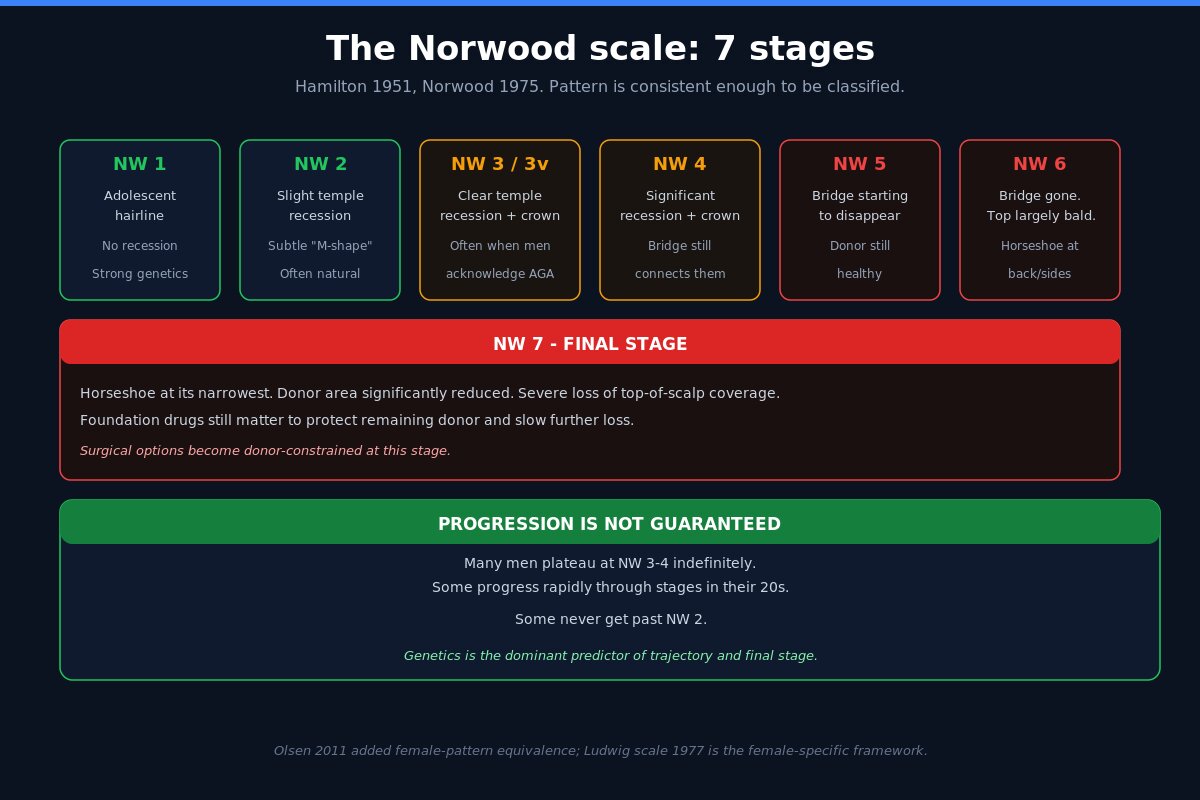
The Norwood scale: what each stage actually means
Reading the scale precisely matters. The classifications are based on visual pattern, not on time or severity per se.
Norwood 1. Adolescent hairline. No recession. Common in men under 25 with no family history of AGA, but also seen in older men with strong genetic resistance.
Norwood 2. Slight recession at the temples – the “M-shape” beginning. Often subtle and difficult to distinguish from natural maturation of the hairline (which happens in most men in their 20s without indicating AGA progression).
Norwood 3. Clear bilateral temple recession with deep frontal angles. Often the first stage where men acknowledge they are losing hair. Two variants: NW3 (just temple recession) and NW3 vertex (temple recession plus a thinning crown).
Norwood 4. Significant temple recession plus visible crown thinning, with a bridge of hair still connecting them across the top. This is often the stage where men start protocol-stacking and considering more aggressive interventions.
Norwood 5. The bridge is starting to disappear. Hair on top is thin enough that scalp shows through. The donor area (back and sides) is still healthy.
Norwood 6. The bridge is gone. Top of the head is largely bald or near-bald. Remaining hair forms a horseshoe pattern at the back and sides.
Norwood 7. The horseshoe is at its narrowest. Donor area is significantly reduced. Final stage.
Stage progression is not linear or guaranteed. Many men plateau at NW 3-4 indefinitely. Some progress rapidly through stages in their 20s. Some never get past NW 2.

The trajectory question matters more than the stage
A static photograph of “what stage am I” is only half the picture. The other half is “where am I heading and how fast?”
Stable trajectory. A Norwood 4 that has not changed in 5 years is in a very different strategic position than a Norwood 4 that just moved from Norwood 3 in the past year. The stable case can play conservatively with maintenance therapy. The fast-moving case needs aggressive intervention immediately.
Age effect. Norwood 3 at 50 typically progresses slower than Norwood 3 at 22. The same stage in a younger man often signals more aggressive underlying genetics and a higher final endpoint. Treatment intensity should scale accordingly.
Family history pattern. If the men in your family typically end up at Norwood 6-7 by their 60s, your Norwood 3 at 30 is on a steeper trajectory than someone with NW 4 at 60 in the family. Genetics is the dominant predictor.
Response to therapy. A Norwood 4 that stabilized on finasteride and a Norwood 4 that continued progressing on finasteride are different decisions. The first patient’s protocol works; the second needs escalation (dutasteride, RU-class compounds, surgical evaluation).

Strategy by stage: the operating framework
The stage-by-stage logic that matches intervention intensity to where you are.
Norwood 1-2: preservation territory. If you are early and stable, the highest-leverage moves are foundational – protect what you have, monitor with photography. Finasteride consideration if family history is aggressive or if any progression is documented over 12-24 months. Minoxidil is reasonable as an early adjunct. Microneedling and ketoconazole shampoo fit here. Saw palmetto or rosemary oil are reasonable for those who prefer a gentler starting protocol.
Norwood 3 (with or without vertex): aggressive intervention zone. Finasteride 1 mg/day is the standard. Minoxidil 5 percent topical twice daily. Microneedling at appropriate frequency. Ketoconazole shampoo 2-3 times per week. The combined stack at this stage is the highest-leverage period of intervention because there is still substantial hair to preserve. The single most common protocol mistake at NW 3 is delay – waiting to “see if it gets worse” before starting. By the time it gets visibly worse, you have lost preservable density that finasteride could have held.
Norwood 4: full stack plus consideration of pipeline options. Same foundation as NW 3. Add: PRP for those with budget, consideration of dutasteride if finasteride response is suboptimal, monitoring of pipeline therapies (clascoterone, pyrilutamide). Surgical consultation for hairline restoration once stability is established for 12-24 months on therapy. The strategic question shifts from “can I prevent more loss” to “can I add density to what is already lost.”
Norwood 5: transplant calculus zone. Foundation drugs continue. Donor area evaluation becomes important. Most men at this stage benefit from surgical evaluation – not necessarily because they will transplant, but because knowing the donor math informs decisions about how aggressively to deploy other interventions. Restoring meaningful coverage usually requires both medical therapy and 1-2 transplant sessions over years.
Norwood 6-7: realistic coverage planning. Donor area is the limiting factor. Foundation drugs continue (necessary to protect the surgical result). Transplant strategy focuses on aesthetic priorities that can actually be achieved with available donor – often hairline restoration plus partial frontal density rather than attempting full top-of-scalp coverage. Scalp micropigmentation may be a complementary option. The honest conversation at this stage is what is achievable versus what is desired.
Watch this for the protocol framing
This video covers the responder-versus-non-responder framing that determines whether your current protocol is working. The same logic applies to stage-based strategy: if you are at Norwood 3 and on finasteride for 18 months without stabilization, the question is not “is finasteride enough” but “is finasteride working for me at all” – and the answer changes the next move significantly. Norwood progression on therapy is the diagnostic that drives escalation.

Common stage-specific mistakes
The errors that show up at each stage and how to avoid them.
NW 1-2: doing too much. Young men at NW 1-2 sometimes start aggressive protocols (finasteride plus dutasteride plus topical RU-class compounds) without documenting progression first. If you are stable, the side effect risk of strong intervention may exceed the benefit. Establish trajectory first; intervene proportionally.
NW 1-2: doing too little. The opposite mistake – documented family history of aggressive AGA, mild current loss, but waiting to start finasteride until “it gets worse.” By the time it does, preservable density has been lost. If trajectory looks aggressive, start treatment early.
NW 3: protocol shopping instead of stacking. Trying minoxidil for 6 months, switching to ketoconazole alone, then trying saw palmetto. None of these monotherapies match the stack effect. NW 3 is when the full stack matters most.
NW 3-4: stopping finasteride after stabilization. Some patients see their hair stabilize and discontinue finasteride, expecting the result to hold. It does not. Finasteride continues to work only as long as it is taken. Discontinuation produces measurable loss within 6-12 months in most cases.
NW 4-5: transplanting too early. Surgery before medical-therapy stability produces poor long-term outcomes as the surrounding native hair continues to recede. Stability for 12-24 months on therapy is the gate.
NW 5-6: unrealistic transplant expectations. Wanting Norwood 1 hairline density restored on a Norwood 6 head. Donor area cannot deliver. Expectations need to align with the donor math.
NW 6-7: chasing miracles. At advanced stages, regenerative therapies, exosomes, and non-validated treatments are heavily marketed. Reality: foundation drugs to protect what remains, surgical planning that respects donor area, and acceptance of what is achievable.
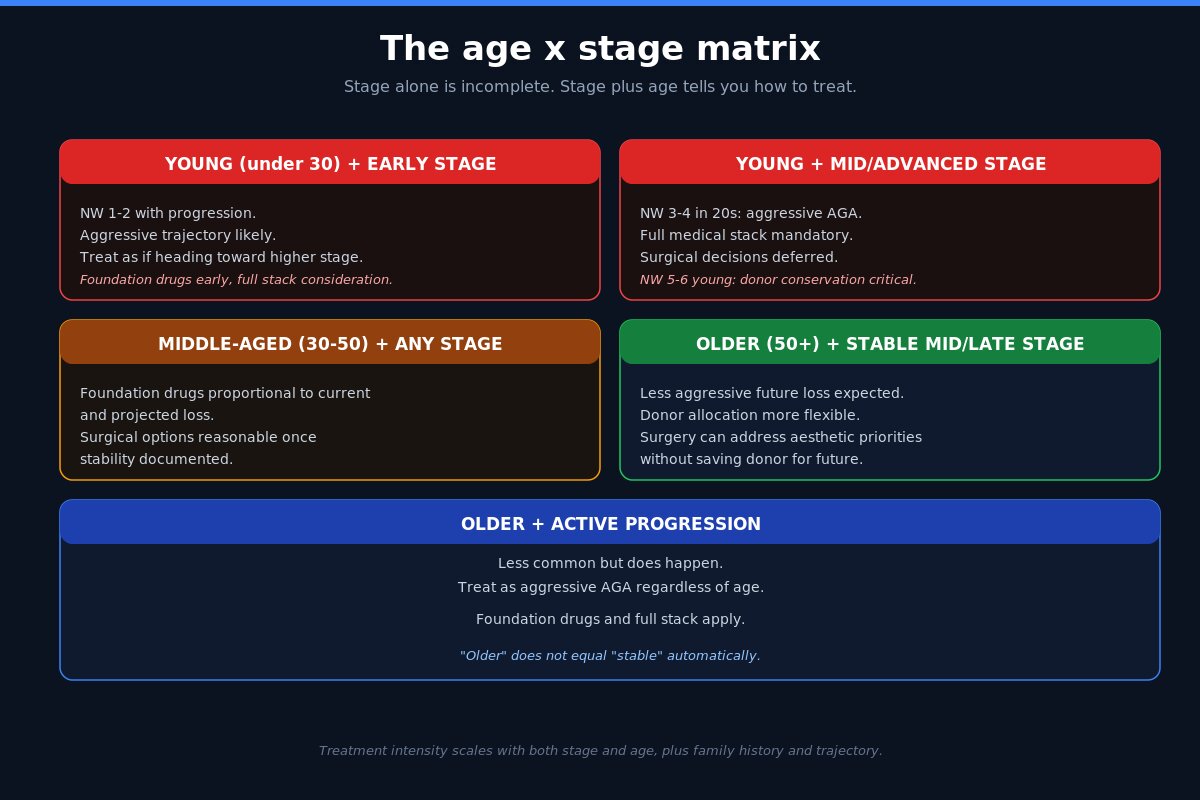
The age x stage matrix
Stage alone is incomplete. Stage plus age tells you how to treat.
Young (under 30) plus early stage (NW 1-2 with progression). Aggressive trajectory likely. Treat as if heading toward higher stage. Foundation drugs early, full stack consideration.
Young plus mid stage (NW 3-4). Aggressive AGA. Full medical stack mandatory. Surgical decisions deferred until stability achieved.
Young plus advanced stage (NW 5-6). Severe AGA. All foundation drugs plus surgical planning. Donor area conservation is critical because future progression demands it.
Middle-aged (30-50) plus any stage. Foundation drugs proportional to current and projected loss. Surgical options reasonable once stability documented.
Older (over 50) plus stable mid-to-late stage. Less aggressive future loss expected. Donor allocation more flexible. Surgery can address aesthetic priorities without worrying about saving donor for unforeseen future loss.
Older plus active progression. Less common but does happen. Treat as aggressive AGA regardless of age.

How to determine your stage accurately
Self-assessment is easy to get wrong because most men either underestimate (denial) or overestimate (anxiety) their stage.
Standardized photography. Front view, both side views, top view, and back view. Same lighting, same angle, same hair condition (dry, no product). Compare to standard Norwood diagrams.
Multiple time-points. One photo set is a snapshot; six months apart is a trajectory. Two years of standardized photos at quarterly intervals is the ideal documentation for trajectory assessment.
Hairline vs crown vs density assessment. The Norwood scale weights frontal recession heavily, but crown thinning and overall density loss can be present without dramatic hairline change. Three-zone assessment (hairline, crown, density) gives a complete picture.
Family history mapping. Father, maternal grandfather, brothers, paternal uncles. Their stages at your age and their final stages. This is one of the strongest predictors of your trajectory.
Dermatologist or hair specialist evaluation. Trichoscopy, pull test, sometimes scalp biopsy. Useful when self-assessment is inconclusive or when atypical features (irregular thinning, scaring, inflammation) suggest non-AGA causes.
Female pattern equivalence
The Norwood scale is male-specific. Female pattern hair loss tends to present differently – more diffuse thinning over the central scalp, less dramatic frontal recession, and often retention of the frontal hairline. Olsen (2011) and the Ludwig scale (1977) describe female-pattern stages.
Strategic framework still holds: stage and trajectory determine strategy. Female-pattern interventions differ in some specifics (spironolactone instead of or alongside finasteride for some patients, hormonal context matters more), but the principle of matching intervention intensity to stage remains the same.
Common myths and where they fail
“Norwood scale is outdated.” Refined and supplemented by other scales (BASP, Norwood-Hamilton variants), but still the working clinical standard. Useful framework for stage-based strategy regardless.
“You can stop progression at any stage.” True for slowing, mostly false for fully stopping. Foundation drugs can dramatically slow but not always stop progression entirely. Trajectory often slows over years on consistent therapy.
“Once you hit Norwood 5, only transplant works.” Foundation drugs still matter at every stage to protect existing hair. Transplant is one tool, not a replacement for the medical layer.
“Stage determines if you should treat.” Stage informs how to treat. The decision to treat is based on trajectory and patient priorities, not stage alone. NW 2 with rapid progression treats more aggressively than stable NW 4.
“My uncle reached Norwood 6, so I will too.” Family history is informative but not deterministic. Modern medical therapy can meaningfully alter the trajectory you would have followed without intervention.
Frequently asked questions about the Norwood scale and treatment strategy
What Norwood stage am I?
Take standardized photos (front, sides, top, back) and compare to the standard Norwood diagrams. If you are between stages, document trajectory over 6-12 months to see direction. A clinician can confirm with trichoscopy if needed.
Can I jump stages?
Progression is usually gradual but can accelerate during periods of life stress, hormonal change, or in genetically aggressive cases. Most men progress one stage per 2-7 years on average without therapy.
Should I start finasteride at Norwood 1-2?
Depends on trajectory and family history. Stable NW 1-2 with no aggressive family history: monitor and consider preservation interventions. NW 1-2 with documented progression or aggressive family history: starting finasteride is reasonable and high-leverage.
Is Norwood 3 the right time to consider transplant?
Almost never. Transplant works best when stability has been established on medical therapy. NW 3 is medical-therapy territory. Surgical evaluation can begin at NW 3-4 once stability is documented for 12-24 months.
What if I am young at Norwood 4-5?
Aggressive AGA. Full medical stack mandatory. Surgical decisions deferred. Donor area conservation is critical. Pipeline therapies (clascoterone, pyrilutamide) worth tracking. Every decision should respect future progression.
Does the Norwood scale apply to women?
Not directly. Female pattern hair loss is more diffuse. Use Ludwig scale or Olsen 2011 framework instead. Treatment strategy by stage still applies.
What is Norwood 3 vertex versus regular Norwood 3?
Both have temple recession. NW 3 is just temple recession. NW 3 vertex adds visible thinning at the crown. Same treatment foundation; vertex variant often progresses more aggressively to NW 4-5.
How do I track my stage over time?
Standardized photography under consistent lighting at the same angles. Quarterly is ideal; annually is the minimum. The eye lies; cameras do not. Without documentation you cannot tell if therapy is working.
Can I reverse my Norwood stage?
Partial reversal is possible with effective therapy in earlier stages. Norwood 3 can sometimes look like Norwood 2 after 12-24 months on full stack. Norwood 5+ rarely fully reverses without surgery; medical therapy preserves and modestly improves but does not regrow significant bald scalp.
Should I start treatment based on stage or trajectory?
Trajectory. Stable Norwood 4 may not need aggressive intervention; rapidly progressing Norwood 2 may need it immediately. Stage informs the type of intervention; trajectory informs the urgency.

Bringing it together
The Norwood scale is a useful map but only half the picture. The other half is trajectory – where you are heading and how fast. The strategic move at every stage is matching intervention intensity to the realistic combination of current stage, age, family history, and progression speed. The biology of androgenetic alopecia is what produces the stages; understanding the underlying program is what lets you intervene at the right level for your specific situation.
For most men in active progression, the foundation is finasteride plus minoxidil plus the layered adjuncts. The decision between finasteride and dutasteride – critical especially at later stages – is covered in when the switch makes sense. For surgical planning at NW 4+ stages, the framework for transplant decision-making is in when transplant actually makes sense. And when protocols stall at any stage, the seven hidden reasons map covered in why your protocol may not be working is the diagnostic to run before changing direction.
This article is for educational purposes only and does not constitute medical advice. Hair loss has multiple potential causes and the right approach depends on your individual history, examination, and trajectory. Speak with a qualified clinician before starting or stopping any treatment. See the full disclaimer.
About the author
Philippe Boissard
Author of Men’s Hairloss Protocol (2020), Better, Smarter, Stronger (2023), and Multi-Axis Body (2025). Researches and writes about hair loss and male physiology, citing primary literature and disclosing affiliate relationships in full. Not a medical doctor; all content is educational. More about Philippe.
Related reading
Get my free hair-loss protocol
The exact evidence-based routine I actually use and recommend: what works, in what order, with no hype. Enter your email on the next page and I’ll send it straight to you.
Send me the free protocol →
[…] on how hair loss actually works explains why active loss keeps expanding the area to cover, the Norwood-scale treatment guide walks through what intervention to consider at each pattern, and the hair cloning pipeline reality […]
[…] Norwood Scale: Treatment Strategy by Stage […]