
Hair Transplant Decision: When It Actually Makes Sense
A hair transplant works under four specific conditions. Stable AGA, adequate donor, realistic expectations, ongoing medical therapy.


A hair transplant is the only intervention in the hair loss toolkit that produces visible new density on bald scalp. It is also irreversible, expensive, and unforgiving of bad timing. The men who get great transplants tend to share four traits – stable AGA, adequate donor area, realistic density expectations, and a long-term plan that includes ongoing medical therapy. The men who get bad transplants share one – they treated the procedure as a one-time fix instead of one piece of a multi-decade strategy.
Quick answer: it makes sense under specific conditions, not as a stand-alone solution
A hair transplant moves follicles from a permanent zone (the back and sides, which are genetically resistant to DHT) into a thinning or bald zone. The transplanted follicles retain their genetic resistance, so they continue producing hair in their new location. This is real and durable – the foundation of modern hair restoration laid out in Bernstein and Rassman (1997) and elaborated by Avram and Rogers (2009).
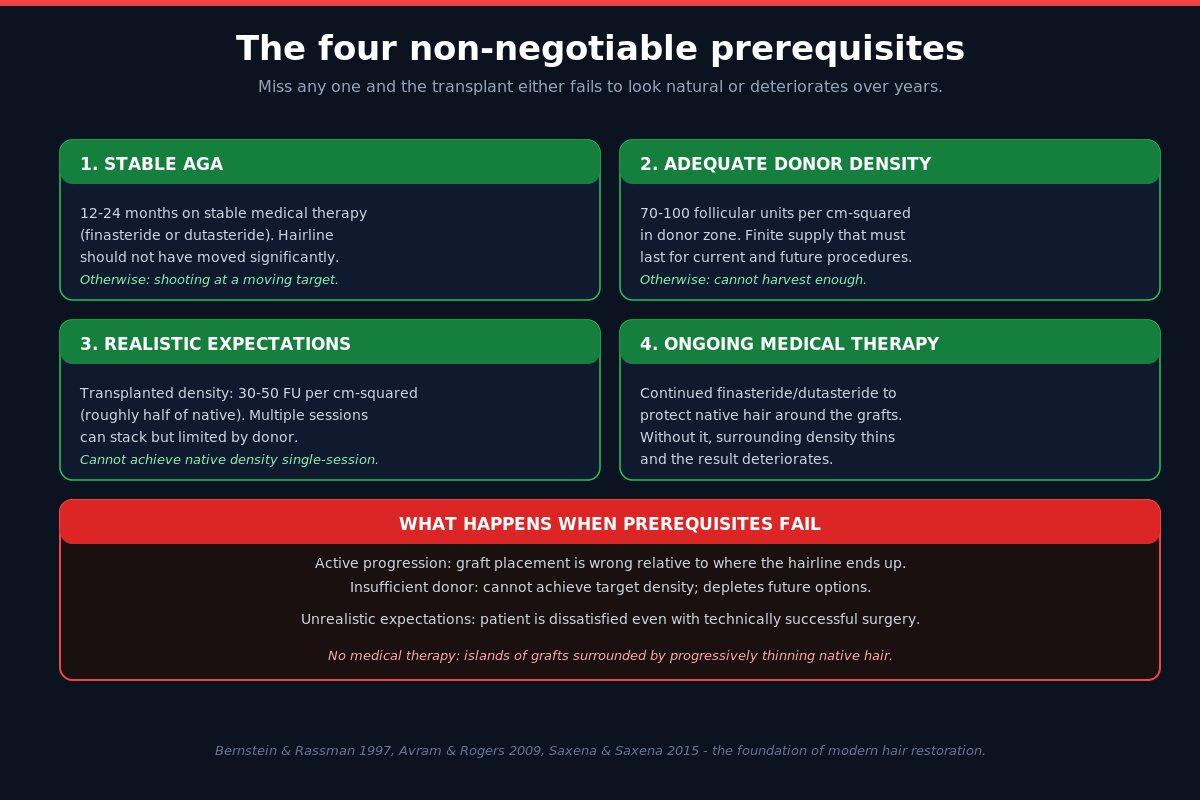
The transplant only works under specific conditions. Saxena and Saxena (2015) and the broader literature converge on four prerequisites: stable AGA progression (otherwise you transplant into a moving target), adequate donor density (otherwise you cannot harvest enough), realistic density expectations (you cannot achieve native density), and ongoing medical therapy to preserve native hair around the grafts (otherwise the gap between transplanted and native hair widens over years).
If those four conditions are met, a transplant is the only intervention that adds genuinely new visible coverage. If any one is missing, the transplant either fails to look natural, depletes donor area for diminishing returns, or produces a result that looks worse over time as native hair continues to recede around it.

What a transplant actually does
The procedure transfers individual follicular units (each a natural grouping of 1-4 hairs) from the donor area to the recipient area. Two main techniques dominate.
FUE (Follicular Unit Extraction). Individual follicular units are removed from the donor area using a 0.7-1.0 mm punch. No linear scar; small dot scars across the donor zone. Healing is faster, recovery is easier, and the donor area can be worn at shorter lengths post-procedure. Most modern transplants use FUE.
FUT (Follicular Unit Transplantation, also called strip). A linear strip of donor scalp is removed and dissected into individual follicular units. Leaves a linear scar that requires longer hair to conceal. Generally yields more grafts per session and somewhat better graft survival rates in experienced hands. Less popular for most patients, but still appropriate for some.
The recipient site is prepared with small incisions. Each graft is placed individually, typically by a team. A typical session moves 1500-3500 grafts (4000-9000 hairs) over 6-10 hours. Larger sessions (5000+ grafts) are possible with proper team and recovery time.
Transplanted follicles enter a temporary shock loss phase, shed for 2-3 months, then begin regrowing. Visible regrowth starts at 4-6 months, with most of the final result visible at 12-15 months.
The four prerequisites
Each condition matters. Missing one compromises the result.
Prerequisite 1: Stable AGA. If your hairline is actively receding while you transplant, the surgeon is shooting at a moving target. The graft placement may look correct now but be in the wrong position relative to your natural hairline two years from now. The standard rule is at least 12-24 months on stable medical therapy (typically finasteride or dutasteride) before considering a transplant. The hairline should not have moved significantly during that period.
Prerequisite 2: Adequate donor density. The back and sides have a finite supply of follicles. Typical donor density is 70-100 follicular units per square centimeter. Larger transplants harvest more grafts, but every graft taken from donor reduces what is available for future procedures. A 5000-graft mega-session in a man with low donor density may leave him unable to do touch-up work in 10 years.
Prerequisite 3: Realistic density expectations. Native scalp density is roughly 80-100 follicular units per square centimeter in a healthy scalp. Transplanted density is typically achievable at 30-50 follicular units per square centimeter in a single session – around half of native. Multiple sessions can build density further but are limited by donor availability. Patients expecting full native-density restoration in a single session are setting up for disappointment.
Prerequisite 4: Ongoing medical therapy. Transplanted follicles are DHT-resistant. Native follicles around them are not. Without continued finasteride or dutasteride, the native hair continues to miniaturize and thin over the years following the transplant. The result: islands of transplanted density surrounded by progressively thinning native hair, which looks worse over time. Almost every reputable surgeon requires ongoing medical therapy as a precondition.
When transplants make sense
Specific situations where the math works.
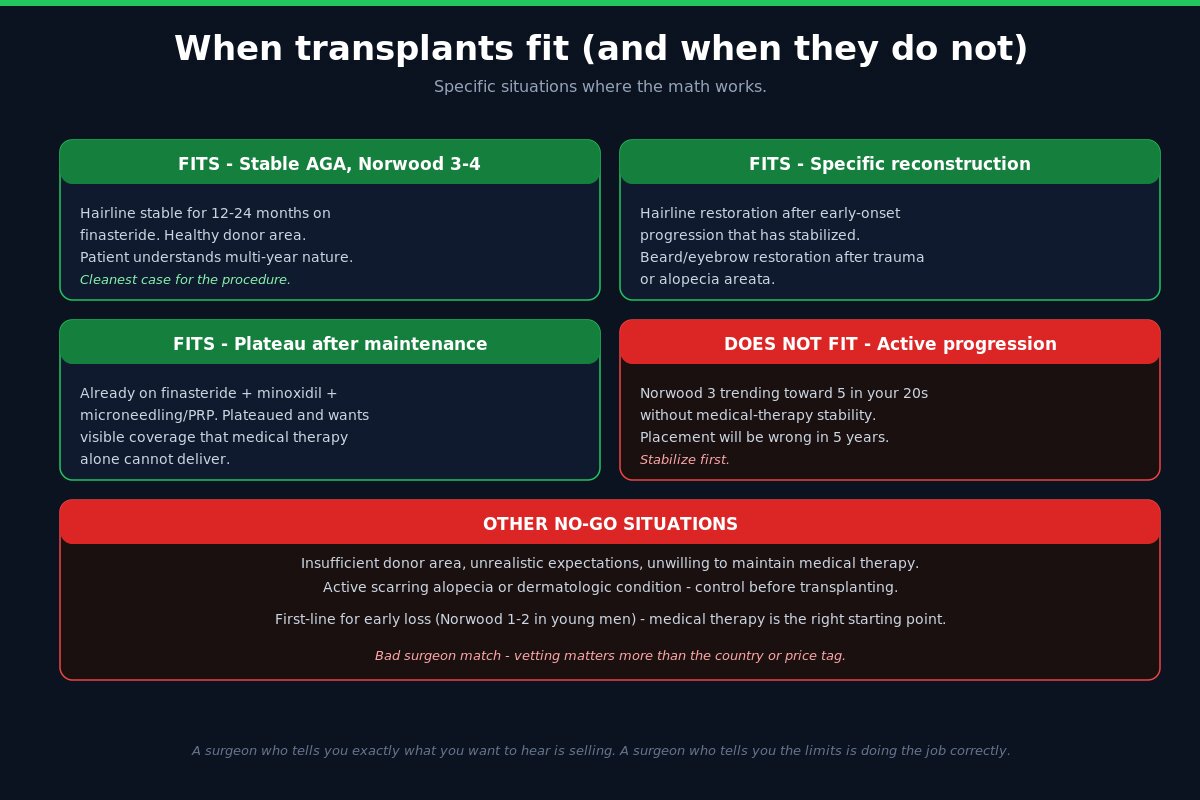
Stable AGA with established loss. Norwood 3-4 with hairline that has not progressed for 12-24 months on finasteride. Donor area is healthy. Patient understands the multi-year nature of the result.
Specific reconstruction needs. Hairline restoration after early-onset progression that has now stabilized. Crown thickening for someone who maintains a longer hairstyle. Beard or eyebrow restoration after trauma or alopecia areata.
Combined with maintenance protocol. A man already on finasteride plus minoxidil plus maintenance microneedling or PRP, who has plateaued and wants visible coverage that medical therapy alone cannot deliver.
Older age with limited remaining loss potential. Men in their 50s and 60s with stable Norwood 4-5 patterns where future progression is limited. Donor area can be allocated to specific aesthetic priorities without worry about needing it for unforeseen future loss.
When transplants do not make sense (yet, or at all)
Active rapid progression. Norwood 3 trending toward Norwood 5 in your 20s without medical therapy stability. Transplant placement will be wrong relative to where your natural hairline will be in 5 years.
Insufficient donor area. Already-thin sides and back, low follicular unit density, or donor scalp affected by diffuse thinning. The transplant cannot deliver the density needed and depletes what donor remains.
Unrealistic expectations. Wanting Norwood 1 hairline density restored on a Norwood 6 head. The math does not work. Setting expectations honestly is the surgeon’s job; refusing to operate is sometimes the right call.
Unwilling to maintain medical therapy. If finasteride is off the table for any reason and you are early in the AGA process, the transplant will look worse over years as the surrounding native hair thins. Some surgeons will operate anyway; the result deteriorates.
Severe scarring alopecia or active dermatologic condition. Active scalp inflammation, scarring conditions like lichen planopilaris, or other dermatologic processes need to be controlled first. Transplanting into actively inflamed scalp produces poor results.
First-line for early loss. Norwood 1-2 in a young man should not be transplanted as a starting move. Medical therapy is the right starting point; transplant comes later if needed and only after stability.
Watch this for the preservation framing
This video covers how to maintain hair while running other interventions that put pressure on the system. Same principle applies to transplants: the procedure does not exist in isolation. The native hair around the grafts continues to age and respond to DHT, and your maintenance protocol determines whether the surrounding density complements the transplant or lags behind it. Long-term results are made or broken by the medical therapy layer.

FUE vs FUT in 2026
Both techniques are still used. The choice depends on patient priorities and surgical context.
FUE advantages: No linear scar. Faster recovery. Donor area can be worn shorter post-procedure. More common today; most clinics default to FUE.
FUE disadvantages: Smaller scars distributed across the donor area can become visible if the donor is shaved very short. Graft survival is technique-dependent and can be lower than FUT in inexperienced hands. Single-session graft counts are more limited.
FUT advantages: Higher graft yields per session. Generally higher graft survival rates in experienced hands. Donor area visible variation is concentrated in one linear area that can be hidden under hair.
FUT disadvantages: Linear scar requires hair length to conceal (usually at least an inch). Longer recovery. Some patients have visible scar widening over time.
For most patients in 2026, FUE is the default choice. Patients who plan to wear their hair very long, need maximum grafts in a single session, or who prioritize graft survival above all else may benefit from FUT.

Cost and what to expect
Pricing varies enormously by geography and surgeon experience.
United States and Western Europe: $4-15 per graft. A 2500-graft session ranges $10,000-37,500. Top-tier surgeons charge at the higher end.
Turkey, India, Mexico: $1-3 per graft. The same 2500-graft session ranges $2,500-7,500. Quality varies significantly between clinics.
What you are paying for: Surgeon experience, team competence, post-operative support, equipment quality, and the realistic outcome distribution at that clinic. Cheap is not always bad and expensive is not always good, but the floor for quality is generally higher in regulated markets.
Recovery timeline: Visible scabbing for 7-10 days. Shock loss starts 2-4 weeks post-op and continues for 2-3 months. Visible regrowth begins month 4-6. Final result at 12-15 months. Some final maturation continues through 18-24 months.
Pain and discomfort: Local anesthesia during the procedure. Mild discomfort for 3-7 days post-op, manageable with standard analgesics. Most patients return to office work in 5-10 days.
Vetting a clinic and surgeon
Critical questions before booking.
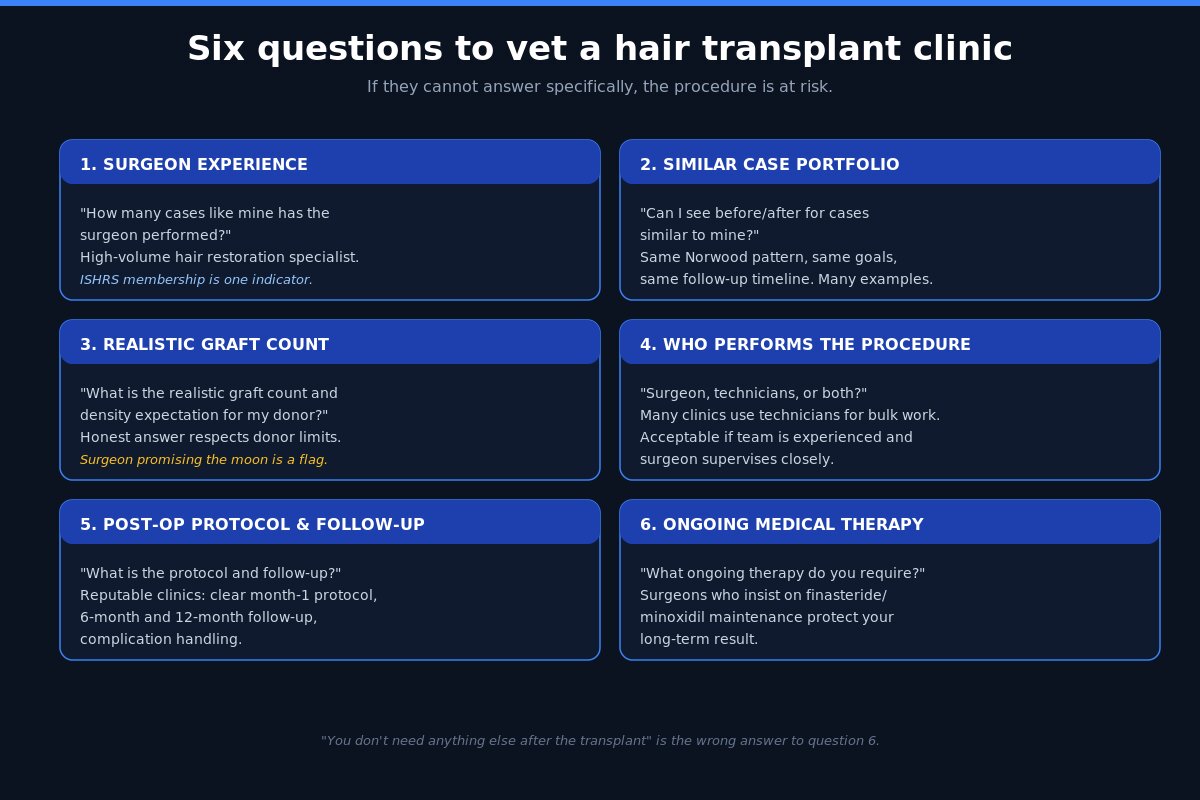
How many cases like mine has the surgeon performed? Look for high-volume hair restoration specialists, not general dermatologists or aesthetics doctors who do hair occasionally. ISHRS membership is one indicator.
Can you see before-and-after photos of cases similar to mine? Same Norwood pattern, same hairline shape goal, same follow-up timeline. A good surgeon has many of these. Cherry-picked best-case photos are easy to fake; consistency across many similar cases matters.
What is the realistic graft count and density expectation for my donor area? A surgeon who tells you exactly what you want to hear is selling. A surgeon who tells you the limits of what your donor can deliver is doing the job correctly.
Who actually performs the procedure? The surgeon, technicians, or both? In some clinics, technicians perform the bulk of the work with the surgeon supervising. This can be fine if the team is experienced; it is a problem if the surgeon is barely involved.
What is the post-operative protocol and follow-up? Reputable clinics have a clear protocol for the first month, a follow-up at 6 months, and at 12 months. They handle complications. Drop-and-disappear surgeons are a problem.
What ongoing medical therapy do they require or recommend? Surgeons who insist on finasteride/minoxidil maintenance are protecting your long-term result. Surgeons who say “no need, the transplant is permanent” are oversimplifying and you will regret it in 10 years.
Combining transplant with the rest of the protocol
The transplant is one intervention layered into a long-term strategy.
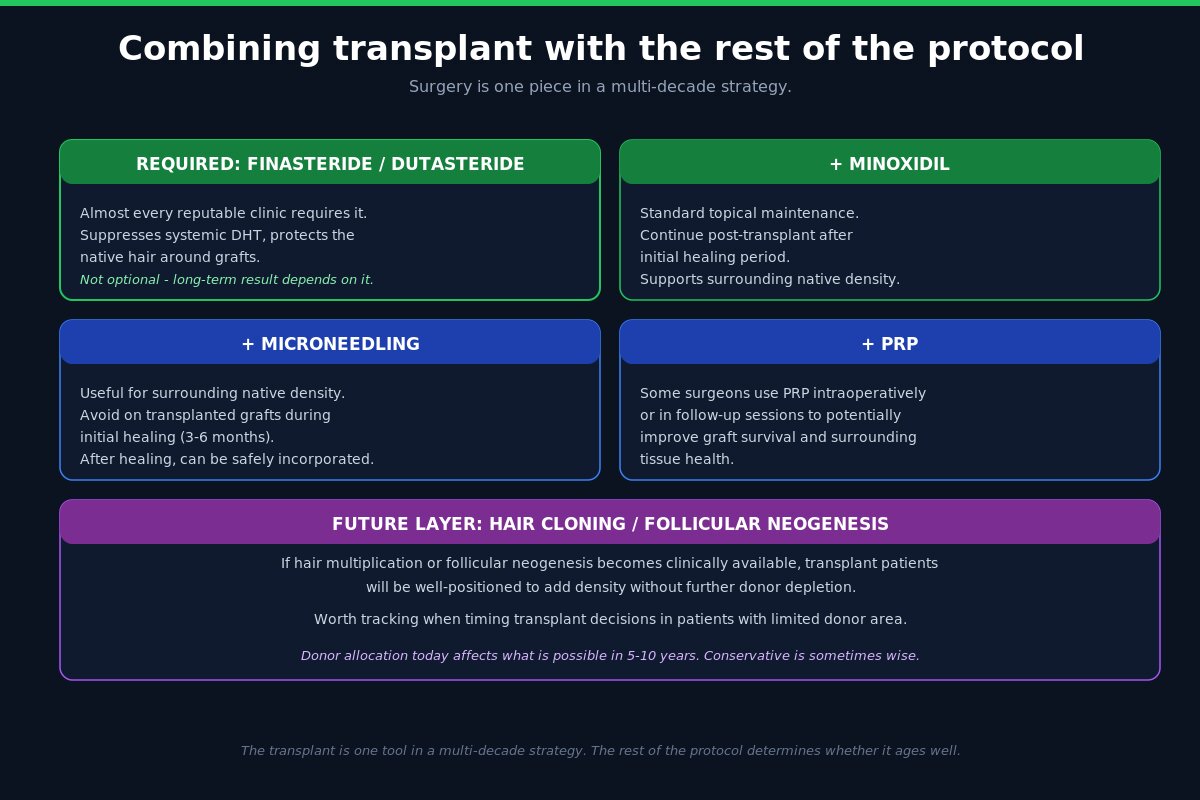
+ Finasteride or dutasteride. Required by almost every reputable clinic. Suppresses DHT systemically and protects the native hair around grafts. Without this, the surrounding density continues to thin and the transplant looks worse over years.
+ Minoxidil. Standard topical maintenance. Continue post-transplant.
+ Microneedling. Useful for surrounding native density. Not on transplanted grafts during initial healing (3-6 months); after that, microneedling can be safely incorporated.
+ PRP. Some surgeons add PRP intraoperatively or in follow-up sessions to potentially improve graft survival and surrounding tissue health. Evidence is suggestive but not definitive.
+ Future hair cloning or pipeline therapies. If hair multiplication or follicular neogenesis becomes clinically available, the transplant patient is well-positioned to add density without further donor depletion. Worth considering when timing transplant decisions in patients with limited donor area.
Common myths and where they fail
“A hair transplant is permanent and you do not need anything else.” No. Transplanted grafts are durable but the surrounding native hair continues to age. Without ongoing medical therapy the surrounding density thins and the transplant looks worse over years.
“You can transplant any number of grafts.” No. Donor area is finite. Mega-sessions of 5000+ grafts in low-density donors can leave patients unable to do touch-up work later. Realistic graft counts respect the donor.
“Cheaper transplants in Turkey are just as good.” Sometimes. The Turkey market includes both excellent and poor clinics. Vetting matters more than the country. Cheap is not automatically bad; expensive is not automatically good. Quality consistency is what matters.
“Hair transplant solves baldness in one visit.” No. Most patients need multiple sessions over years to build the density they want. The first session establishes coverage; later sessions refine.
“Transplanted hair never falls out.” Mostly true but with caveats. Transplanted follicles are DHT-resistant but not immune to other causes of hair loss (nutrient deficiency, severe TE, scarring conditions). Day-to-day hair loss looks the same as native hair.
Frequently asked questions about hair transplants
How young is too young for a hair transplant?
Generally, men under 25-28 should not have transplants unless there is a strong specific reason and stable AGA documented over years. Early transplants in young men with active progression often produce results that look unnatural as the rest of the hair continues to recede.
How much does a hair transplant actually cost?
$2,500-7,500 for medical-tourism destinations like Turkey or India for a 2500-graft session. $10,000-37,500 in the US/Western Europe for the same session size. Top-tier surgeons in regulated markets charge at the higher end.
How long does the result last?
Transplanted grafts are DHT-resistant and durable indefinitely. The native hair around them continues to age. With ongoing medical therapy, results can look excellent for decades. Without therapy, results deteriorate as native hair recedes.
Will I need a second transplant?
Many patients do, either to add density to the original area or to address new areas of loss that emerged. Conservative first sessions and ongoing medical therapy reduce this need.
What is the realistic density I can achieve?
Native scalp is 80-100 follicular units per square centimeter. Transplanted density is typically 30-50 per session. Multiple sessions can stack but are limited by donor area. Density goals should be set with the surgeon based on your specific donor evaluation.
What happens if I stop finasteride after a transplant?
Native hair around the grafts continues to thin and miniaturize. Over 5-10 years, the gap between transplanted density and native hair widens, producing islands of grafts surrounded by progressively thinner native scalp. Aesthetic result deteriorates significantly.
Can women get hair transplants?
Yes, with case selection. Female pattern hair loss is more diffuse and the donor area is less reliably DHT-resistant. Donor evaluation is critical. Reputable surgeons turn down many female candidates because the math does not work for them specifically.
Does the procedure hurt?
Local anesthesia during the procedure. Mild-to-moderate post-op discomfort for 3-7 days, manageable with standard analgesics. Most patients return to office work in 5-10 days.
Are FUE scars completely invisible?
Smaller and harder to see than FUT linear scars. Visible if the donor is shaved very short or has been over-harvested. Most patients can wear hair at standard lengths without visible donor scarring.
What if my transplant looks bad?
Bad transplants happen, mostly due to poor surgeon selection or unrealistic expectations. Some can be partially corrected by experienced revision surgeons; others cannot. Vetting before the first procedure is the most important step.

Bringing it together
A hair transplant is a real and durable intervention when the prerequisites are met. The four conditions are non-negotiable: stable AGA, adequate donor area, realistic density expectations, and ongoing medical therapy. Get one wrong and the result either fails to look natural or deteriorates over years. Get all four right and the procedure produces visible new coverage that lasts. The biology of hair loss explains why DHT-resistant donor follicles retain their resistance after transplant; that is the entire reason transplants work.
For most men, the transplant decision should come after years of medical therapy stabilization, not as a first move. The choice between finasteride alone, finasteride plus dutasteride, and the broader question of when to switch from finasteride to dutasteride is foundational to the long-term hair plan that a transplant fits into. For men with limited donor area, the developing pipeline of hair cloning and follicular neogenesis therapies is worth tracking because future density-additive procedures could meaningfully change the donor-allocation math. The protocol is multi-decade; transplant is one tool within it.
This article is for educational purposes only and does not constitute medical advice. Hair loss has multiple potential causes and the right approach depends on your individual history, examination, and donor area evaluation. Surgical decisions should always be made with a qualified hair restoration surgeon. See the full disclaimer.
About the author
Philippe Boissard
Author of Men’s Hairloss Protocol (2020), Better, Smarter, Stronger (2023), and Multi-Axis Body (2025). Researches and writes about hair loss and male physiology, citing primary literature and disclosing affiliate relationships in full. Not a medical doctor; all content is educational. More about Philippe.
Related reading
Get my free hair-loss protocol
The exact evidence-based routine I actually use and recommend: what works, in what order, with no hype. Enter your email on the next page and I’ll send it straight to you.
Send me the free protocol →
[…] sense. For surgical planning at NW 4+ stages, the framework for transplant decision-making is in when transplant actually makes sense. And when protocols stall at any stage, the seven hidden reasons map covered in why your protocol […]
[…] Hair Transplant Decision: When It Actually Makes Sense […]
[…] Hair Transplant Decision: When It Actually Makes Sense […]