
Hair Loss in Your 20s vs Your 40s: Different Strategies by Decade
Earlier onset deserves more aggressive treatment, not less. Preservation compounds across decades. Here is the framework for matching strategy to age, by decade.


The same drug at the same dose produces a different optimal strategy depending on when in life the man is taking it. A 24-year-old with progressing hair loss is solving a different problem than a 44-year-old with progressing hair loss, and the same protocol applied to both is the wrong protocol for at least one of them. Earlier onset means more aggressive androgenetic alopecia trajectory, more years of cumulative miniaturization to prevent, and more reasons to start aggressive treatment fast. Later onset means slower progression, more conservative options, and a different math on the cost-benefit ratio of every intervention. This article is the framework for matching strategy to timeline.
Quick answer: should strategy change with age?
Yes. The biology is the same but the trajectory is different. A 22-year-old with visible Norwood 2 progression has decades of AGA ahead, often a more aggressive form, and the math on starting finasteride immediately is different from the same drug being started at 45 with the same Norwood stage. The 22-year-old gets more lifetime benefit from preservation; the 45-year-old gets less marginal benefit and faces more competing health considerations. Strategy varies by decade, by Norwood stage at first observation, and by progression rate.
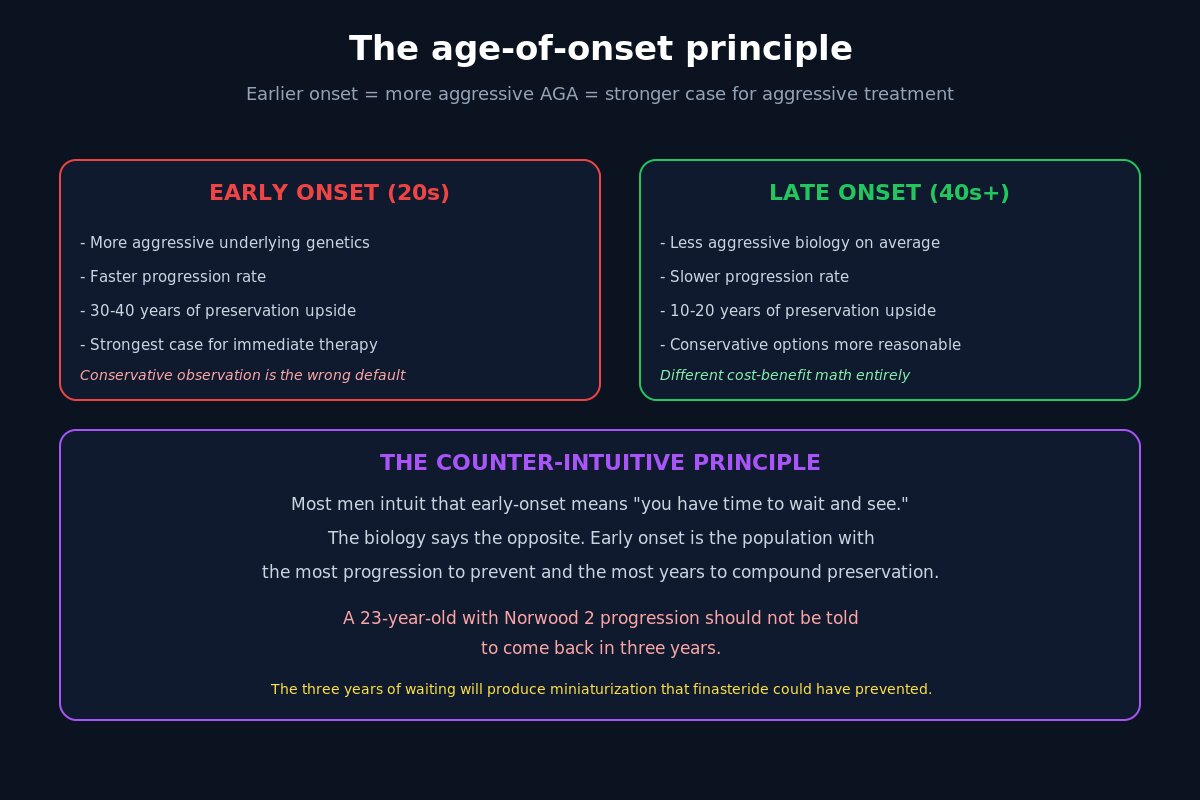
The age-of-onset principle
The earlier AGA onset occurs, the more aggressive the underlying genetics tend to be. Men who hit Norwood 2 in their early twenties typically progress faster across their thirties and forties than men who hit Norwood 2 at 35. This is partly genetics – early-onset alleles cluster – and partly the simple fact that more years of androgen exposure produce more miniaturization in a sensitive scalp. The clinical implication is that early onset is a stronger indication for aggressive treatment, not weaker.
The reverse is also true. Men whose AGA does not become visible until their forties often have less aggressive underlying biology, slower progression rate, and more time to evaluate intervention before significant loss accumulates. The strategy can be more conservative because the math is different.
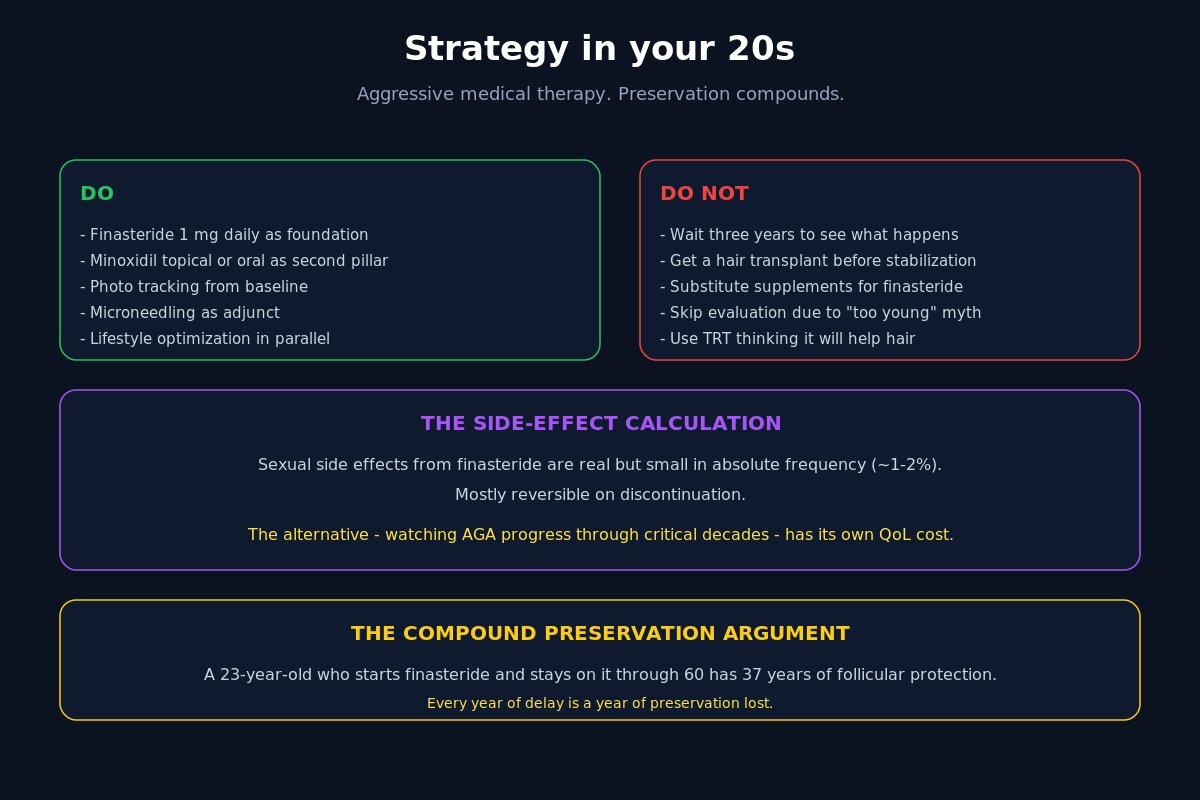
Strategy in your 20s
The man in his twenties with visible AGA progression has the strongest indication for aggressive medical therapy. Finasteride 1 mg daily is the foundational intervention. Minoxidil topical or oral is the second pillar. Both should be started early because the goal is preservation, not regrowth, and preservation math compounds across decades. A 23-year-old who starts finasteride and stays on it through age 60 has roughly 37 years of compounded follicular protection. A 40-year-old starting the same drug has 25 fewer years of preservation upside.
The arguments against aggressive early treatment usually center on side-effect risk, particularly sexual side effects from finasteride. The data on this risk is real but the absolute frequency is small (1-2% in trials, somewhat higher in observational studies), the side effects are mostly reversible on discontinuation, and the alternative – watching AGA progress through critical social and professional decades – has its own quality-of-life cost that men frequently underweight when they are 22.
Photo tracking is essential in the twenties because progression is often subtle month-to-month and only becomes obvious in retrospect. Microneedling is reasonable as an adjunct. Hair transplantation is not indicated yet because the loss pattern has not stabilized; a 24-year-old who gets a hair transplant before his AGA has stabilized will need additional procedures every 3-5 years to chase progressing loss behind the transplanted line.
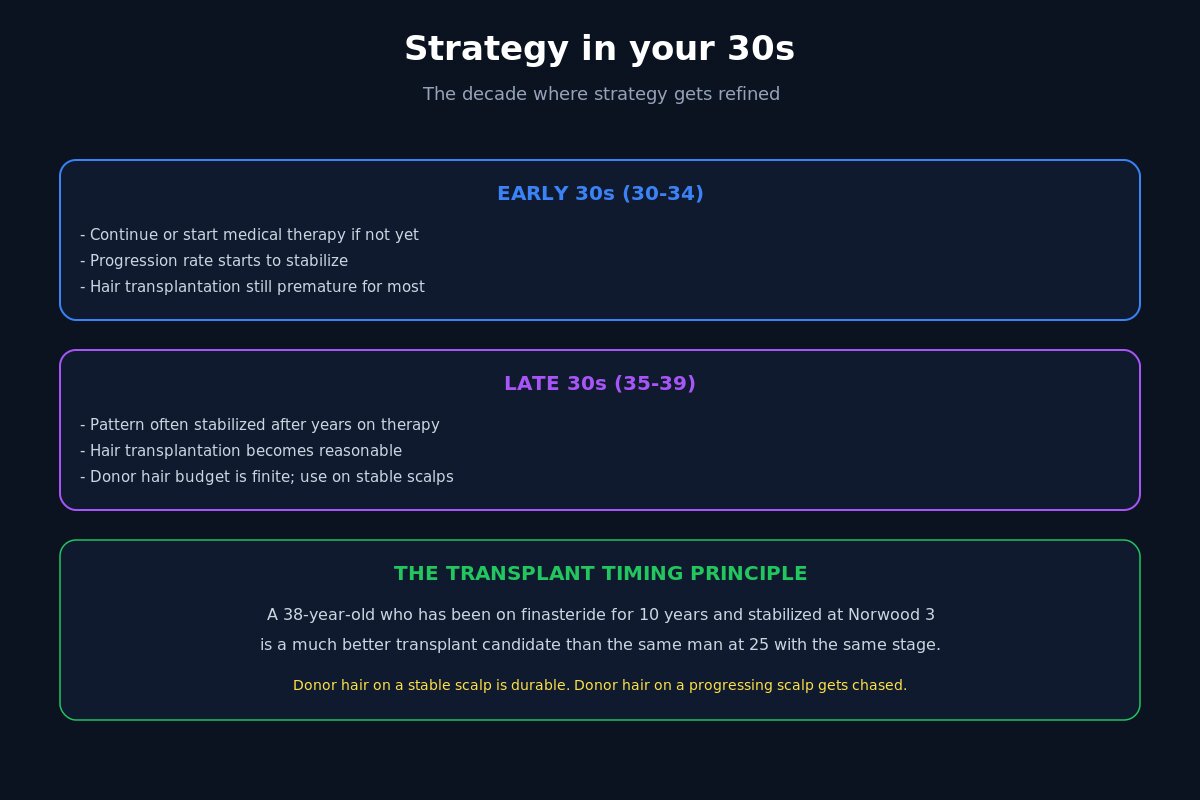
Strategy in your 30s
The thirties are the decade where most men either commit to long-term medical therapy or accept a Norwood progression they will live with. The progression rate has typically stabilized somewhat by the early thirties, which makes it easier to predict trajectory and design intervention. Finasteride and minoxidil are still the foundation. The decision about hair transplantation becomes more reasonable in the late thirties, after several years of medical therapy have stabilized the pattern.
The man in his late thirties who has been on finasteride for ten years and has stabilized at Norwood 3 is a much better transplant candidate than the same man at 25 with the same Norwood stage but unstable progression. Donor hair budget is finite; using it on a stable scalp is a much better return than using it on a progressing scalp.
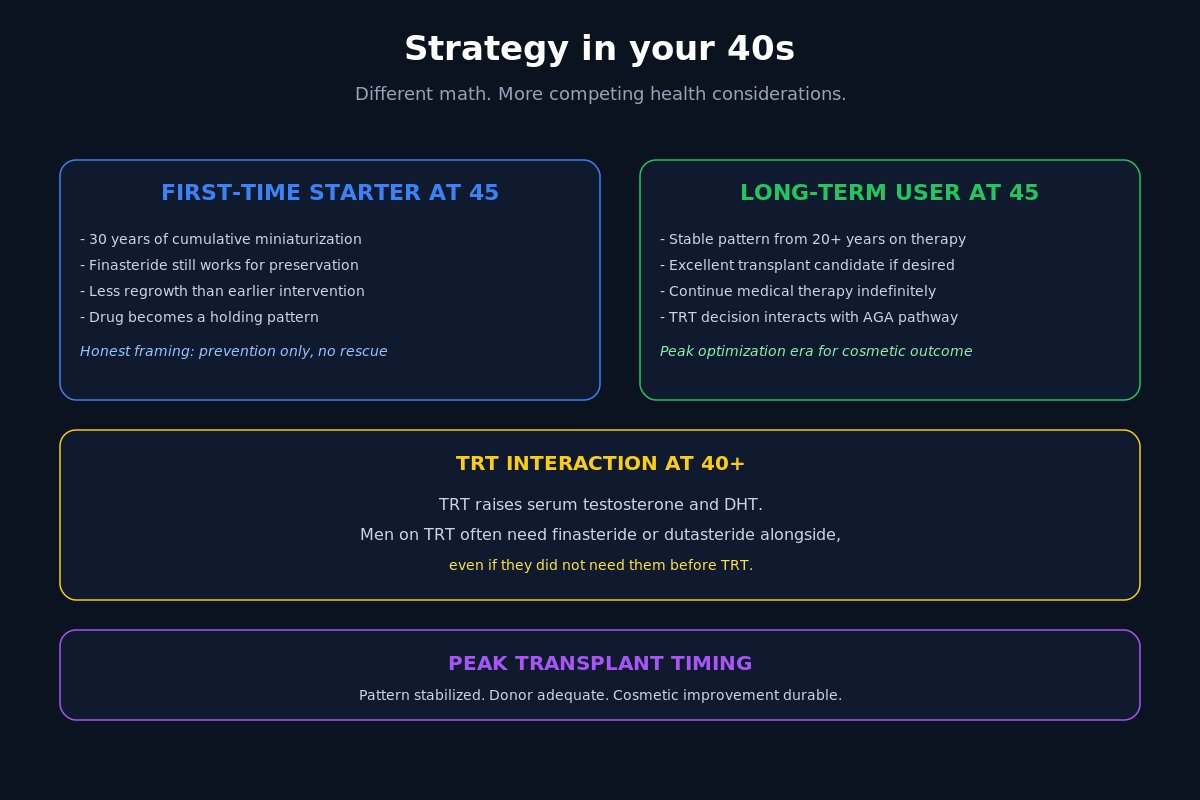
Strategy in your 40s
The forties bring different considerations. Progression rate slows further. Other health factors – cardiovascular risk, metabolic markers, testosterone trajectory – become more relevant. The decision about TRT enters the picture for some men, and TRT interacts with the AGA pathway in ways the man at 22 did not have to think about. The cost-benefit math on every intervention shifts toward what works without significant downside, because total downside-years are fewer.
For a 45-year-old starting finasteride for the first time, the calculation is different from the 25-year-old. He has 30 years of cumulative miniaturization that finasteride cannot reverse, only prevent further. He gets the preservation benefit but not the regrowth that earlier intervention would have produced. The drug still works; the upside is just smaller. The honest framing is that finasteride at 45 is a holding pattern.
Hair transplantation in the forties is at peak reasonable timing. Pattern is stabilized. Donor hair is still adequate. Cosmetic improvement is durable because there is less progressing loss to chase. The trade-off is whether the man wants to invest the cost and recovery time at 45 vs accepting the existing stage as the new baseline.
Watch this on the channel
How I Keep My Hair on TRT – frames how aging biology interacts with the AGA pathway and why the calculation shifts across decades.
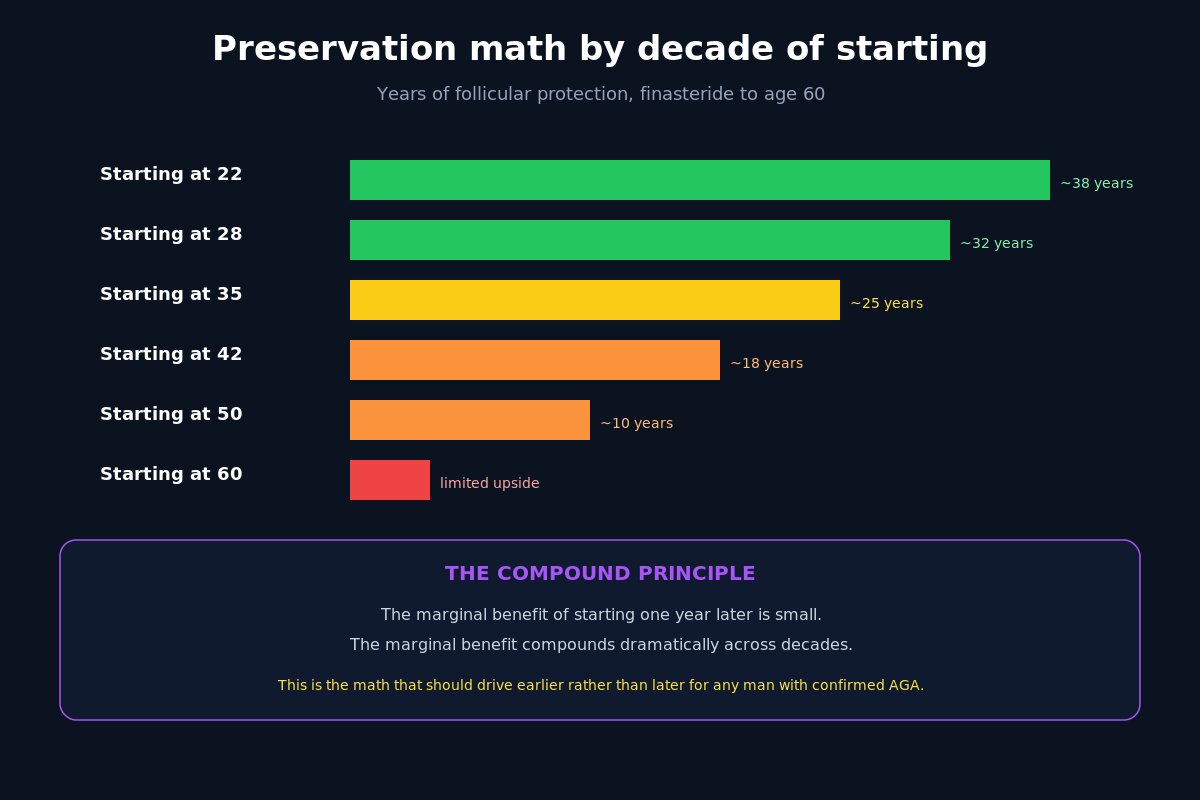
The preservation math by decade
The preservation argument compounds. Finasteride started at 22 prevents an estimated 30-40 years of AGA progression. Started at 32, it prevents 20-30 years. Started at 42, it prevents 10-20. The marginal benefit of starting one year later is small for any single year but compounds dramatically across decades. This is the math that should drive earlier rather than later decision-making for any man with confirmed AGA progression.
The opposite math also matters. A 60-year-old at Norwood 6 has very limited upside from any intervention. The donor hair budget for a transplant is constrained by what is left at the back and sides. Finasteride preservation is now small in absolute terms because the timeline ahead is short and the existing miniaturization is large. The honest framing for late-onset late-stage AGA is acceptance plus possibly limited cosmetic intervention if the man wants it.
Earlier onset = more aggressive treatment
The clinical principle that aligns with the biology: earlier onset deserves more aggressive treatment, not less. Most men intuitively go in the opposite direction. They feel young, the loss seems early, they assume there is time to wait and see. The actual genetics suggest the opposite. Early onset is the population that benefits most from immediate intervention because they have the most progression to prevent and the most years to compound the preservation.
This means: a 23-year-old with Norwood 2 progression should not be told to come back in three years to see if it gets worse. He should be offered the conversation about finasteride immediately because the three years of waiting will produce miniaturization that finasteride could have prevented. Conservative observation is the wrong default for early-onset AGA.
Common myths about hair loss strategy by age
The myth that “you are too young for finasteride” misjudges the biology entirely – earlier onset is the stronger indication. The myth that “wait and see” is the conservative move ignores the compound progression of untreated AGA. The myth that older men should not start finasteride because the upside is small confuses upside with stability – finasteride at 50 is still preventing further loss even if it does not regrow. The myth that hair transplantation should happen as soon as possible inverts the actual logic – donor hair is finite and should be used on stable patterns. The myth that lifestyle changes can substitute for medical therapy in early-onset AGA wastes the years that matter most.
Frequently asked questions about hair loss strategy by age
What age should I start finasteride?
As soon as you have confirmed AGA progression. There is no “too young” cutoff for finasteride if the loss is progressing. The drug is approved for men 18 and over and the preservation benefit compounds with earlier start.
Is finasteride less effective in older men?
Modestly. Older men typically have more cumulative miniaturization to reverse, which limits regrowth potential. The preservation benefit (preventing further loss) is similar across ages. Older men should not skip the drug; they should adjust their expectations about regrowth.
When is the best age for a hair transplant?
Late thirties to fifties for most men. The pattern needs to have stabilized, ideally with several years of medical therapy showing no further progression. Younger transplants risk chasing progressing loss. Older transplants face donor hair limits if loss is advanced.
Should men in their 20s try lifestyle changes first?
Lifestyle is worth optimizing in any decade, but as a substitute for finasteride in early-onset AGA, it is the wrong play. The years of progression saved by finasteride cannot be recovered later. Lifestyle plus finasteride is better than either alone.
Does AGA progression slow down with age?
Yes, on average. Most men’s AGA progression rate is fastest in the twenties and early thirties and slows by the late thirties to forties. This is part of why early intervention is more impactful – you are intervening during the steepest part of the progression curve.
Is it ever too late to start treatment?
Rarely “too late” in absolute terms, but the upside shrinks as cumulative miniaturization grows. A 65-year-old at Norwood 6 will get less benefit from finasteride than a 25-year-old at Norwood 2. Whether the small benefit is worth it becomes a personal-value decision.
Should I worry about side effects more in my 50s?
Side-effect frequency is broadly similar across age groups. Older men sometimes have more sensitivity to changes in sexual function due to baseline testosterone changes, but the actual frequency of finasteride sexual side effects is not strongly age-dependent in the trial data.
How does TRT change the strategy?
TRT raises serum testosterone and DHT, which can accelerate AGA progression. Men on TRT in their forties or fifties often need finasteride or dutasteride alongside the TRT to maintain hair, even if they did not need them before TRT. This is one of the most common interactions in the 40+ AGA population.
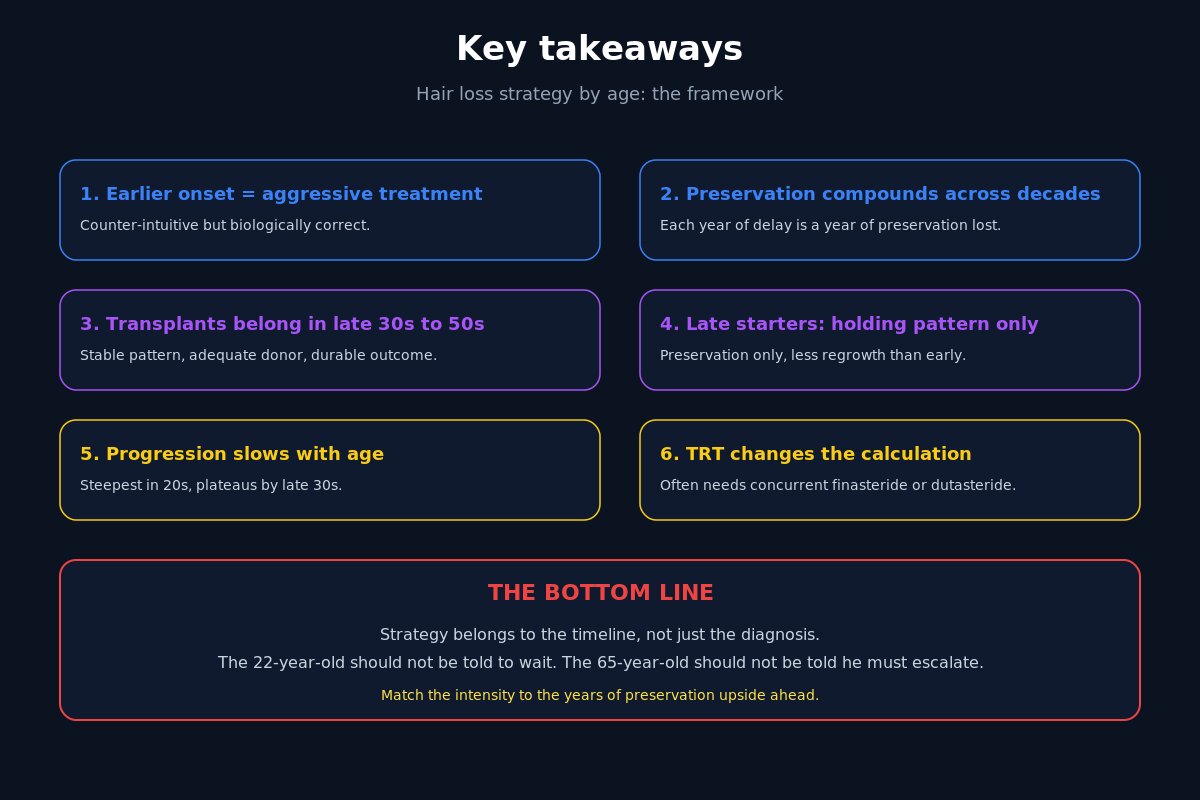
Bringing it together
The biology of AGA does not change with age but the math around it does. Earlier onset is a stronger case for aggressive medical therapy because preservation compounds across decades. Later onset deserves more conservative consideration because the upside is smaller and the alternative interventions need to clear a different cost-benefit threshold. Hair transplantation is best done in the late thirties to fifties when patterns have stabilized. The 22-year-old should not be told to wait. The 65-year-old at Norwood 6 should not be told he must start aggressive therapy. The strategy belongs to the timeline, not just to the diagnosis.
About the author
Philippe Boissard
Author of Men’s Hairloss Protocol (2020), Better, Smarter, Stronger (2023), and Multi-Axis Body (2025). Researches and writes about hair loss and male physiology, citing primary literature and disclosing affiliate relationships in full. Not a medical doctor; all content is educational. More about Philippe.
Related reading
Get my free hair-loss protocol
The exact evidence-based routine I actually use and recommend: what works, in what order, with no hype. Enter your email on the next page and I’ll send it straight to you.
Send me the free protocol →