
PRP for Hair Loss: Protocol, Evidence, and Realistic Expectations
Platelet-rich plasma works in mild-to-moderate AGA when properly administered. Effect tier similar to topical minoxidil. Protocol variability drives outcome variability between clinics.

PRP for hair loss is real, expensive, variable, and protocol-sensitive. The literature is positive overall and the mechanism is plausible, but reading the trials carefully reveals why some clinics produce dramatic results and others produce nothing: centrifugation method, platelet concentration, injection technique, and treatment frequency vary enormously. The honest framing is that PRP works under specific conditions and is unreliable under loose ones.
Quick answer: real intervention, protocol-dependent, reasonable mid-tier option
Platelet-rich plasma (PRP) involves drawing the patient’s blood, centrifuging it to concentrate platelets, and injecting that concentrate into the scalp. The platelets release growth factors (PDGF, VEGF, IGF, EGF, others) that stimulate follicular activity and modestly improve hair count over 3-6 months. Gentile et al. (2015) showed clinically meaningful hair count and density gains in a randomized half-scalp comparison. Alves and Grimalt (2016) added systematic-review confirmation. Gupta and Carviel (2017) catalogued the protocol variability that drives outcome variability.
The honest framing: in the right hands with the right protocol, PRP produces real but moderate improvements. As an adjunct alongside finasteride and minoxidil, it can be the difference between “stable but no regrowth” and “stable plus modest density improvement.” It is not a cure, not equivalent to a hair transplant, and not magic.
How PRP actually works
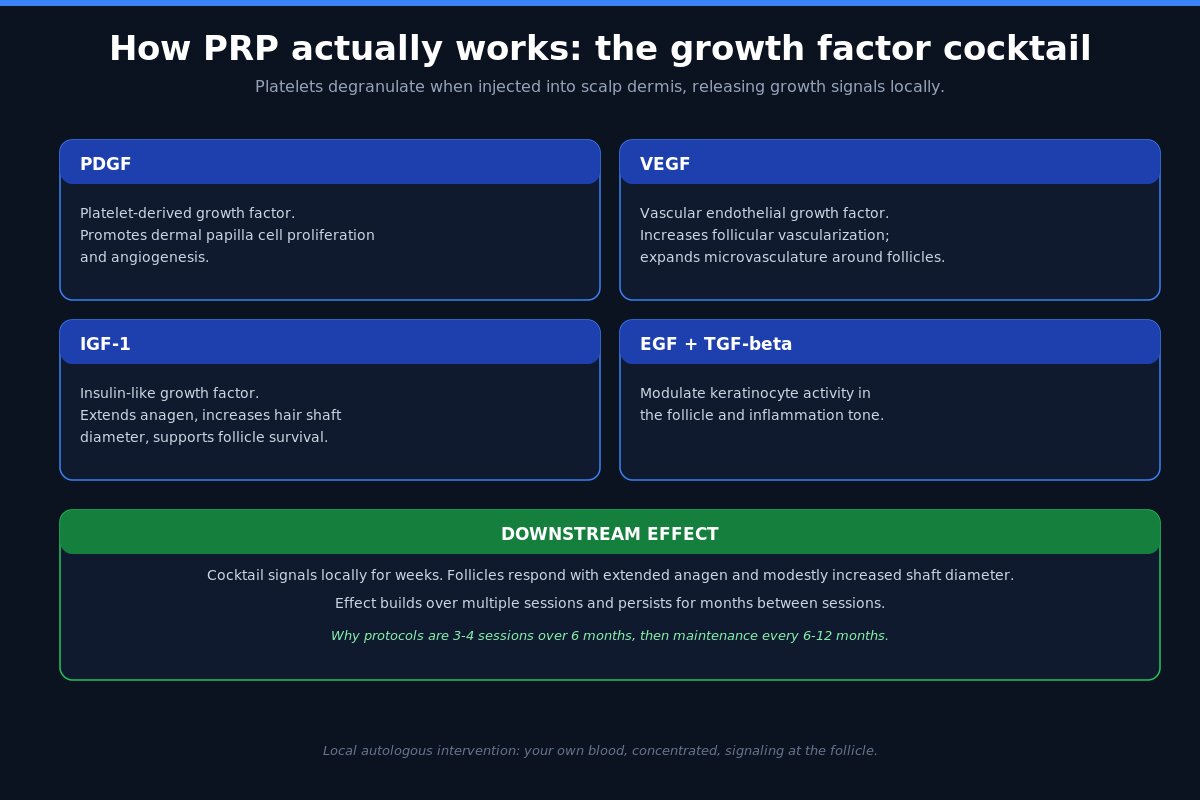
The mechanistic basis is the cocktail of growth factors released when platelets degranulate. Key players include:
PDGF (platelet-derived growth factor). Promotes dermal papilla cell proliferation and angiogenesis. Direct relevance to follicular activity.
VEGF (vascular endothelial growth factor). Increases follicular vascularization. Hair follicles need a robust blood supply and VEGF expansion of microvasculature is plausibly hair-helpful.
IGF-1 (insulin-like growth factor). Extends anagen phase, increases hair shaft diameter, supports follicle survival.
EGF (epidermal growth factor). Modulates keratinocyte activity in the follicle.
TGF-beta. Mixed effects – some forms support follicle activity, others modulate inflammation.
When PRP is injected into the scalp dermis at follicle depth, this cocktail signals locally for weeks. The follicles respond with extended anagen phase and modestly increased shaft diameter. The effect builds over multiple sessions and persists for months between sessions, which is why typical protocols use 3-4 sessions over 6 months followed by maintenance every 6-12 months.
What the trials actually showed
Reading the foundational papers honestly.
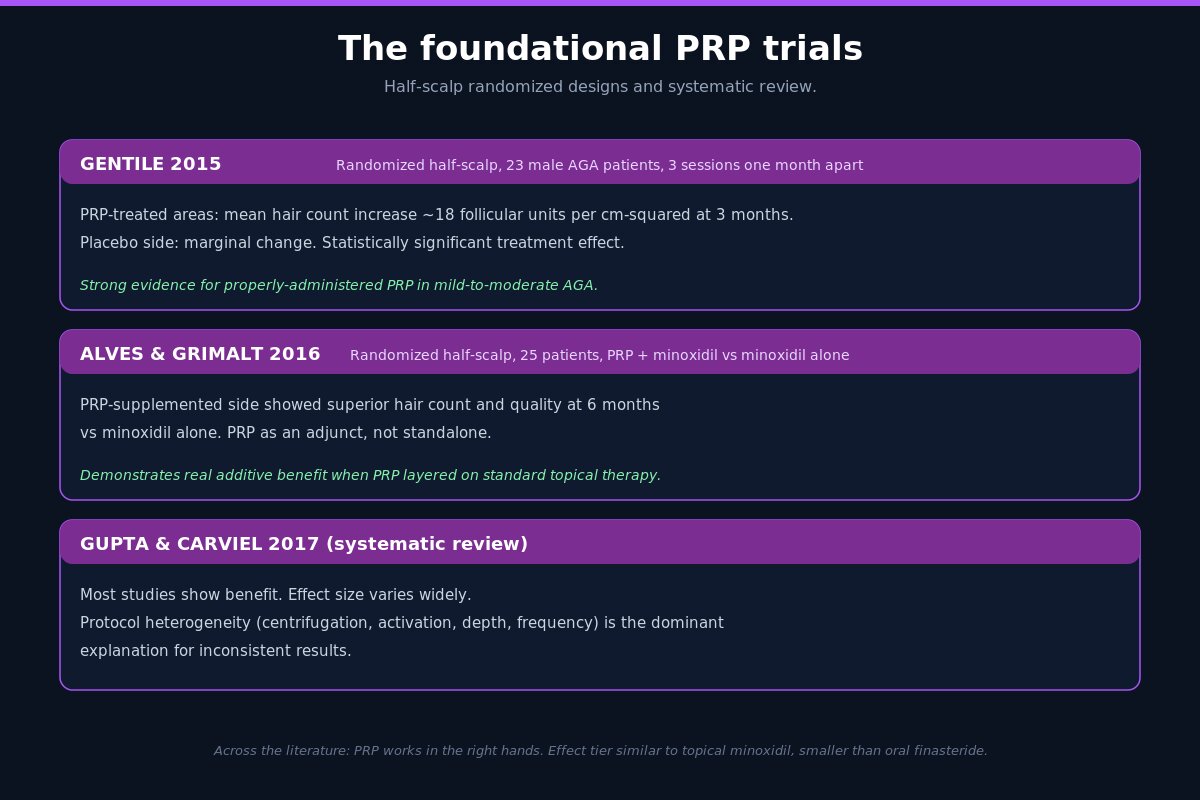
Gentile et al. (2015). Randomized half-scalp study: PRP injected on one side, placebo on the other, in 23 male AGA patients. Three sessions, one month apart. Endpoints at three months: PRP-treated areas showed mean hair count increase of 18.0 follicular units per cm-squared versus marginal change on placebo side. Statistically significant. Side effects: transient injection-site discomfort.
Alves and Grimalt (2016). Randomized half-scalp trial in 25 patients. PRP plus standard topical (minoxidil) on one side versus minoxidil alone on the other. PRP-supplemented side showed superior hair count and quality at six months. Importantly: this was PRP as an adjunct, not standalone.
Gupta and Carviel (2017). Systematic review of PRP studies up to that date. Conclusion: most studies show benefit; effect size varies widely; protocol heterogeneity (centrifugation method, activation, injection depth, frequency) is the dominant explanation for inconsistent results.
Across the broader literature, PRP studies generally show measurable hair count gains, with effect size in the same tier as topical minoxidil but smaller than oral finasteride. The benefit fades without maintenance sessions.
Why protocol matters so much
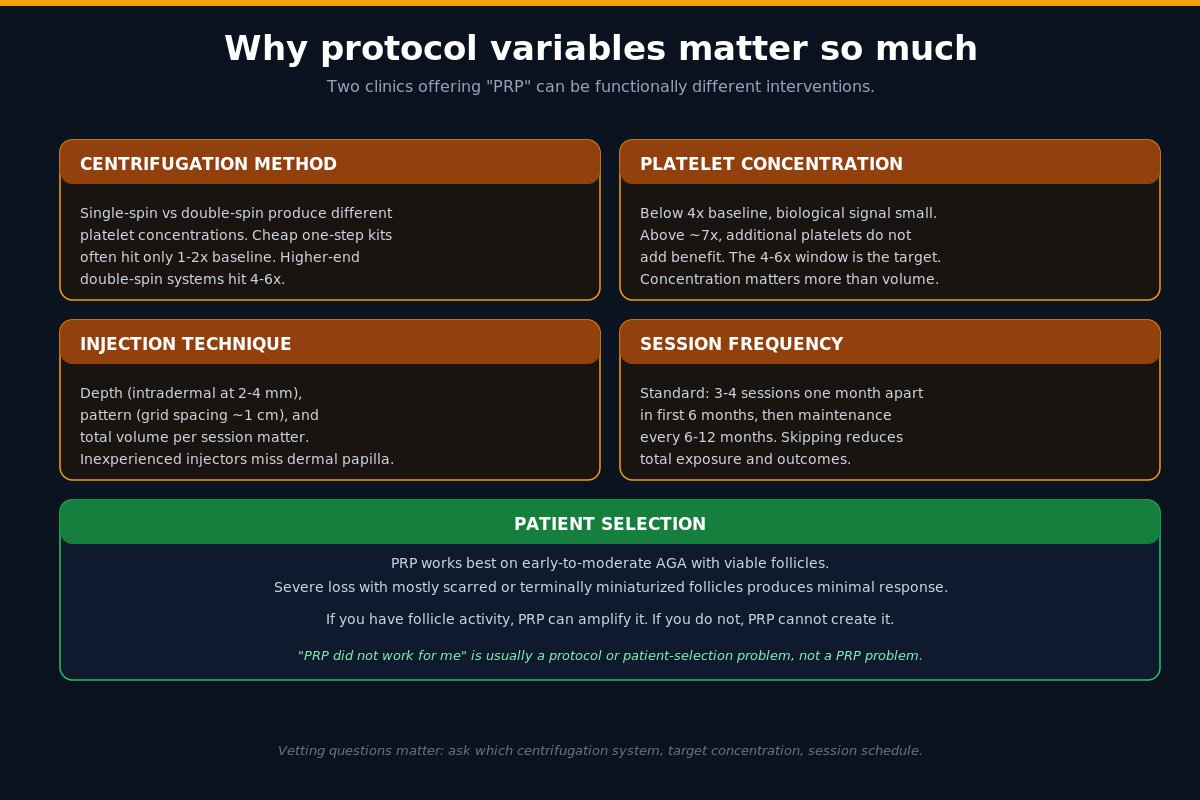
Two clinics offering “PRP for hair loss” can produce different outcomes because they are essentially using different interventions. The variables that matter:
Centrifugation method. Single-spin versus double-spin protocols produce different platelet concentrations. Higher platelet concentration is generally better (within limits) – a 4-6x baseline platelet count is a common target. Cheaper one-step systems often hit only 1-2x.
Platelet concentration. Below 4x baseline, biological signal is small. Above ~7x, additional platelets do not appear to add benefit. Within that window, more is better.
Activation versus non-activation. Some protocols add calcium chloride or thrombin to activate platelets immediately before injection. Others use unactivated PRP, relying on the scalp tissue to trigger degranulation. Trial data is mixed; both can work.
Injection technique. Depth (intradermal at 2-4 mm), pattern (grid spacing roughly 1 cm), and total volume per session matter. Inexperienced injectors deposit PRP too superficially or too deeply, missing the dermal papilla level.
Treatment schedule. The standard protocol from positive trials is 3-4 sessions in the first 6 months, then maintenance every 6-12 months. Skipping sessions or extending intervals reduces total exposure.
Patient selection. PRP works best on early-to-moderate AGA with viable follicles. Severe loss with mostly scarred or terminally miniaturized follicles produces minimal response.
When you read “PRP did not work for me,” the question is rarely whether PRP works – it usually does for mild-to-moderate AGA – but rather which version of PRP was actually administered.
Watch this for the patience framing
This video covers why hair changes show up over months. PRP is exactly that kind of intervention – the first session is barely a baseline, the second session is when the cumulative signal starts, and visible change typically appears at session three or four. Most “PRP did not work” stories quit after session one or two.
Realistic results: what to expect
The honest preview of typical PRP outcomes in a properly-administered protocol.
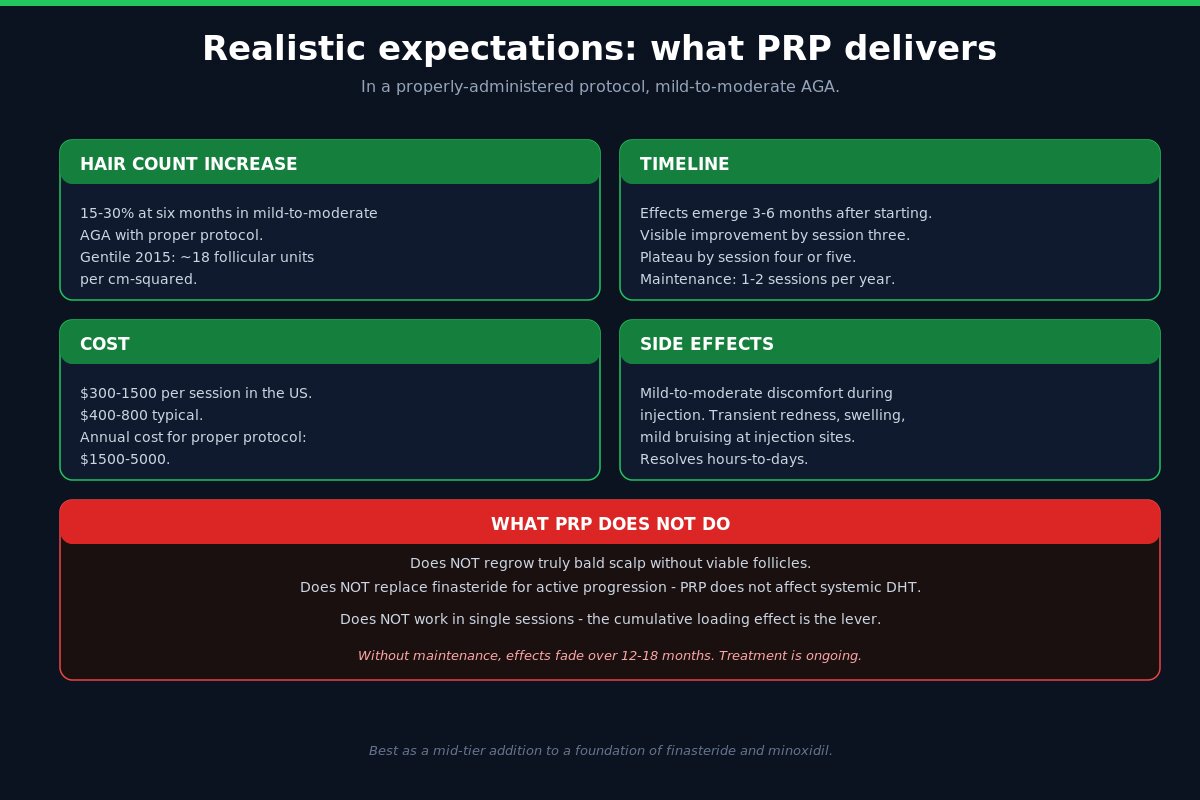
Hair count increase: 15-30 percent at six months in mild-to-moderate AGA, in studies with adequate platelet concentration and injection technique. Gentile 2015 specifically reported about 18 follicular units per cm-squared gain.
Hair shaft diameter: Modest thickening of existing hairs. Less dramatic than density change in most trials but contributes to overall “fullness” perception.
Timeline: Effects emerge 3-6 months after starting. Visible improvement typically by session three. Plateau by session four or five.
Maintenance requirement: Effects fade without continued sessions. Most protocols require 1-2 maintenance sessions per year after the initial loading phase.
Cost: $300-1500 per session in the US, depending on clinic and protocol. Annual cost for proper protocol: typically $1500-5000.
Pain: Mild-to-moderate discomfort during injection. Most clinics use topical anesthesia or vibration distraction. Improves significantly after the first session.
Side effects: Transient redness, swelling, mild bruising at injection sites. Resolves within hours-to-days.
Where PRP fits in a hair protocol
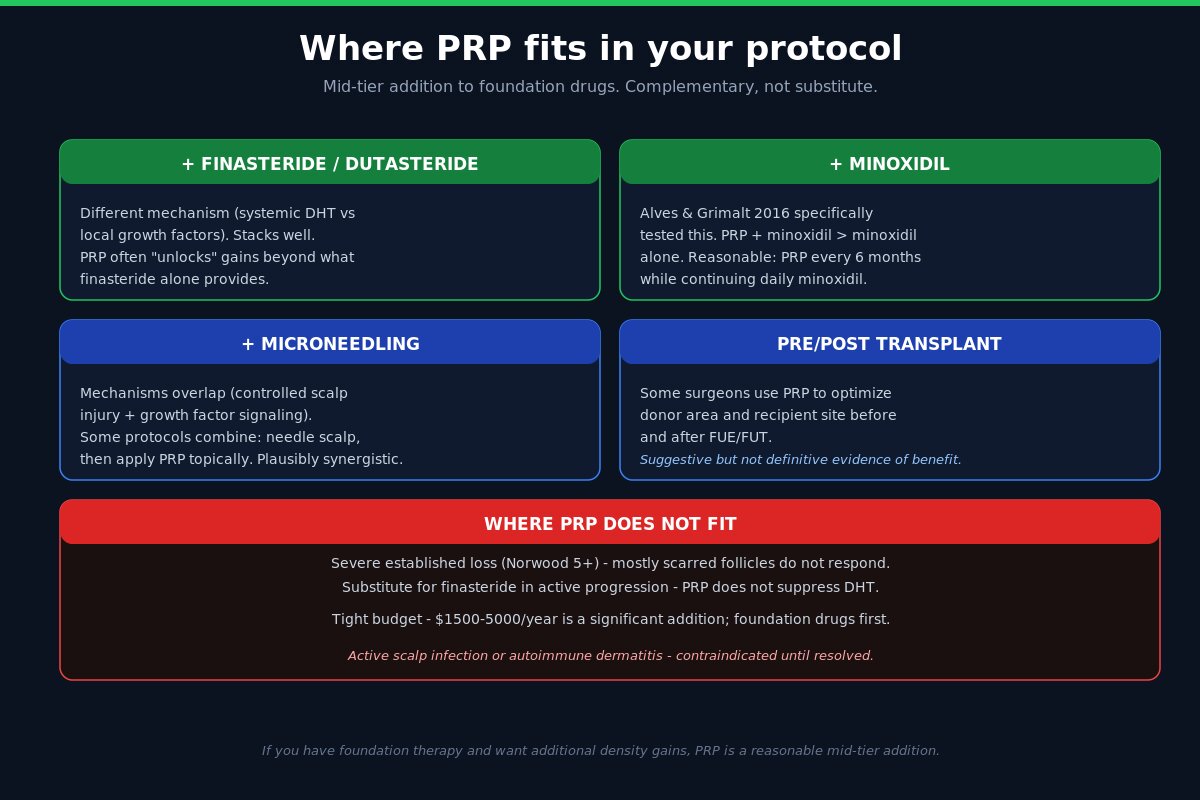
The cleanest place for PRP is as a mid-tier addition for someone already on a foundation of finasteride and minoxidil who wants additional density gains.
+ Finasteride/dutasteride. Different mechanism (systemic DHT versus local growth factors). Stacks well. PRP often “unlocks” additional gains beyond what finasteride alone provides.
+ Minoxidil. The Alves and Grimalt trial specifically tested this combination and showed superior outcomes versus minoxidil alone. Reasonable to do PRP every 6 months while continuing daily minoxidil.
+ Microneedling. Microneedling and PRP overlap mechanistically (both involve controlled scalp injury and growth factor signaling). Some protocols combine them in the same session – microneedle the scalp, then apply PRP topically to the freshly needled tissue. Effect is plausibly synergistic.
Pre-transplant. Some surgeons use PRP to optimize the donor area and recipient site before and after FUE/FUT. The evidence is suggestive but not definitive that PRP improves transplant outcomes.
Standalone PRP only. Reasonable but suboptimal. The effect size is in the same ballpark as topical minoxidil. If you cannot use topical minoxidil and prefer in-clinic intervention, PRP works. If you can layer it, you should.
Where PRP does not fit
Severe established loss. Norwood 5+ with mostly scarred follicles will not regrow from PRP. The remaining viable follicles can improve, but bald areas will not respawn.
Substitute for finasteride in active progression. PRP does not suppress DHT. A man with active rapid AGA needs the systemic intervention; PRP layered on top is reasonable, but PRP in place of finasteride is a downgrade.
Quick fix. Hair cycle math means real changes take 3-6 months. Single-session “magic” results are usually swelling, not new hair.
Tight budget. $1500-5000 per year for proper PRP plus the cost of finasteride and minoxidil adds up. If budget is tight, PRP is the optional layer; the foundation drugs come first.
Active scalp infection or autoimmune dermatitis. Contraindicated. Treat the underlying issue first.
How to vet a PRP clinic
Questions worth asking before booking.
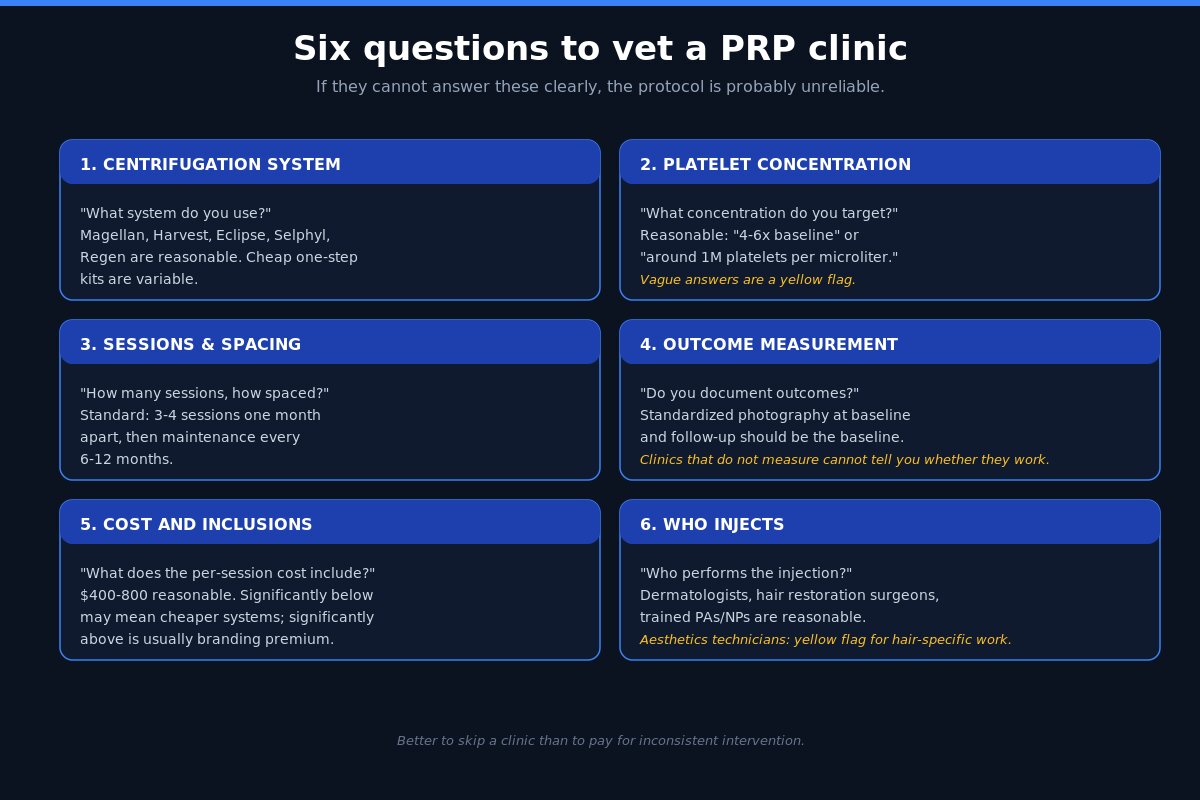
What centrifugation system do you use? Higher-end systems (e.g., Magellan, Harvest, Eclipse, Selphyl, Regen) tend to produce more consistent platelet concentration. Cheaper one-step kits are variable. Ask which they use.
What platelet concentration do you target? A reasonable answer is “4-6x baseline” or “around one million platelets per microliter.” Vague answers are a yellow flag.
How many sessions and how spaced? Standard answer: 3-4 sessions one month apart, then maintenance every 6-12 months. Wildly different protocols are less established.
Do you measure outcomes? Standardized photography at baseline and follow-up should be the baseline. Clinics that do not document outcomes cannot tell you whether their protocol works.
What is the per-session cost and what does it include? A professional protocol at $400-800 per session is reasonable. Significantly below that may mean cheaper systems or shorter procedures; significantly above usually means you are paying for branding.
Who does the injection? Dermatologists, hair restoration surgeons, and trained PAs/NPs are reasonable. Aesthetics technicians are a yellow flag for hair-specific work where injection depth and pattern matter.
Common myths and how they fail
“PRP regrows hair from bald scalp.” No. PRP works on existing viable follicles. Truly bald areas with no follicle activity do not respawn.
“One session is enough.” No. The clinical literature uses 3-4 session loading protocols. Single sessions produce minimal sustained effect.
“All PRP is the same.” No. Centrifugation, concentration, activation, and injection technique vary enormously. Two clinics labeled “PRP” can be functionally different interventions.
“PRP replaces finasteride.” No. PRP does not address the systemic DHT pathway. It is an adjunct, not a substitute.
“PRP grows hair forever.” No. Without maintenance, effects fade over 12-18 months. Treatment is ongoing, not one-and-done.
Frequently asked questions about PRP for hair loss
Does PRP actually work?
Yes, when properly administered. Multiple controlled trials show hair count gains in mild-to-moderate AGA. The variability in real-world outcomes traces mostly to protocol differences between clinics, not to PRP being unreliable in principle.
How many sessions do I need?
Three to four sessions one month apart for the loading phase, then maintenance every 6-12 months. Single sessions produce minimal sustained effect.
How much does PRP cost?
$300-1500 per session in the US, with $400-800 being typical. Annual cost for proper protocol: $1500-5000 depending on clinic and frequency.
Does it hurt?
Mild-to-moderate discomfort during the injections. Most clinics use topical anesthesia, vibration distraction, or both. Subsequent sessions are usually less uncomfortable as you know what to expect.
Can I do PRP at home?
No. Proper PRP requires medical-grade centrifugation, sterile preparation, and appropriate injection technique. At-home “PRP kits” are not equivalent and carry infection risk.
How does PRP compare to a hair transplant?
Different interventions for different situations. Transplants move follicles into bald areas. PRP improves activity of existing follicles. Many men get both – transplant for restored coverage, PRP for ongoing density of remaining native hair.
How does PRP compare to microneedling?
Mechanisms overlap. Microneedling alone is cheaper and can be done at home. PRP is more concentrated growth factor delivery but requires clinic visits. Combining them is plausible and some protocols do.
Is PRP safe long term?
Yes. Using your own blood eliminates immune reaction risk. Long-term safety profile from years of use across hair, joint, and aesthetic indications is generally favorable.
Can women get PRP for hair loss?
Yes. Female pattern hair loss responds similarly to PRP as male pattern. The protocol is essentially identical.
What if I cannot find a clinic with proper protocol?
Ask the questions in the vetting section above. If the clinic cannot answer them clearly, the protocol may be unreliable. Better to skip than to pay for inconsistent intervention.
Bringing it together
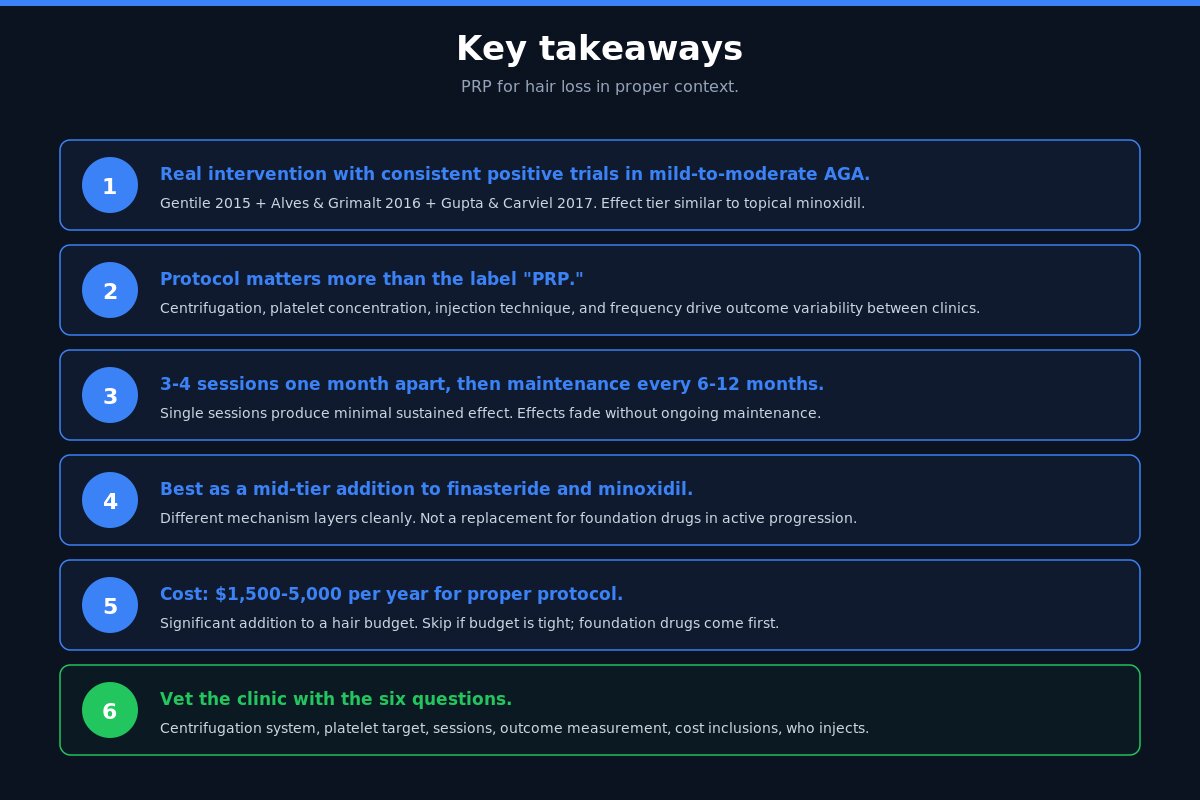
PRP is a real mid-tier intervention with solid mechanism and consistent positive trials when the protocol is right. It does not replace foundation drugs, does not regrow truly bald scalp, and does not work in a single session – but in the proper protocol layered with finasteride and minoxidil, it can produce real density gains. The biology of androgenetic alopecia tells you why a growth-factor-driven local intervention helps but cannot stop the underlying program.
The core protocol-design insight comes from why protocols fail: stacking interventions across systemic, topical, and procedural layers covers what any single tool misses. PRP fits cleanly in the procedural layer, alongside microneedling. For where the field is heading next – exosomes, hair cloning, and the experimental procedures – the framework is in the 2026 hair cloning pipeline review.
This article is for educational purposes only and does not constitute medical advice. Hair loss has multiple potential causes and the right approach depends on your individual history, examination, and bloodwork. Speak with a qualified clinician before starting or stopping any treatment. See the full disclaimer.
About the author
Philippe Boissard
Author of Men’s Hairloss Protocol (2020), Better, Smarter, Stronger (2023), and Multi-Axis Body (2025). Researches and writes about hair loss and male physiology, citing primary literature and disclosing affiliate relationships in full. Not a medical doctor; all content is educational. More about Philippe.
Related reading
Get my free hair-loss protocol
The exact evidence-based routine I actually use and recommend: what works, in what order, with no hype. Enter your email on the next page and I’ll send it straight to you.
Send me the free protocol →
[…] in the 2026 hair cloning pipeline review. For the more established adjacent intervention, see the PRP analysis – same family of regenerative approaches, much stronger evidence base. The right move for […]
[…] PRP for Hair Loss: Protocol, Evidence, and Realistic Expectations […]
[…] PRP for Hair Loss: Protocol, Evidence, and Realistic Expectations […]