
Exosomes for Hair Loss: 2026 Hype vs Evidence
Plausible biology, thin clinical data, premium pricing. The honest 2026 read on exosome therapy for hair loss and where it actually fits.

Exosomes are the buzzword of the 2020s aesthetic clinic – small extracellular vesicles that carry signaling molecules between cells, marketed as the next-generation regenerative therapy for hair loss. The preclinical work is genuinely promising. The clinical work is thin. Clinics charging four-figure prices per treatment are billing on the preclinical promise, not on validated trial outcomes. The honest read in 2026 is that exosomes for hair are an experimental option, not yet a validated standard of care.
Quick answer: promising biology, thin clinical evidence, premium pricing
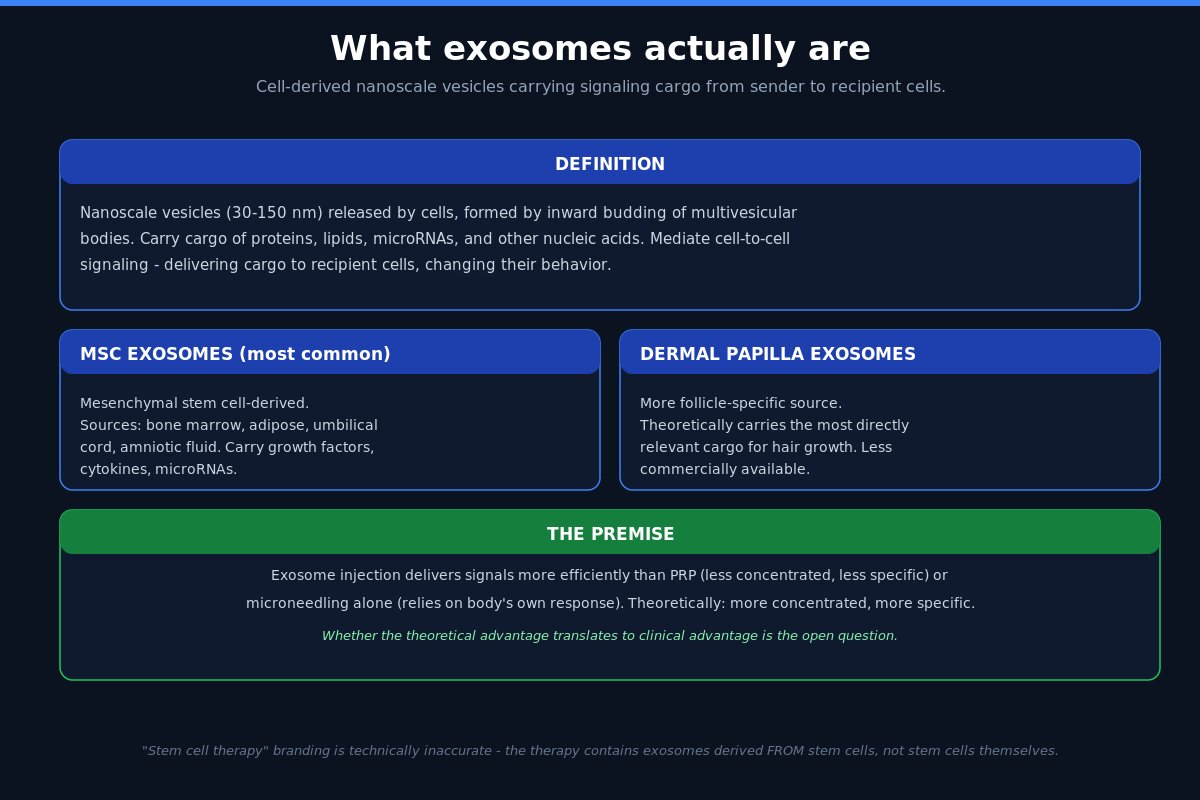
Exosomes are nanoscale vesicles (30-150 nm) released by cells, packed with proteins, lipids, and nucleic acids that mediate cell-to-cell signaling. In hair-loss applications, exosomes derived from mesenchymal stem cells, dermal papilla cells, or amniotic fluid are injected into the scalp with the goal of inducing follicle activity through the same kind of signaling that PRP delivers via growth factors – but theoretically more concentrated and more specific.
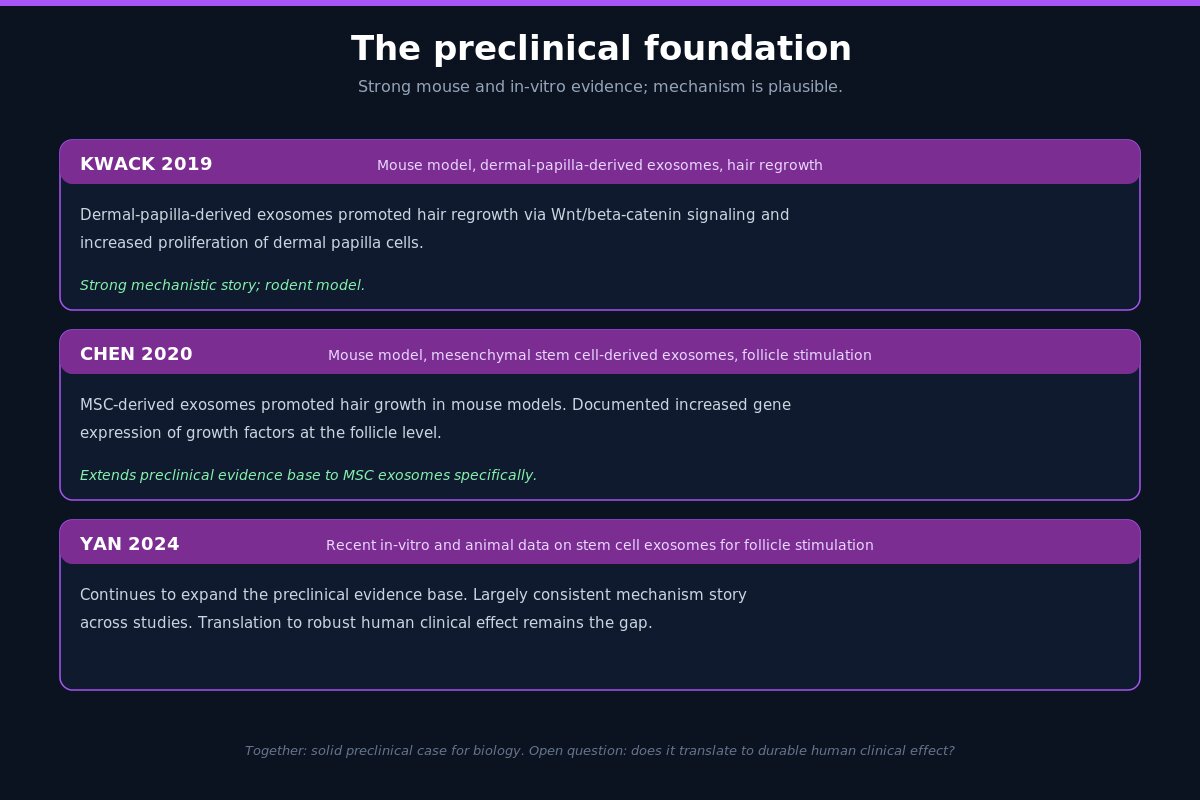
The preclinical work is solid. Kwack et al. (2019) showed dermal-papilla-derived exosomes promoted hair regrowth in mouse models. Chen et al. (2020) extended to mesenchymal stem cell exosomes with similar findings. Yan et al. (2024) added more recent in-vitro and animal data on stem-cell exosomes for follicle stimulation.
The clinical translation is thin. Few well-designed human trials have been published. Most clinical evidence comes from small case series, single-arm studies, or vendor-funded data. Clinics offering exosome treatments charge $1500-5000 per session, often with 1-3 sessions recommended, which is more than PRP for less validated benefit.
The honest framing in 2026: experimental, plausible, premium-priced. Reasonable for early adopters who understand the evidence is preclinical-to-early-clinical. Not yet competitive cost-versus-validation against PRP, microneedling, or standard topicals.
What exosomes actually are
Cells continuously release extracellular vesicles into surrounding tissue and fluids. Exosomes are the smaller subset (30-150 nm), formed by inward budding of multivesicular bodies and released into the extracellular space. They carry a cargo of proteins, lipids, microRNAs, and other nucleic acids. When exosomes encounter recipient cells, they deliver this cargo, which can change recipient cell behavior.
For hair purposes, the candidate exosome sources include:
Mesenchymal stem cell (MSC) exosomes. Most commonly used. Cell sources include bone marrow, adipose tissue, umbilical cord, and amniotic fluid. The exosomes carry growth factors, cytokines, and microRNAs known to support tissue regeneration generally.
Dermal papilla cell exosomes. More follicle-specific. Dermal papilla cells are the signaling hub at the base of the hair follicle; their exosomes theoretically carry the most directly relevant cargo for hair growth.
Amniotic fluid exosomes. Marketed for general regenerative purposes. Heterogeneous source; cargo varies by donor.
The premise is that exosome injection delivers the right signals more efficiently than PRP (which delivers growth factors in a less concentrated and less specific package) or microneedling alone (which relies on the body’s own response to controlled injury).
The preclinical foundation
Reading the cited preclinical work honestly.
Kwack et al. (2019). Mouse study showing dermal-papilla-derived exosomes promoted hair regrowth via Wnt/beta-catenin signaling and increased proliferation of dermal papilla cells. Strong mechanistic story; rodent model.
Chen et al. (2020). Mesenchymal stem cell-derived exosomes promoted hair growth in mouse models. Documented increased gene expression of growth factors at the follicle level.
Yan et al. (2024). More recent work expanding the in-vitro and animal evidence base for stem cell exosomes promoting follicle stimulation. Extends earlier findings; continues to be largely preclinical.
Together this body of work establishes that exosomes can stimulate hair follicle activity in animal models. The mechanism is plausible and generally consistent across studies. The translation to robust human clinical effect remains the gap.
The clinical evidence gap
The honest accounting of human data.
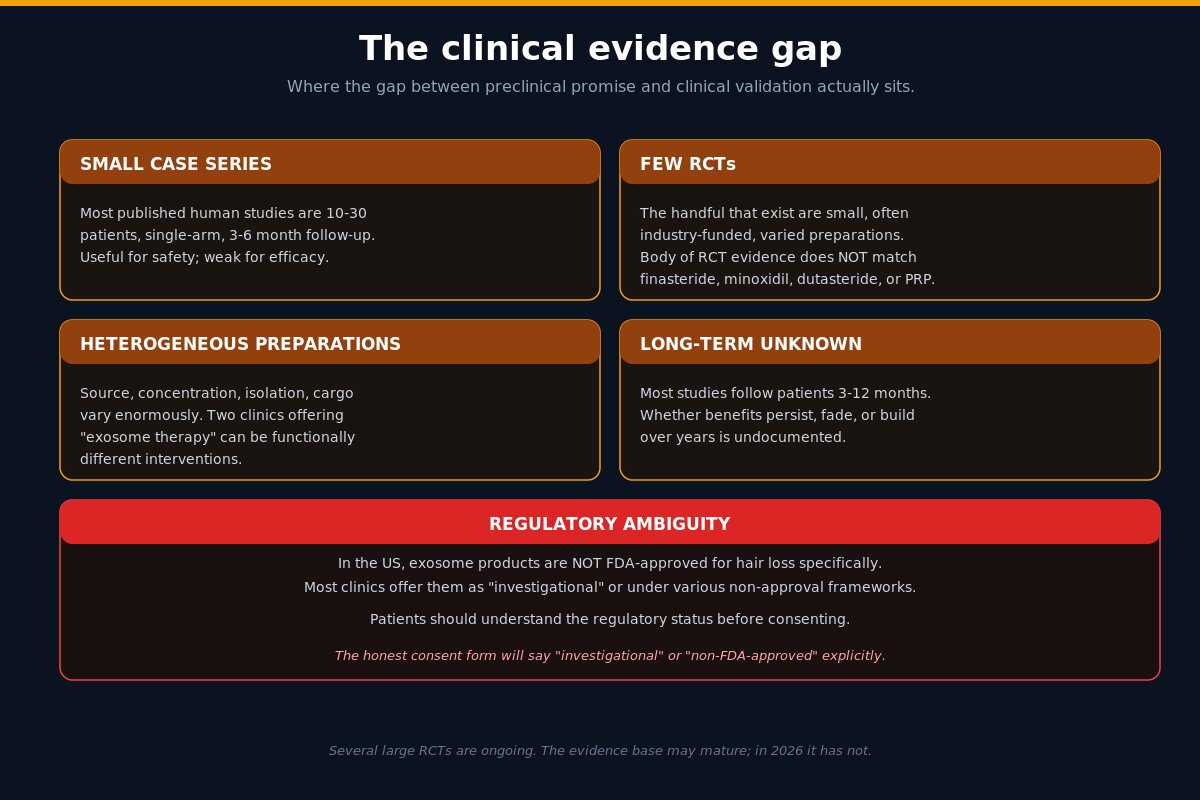
Most published human studies are small case series. Typically 10-30 patients, single-arm (no placebo or comparator), short follow-up (3-6 months). Useful for demonstrating safety; weak for demonstrating efficacy.
Few randomized controlled trials. The handful that exist are small, often industry-funded, and use varied exosome preparations. The body of RCT evidence does not yet match the body of evidence for finasteride, minoxidil, dutasteride, or PRP.
Heterogeneous preparations. Exosome products vary enormously in source, concentration, isolation method, and cargo characterization. “Exosome therapy” at one clinic and “exosome therapy” at another may use products as different as PRP and minoxidil from each other.
Long-term outcomes unknown. Most studies follow patients 3-12 months. Whether benefits persist, fade, or build over years is undocumented.
Regulatory ambiguity. In the US, exosome products fall into a regulatory gray zone – generally not FDA-approved for hair loss specifically, often sold as “non-FDA-approved investigational treatment.” Patients should understand this before consenting.
Watch this for the broader framing
This video covers how a compound’s mechanism and delivery affect outcomes. Same logic applies to exosomes: the source cell, the isolation method, the cargo characterization, and the injection technique together determine whether what you receive is biologically active. Two clinics offering “exosome therapy” can be administering functionally different interventions.
Pricing reality
The economics of exosome treatments deserve scrutiny.
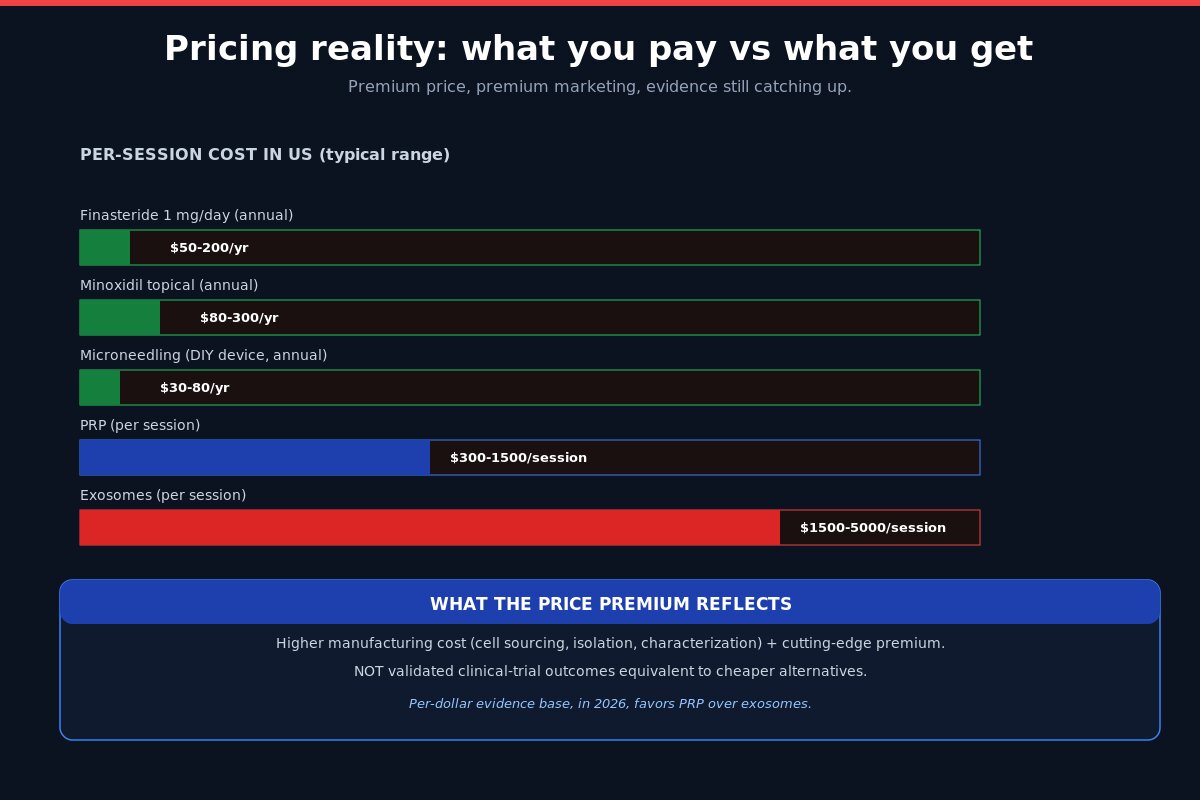
Typical cost: $1500-5000 per session in the US. Multiple sessions often recommended (commonly 1-3 in initial protocol).
Comparison to PRP: PRP runs $300-1500 per session with stronger clinical evidence base. Per-session cost favors PRP; total program cost similarly favors PRP.
What you are paying for: Cell source, isolation processing, and the premium of being on the cutting edge of regenerative medicine. The biological cost of producing high-quality exosomes is genuinely higher than producing PRP, so some price premium is reasonable.
What you are not paying for: Validated clinical-trial outcomes equivalent to the evidence base for cheaper alternatives.
Marketing framing to watch for: “Stem cell” and “regenerative” branding tends to overpromise. The therapy contains exosomes derived from stem cells, not stem cells themselves. The “stem cell therapy” framing in marketing material is technically inaccurate and inflates perceived value.
Where exosomes might fit (cautiously)
Reasonable use cases if you understand the evidence limits.
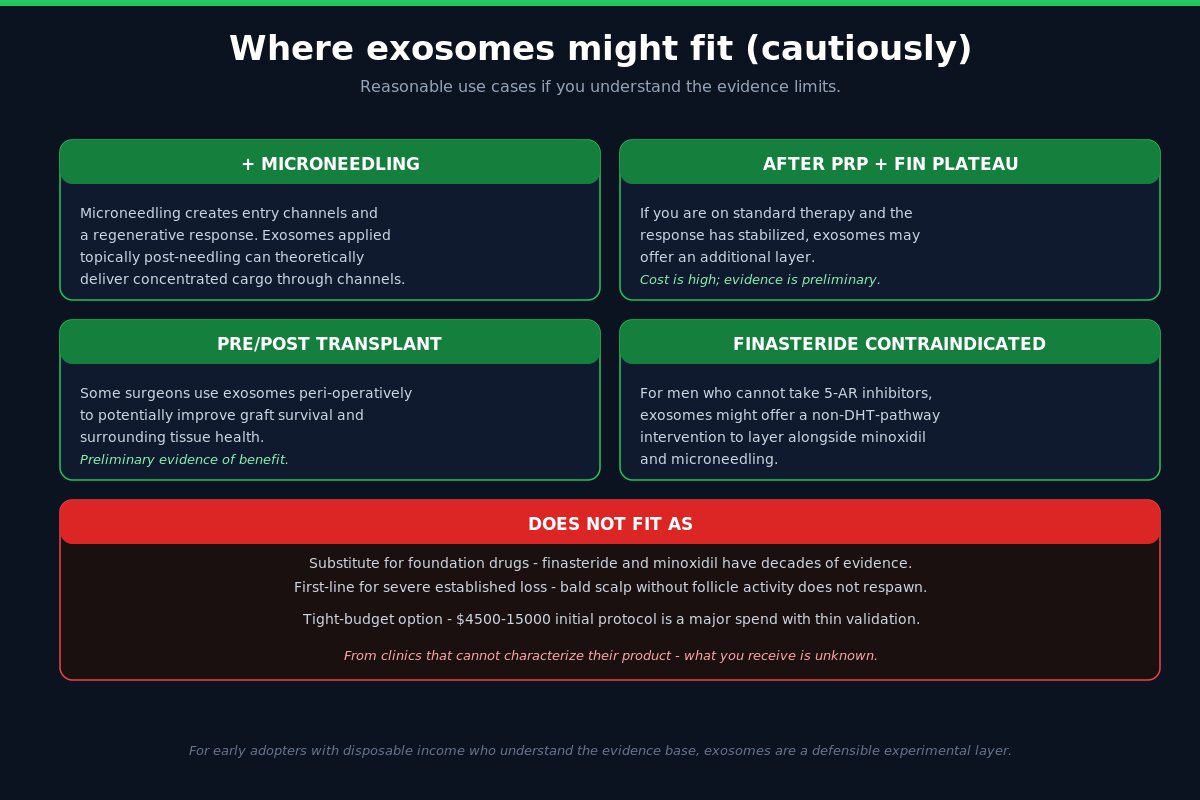
Combined with microneedling. Microneedling creates entry channels and triggers a regenerative response. Exosomes applied topically post-needling can theoretically deliver concentrated signaling cargo through those channels. Some early reports suggest synergy.
Adjunct after PRP and finasteride have plateaued. If you are on standard therapy and the response has stabilized, exosomes may offer an additional layer. The cost is high; the evidence is preliminary; the user should know that going in.
Pre-transplant or post-transplant adjunct. Some surgeons use exosomes peri-operatively to potentially improve graft survival and surrounding tissue health. Evidence is preliminary.
Where finasteride is contraindicated. For men who cannot take 5-AR inhibitors, exosomes might offer one of several non-DHT-pathway interventions to layer alongside minoxidil and microneedling.
For early adopters with disposable income who understand the evidence base. Some patients want access to the cutting edge, accept that “experimental” means evidence is incomplete, and have the budget to participate. That is a defensible position if informed.
Where exosomes do not fit
As a substitute for foundation drugs. Finasteride and minoxidil have decades of evidence. Skipping them in favor of exosomes is trading a known intervention for a less validated one.
Without standard therapy already in place. Exosomes are an addition, not a starting point. Foundation comes first.
For severe established loss. Like PRP, exosomes work on viable follicles. Truly bald scalp without follicle activity will not respawn from any growth factor or signaling intervention.
On a tight budget. $4500-15000 for an initial protocol plus the cost of foundation drugs is a major spend. Until the clinical evidence base matures, the cost-versus-validation calculation does not favor exosomes for most people.
From clinics that cannot characterize their product. If a clinic cannot tell you the exosome source, isolation method, concentration, and quality control measures, what you are receiving is unknown. Walk away.
How to vet an exosome clinic
Critical questions before booking.
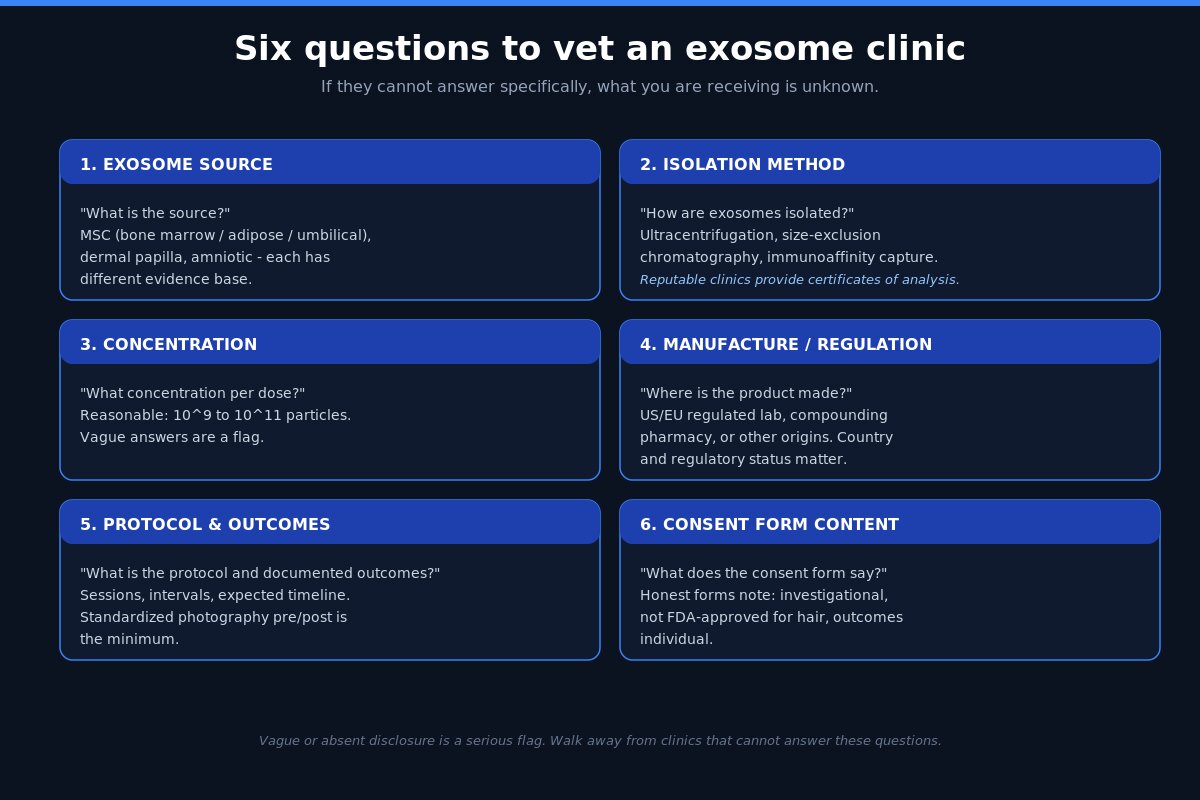
What is the exosome source? MSC, dermal papilla, amniotic – each has different characterization and evidence base. The clinic should be able to answer specifically.
How are exosomes isolated and characterized? Ultracentrifugation, size-exclusion chromatography, and immunoaffinity capture are common methods. Quality of isolation affects what you receive. Reputable clinics provide certificates of analysis.
What is the exosome concentration per dose? Reported in particles per milliliter or per dose. Reasonable answers are in the range of 10^9 to 10^11 particles. Vague answers are a flag.
Where is the product manufactured and is it US/EU regulated? Compounding pharmacies, specialized labs, and various levels of regulatory oversight exist. Country of manufacture and regulatory status affect what you should expect.
What is the protocol and what are the documented outcomes? Sessions, intervals, expected timeline. Standardized photography pre/post is the minimum.
What does the consent form actually say? The honest consent form will note that exosome therapy for hair loss is investigational, not FDA-approved for this indication, and outcomes are individual. Vague or absent disclosure is a flag.
Common myths and how they fail
“Exosomes are stem cell therapy.” No. Exosomes are vesicles released by cells; the therapy contains the vesicles, not living cells. “Stem cell therapy” branding is technically inaccurate.
“Exosomes are FDA-approved for hair loss.” No. As of 2026, exosome therapy for hair loss is not FDA-approved. Most clinics offer it as “investigational” or under various other regulatory framings.
“Exosomes work better than PRP.” Possibly true mechanistically, but not yet established by clinical evidence. The PRP evidence base is currently stronger and cheaper to access.
“One session of exosomes equals years of finasteride.” No. The mechanisms are different and the comparison is not meaningful. Finasteride suppresses systemic DHT continuously; exosomes deliver a one-time signaling cargo locally.
“Exosomes are safer than other therapies.” Maybe, given the autologous mechanism and natural biological role. Long-term safety data is limited; short-term safety in studies has been good.
Frequently asked questions about exosomes for hair loss
Do exosomes actually work for hair loss?
Preclinical and early clinical evidence is positive. Robust clinical trial data is thin in 2026. The honest answer: probably yes for some patients, but the magnitude and consistency are not yet validated to the level of finasteride, minoxidil, or even PRP.
How does exosome therapy compare to PRP?
PRP has stronger clinical evidence and lower cost. Exosomes have a more concentrated and theoretically more specific signaling cargo, but at higher cost and weaker clinical validation. PRP is the better cost-versus-validation choice for most people in 2026.
How much does it cost?
$1500-5000 per session, with multiple sessions often recommended. Total program cost commonly $4500-15000. Significantly higher than PRP for less established benefit.
How many sessions are needed?
Protocols vary. Common: 1-3 sessions in an initial loading phase, followed by maintenance every 6-12 months if results justify it. There is no consensus protocol because the evidence base does not yet support one.
How long until I see results?
Like other regenerative interventions, hair cycle changes take 3-6 months minimum. Standardized photography is the only reliable way to assess change.
Are exosomes safer than other treatments?
Short-term safety in published studies has been good. Long-term safety data is limited. The autologous-like mechanism (exosomes are biological signaling vesicles) suggests low immunogenic risk. Always discuss with a qualified clinician.
Can exosomes regrow hair where I am bald?
Like PRP and other regenerative therapies, exosomes work on viable follicles. Bald scalp without follicle activity does not respawn from exosome therapy.
Should I do exosomes instead of finasteride?
No. Finasteride suppresses systemic DHT and has 25+ years of evidence. Exosomes are an addition, not a substitute. Skipping foundation therapy in favor of exosomes is trading a known intervention for a less validated one.
Are exosomes FDA-approved for hair loss?
No. As of 2026, exosome therapy for hair loss is not FDA-approved. Most US clinics offer it as investigational or under various non-approval frameworks. Understand the regulatory status before consenting.
Will exosomes become standard of care?
Possibly, if the clinical evidence base matures. Several trials are ongoing. The mechanism is plausible enough that with good RCT data, exosomes could become a validated mid-tier option. As of 2026, that data does not yet exist.
Bringing it together
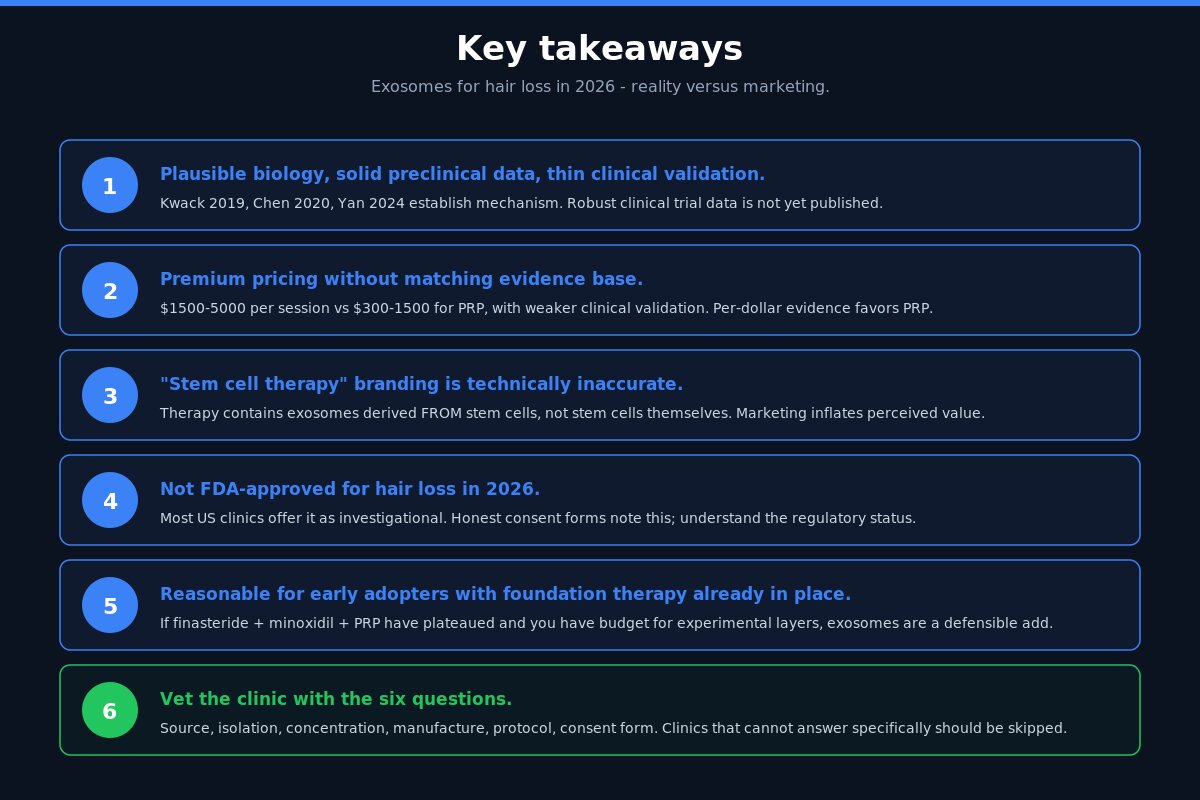
Exosomes for hair loss are at the intersection of real science and aggressive marketing. The biology is plausible. The preclinical evidence is solid. The clinical translation is incomplete. The pricing is premium. The honest framing is: experimental option in 2026, with reasonable mechanism, weaker clinical validation than alternatives, and a cost that does not yet match the evidence. The biology of hair loss tells you where signaling-cargo interventions can theoretically help; the gap between theoretical and demonstrated is the part to evaluate honestly.
For where regenerative-medicine interventions are heading, the broader pipeline picture is in the 2026 hair cloning pipeline review. For the more established adjacent intervention, see the PRP analysis – same family of regenerative approaches, much stronger evidence base. The right move for most men in 2026 is foundation therapy plus established adjuncts; exosomes are the experimental layer for those with the budget, the patience for an evolving evidence base, and informed consent.
This article is for educational purposes only and does not constitute medical advice. Hair loss has multiple potential causes and the right approach depends on your individual history, examination, and bloodwork. Speak with a qualified clinician before starting or stopping any treatment. See the full disclaimer.
About the author
Philippe Boissard
Author of Men’s Hairloss Protocol (2020), Better, Smarter, Stronger (2023), and Multi-Axis Body (2025). Researches and writes about hair loss and male physiology, citing primary literature and disclosing affiliate relationships in full. Not a medical doctor; all content is educational. More about Philippe.
Related reading
Get my free hair-loss protocol
The exact evidence-based routine I actually use and recommend: what works, in what order, with no hype. Enter your email on the next page and I’ll send it straight to you.
Send me the free protocol →
[…] Exosomes for Hair Loss: 2026 Hype vs Evidence […]