
Hair Cloning, Stem Cells, and Follicular Neogenesis: A 2026 Pipeline Reality Check
Hair cloning has been five years away for the last twenty. Honest 2026 read on Stemson, dNovo, Pelage PP405, HairClone, Replicel, and the Tsuji lab. Plan accordingly.


Hair cloning has been “five years away” for the last twenty. The pipeline is real, the science is moving, and one or two programs are now in actual human trials. None of that means a commercial therapy is imminent. The honest 2026 read: cell-based regeneration is still pre-commercial, the most-likely first arrival is a small-molecule stem cell stimulator (not a transplant), and the realistic ETA for any of it is five to ten-plus years. Plan accordingly.
Quick answer: should you wait for hair cloning?
No. The current pipeline contains six to eight serious programs across three different mechanism classes (cell therapy, direct reprogramming, small-molecule stem cell activation). The most advanced has reached Phase 2a; most are in preclinical or Phase 1. Even the leaders are five-plus years from a commercial product, and most therapies in this stage do not reach market. Treat this as a watch-list, not a treatment plan.
What you should do instead: actually understand how hair loss works at the follicular level, treat with what is currently evidence-validated, and revisit the pipeline annually to see which programs hit Phase 2/3 endpoints. The miniaturized follicles you preserve now are the ones the pipeline therapies (when they arrive) will have something to work with.
What “hair cloning” actually means (the terminology problem)
Three different mechanism classes get bundled under “hair cloning” in popular coverage. They are not interchangeable, and the regulatory and commercial timelines differ.
- Cell therapy / autologous expansion: take cells from a healthy hair follicle (typically dermal papilla cells or dermal sheath cup cells), expand them in culture, reinject them into thinning areas. The science is decades old (Jahoda, Reynolds, Higgins). Practical at scale is the hard part.
- iPSC and direct reprogramming: generate hair-inductive cells from stem cells (induced pluripotent or directly reprogrammed). Stemson Therapeutics and dNovo Bio are the two highest-profile US programs.
- Small-molecule follicle activation: drugs that target hair follicle stem cells (HFSCs) to push quiescent follicles back into anagen. Pelage Pharmaceuticals PP405 is the flagship. This is closer to a topical drug than a cellular therapy.
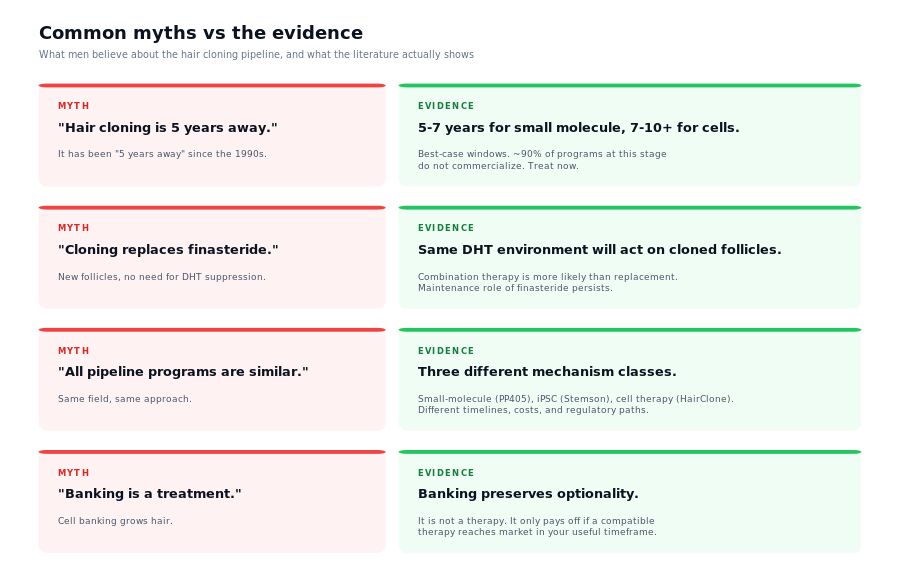
The “hair cloning is coming” headlines usually conflate these. The Pelage program could plausibly reach commercial approval in a 5-7 year window because the regulatory path for a small molecule is faster. The cell-based programs are 7-10+ years out even if they succeed.

The 2026 pipeline at a glance
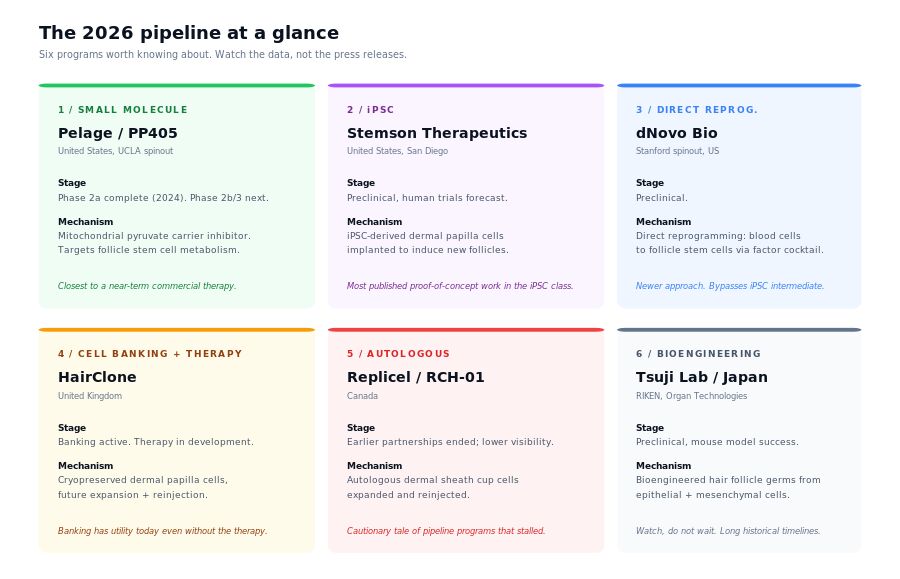
Six programs are worth knowing about. Some are quiet for legitimate reasons (early-stage R&D), some are quiet because their development has stalled, some are still publicly active but moving slower than their original timelines. As always, watch the data, not the press releases.
Stemson Therapeutics (US, iPSC platform)
Founded around 2018 in San Diego, Stemson uses induced pluripotent stem cells to generate hair-inducing dermal papilla cells. The published proof-of-concept work (collaborations with Sanford Burnham Prebys) showed that human iPSC-derived dermal papilla cells could induce hair follicle formation in mouse skin grafts. The path to human therapy involves growing follicles or follicle-like structures from a patient’s own iPSCs, then implanting. Funding has been steady but timelines have slipped multiple times. As of the most recent public communications, human trials are forecast but not yet underway.
dNovo Bio (US, direct reprogramming)
A Stanford spinout focused on direct cellular reprogramming: converting non-follicular cells (such as blood cells) into hair follicle stem cells via a defined factor cocktail, bypassing the iPSC intermediate. The advantage is speed and cost; the disadvantage is that the technology is newer and less de-risked than iPSC. Preclinical work has been published; clinical trials have not yet started publicly.
Pelage Pharmaceuticals (US, PP405 small molecule)
The outlier of the pipeline because it is not cell therapy. PP405 is a topical small molecule (a mitochondrial pyruvate carrier inhibitor) that targets follicle stem cell metabolism, originally identified in the Lowry and Christofk labs at UCLA. Phase 2a results in 2024 reported hair regrowth signals in men with AGA. As of 2026, advanced Phase 2 / 3 studies are the next milestone. If the data holds, PP405 is structurally the closest the pipeline has to a near-term commercial therapy: small molecules clear regulatory hurdles faster than cell therapies.
HairClone (UK, cell banking + therapy)
HairClone is two things: a cell banking service (live now) and a therapy in development (not commercially available). Patients can have follicles harvested and dermal papilla cells cryopreserved against future use. The therapy itself, when commercial, would expand the banked cells and reinject. The banking service has utility today even without the therapy: if the science matures in 2030 or beyond, you have unaged cells ready. The clinical evidence for the therapy itself is still developing.
Replicel Life Sciences and earlier autologous programs (Canada)
RCH-01 used autologous dermal sheath cup cells. Earlier development partnerships (with Shiseido) ended; the program continues at lower visibility. Multiple precursor programs (Aderans, Intercytex) reached human trials in earlier eras and either failed efficacy endpoints or quietly closed. This is part of the honest reality check: the pipeline is littered with programs that looked promising at this stage and did not deliver.
Tsuji Lab and Japanese bioengineering (Japan, RIKEN / Organ Technologies)
Tsuji and colleagues have published extensively on bioengineered hair follicle germs (HFGs) generated from epithelial and mesenchymal cells, with successful follicle regeneration in mouse models (Toyoshima et al. 2012). The Japanese program targets full follicle reconstruction rather than activation. Commercial timelines from this lab have historically been long. Worth tracking, not worth waiting on.
The pipeline reality check
A few hard numbers and base rates worth holding in mind.
- Drug development base rate: roughly 10 percent of drugs that enter Phase 1 reach approval. The rate is lower for novel cell therapies than for small molecules.
- Time from Phase 1 to approval: typically 7-10 years across drug classes, with cell therapies on the longer end.
- Hair-loss-specific track record: the field has had multiple “five-year-away” cycles since the 1990s. Some programs failed for efficacy. Some failed for funding. Some failed because their targets did not survive contact with regulatory expectations.
- Manufacturing complexity: autologous cell therapies require per-patient manufacturing. Even when efficacy is solved, scale and cost are not. Hair loss as an indication has to compete economically with current $25-50/month treatments.

What the science actually has to solve
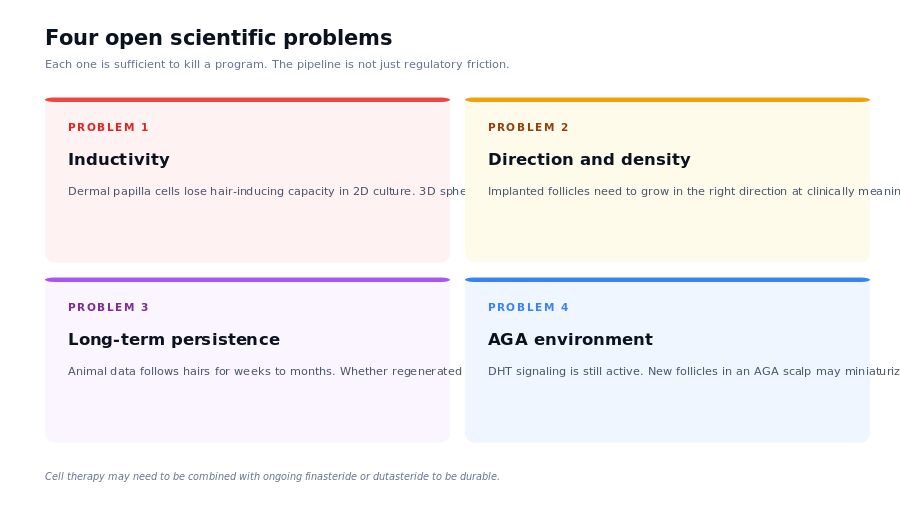
Beyond regulatory and commercial concerns, the underlying biology has not been fully cracked.
- Inductivity: dermal papilla cells lose their hair-inducing capacity after expansion in 2D culture. 3D spheroid culture (Higgins et al. 2013, Columbia) helps, but maintaining inductivity at clinical scale is still a problem.
- Hair direction and density: implanted follicles need to grow in the right direction at clinically meaningful density. Mouse models do not predict the cosmetic outcome in human scalp reliably.
- Long-term persistence: animal models typically follow regenerated hairs for weeks to months. Whether reinjected or regenerated follicles produce sustained anagen-telogen cycling for years is open.
- Preexisting AGA biology: any cell therapy that puts new follicles into a scalp where DHT signaling is still active will face the same miniaturization the original follicles did. Cell therapy may need to be combined with ongoing DHT suppression to be durable.
Should you wait or treat now?
The decision rule is straightforward when you separate the variables.
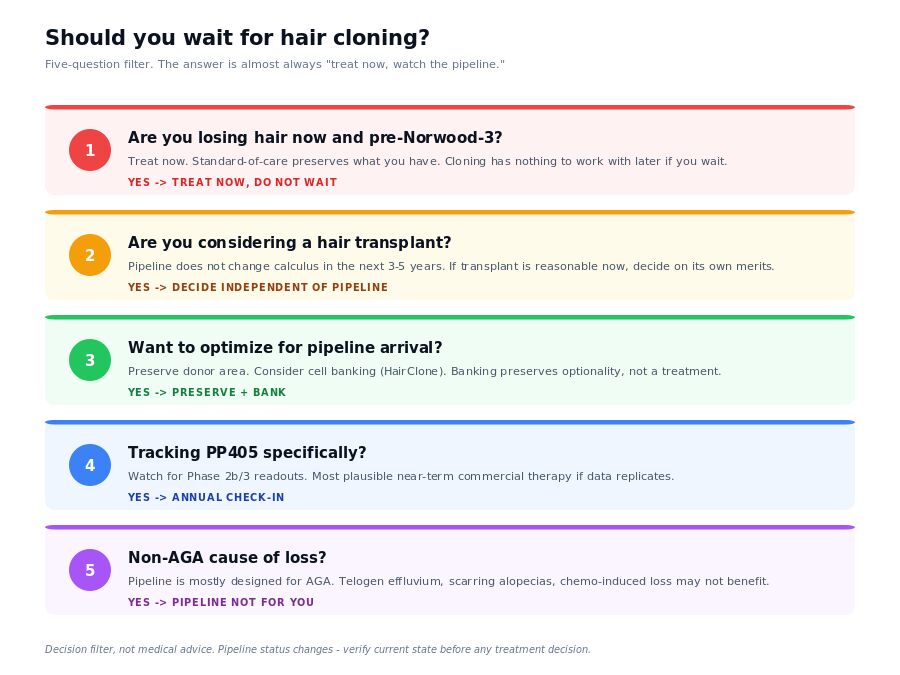
- You are losing hair now and pre-Norwood-3. Treat now. Standard-of-care interventions (finasteride, minoxidil, dutasteride for partial responders, microneedling) have established efficacy and are inexpensive. Preserving what you have is the prerequisite for any future therapy. The decision logic for finasteride vs dutasteride is in why finasteride fails some men.
- You have already lost significant density and are considering transplant. The hair cloning pipeline does not change the calculus on a transplant decision in the next 3-5 years. If a transplant is medically reasonable now, the wait time for cell-based therapies is not your decision input.
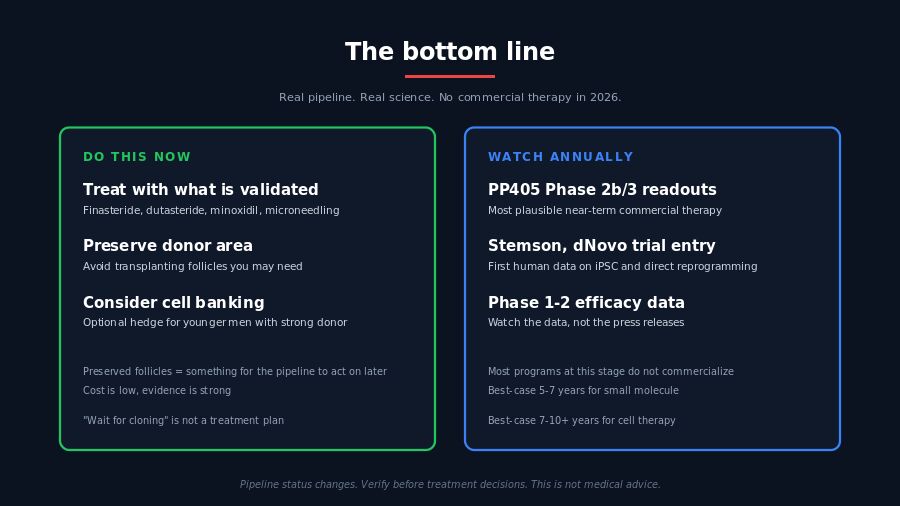
- You want to optimize for the pipeline arriving. Two practical moves: preserve donor area aggressively (do not transplant follicles you may need later as a cell source), and consider cell banking through a service like HairClone. Banking is not a treatment but it preserves optionality.
- You are tracking PP405 specifically. Watch for Phase 2b/3 readouts. If they replicate the Phase 2a regrowth signals, this is the most plausible near-term commercial therapy. The mechanism is closer to a topical drug than to true cloning, but it would be the first clinically validated stem cell-stimulating therapy.
- You have a non-AGA cause of loss. Pipeline therapies are mostly designed for AGA. Telogen effluvium, cicatricial alopecias, and chemo-induced loss have different mechanisms and may not benefit from these programs. The failure modes most men miss are covered in why your hair loss protocol isn’t working.
Why this video is relevant: while the pipeline matures, current compounds keep producing real results. The 12-week JXL069 progress walk-through is a useful counterpoint to “I’ll wait for hair cloning” – it shows what reasonable expectations look like for an actively-tested compound today, on the same timeline a pipeline therapy would need to clear before it ships. The point of the article is “treat now, watch the pipeline” and this is what “treat now” can look like.
Common myths about hair cloning
Frequently asked questions about hair cloning
When will hair cloning be available?
The most realistic near-term option is PP405 (Pelage Pharmaceuticals), a small-molecule topical that could plausibly reach approval in a 5-7 year window if Phase 2b/3 data holds. Cell-based therapies (Stemson, dNovo, HairClone) are 7-10-plus years out even in best-case scenarios. Most programs in this stage do not commercialize.
Is hair cloning the same as a hair transplant?
No. A transplant moves existing hair follicles from donor to recipient sites. Hair cloning generates new follicles from cells (either expanded or reprogrammed) and implants them. The “limited donor area” problem that constrains transplants is what cell-based therapies aim to solve.
Will hair cloning work for everyone?
Pipeline programs are mostly designed for AGA. They are unlikely to address scarring alopecias or chemotherapy-induced loss without separate development. Even within AGA, response variability is expected: the same follicular environment that miniaturized native follicles will act on cloned follicles unless DHT signaling is also addressed.
Should I bank my hair follicle cells now?
Reasonable for some men, premature for most. Cell banking costs real money and only pays off if a therapy that uses banked cells reaches market in a useful timeframe for you. If you are in your 30s with a strong donor area and progressive loss, banking is a defensible hedge. If you are in your 50s with significant existing loss, the math is harder. Pricing varies by provider; ask about long-term storage costs.
Has any hair cloning therapy actually worked in humans?
PP405 (Pelage) reported Phase 2a regrowth signals in men with AGA. Those are early-phase results that need replication in larger Phase 2b/3 trials before “it works” is established. For cell-based programs, no commercially-validated human therapy exists yet. Earlier autologous trials (Replicel, Aderans, Intercytex precursors) showed mixed or negative results.
Will hair cloning replace finasteride?
Probably not as a complete replacement, even after the pipeline matures. The same DHT environment that drives miniaturization will act on regenerated follicles. Cell therapy combined with ongoing DHT suppression is more likely than cell therapy alone. Finasteride’s role as a maintenance therapy is unlikely to disappear soon.
How much will hair cloning cost?
Unknown for any program not yet commercial. Autologous cell therapies are expensive to manufacture (per-patient processing) and historically launch at multi-thousand dollar price points. Even if approved, expect early pricing well above current treatment costs. Insurance coverage for cosmetic indications is typically limited.
Can I take a current treatment and switch to hair cloning later?
Yes, and this is the right framing. Current treatments preserve follicles and slow miniaturization. Future therapies, if they arrive, will work better on a scalp that still has follicles to act on. The neutral coverage of post-finasteride syndrome is the most relevant background if tolerance is your concern.
Bringing it together
Hair cloning, in 2026, is a real research field with a serious pipeline and no commercially available therapy. PP405 is the closest near-term commercial option and is structurally a small-molecule drug rather than true cloning. Cell-based programs (Stemson, dNovo, HairClone, Replicel) are five to ten-plus years from market in best-case scenarios, and most programs at this stage do not commercialize. The honest read: do not wait. Treat with what is currently evidence-validated, preserve donor area, consider cell banking if you are in the right risk profile, and revisit the pipeline annually as Phase 2/3 readouts come in.
If you are still working out where you sit, the foundation pieces are how hair loss actually works for the biology, why finasteride fails some men for the standard-of-care decision logic, post-finasteride syndrome for tolerance considerations, and why your hair loss protocol isn’t working for the failure modes most men miss.
This article is not medical advice. It is a synthesis of publicly available research and pipeline status aimed at informing your conversation with a qualified clinician. Pipeline timelines and program statuses change; verify current state before any treatment decision. See the full disclaimer.
Related reading
About the author
Philippe Boissard
Author of Men’s Hairloss Protocol (2020), Better, Smarter, Stronger (2023), and Multi-Axis Body (2025). Researches and writes about hair loss and male physiology, citing primary literature and disclosing affiliate relationships in full. Not a medical doctor; all content is educational. More about Philippe.
Get my free hair-loss protocol
The exact evidence-based routine I actually use and recommend: what works, in what order, with no hype. Enter your email on the next page and I’ll send it straight to you.
Send me the free protocol →
[…] Norwood-scale treatment guide walks through what intervention to consider at each pattern, and the hair cloning pipeline reality check covers what is plausibly coming for follicle-replacement options before SMP becomes the only […]
[…] Hair Cloning, Stem Cells, and Follicular Neogenesis: A 2026 Pipeline Reality Check […]