
Dutasteride Mesotherapy Injections: The Korea Protocol Explained
Dutasteride mesotherapy delivers diluted dutasteride into the scalp via micro-injections. Real effect but smaller than oral. Higher cost. Narrow use case. Here is the honest read.

Dutasteride mesotherapy is the procedure where a clinician injects diluted dutasteride directly into the scalp at multiple points using a thin needle. The protocol was popularized in Korean dermatology around 2018, has spread through Spain and parts of Europe, and is now offered by a small but growing number of clinics in the United States. The pitch is straightforward: deliver dutasteride directly to the follicles, get the strong DHT suppression, avoid the systemic exposure that drives oral-dutasteride side effects. The reality is more complicated. The published evidence is small, the systemic absorption is non-zero, the cost stacks up across sessions, and the convenience math rarely beats oral therapy for most men. This article walks through what dutasteride mesotherapy actually is, what the trial data shows, where it fits, and where it does not.
Quick answer: should you consider dutasteride mesotherapy?
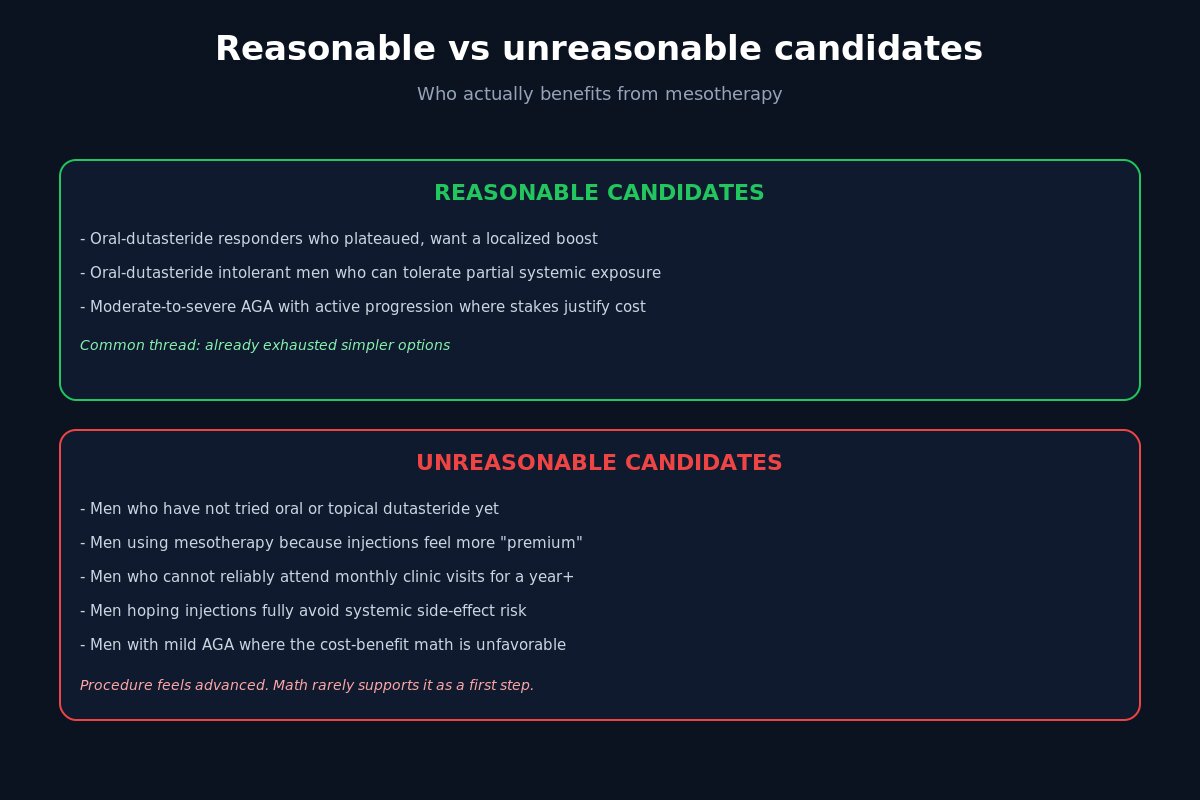
For a narrow set of cases, yes. For most men with AGA, no. The reasonable candidates are men who tolerated oral dutasteride poorly but want stronger DHT suppression than topical formulations provide, or men who have plateaued on oral therapy and want to add a high-local-concentration boost. The poor candidates are men who have not tried oral or topical dutasteride yet, men using mesotherapy because injections feel more “premium” than pills, or men who cannot reliably attend monthly clinic visits over the year-plus protocol the procedure requires. The procedure is real and the data shows some effect, but the cost-benefit math compared to a pill is rarely flattering.
What dutasteride mesotherapy actually is
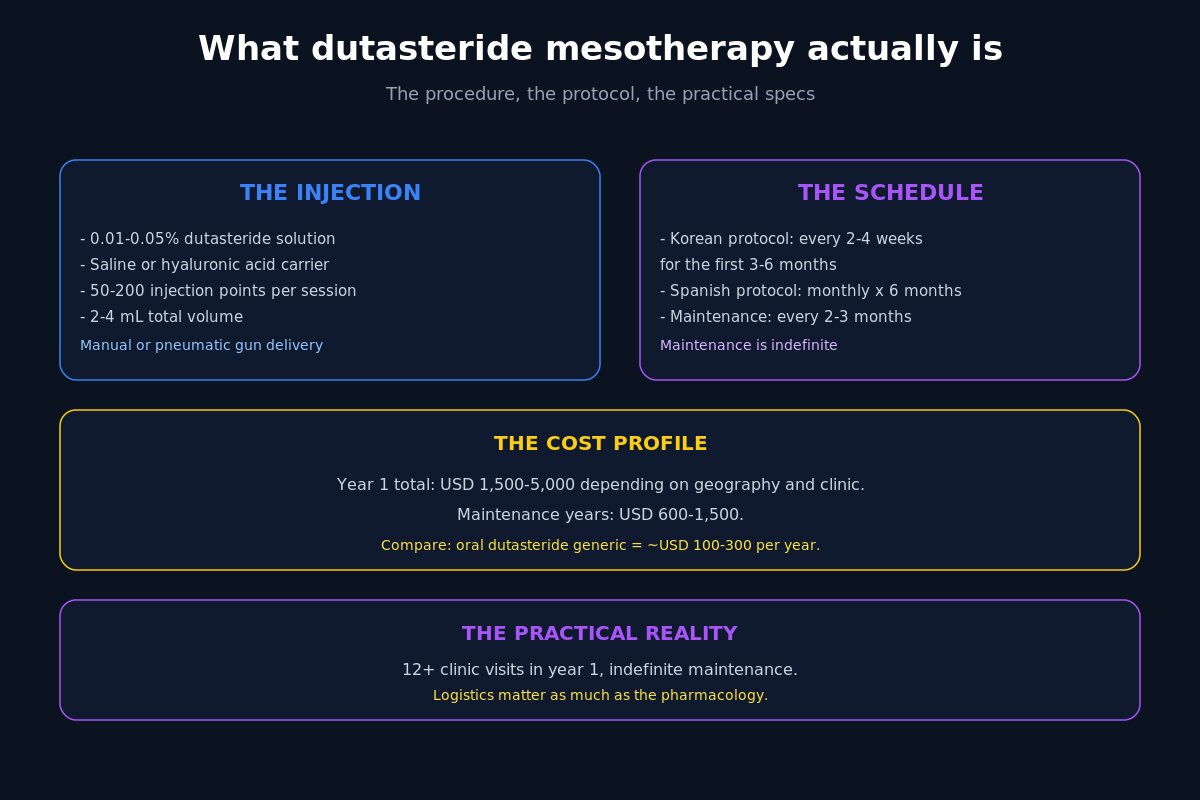
The procedure delivers a dilute dutasteride solution into the dermis of the scalp using either manual injection (multiple small needle punctures across the affected area) or a mesotherapy gun (rapid pneumatic injection covering the area faster). The dilution typically runs 0.01 to 0.05 percent dutasteride in saline or hyaluronic-acid carrier. Total volume per session is usually 2-4 mL distributed across 50-200 injection points, depending on the clinic’s protocol.
The treatment schedule has variations. The Korean protocol is the most-cited, with sessions every 2-4 weeks for the first 3-6 months, then maintenance every 2-3 months indefinitely. The Spanish protocol from Saceda-Corralo et al. 2017 used monthly sessions for 6 months. Maintenance frequency after the initial intensive phase varies. The total cost across the first year typically lands between USD 1,500 and USD 5,000 depending on the geography and clinic.
The published evidence
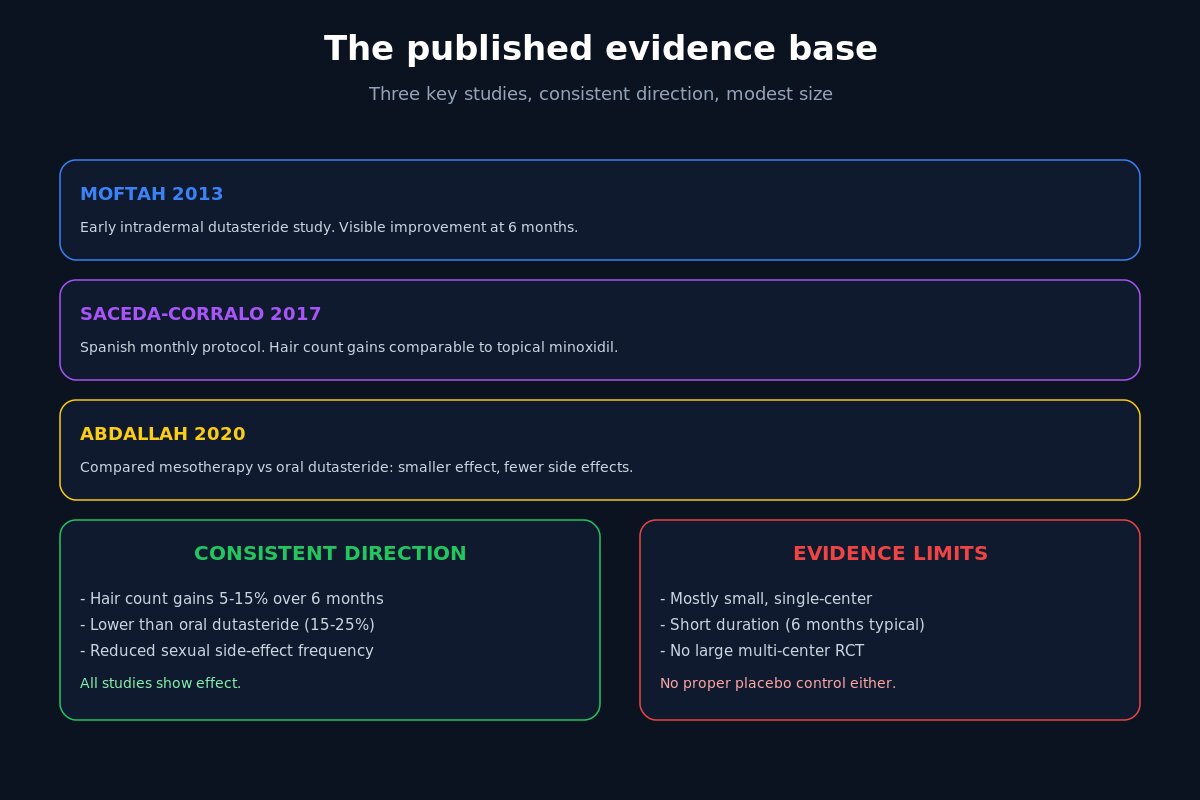
The trial base for dutasteride mesotherapy is small but consistent in the direction of effect. Moftah et al. 2013 was an early study showing intradermal dutasteride produced visible improvement in androgenetic alopecia at 6 months. Saceda-Corralo et al. 2017 was a Spanish study with monthly sessions reporting target-area hair count gains comparable to topical minoxidil. Abdallah et al. 2020 added a comparison arm with oral dutasteride, showing the mesotherapy effect was somewhat smaller than oral but with reduced systemic side-effect frequency.
The pattern across these studies is consistent: hair count gains in the range of 5-15 percent over 6 months, lower than oral dutasteride’s 15-25 percent in similar timelines, but with measurably reduced sexual side-effect frequency. The trials are mostly small, single-center, and short-duration. There is no large multi-center randomized trial with proper placebo control to confirm the effect size precisely.
The systemic absorption question
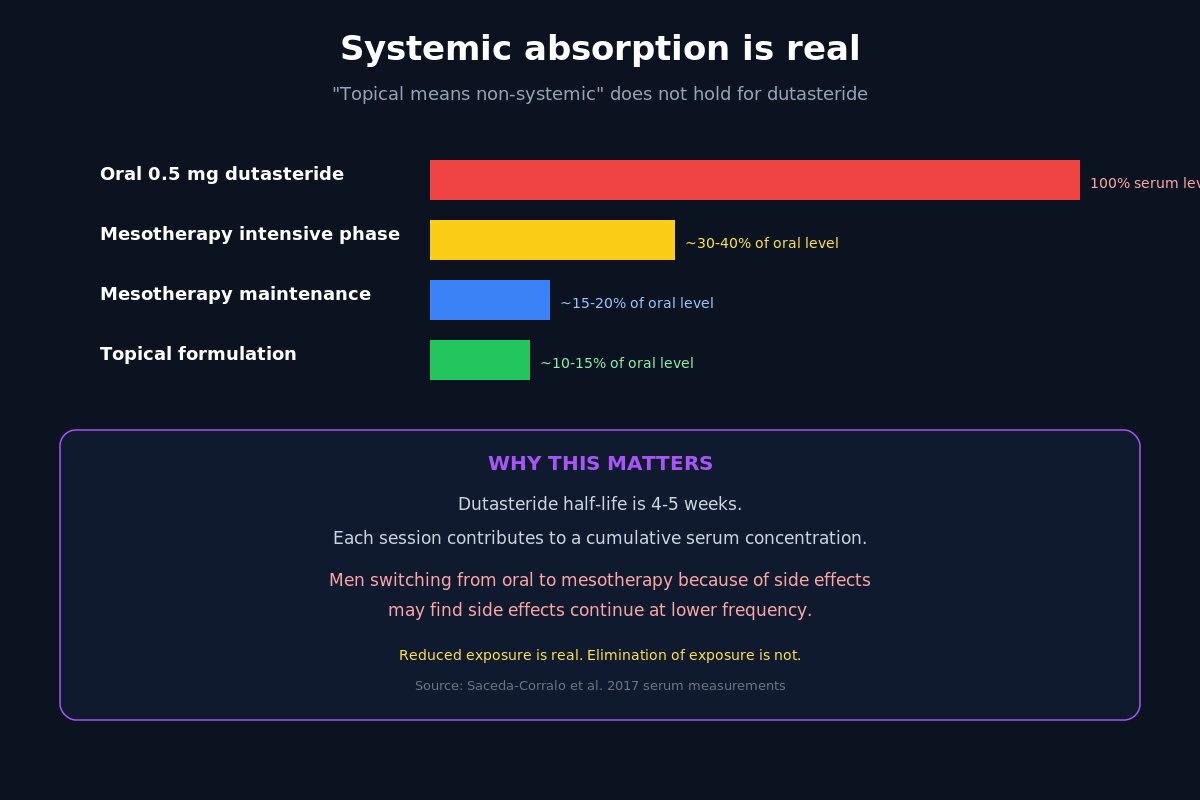
The pitch for mesotherapy assumes local action with reduced systemic exposure. The pharmacokinetics tell a more nuanced story. Intradermal dutasteride is absorbed into the systemic circulation, and the long elimination half-life of dutasteride (4-5 weeks) means each session contributes to a cumulative serum concentration that builds across the protocol. Saceda-Corralo et al. 2017 measured serum dutasteride levels and found they reached approximately 30-40 percent of the levels seen with oral 0.5 mg dosing during the intensive phase.
This matters because the marketing-implied “topical means non-systemic” framing does not hold for dutasteride. The serum concentration is reduced compared to oral but is still pharmacologically meaningful. Men switching from oral dutasteride to mesotherapy because they had sexual side effects on oral may find the side effects continue or partially continue on mesotherapy, especially during the intensive monthly-session phase. The reduction is real but is not the elimination men sometimes expect.
How mesotherapy compares to alternatives
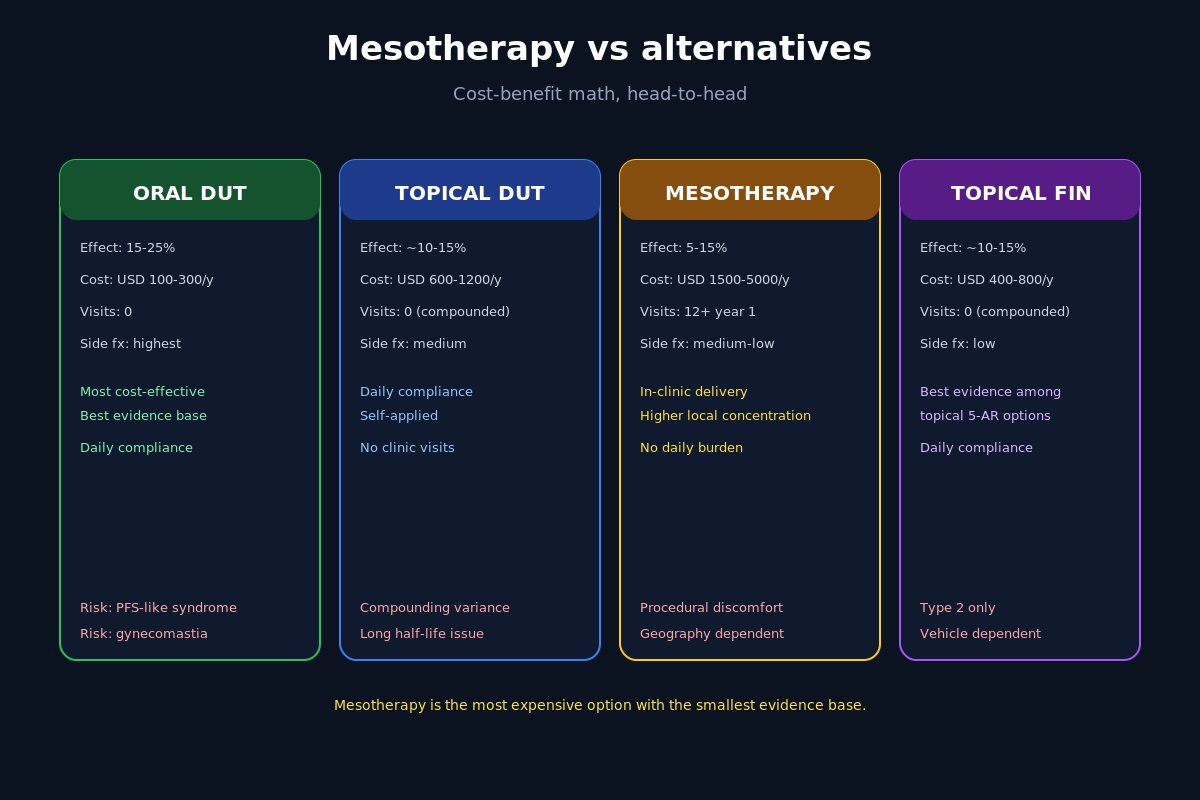
Compared to oral dutasteride 0.5 mg daily, mesotherapy produces somewhat smaller hair-count gains (5-15 percent vs 15-25 percent in matched trials) with somewhat reduced sexual side-effect frequency, at substantially higher cost (USD 1,500-5,000 first year vs USD 100-300 for generic oral) and substantially higher time investment (12+ clinic visits vs daily pill).
Compared to topical dutasteride from a compounding pharmacy, mesotherapy shows similar effect-size data with the operational advantages of in-clinic application (no daily compliance burden, higher local concentration) but the disadvantages of cost and visit dependency. Topical dutasteride is roughly USD 50-100 per month and self-applied; mesotherapy is roughly 3-5 times the cost and requires being in a city with a clinic offering it.
Compared to topical finasteride, mesotherapy is mechanistically stronger (dutasteride blocks both 5-AR isoenzymes) but has thinner trial data. Topical finasteride has multiple randomized trials including Caserini 2014 and Olsen 2007 showing efficacy. Mesotherapy’s evidence base is smaller and more heterogeneous in protocol.
Watch this on the channel
Finasteride Isn’t Working? Here’s Why – frames why escalating to dutasteride is the standard step before considering mesotherapy, and why the cost-benefit math depends heavily on where on the AGA escalation ladder you actually are.
The procedure experience
A typical session runs 30-60 minutes. Pre-procedure may include numbing cream applied to the scalp 30-45 minutes before the injections start, though some clinics skip this. The injections themselves feel like rapid pinpricks across the scalp, with the sensation more uncomfortable than painful for most patients. Bleeding is typically minor; small drops at the injection points are common but do not require dressing.
Post-procedure, the scalp is typically tender for 24-48 hours. Some patients experience mild redness or a “warm” sensation through the day. Strenuous exercise and direct sun exposure are usually avoided for 1-2 days after each session. The total downtime is small but the cumulative discomfort across 12+ sessions in a year is non-trivial. Some patients tolerate the experience easily; others find it harder than expected and drop out before completing the protocol.
Where mesotherapy fits in a protocol
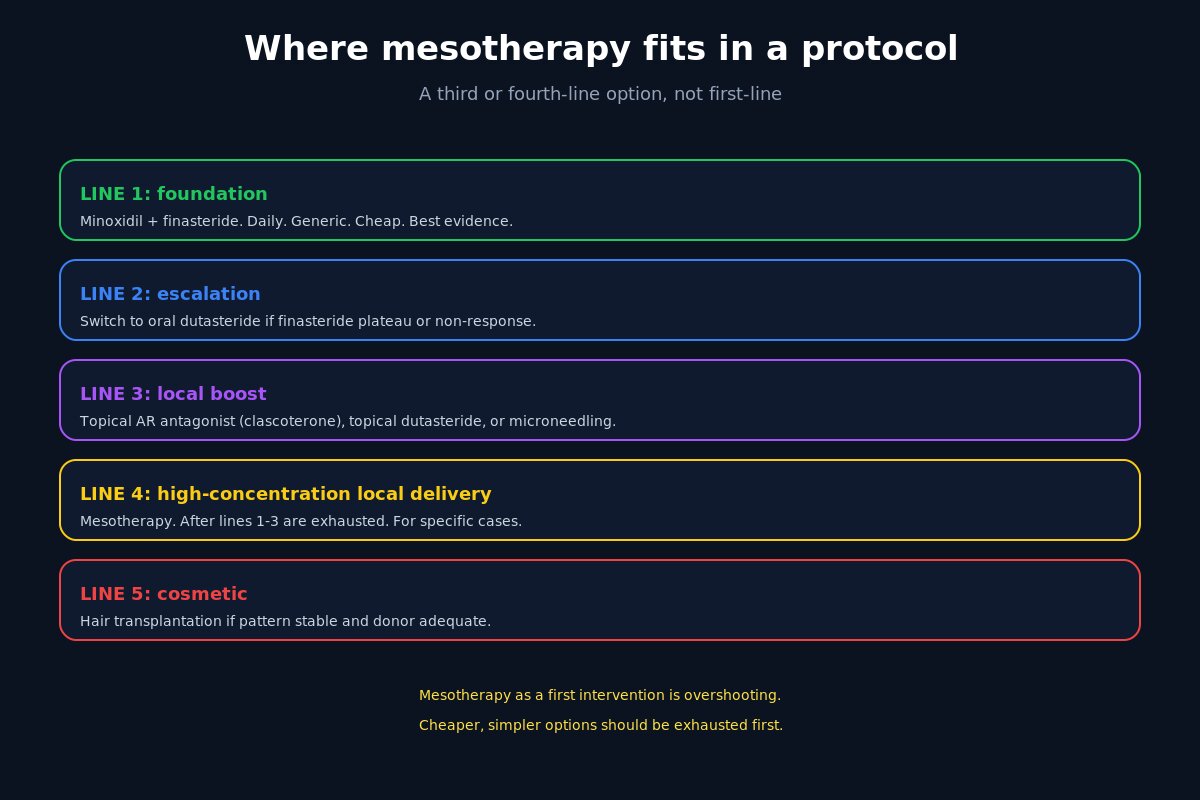
The honest placement of mesotherapy in a hair loss strategy is as a third or fourth-line option, not a first-line one. The conventional escalation runs: minoxidil + finasteride first, escalate to dutasteride if needed, add topical AR antagonists or topical dutasteride for additional local effect, consider mesotherapy if the man has tried the above and wants stronger local delivery without further increasing daily systemic exposure.
The men for whom mesotherapy makes the most sense are oral-dutasteride responders who have plateaued and want to add localized boost, oral-dutasteride intolerant men who can tolerate the partial systemic exposure of mesotherapy but not oral, and men whose AGA is moderate-to-severe with active progression where the cost and time are justified by the magnitude of the problem. Mesotherapy as a first intervention is overshooting; the cheaper, simpler options should be exhausted first.
What to ask a clinic before starting
What concentration of dutasteride and what carrier are used. The published protocols use 0.01 to 0.05 percent in saline or hyaluronic acid; concentrations dramatically outside this range should raise questions. What the per-session cost is and the total expected cost across year 1. Whether the maintenance phase is built into the quoted price or charged separately. What the operator’s training and volume is – this is a procedure where injection technique matters and clinic volume correlates with consistency. Whether the clinic measures and tracks hair count or only relies on photo evidence. Whether they have informed-consent disclosure of systemic absorption levels and side-effect frequency.
Common myths about dutasteride mesotherapy
The myth that mesotherapy is “topical and therefore non-systemic” misjudges the pharmacokinetics. The myth that it is dramatically more effective than oral dutasteride inverts the actual data. The myth that injections are inherently more “advanced” than pills confuses delivery format with efficacy. The myth that one round of sessions produces lasting results ignores that AGA is chronic and the protocol requires indefinite maintenance. The myth that mesotherapy avoids the side-effect risk of oral entirely is incorrect; reduced is not the same as absent. The myth that the procedure is risk-free overlooks the small but real complications of multi-point intradermal injection (infection, scarring, vascular injury, allergic reaction).
Frequently asked questions about dutasteride mesotherapy
How effective is dutasteride mesotherapy compared to oral dutasteride?
Roughly 60-75 percent as effective at hair-count outcomes in published comparisons. The trade-off is reduced sexual side-effect frequency at substantially higher cost and time investment.
Does mesotherapy avoid systemic side effects?
Reduces, does not avoid. Serum dutasteride levels reach 30-40 percent of oral dosing levels during the intensive monthly phase. Sexual side effects can occur, though at lower frequency than oral.
How often do I need sessions?
Typically every 2-4 weeks for the first 3-6 months (intensive phase), then every 2-3 months for maintenance indefinitely. Skipping maintenance leads to gradual loss of effect over months.
How much does dutasteride mesotherapy cost?
USD 1,500-5,000 in year 1 in most markets. Maintenance phase typically USD 600-1,500 per year. Substantially higher than oral dutasteride or topical compounded options.
Does it hurt?
Most patients report rapid pinprick sensations rather than sharp pain. Numbing cream is offered at most clinics. The sessions themselves are tolerable; the cumulative discomfort across 12+ visits is the harder part.
Can I do mesotherapy at home?
Strongly advise against. Sterile technique, depth control, distribution pattern, and concentration accuracy are all difficult outside a clinical setting. Home injections increase infection and dosing-error risk substantially.
How does mesotherapy compare to PRP for hair loss?
Different mechanisms. PRP delivers growth factors; dutasteride mesotherapy delivers an AR-pathway drug. They can be combined. PRP has a similar evidence-base size and similar cost-benefit profile.
Is the effect permanent?
No. AGA continues to progress without ongoing therapy. The maintenance phase exists because skipping it leads to gradual loss of the effect achieved during the intensive phase.
Bringing it together
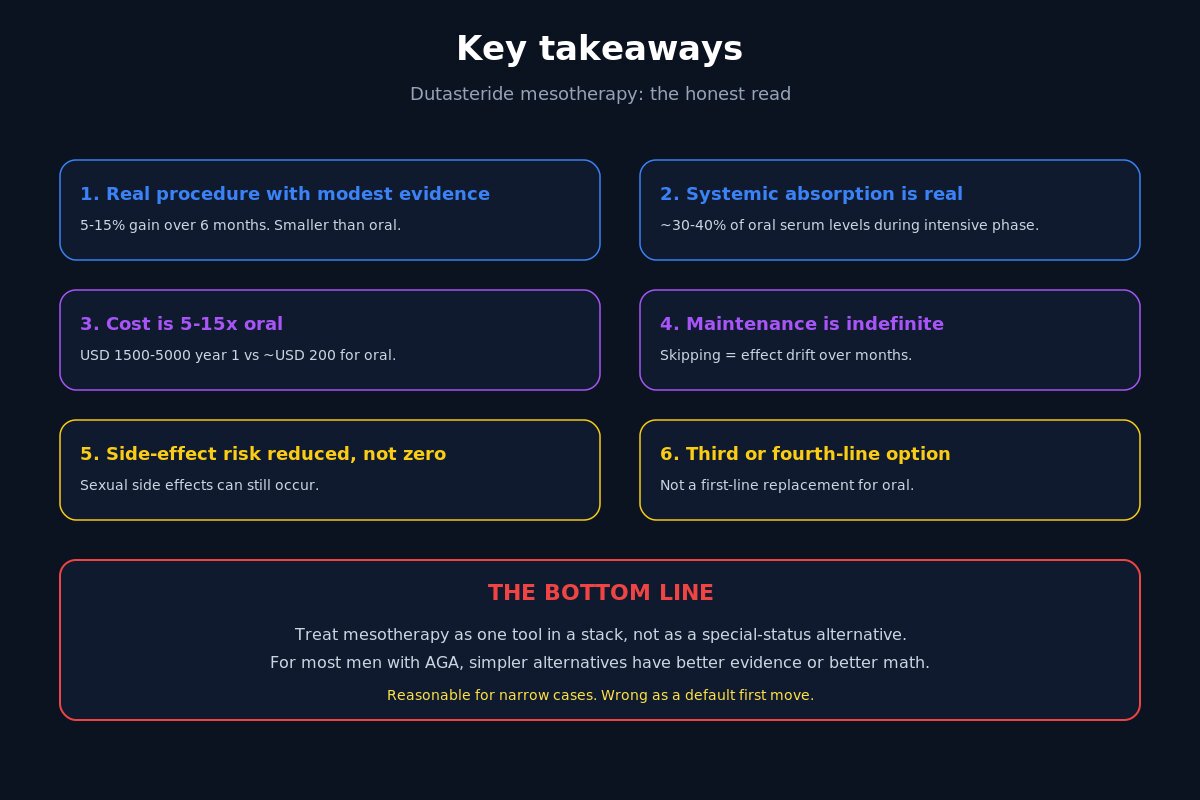
Dutasteride mesotherapy is a real procedure with a real but modest evidence base. It produces hair-count gains in the range of 5-15 percent over the first 6 months, somewhat smaller than oral dutasteride at substantially higher cost and time investment. The systemic absorption is reduced but not eliminated, so men hoping mesotherapy will let them avoid sexual side-effect risk entirely will be partially disappointed. The procedure makes the most sense for a narrow group of men who have already tried the conventional escalation ladder and want stronger local delivery as a fourth-line option. For most men with AGA, the cheaper, simpler alternatives have either better evidence or better cost-benefit math. Treat mesotherapy as one tool in a stack rather than as a special-status alternative to oral therapy.
About the author
Philippe Boissard
Author of Men’s Hairloss Protocol (2020), Better, Smarter, Stronger (2023), and Multi-Axis Body (2025). Researches and writes about hair loss and male physiology, citing primary literature and disclosing affiliate relationships in full. Not a medical doctor; all content is educational. More about Philippe.
Related reading
- PRP for Hair Loss: Protocol, Evidence, and Realistic Expectations
- The Microneedling Protocol That Actually Works (And the Three Mistakes Most Men Make)
- Low-Level Laser Therapy for Hair Loss: What the Evidence Actually Shows
- Why Your Hair Loss Protocol Isn’t Working: The 7 Hidden Reasons Most Men Miss
Get my free hair-loss protocol
The exact evidence-based routine I actually use and recommend: what works, in what order, with no hype. Enter your email on the next page and I’ll send it straight to you.
Send me the free protocol →