
The Microneedling Protocol That Actually Works (And the Three Mistakes Most Men Make)
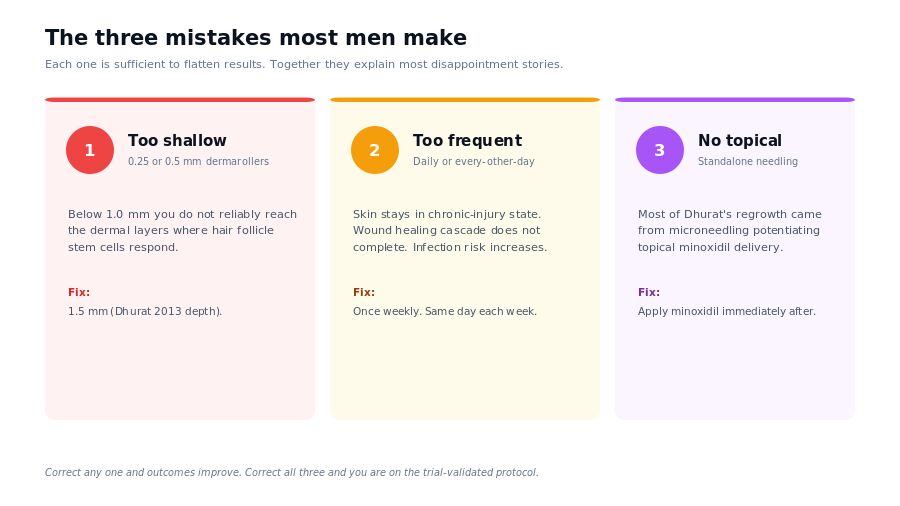
Microneedling is the most evidence-backed adjunct in hair loss, and also the one most men do wrong. Three mistakes flatten results: depth too shallow, frequency too high, and using it as standalone instead of a delivery system.

Microneedling is the most evidence-backed adjunct treatment in hair loss, and also the one most men do wrong. Three mistakes account for most of the disappointing results: needles too shallow to do anything, frequency that prevents skin recovery, and using it as a stand-alone instead of a delivery system. The trial protocol that actually works is specific. None of the three mistakes is in it.
Quick answer: does microneedling work for hair loss?
Yes, when the protocol is right. Dhurat et al. 2013 (the foundational RCT) showed that microneedling at 1.5 mm depth, weekly, combined with topical minoxidil, more than doubled hair count gains versus minoxidil alone over 12 weeks. Subsequent trials and meta-analyses (Yu 2018, Abdi 2023) have replicated the pattern: microneedling adds clinically meaningful regrowth on top of standard treatments, but only when depth, frequency, and combination are dialed in. Standalone microneedling at consumer 0.25 mm dermarollers, used too frequently, with no topical synergy, produces marginal results at best.
The point of this article is to lay out exactly what the trials did, why the parameters matter biologically, and what most men get wrong. The full mechanism of follicular DHT signaling and miniaturization that microneedling sits on top of is covered in how hair loss actually works.
What microneedling actually does to the scalp
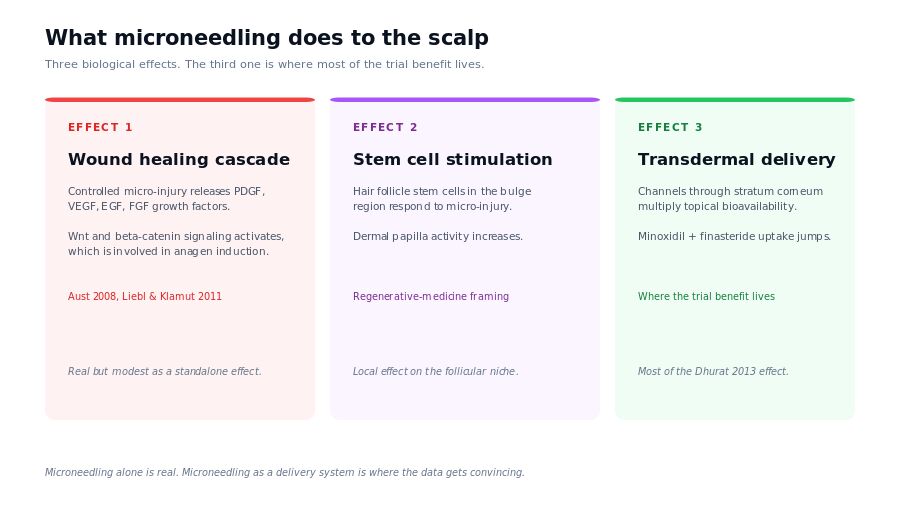
Microneedling creates controlled micro-injuries in the skin. The biological response includes three relevant effects for hair loss.
- Wound healing cascade. Platelet-derived growth factor, VEGF, EGF, and FGF release. Wnt and beta-catenin signaling pathway activation, which is involved in anagen induction (Aust et al. 2008, Liebl & Klamut 2011).
- Stem cell stimulation. The micro-injury stimulates hair follicle stem cells (bulge-region) and dermal papilla activity. This is the regenerative-medicine framing that gets the most attention.
- Transdermal delivery. Channels through the stratum corneum increase the penetration of co-applied topicals (minoxidil, finasteride). Needling alone helps; needling plus topical helps more.
The third effect is where most of the trial benefit comes from. Microneedling on its own is real but modest. Microneedling as a delivery system that multiplies the bioavailability of standard topical treatments is where the data gets convincing.
Mistake 1: needles too shallow to do anything
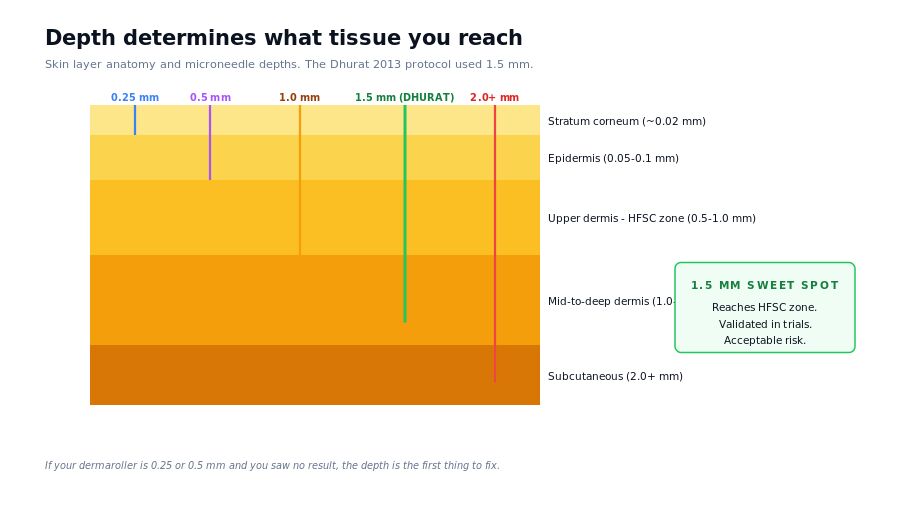
The single biggest reason men do not see results from microneedling is depth. Consumer dermarollers are typically sold at 0.25 mm, 0.5 mm, 0.75 mm, 1.0 mm, and 1.5 mm. Skin anatomy matters: the stratum corneum is roughly 0.02 mm thick, the epidermis is 0.05 to 0.1 mm, and the upper dermis where hair follicle stem cells reside extends from roughly 0.5 mm down. Anagen-phase scalp hair follicles extend to 4 mm.
- 0.25 mm: penetrates the stratum corneum and epidermis only. Useful for cosmetic skin texture. Not enough to reach the follicular stem cell zone or activate meaningful wound healing.
- 0.5 mm: reaches the upper dermis. Some delivery enhancement for topicals, weak hair-specific signaling.
- 1.0 mm: mid-dermis penetration. Better delivery, modest regenerative response.
- 1.5 mm: the depth used in Dhurat et al. 2013. Reaches the level where hair follicle stem cells respond. Established efficacy in the trial that started the field.
- Above 2.0 mm: beyond what trials have validated. Higher pain, bleeding, infection risk without proportional efficacy gains.
Practical: if your dermaroller is 0.25 or 0.5 mm and you have been “microneedling for hair loss” with no result, the depth is the first thing to fix. The Dhurat protocol used 1.5 mm. The trial that established the field. Use that depth.
Mistake 2: too frequent, no recovery
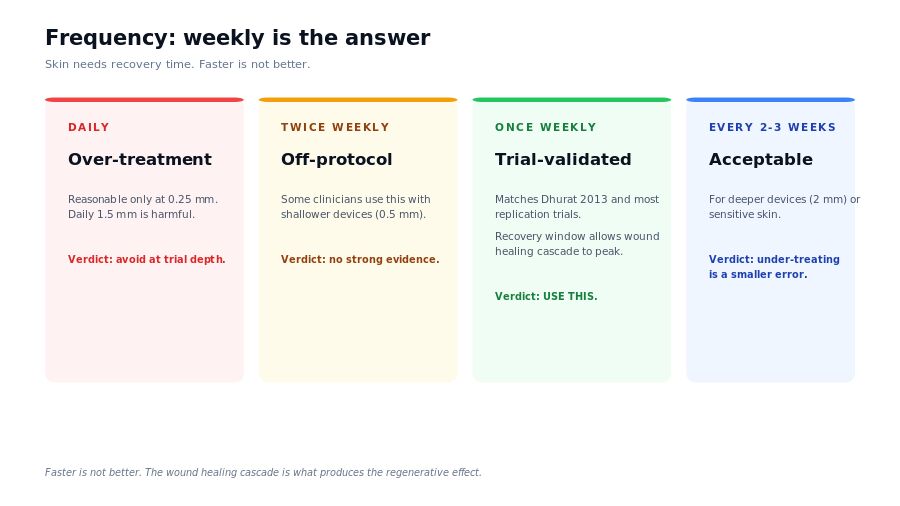
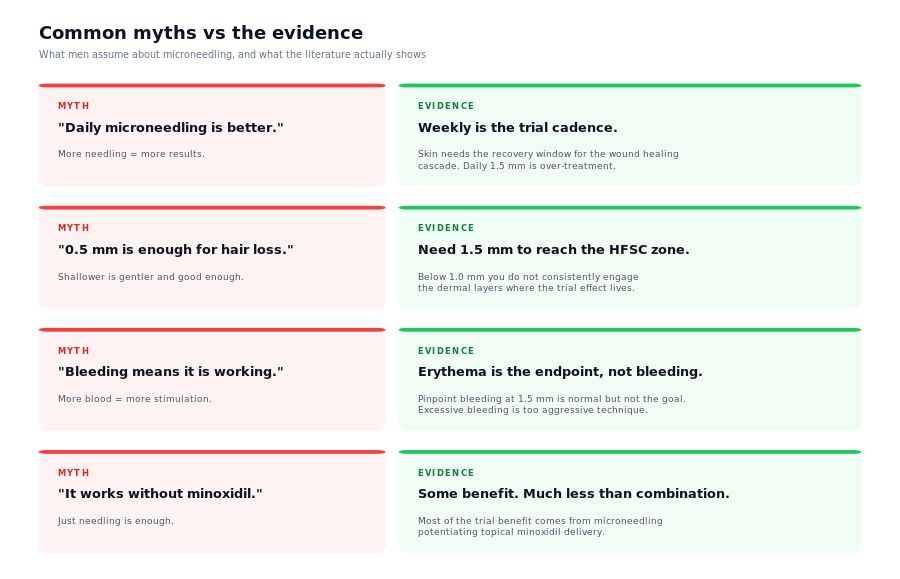
The second most common error is frequency. The Dhurat protocol was once weekly. That spacing is biologically meaningful: skin needs time to complete the wound healing cascade and reset before the next injury. Daily or every-other-day microneedling keeps the skin in a chronic-injury state that does not deliver the same anagen-induction effect, and increases infection and irritation risk.
- Once weekly: matches Dhurat 2013 and most replication trials. The recovery window allows the wound healing cascade to peak and reset. Use this.
- Twice weekly: not in the trial protocols. Some clinicians use this with shallower needles (0.5 mm) to balance frequency against recovery. No strong evidence advantage.
- Daily: reasonable only at very shallow depth (0.25 mm), and the evidence at that depth is weak. Daily 1.5 mm is harmful.
- Every 2-3 weeks: may be the right cadence with deeper devices (2.0 mm dermapens) or for sensitive skin. Less frequent than weekly should not be a problem; under-treating is a smaller error than over-treating.
Pattern: weekly at 1.5 mm is the trial-validated cadence. Faster is not better. Slower does not lose much.
Mistake 3: standalone instead of delivery system
The most-misread fact in microneedling is this: most of the regrowth benefit in trials comes from the combination with topical minoxidil, not from needling alone. Dhurat 2013 was specifically minoxidil + microneedling versus minoxidil alone. The microneedling group did dramatically better. The trial did not isolate microneedling-only.
Subsequent isolation studies have shown that microneedling-only does produce some hair count benefit over no treatment, but the effect size is much smaller than the combination. Microneedling is real, but it is most powerful when used as a transdermal delivery channel for treatments that already work.
- Microneedling + minoxidil: the validated combination. Apply minoxidil right after needling, while channels are still open.
- Microneedling + topical finasteride: mechanistically reasonable, less studied than minoxidil combination. The full case for topical finasteride and dosing is in the topical finasteride article.
- Microneedling + oral finasteride: additive but not synergistic. Oral finasteride works systemically; microneedling does not enhance its delivery.
- Microneedling alone: some benefit. Less than the combinations. Not the trial-validated approach.
Practical: if you are microneedling weekly at 1.5 mm and not pairing with a topical, you are leaving most of the benefit on the table.
The trial evidence base
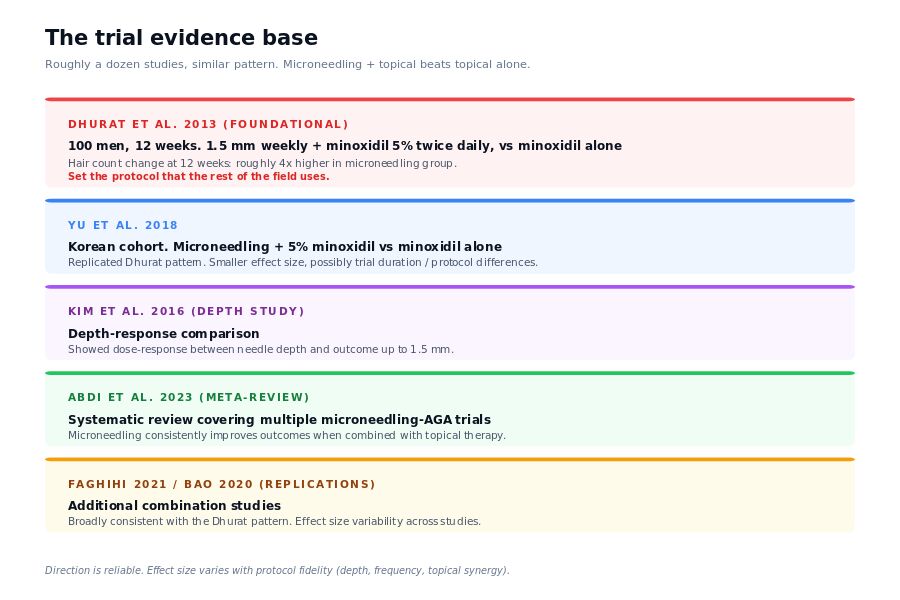
Microneedling for AGA has a meaningful trial record. The studies that matter:
- Dhurat et al. 2013: 100 men, 12 weeks. Microneedling 1.5 mm weekly + minoxidil 5% twice daily, vs minoxidil alone. Hair count change at 12 weeks: roughly 4 times higher in the microneedling group. Foundational study.
- Yu et al. 2018: Korean cohort. Microneedling + 5% minoxidil vs minoxidil alone. Replicated the Dhurat pattern with smaller effect size, possibly due to shorter trial duration and protocol differences.
- Kim et al. 2016: depth comparison. Showed dose-response between needle depth and outcome up to 1.5 mm.
- Abdi et al. 2023: systematic review covering multiple microneedling-AGA trials. Conclusion: microneedling is an evidence-backed adjunct that consistently improves outcomes when combined with topical therapy.
- Faghihi et al. 2021 / Bao et al. 2020: additional combination studies, broadly consistent with the Dhurat pattern.
Pattern: across roughly a dozen studies, microneedling 1.0 to 1.5 mm weekly combined with topical minoxidil consistently outperforms minoxidil alone. Effect sizes vary, but the direction is reliable.
The protocol that actually works
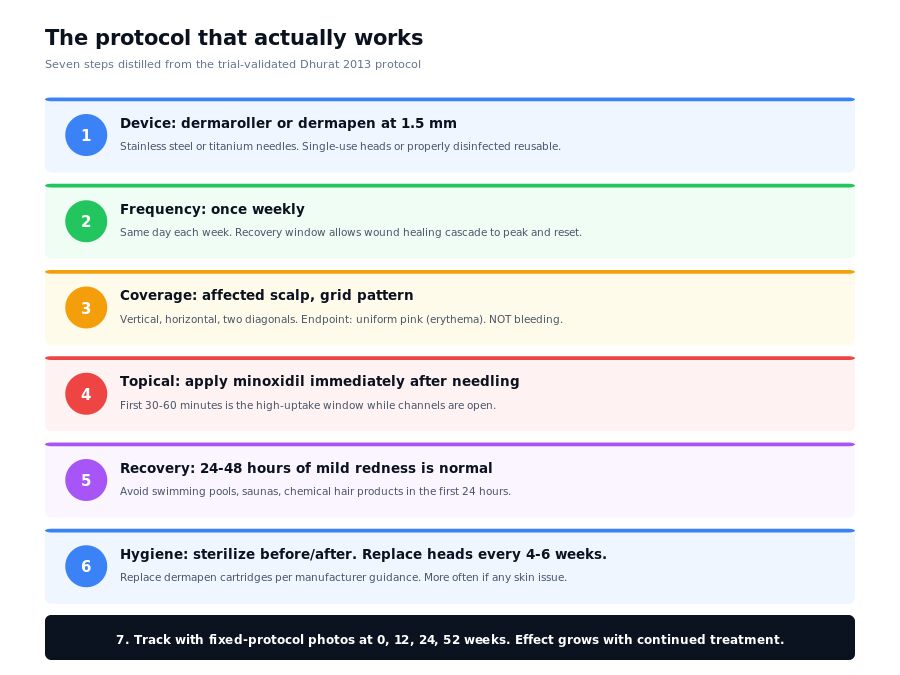
Translation of the trial data into a usable protocol:
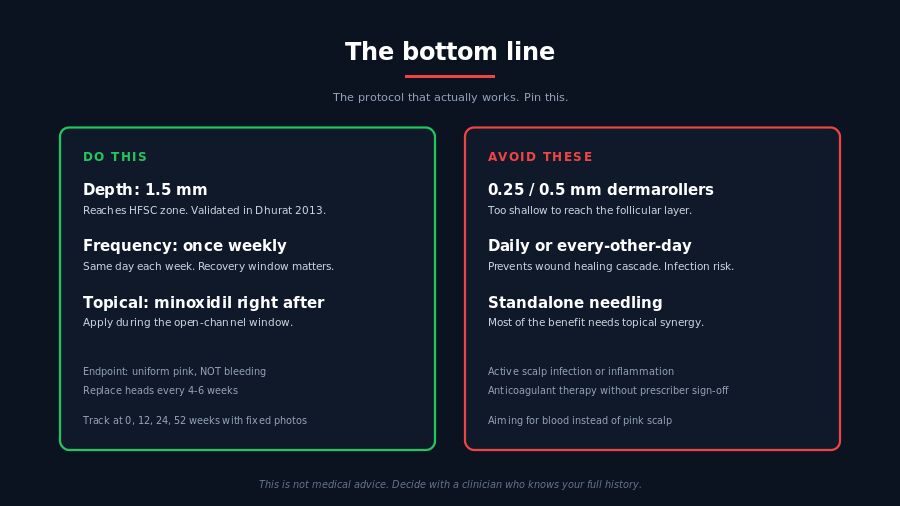
- Device: dermaroller or dermapen at 1.5 mm. Stainless steel or titanium needles. Single-use heads or properly disinfected reusable heads.
- Frequency: once weekly. Same day each week if possible.
- Coverage: the affected scalp area. Roll or stamp in a grid pattern (vertical, horizontal, two diagonals) until the scalp is uniformly pink. Erythema (redness) is the endpoint, not bleeding.
- Topical timing: apply minoxidil immediately after needling, while channels are open. The 30-60 minutes after needling is the high-uptake window.
- Recovery: 24-48 hours of mild redness is normal. Avoid swimming pools, saunas, or chemical hair products in the first 24 hours.
- Hygiene: sterilize device before and after use. Replace dermaroller heads every 4-6 weeks regardless of brand claims. Replace dermapen needle cartridges per manufacturer guidance, more often if scalp infection risk.
- Duration: evaluate at 12, 24, and 52 weeks with fixed-protocol photos. The Dhurat 12-week effect grows with continued treatment.
Side effects, safety, and when not to needle
Microneedling is well-tolerated when done correctly. The risks worth knowing:
- Infection. The most serious risk. Caused by unsterilized devices, contaminated water, or post-needling exposure to bacteria-rich environments (gym, public pools). Symptoms: persistent redness, pus, fever. Stop immediately and see a clinician.
- Excessive bleeding. Pinpoint bleeding at 1.5 mm is normal and minor. Significant bleeding suggests technique problems (too aggressive, too deep) or anticoagulant interaction.
- Hyperpigmentation. Rare in scalp application. More common on facial use of microneedling.
- Active scalp infection or inflammatory dermatosis: do not needle through psoriasis, seborrheic dermatitis, folliculitis, or any active inflammation.
- Anticoagulant therapy: consult your prescriber. Microneedling can cause bleeding that may not stop normally.
Common myths about microneedling
Why this video is relevant: microneedling results take 12-24 weeks to show in photos and 6+ months to look obvious. Most men give up before they would have seen results, or convince themselves something is not working when the timeline is just doing its normal thing. This video covers why fixed-protocol photo tracking matters and how to read your own progress honestly. The microneedling protocol is the right one. The patience is part of the protocol too.
Frequently asked questions about microneedling for hair loss
What is the right microneedling depth for hair loss?
1.5 mm. That is the depth used in Dhurat et al. 2013 and most replication trials. Below 1.0 mm you do not reliably reach the dermal layers where hair follicle stem cells respond. Above 2.0 mm you increase pain and infection risk without proportional efficacy gains.
How often should I microneedle?
Once weekly at 1.5 mm. The trial protocols established weekly cadence because skin needs the recovery window to complete the wound healing cascade. Daily 1.5 mm is over-treatment.
Does microneedling work without minoxidil?
Some benefit, much smaller than the combination. The Dhurat trial that established the field tested microneedling + minoxidil. Most of the regrowth benefit in the literature comes from microneedling enhancing topical delivery rather than from needling alone.
Can I microneedle while taking finasteride?
Yes. They work additively, not synergistically. Oral finasteride suppresses systemic DHT. Microneedling enhances topical delivery and stimulates local stem cells. Combining is reasonable. The full decision logic for finasteride is in why finasteride fails some men.
Dermaroller or dermapen?
Either works at the right depth. Dermapens have adjustable depth and motorized needling, which produces more uniform delivery. Dermarollers are cheaper and effective if used with consistent pressure. The trials that established the protocol used both. The depth setting matters more than the device type.
How long until I see results?
The Dhurat 12-week trial showed measurable hair count differences at 12 weeks. Visible cosmetic improvement typically takes 6 months. Track with fixed-protocol photos at 0, 12, 24, and 52 weeks. Microneedling responses, like all hair loss treatments, look slow until they suddenly look obvious around the 6-month mark.
Does it hurt?
1.5 mm scalp microneedling is uncomfortable but typically tolerable without anesthetic. Topical lidocaine 4-5% applied 30 minutes before treatment reduces pain meaningfully. Pain decreases with experience. If pain is severe, depth may be too aggressive for your sensitivity.
Should I needle areas that are not yet thinning?
Limited data. The trials targeted areas of established loss. Treating non-thinning areas is unlikely to harm but the benefit is unclear. Most clinicians focus on the established loss zone and the immediate transition area.
Bringing it together
Microneedling works when you do it right. The trial-validated protocol is 1.5 mm depth, once weekly, applied to the affected scalp, with topical minoxidil applied immediately after to use the open channels. Three errors account for most disappointing results: depth too shallow, frequency too high, and using needling without a topical to potentiate. Correct any one of those and outcomes improve. Correct all three and you are on the protocol that produced the foundational Dhurat data.
If you are integrating microneedling into a broader protocol, the rest of the toolkit matters. The pillar guide on how hair loss actually works covers the DHT pathway and why systemic suppression matters. The deep dive on why finasteride fails some men covers when systemic treatment is the bottleneck. The neutral coverage of post-finasteride syndrome is the most relevant background if you cannot use systemic treatment. And the failure-mode analysis in why your hair loss protocol isn’t working covers the seven traps most men fall into when stacking treatments.
This article is not medical advice. It is a synthesis of peer-reviewed literature aimed at informing your conversation with a qualified clinician. Treatment decisions should be made with a prescriber who can evaluate your full medical history, contraindications, and individual risk profile. See the full disclaimer.
Related reading
About the author
Philippe Boissard
Author of Men’s Hairloss Protocol (2020), Better, Smarter, Stronger (2023), and Multi-Axis Body (2025). Researches and writes about hair loss and male physiology, citing primary literature and disclosing affiliate relationships in full. Not a medical doctor; all content is educational. More about Philippe.
Get my free hair-loss protocol
The exact evidence-based routine I actually use and recommend: what works, in what order, with no hype. Enter your email on the next page and I’ll send it straight to you.
Send me the free protocol →
[…] The Microneedling Protocol That Actually Works (And the Three Mistakes Most Men Make) […]
[…] The Microneedling Protocol That Actually Works (And the Three Mistakes Most Men Make) […]
[…] The Microneedling Protocol That Actually Works (And the Three Mistakes Most Men Make) […]