
Scalp Massage and Hair Growth: Koyama 2016 Reality Check
Scalp massage has a plausible mechanism and one small study supporting modest effects. The right place is as a daily 4-5 minute adjunct, not a primary therapy.

Scalp massage is the most accessible hair intervention – free, no side effects, easy to do daily. The popular evidence base traces almost entirely to one small study from 2016. Reading that study honestly produces a more careful conclusion: there is a plausible mechanism, the evidence is real but thin, and the right place for scalp massage in a protocol is as a no-cost adjunct, not a primary therapy.
Quick answer: real mechanism, very small trial, reasonable adjunct
Koyama et al. (2016) published a 24-week study where 9 healthy Japanese men performed standardized 4-minute daily scalp massage. Hair thickness increased modestly. Gene expression in punch biopsy samples showed upregulation of pathways associated with hair growth and downregulation of pathways associated with hair loss. The findings are real and the mechanism is plausible. The sample size is 9. That single number constrains how much weight the study can carry.
English and Barazesh (2019) added a survey-based observational study on standardized scalp exercises with larger participant numbers but no biopsy or instrument-measured hair count. Self-reported improvement was common.
The honest framing: scalp massage is one of the few hair interventions with a plausible mechanism, real human data, no side effects, and zero monetary cost. It belongs in almost every hair protocol as a daily adjunct. It will not stop active androgenetic alopecia on its own.
What Koyama 2016 actually showed
The study is small enough to read carefully and worth the effort.
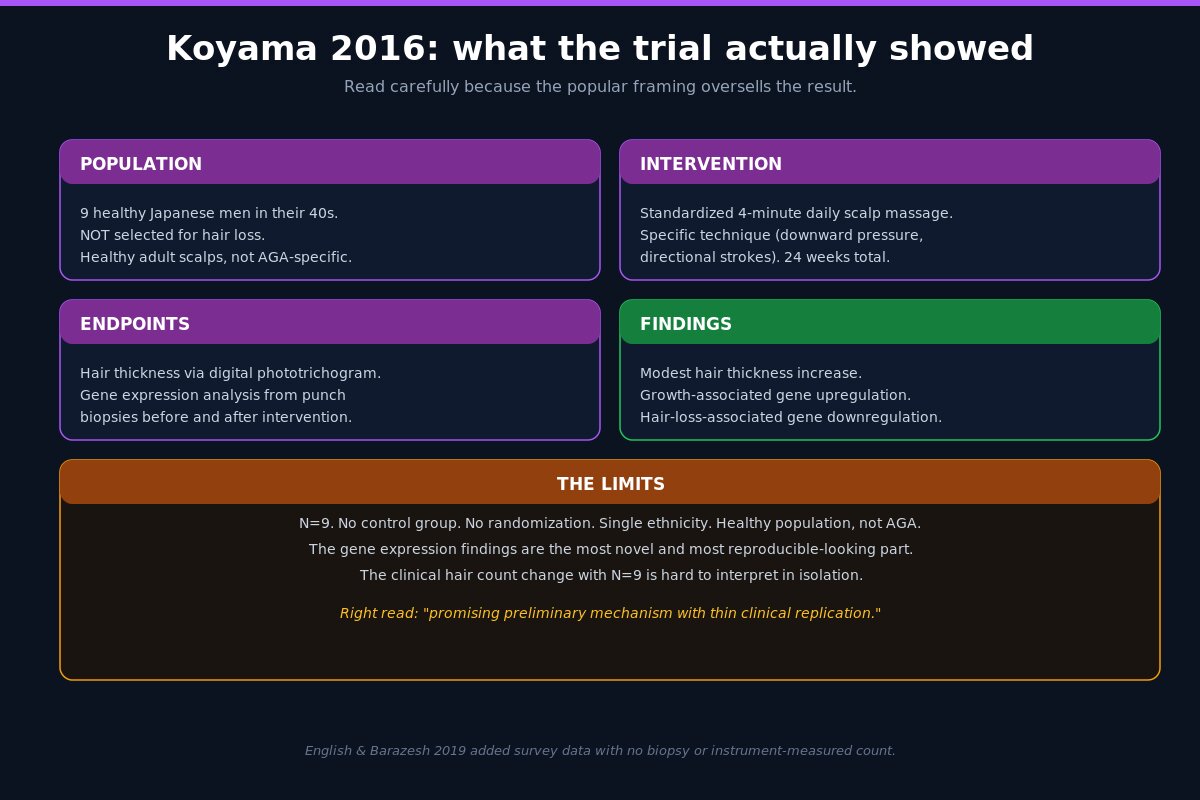
Population: 9 healthy Japanese men in their 40s. Important: not selected for hair loss, not stratified by Norwood stage. Healthy adult scalps.
Intervention: Standardized 4-minute daily scalp massage for 24 weeks. The technique was specific – downward pressure with the fingertips, moving in particular directions to apply mechanical stretch to the scalp tissue.
Endpoints: Hair thickness measured by digital phototrichogram. Gene expression analysis from punch biopsies before and after the intervention.
Findings: Hair thickness increased modestly. Gene expression analysis showed upregulation of growth-associated pathways (including ALPL, IL6ST, and related genes) and downregulation of pathways associated with hair loss (including IL1F6, IL13, and others).
Limits: N=9. Healthy population, not a hair-loss population. No control group. No randomization. Single ethnicity. The gene expression findings are the most novel and most reproducible-looking part, but the clinical hair count change with N=9 is hard to interpret.
Treating this as a finished case for scalp massage is overreach. Treating it as zero evidence is also wrong. The right read: “promising preliminary mechanism with thin clinical replication.”
The mechanical-induction hypothesis
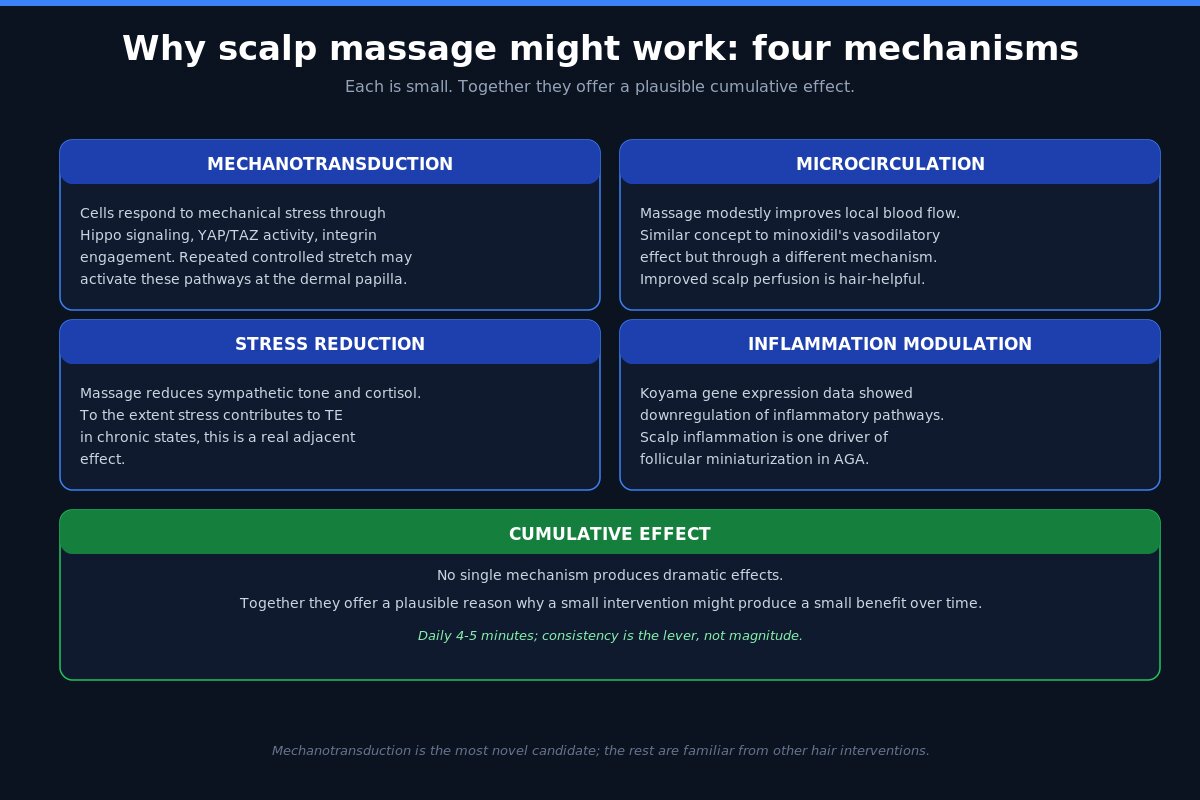
The biological rationale for scalp massage involves mechanical signaling at the follicle level. Several pathways have been proposed.
Mechanotransduction. Cells respond to mechanical stress through specific pathways – Hippo signaling, YAP/TAZ activity, integrin engagement. Repeated controlled stretch on scalp tissue may activate these pathways at the dermal papilla, with downstream effects on follicle cycling.
Microcirculation. Massage modestly improves local blood flow, similar in concept to minoxidil’s vasodilatory effect but through a different mechanism. Improved scalp perfusion is theoretically beneficial for hair purposes.
Stress reduction. Massage reduces sympathetic tone and cortisol secretion in studies of body massage. To the extent stress contributes to telogen effluvium (which it does in chronic states; see prior article), this is a small but real adjacent effect.
Inflammation modulation. The Koyama gene expression data showed downregulation of inflammatory pathways. Scalp inflammation is one driver of follicular miniaturization in AGA. If massage modestly reduces this inflammatory tone, that is mechanistically helpful.
None of these mechanisms produce dramatic effects. Together they offer a plausible reason why a small intervention might produce a small but real benefit over time.
Effect size: what scalp massage realistically delivers
Honest framing on what to expect.
Standalone scalp massage. No good data on standalone scalp massage producing meaningful hair density increases in active AGA. Koyama 2016 showed thickness changes in healthy adults without AGA. The effect in AGA-specific populations is unstudied.
As an adjunct to existing therapy. Plausible additive effect, though not directly tested in head-to-head trials. The mechanisms (mechanotransduction, circulation, inflammation) do not redundantly overlap with finasteride or minoxidil, so additive effects are biologically reasonable.
Time investment. 4-5 minutes per day. Free.
Risk profile. Functionally zero. Excessive force or aggressive scrubbing could cause traction damage or skin irritation; standard gentle pressure is safe.
Comparison to other adjuncts. The effect size is likely smaller than topical interventions like rosemary oil or 2 percent minoxidil. The cost-benefit ratio is excellent because the cost is essentially zero. The effect is small but free.
Watch this for the patience framing
This video covers why hair changes show up over months, not weeks. Scalp massage is exactly that kind of intervention – small daily input, slow accumulation, visible only across months. The patience framing matters because most people abandon scalp massage at week 4 expecting a result that the cycle physiology cannot produce that fast.
How to actually do scalp massage
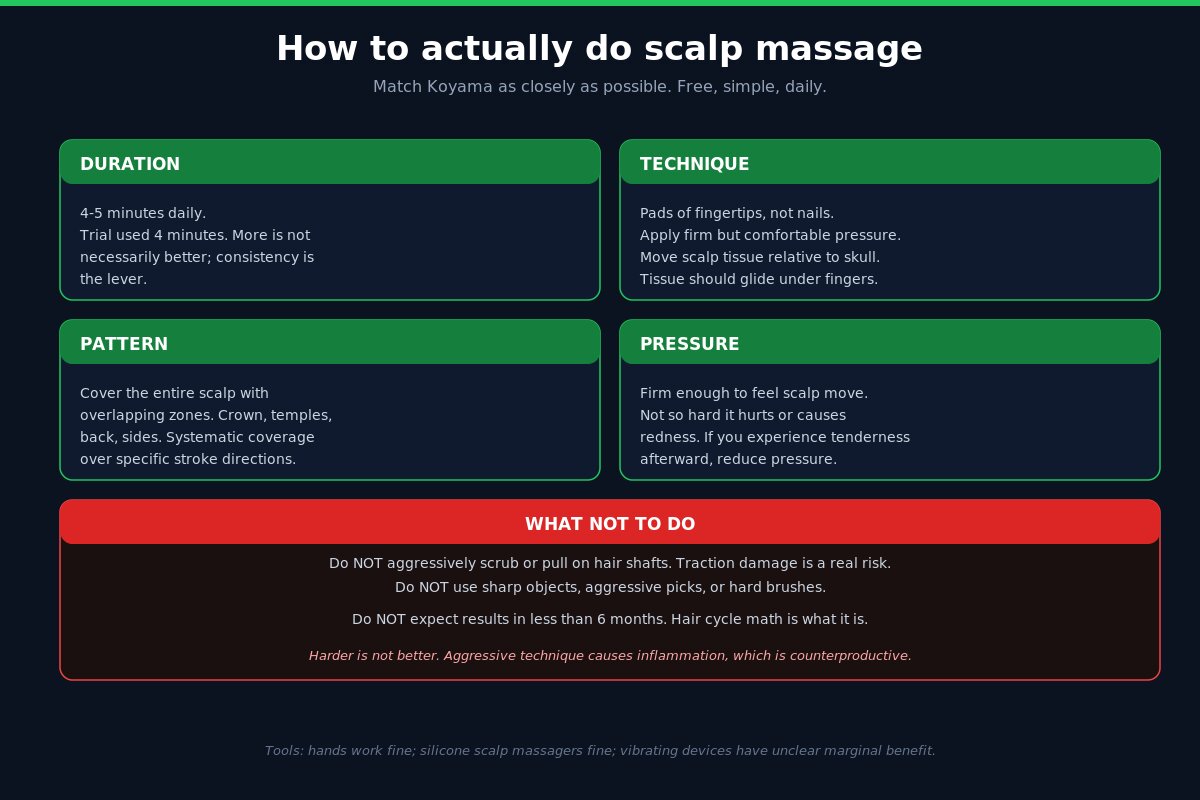
To match Koyama as closely as possible:
Duration. 4-5 minutes daily. The trial used 4 minutes. More is not necessarily better; consistency is the lever.
Technique. Use the pads of your fingertips, not nails. Apply firm but comfortable pressure to the scalp tissue. The aim is to move the scalp itself relative to the skull, not just to massage hair on the surface. The tissue should glide slightly under your fingertips.
Pattern. Cover the entire scalp with overlapping zones. Most users find a systematic crown-to-temple-to-back pattern easiest. The Koyama trial used specific directional strokes; the broader principle is consistent coverage rather than a specific technique.
Pressure. Firm enough to feel the scalp move. Not so hard that it hurts or causes redness. If you experience scalp tenderness afterward, reduce pressure.
Frequency. Once daily is adequate. Twice daily is fine but probably not additive. The Koyama protocol was once daily.
Timing. Any time of day. Many users prefer evening as a relaxation routine. Compatible with topical applications – massage helps distribute and slightly increases absorption.
Tools. Hands work fine. Silicone scalp massagers are popular and effective for users who find finger massage tiring. Vibrating scalp massagers are sold but the marginal benefit over manual is unclear.
What not to do. Do not aggressively scrub or pull on hair shafts. Do not use sharp objects or aggressive picks. Do not expect results in less than 6 months.
The Hairguard GrowBand and similar devices
Several devices apply mechanical stretch to the scalp through wearable technology. The Hairguard GrowBand is the best-known. The premise is that mechanical stretch produced consistently by a device replicates the gene-expression changes seen in Koyama 2016 with less daily effort.
The clinical evidence base for the device specifically is limited but the mechanistic argument is sensible. The argument applies the Koyama mechanism to a passive delivery method – the cells respond to stretch regardless of whether a device or a hand applies it. Whether the magnitude is comparable to manual massage is unstudied directly.
Disclosure: an affiliate relationship exists with Hairguard. The GrowBand is available with a small additional discount via the affiliate link in articles where it is recommended. If you are skeptical of devices or prefer the free option, manual massage is the clean baseline.
Combining with other interventions
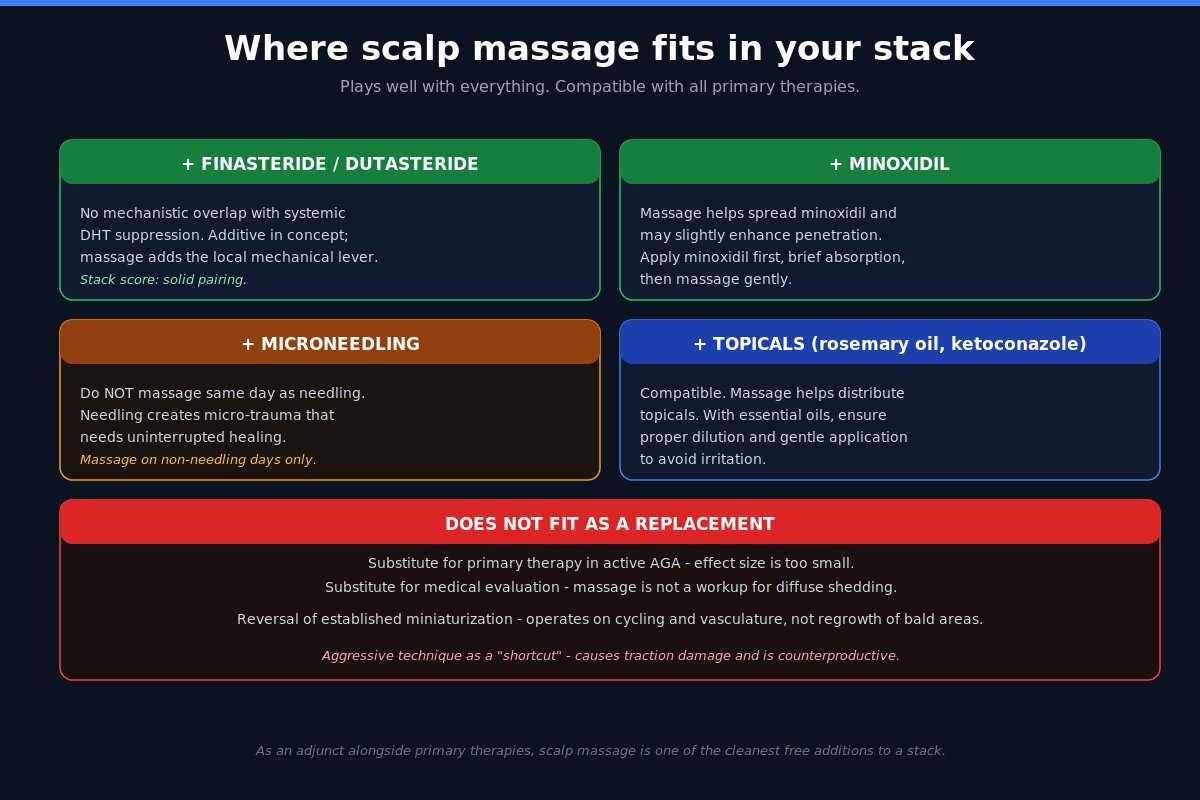
Scalp massage plays well with everything in the standard hair toolkit.
+ Finasteride/dutasteride. No mechanistic overlap with systemic DHT suppression. Additive in concept; massage adds the local mechanical lever.
+ Minoxidil. Massage helps spread minoxidil and may slightly enhance penetration. Apply minoxidil first, allow brief absorption, then massage gently.
+ Microneedling. Do not massage the scalp on the same day as microneedling. The needling creates micro-trauma that needs uninterrupted healing. Massage on non-needling days is fine.
+ Topical formulations (rosemary oil, ketoconazole shampoo, peptides). Massage is compatible. With essential oils, ensure proper dilution and apply gently to avoid irritation.
Standalone with no other treatment. Reasonable for someone with very early or very mild loss who is not yet ready to commit to medications. Set expectations low.
Where scalp massage does not fit
Substitute for primary therapy in active AGA. A man with rapid Norwood progression cannot rely on massage. The effect size is too small.
Substitute for medical evaluation. Scalp massage is not a workup for diffuse shedding. If you are losing hair from an unclear cause, get bloodwork before assuming massage will fix it.
Reversal of established miniaturization. Massage operates on follicle cycling and vasculature. It does not regrow hair on truly bald or terminally miniaturized areas.
Aggressive technique as a “shortcut.” Harder is not better. Aggressive massage can cause traction damage, skin breakdown, and inflammation that is counterproductive.
Common myths and where they fail
“Scalp massage alone reverses AGA.” No good evidence. Koyama 2016 showed thickness changes in healthy men, not AGA reversal.
“Vigorous scalp scrubbing is better.” Aggressive technique produces traction damage and inflammation. Gentle, consistent firm pressure is the trial-tested approach.
“You need a special device.” Manual massage is what was tested. Devices may add convenience or consistency but do not have stronger trial evidence.
“Results show in 4 weeks.” No. Hair cycle math gives you 3-6 months minimum before measurable changes. Most users abandon too early.
“Massage thickens hair shafts directly.” Hair shaft diameter is determined by the follicle. Massage may modestly improve follicle health, which over time produces slightly thicker hair shafts. The mechanism is indirect.
Frequently asked questions about scalp massage and hair growth
Does scalp massage actually grow hair?
Limited but real evidence. Koyama 2016 showed modest hair thickness increases and growth-associated gene expression changes in 9 healthy men over 24 weeks. The effect size is small and the trial is small. As an adjunct it is worthwhile; as a primary therapy it is insufficient for active AGA.
How often should I massage my scalp?
Once daily for 4-5 minutes matches the Koyama protocol. Twice daily is fine but probably not additive. Consistency over months is the lever.
How hard should I press?
Firm enough to feel the scalp tissue move under your fingertips. Not so hard that it hurts. If you experience scalp tenderness afterward, reduce pressure. Aggressive scrubbing causes traction damage.
How long until I see results?
Six months minimum, matching the trial duration. Hair cycle changes do not appear in weeks. Standardized photography under consistent lighting is the only reliable way to track.
Should I use a massage device?
Manual massage is what the trial tested. Devices add convenience but do not have stronger evidence. The Hairguard GrowBand applies sustained mechanical stretch on the same biological premise; whether the magnitude matches manual massage is unstudied.
Can scalp massage replace finasteride or minoxidil?
No. The effect size is small relative to those interventions. Massage fits as an adjunct alongside primary therapies, not as a substitute.
Are there side effects?
Functionally none with proper technique. Aggressive massage can cause traction damage, skin irritation, or breakage of fragile hair. Gentle firm pressure is safe.
Should I use oil during massage?
Optional. Massage works without oil. With oil (jojoba, rosemary oil at 2 percent dilution, or other carriers), the lubrication reduces friction and you can combine the massage with topical application. Some people prefer dry massage; both are reasonable.
What if I have a very sensitive scalp?
Reduce pressure. The biological signal is mechanotransduction at the dermal papilla level, not skin-surface pressure. A lighter touch with consistent daily application is preferable to harder pressure that produces irritation.
Will scalp massage work for women?
The Koyama trial enrolled men. The mechanism is not sex-specific; massage is reasonable for women with hair loss. Effect size is likely similar – small but real, suitable as an adjunct.
Can children do scalp massage?
Hair loss is rare in children and usually has different causes than adult AGA. Massage is harmless but treatment-relevant evaluation should come first.
Bringing it together
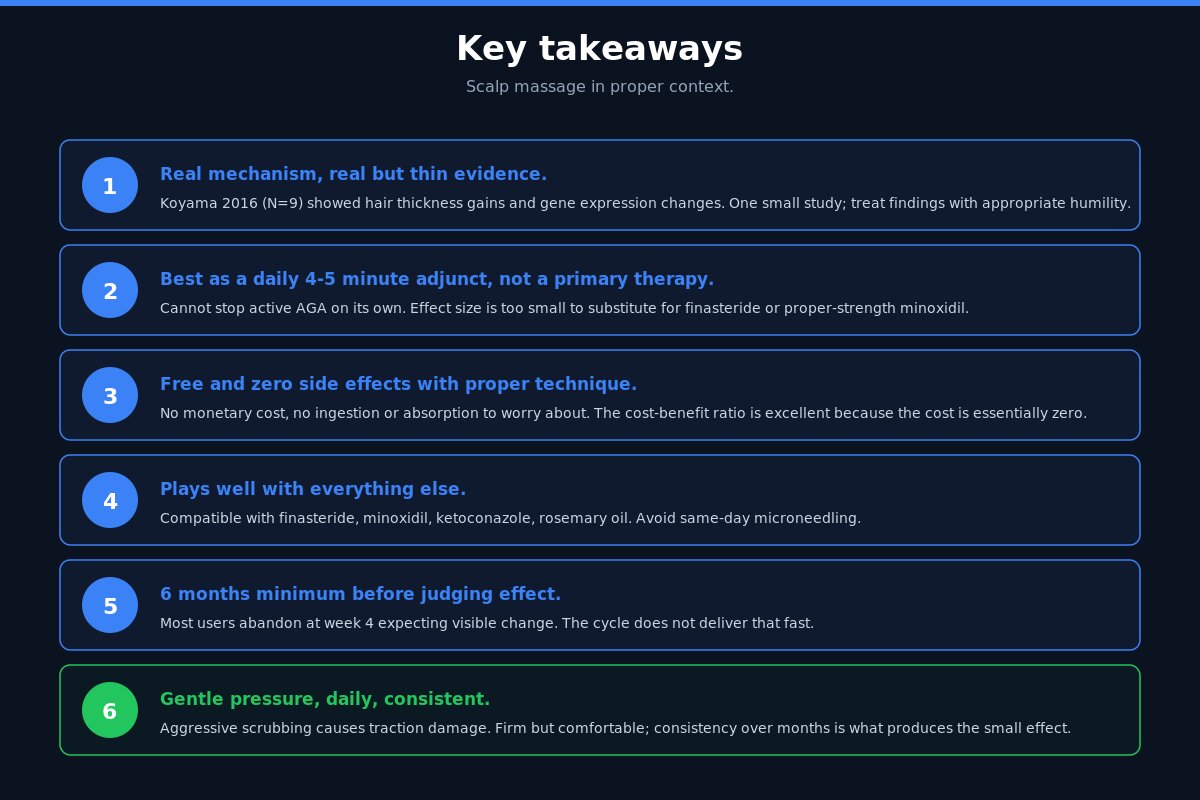
Scalp massage is the cheapest, easiest, lowest-risk intervention in the hair toolkit, with a plausible mechanism and one small but real human study supporting modest effects. It belongs in almost every hair protocol as a daily 4-5 minute adjunct. It does not replace serious therapy for active AGA. The biology of hair loss is what determines whether massage is enough on its own (almost never) or a useful addition (almost always).
For anyone building a multi-pronged hair protocol, the right move is: primary therapy that targets the actual cause (DHT, deficiency, stress), local interventions that work directly at the follicle (microneedling, topicals), and zero-cost adjuncts like scalp massage layered through. The framework for what fails when those layers are missing or wrong is in why your protocol may not be working.
This article is for educational purposes only and does not constitute medical advice. Hair loss has multiple potential causes and the right approach depends on your individual history, examination, and bloodwork. Speak with a qualified clinician before starting or stopping any treatment. See the full disclaimer.
About the author
Philippe Boissard
Author of Men’s Hairloss Protocol (2020), Better, Smarter, Stronger (2023), and Multi-Axis Body (2025). Researches and writes about hair loss and male physiology, citing primary literature and disclosing affiliate relationships in full. Not a medical doctor; all content is educational. More about Philippe.
Related reading
Get my free hair-loss protocol
The exact evidence-based routine I actually use and recommend: what works, in what order, with no hype. Enter your email on the next page and I’ll send it straight to you.
Send me the free protocol →