
Low-Level Laser Therapy for Hair Loss: What the Evidence Actually Shows
Low-level laser therapy produces real but modest hair count gains in randomized sham-controlled trials. Here is where LLLT genuinely fits in a serious hair loss protocol, and where the marketing oversells the data.

Low-level laser therapy is one of the most over-marketed and most under-explained interventions in the hair loss world. The trials are real, the effect is small but measurable, and the gap between what a $1,200 helmet can do and what its sales page promises is wide enough to mislead a careful reader. This is the honest read on LLLT in 2026.
Quick answer: does LLLT actually grow hair?
Yes, but modestly. Multiple randomized sham-controlled trials in androgenetic alopecia show that low-level laser therapy at red wavelengths (around 650 to 680 nanometers) produces a statistically significant increase in terminal hair count over 16 to 26 weeks of consistent use. Effect sizes typically land between 17 and 35 additional hairs per square centimeter compared with a sham device, which is meaningful but smaller than what 5 percent minoxidil or oral finasteride deliver in head-to-head comparisons.
LLLT is best treated as an adjunct, not a primary therapy. It will not stop active androgenetic alopecia on its own, it does not replace finasteride or dutasteride for men with progressive miniaturization, and the per-hair cost-effectiveness is poor compared with cheaper interventions. Where it earns a place in a protocol is as a low-side-effect addition for men who are already on a real treatment, who can commit to using a device three to five times per week for a year or more, and who have the budget to absorb the device cost without it crowding out higher-yield options.
What LLLT actually is, and why “low-level” matters
Low-level laser therapy, also called photobiomodulation, refers to the delivery of red or near-infrared light at energy densities low enough to avoid heating or damaging tissue. The wavelengths used in commercial hair devices cluster around 650 to 680 nanometers (visible red), with some second-generation caps adding 808 nanometer near-infrared diodes for deeper penetration. The “low-level” qualifier is the entire point: this is not a hair-removal laser, not a thermal device, not anything that ablates or wounds the scalp.
The leading mechanistic theory, summarized by Avci and colleagues in their 2014 review in Lasers in Surgery and Medicine, centers on cytochrome c oxidase in the mitochondrial electron transport chain. Red and near-infrared photons in the 600 to 900 nanometer window are absorbed by cytochrome c oxidase, increasing electron transport efficiency and ATP production. Downstream effects include modulation of reactive oxygen species, release of nitric oxide, and changes in the expression of genes involved in proliferation and survival. In the follicle, this is hypothesized to extend anagen, push some telogen follicles back into anagen, and reduce the apoptotic signaling that drives miniaturization.
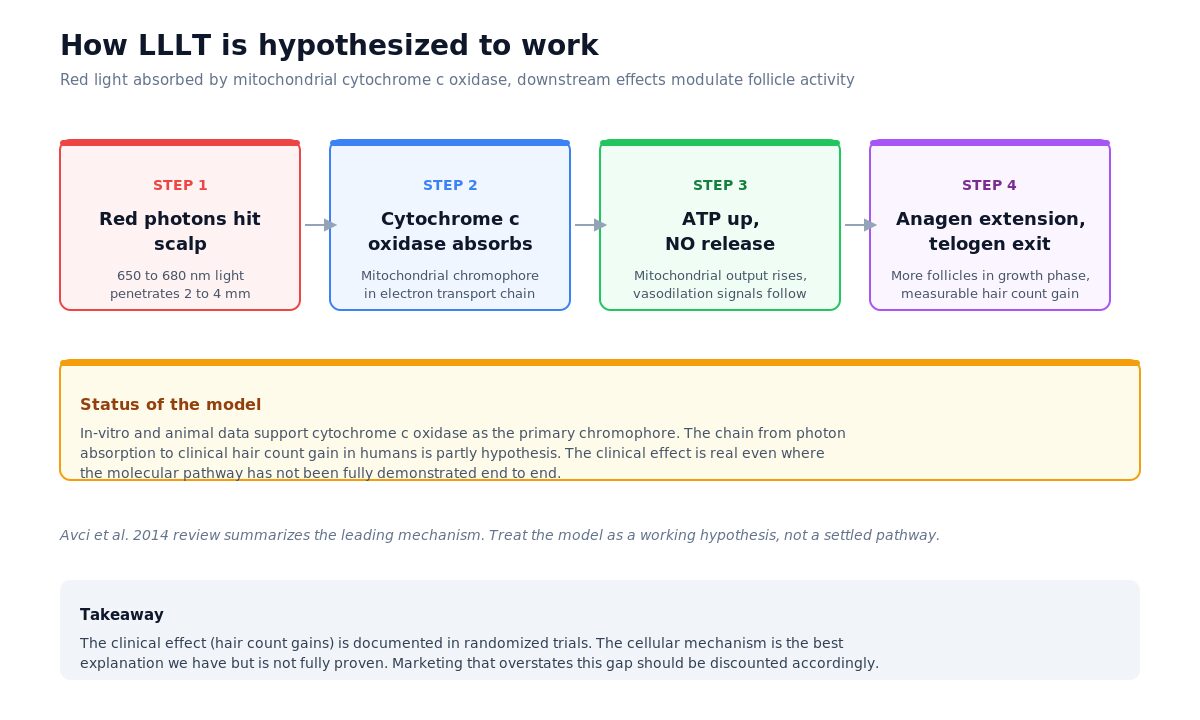
That is the cleanest version of the story. The honest version is that the mechanism remains a working model rather than a fully demonstrated pathway, and the in-vitro and animal data supporting cytochrome c oxidase as the primary chromophore are stronger than the in-vivo human data tying the molecular events to hair count. The clinical effect is real, but the chain from photon to hair shaft is still partly hypothesis. Anyone selling you a device with phrases like “scientifically proven to reactivate dormant follicles” is overselling the certainty of a model that researchers themselves describe in cautious terms.
Wavelength, power, and why scalp anatomy limits how deep light gets
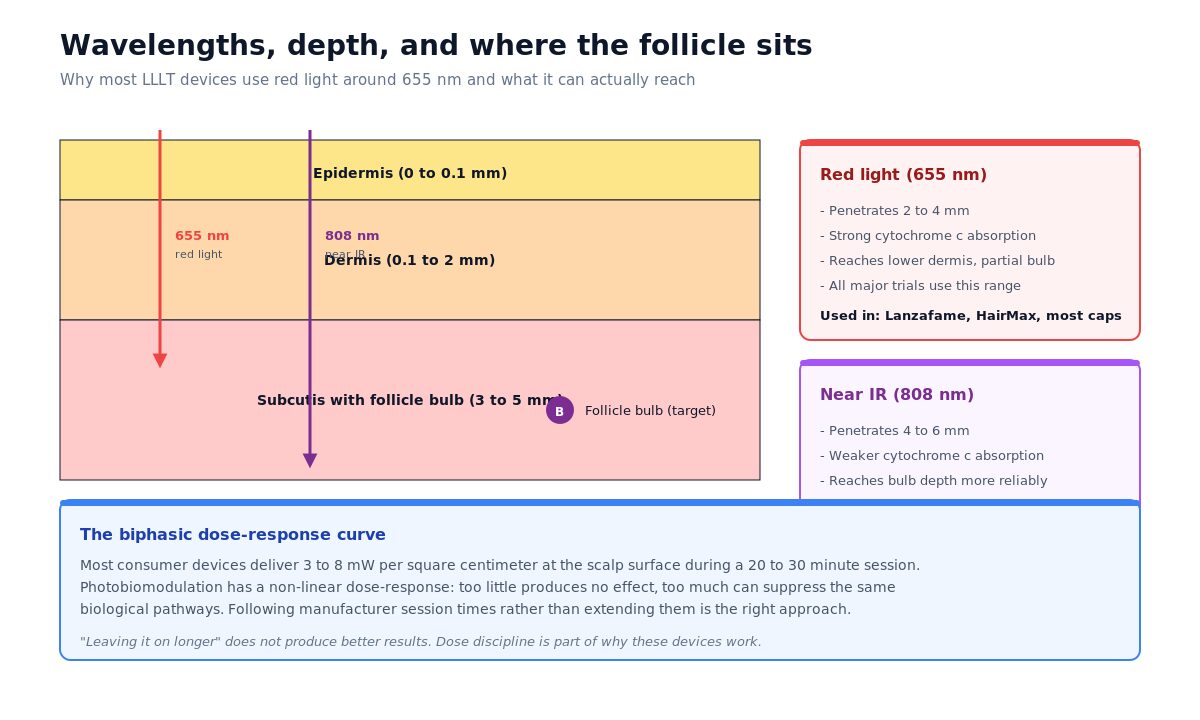
Two parameters dominate device design: wavelength and power density at the scalp. Red light at 650 to 680 nanometers penetrates roughly 2 to 4 millimeters into tissue before scattering and absorption attenuate it below useful intensity. The hair follicle bulb sits at a depth of 3 to 5 millimeters, so red light at the upper end of that wavelength range reaches the lower follicle but loses intensity rapidly with depth. Near-infrared at 808 to 850 nanometers penetrates further but is absorbed less efficiently by cytochrome c oxidase, which is one reason most commercial devices stick to red.
Power density at the scalp surface is the other variable. Most consumer devices deliver between 3 and 8 milliwatts per square centimeter at the scalp during a session, with effective dose accumulating over the 20 to 30 minute exposure time recommended by manufacturers. The biphasic dose-response curve familiar to photobiomodulation researchers means that under-dosing is ineffective and over-dosing can suppress the very same biological effects. This is why session length and frequency are not negotiable with these devices and why “leaving it on longer” does not produce better results.
The trial evidence, and how to read it without getting marketed to
The strongest single trial in the literature remains Lanzafame and colleagues 2014, a randomized double-blind sham-controlled study of a 655 nanometer laser comb in 41 men with Hamilton-Norwood IIa to V androgenetic alopecia. Over 16 weeks of use three times per week for 25 minutes per session, the active group gained 35.0 hairs per square centimeter versus 5.7 in the sham group. The difference was statistically significant, the trial was properly blinded with an inert sham device, and the methodology has held up under scrutiny.
Lanzafame ran a parallel trial in women in 2014 with similar design, finding a comparable effect. Munck and colleagues 2014 conducted a smaller randomized study using a different device geometry and reported effect sizes in the same range. Several industry-sponsored trials (HairMax, iGrow, Capillus, Theradome) have replicated the basic finding, although the proximity to the manufacturer is a real flag and the magnitude of effect varies device to device.
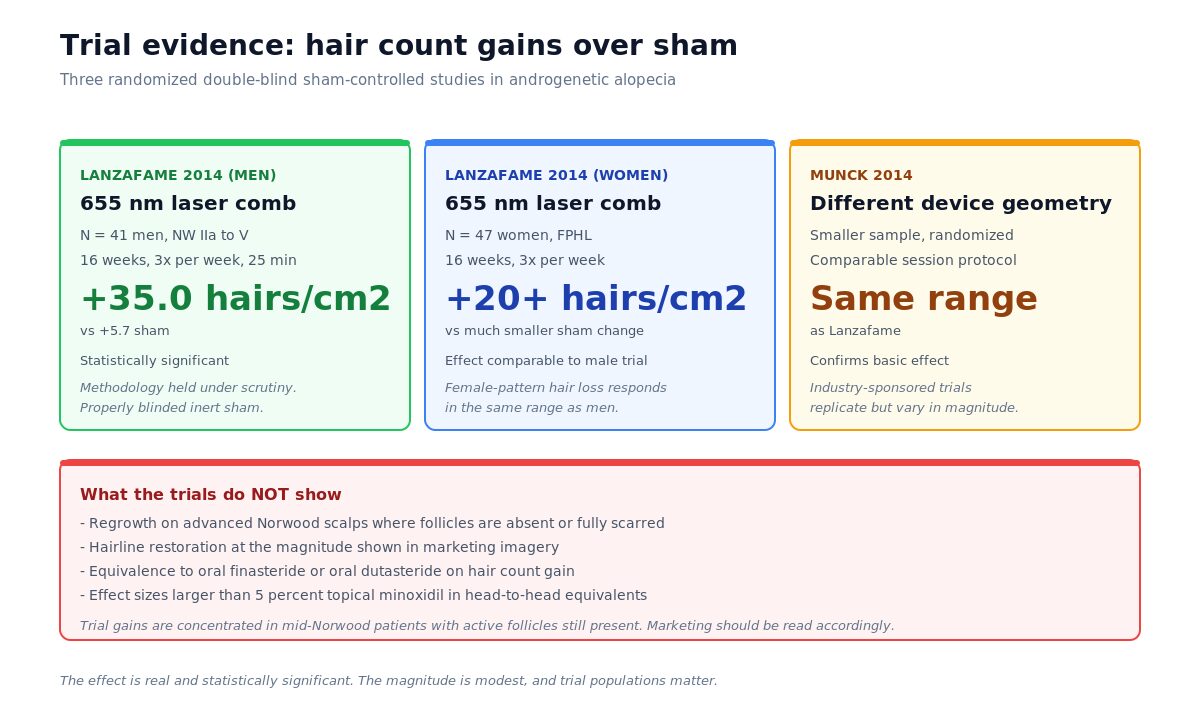
What the trials do not show, despite frequent marketing claims to the contrary, is that LLLT regrows lost hairlines, restores severely miniaturized regions, or produces effects equivalent to the standard pharmacological treatments. Hair count gains in the trials are real but are concentrated in mid-Norwood patients with active follicles still present. There is no published evidence that LLLT can revive a fully scarred or fully miniaturized region, and the marketing imagery showing dense regrowth on advanced Norwood scalps is not supported by the trial data.
Comparing LLLT to minoxidil, finasteride, and microneedling on effect size
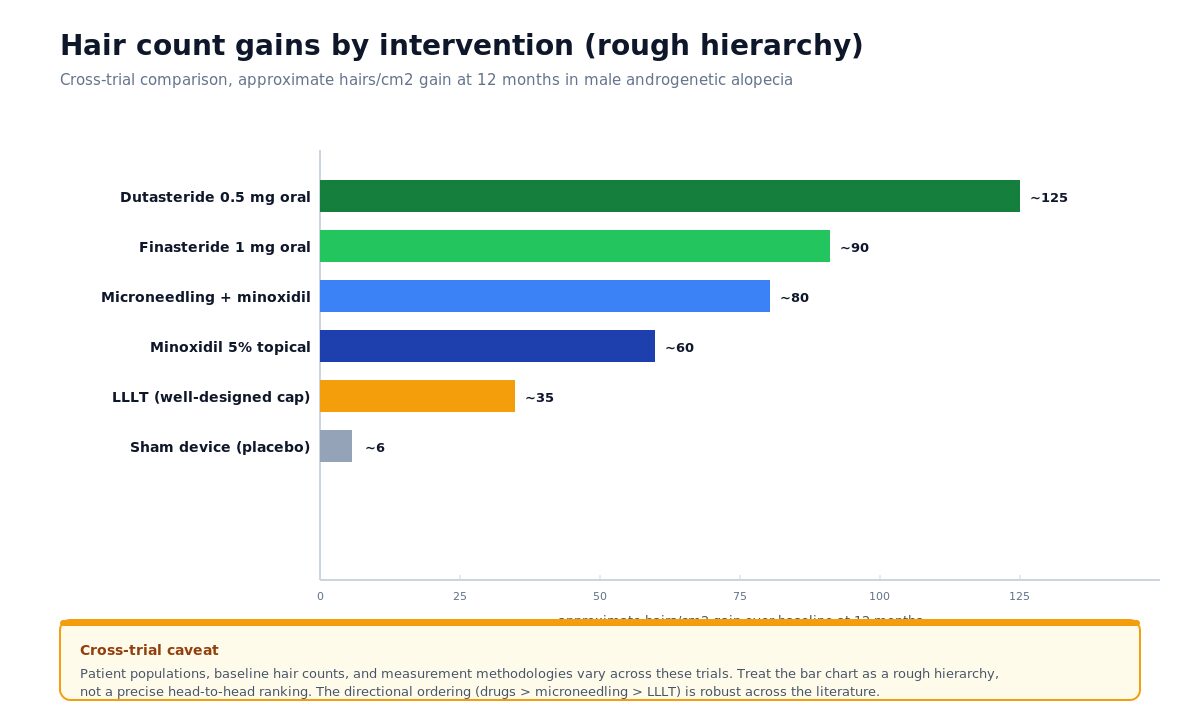
Cross-trial comparisons are imperfect because patient populations, baseline hair counts, and measurement methodologies vary. With that caveat, the rough hierarchy from the literature is: oral finasteride and dutasteride deliver the largest hair count gains in androgenetic alopecia at 12 months, followed by 5 percent minoxidil, followed by microneedling combined with minoxidil (Dhurat 2013), followed by LLLT used as a single agent. Effect sizes for LLLT in the published trials sit roughly at one-third to one-half of what minoxidil alone produces in equivalent patients.
This matters because protocol design is a budget question, not just a hair count question. A man who has $1,200 to spend on hair preservation gets more for that money by funding a year of finasteride, a quality 5 percent minoxidil supply, and a microneedling roller, with change to spare, than by buying a single LLLT device. The pharmacological backbone delivers more hair count per dollar by a wide margin. LLLT becomes economically defensible only after that backbone is in place and the question is whether to add an adjunct at the margin.
Devices: caps, helmets, combs, and panels
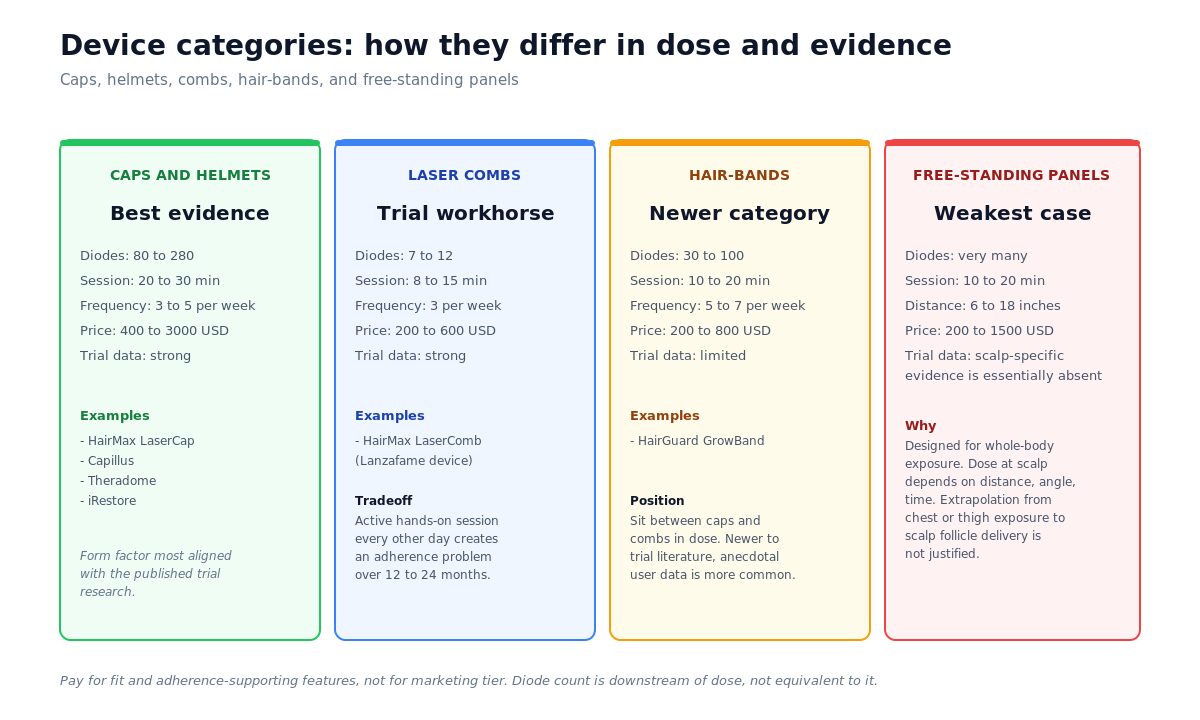
Consumer LLLT devices fall into four broad categories, and the differences matter more than the marketing acknowledges. Caps and helmets place a fixed grid of laser diodes against the scalp, deliver 80 to 280 diodes depending on price tier, and require 20 to 30 minute sessions three to five times per week. The HairMax LaserCap, Capillus, Theradome, and iRestore product families dominate this segment, with prices ranging from roughly $400 for entry-level domes to over $3,000 for premium caps. The trial evidence concentrates here, and this is the form factor most aligned with the published research.
Laser combs (the original HairMax LaserComb is the prototype) require active passing across the scalp and are the form factor used in Lanzafame 2014. They deliver fewer diodes per session but with closer scalp contact, and the trial data is equally good for them. The downside is the active hands-on session every other day, which is a real adherence problem over the 12 to 24 month timelines required to see results. Hair-band-style devices (HairGuard GrowBand and similar) sit between caps and combs in dose and are newer to the trial literature.
Free-standing red-light panels are the most divergent category. Panels marketed for general body photobiomodulation deliver red and near-infrared light at much higher power densities than scalp devices, but they are designed for full-body exposure rather than focused scalp delivery. The dose at the scalp will depend on distance, angle, and time, and there is essentially no scalp-specific trial data on panels. Some users report results, but the evidence base is anecdotal rather than randomized, and dose extrapolation from chest or thigh exposure to scalp follicles is not justified.
The 12-week JXL069 video is the closest counterpart to the LLLT timeline question. The point is not the compound itself but the framing: any hair intervention with a small to moderate effect size needs months of consistent use before judgment, and any device or topical that promises faster needs to be read with the same skepticism applied to LLLT. The video walks through what real, modest progress looks like on camera versus how marketing tends to present it.
Where LLLT actually fits in a protocol
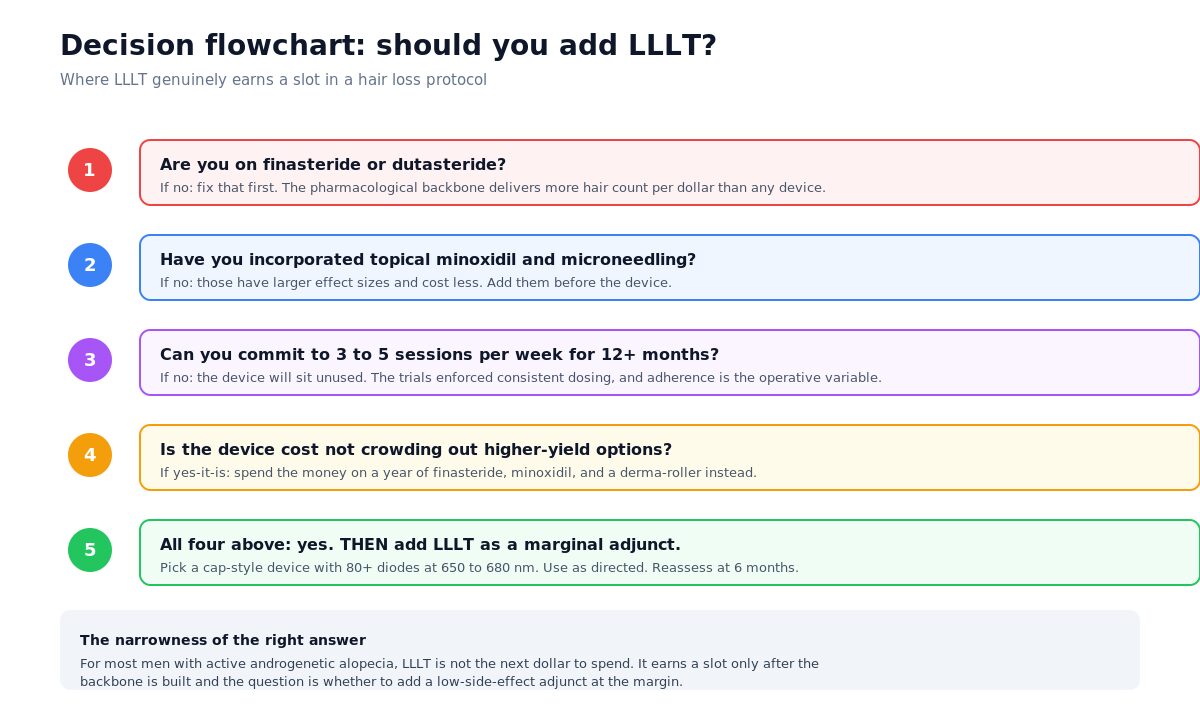
The decision tree for adding LLLT to a hair loss protocol is narrower than the marketing suggests. The strongest case is a man already on finasteride or dutasteride with a stable response who wants to add a low-side-effect adjunct without stacking another systemic or topical drug. He has reached the limit of what 5-alpha reductase inhibition will buy him, microneedling has been incorporated, and LLLT becomes a marginal addition that can be operated in parallel without interaction concerns or side-effect overlap. For a deeper read on why a protocol can plateau even when the core drugs are working, the article on why finasteride fails some men even when it is working covers the response-versus-progression distinction.
The weakest case is a man who is using LLLT as his only treatment for active androgenetic alopecia. The trial data does not support that strategy, the effect size is too small relative to ongoing miniaturization, and the cost of replacing pharmacological treatment with a device is hair count that will not be recovered. A reader who wants to understand the underlying biology of why monotherapy with a weak intervention fails should read how hair loss actually works, particularly the sections on the DHT pathway and follicular miniaturization.
Realistic expectations on timeline and visible results
The trial timelines are 16 to 26 weeks for first measurable hair count change, with longer follow-up data showing continued slow gains out to 12 months in the better-designed studies. In practical terms this means committing to consistent use three to five times per week for a minimum of six months before drawing conclusions. Anyone evaluating an LLLT device at three months is not giving the intervention a fair test. Anyone who claims to “see a difference” at four weeks is observing variation in lighting, hair length, or styling rather than terminal hair count.
Adherence is the operative variable that decides whether LLLT works for a given person. The trials enforced consistent dosing schedules with high adherence rates. In real-world use the failure mode is missing sessions, abandoning the device by month four when results are not yet visible, or shifting from prescribed schedules to “when I remember” patterns. The article on why your hair loss protocol is not working covers adherence failure modes in detail and applies directly here.
Common myths about LLLT
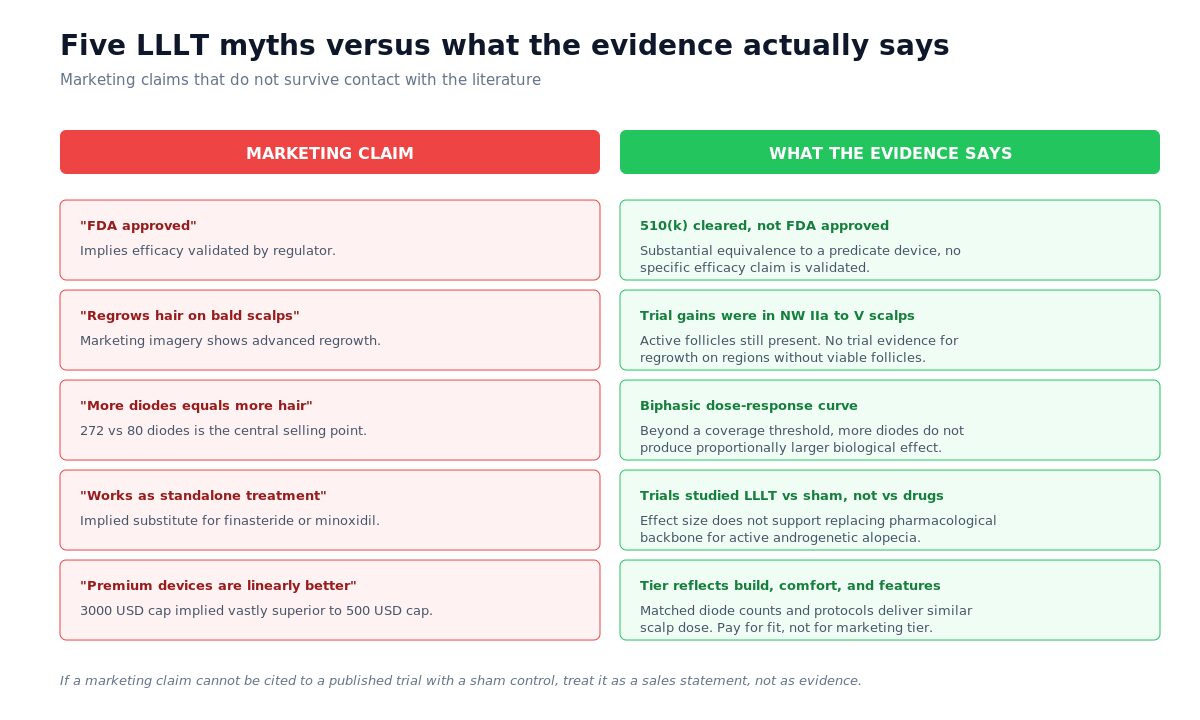
The marketing around LLLT has built a substantial mythology that needs unwinding before a buying decision. Five recurring claims do not survive contact with the literature.
Myth 1: LLLT is FDA approved. The accurate statement is that several LLLT devices for hair loss have received FDA clearance under the 510(k) pathway as Class II medical devices, which signals substantial equivalence to a predicate device, not approval based on demonstrated efficacy. Clearance and approval are different regulatory categories. The 510(k) clearance does not validate any specific efficacy claim.
Myth 2: LLLT regrows hair on bald scalps. The trial evidence shows hair count gains in scalps with active follicles still present (Hamilton-Norwood IIa to V in Lanzafame). There is no trial evidence supporting regrowth on regions with no remaining viable follicles. Marketing imagery suggesting otherwise misrepresents the data.
Myth 3: More diodes equals more hair. Beyond a certain coverage threshold, additional diodes do not produce proportionally larger effects. The biphasic dose-response curve means dose matters but more is not better. Marketing that emphasizes 272 diodes versus 80 diodes is selling a number that is downstream of, not equivalent to, biological effect.
Myth 4: LLLT works without any other treatment. The trials studied LLLT versus sham, not LLLT replacing standard care. The implicit comparison most consumers make (“I will use this instead of finasteride”) was not what the trials evaluated, and the effect size in the trials does not support that substitution.
Myth 5: Premium devices are linearly better than entry-level devices. Price tiering in this category reflects build quality, comfort, and feature sets more than measurable scalp dose. A $2,000 cap and a $500 cap with similar diode counts and matched session protocols deliver similar dose at the scalp. Pay for fit and adherence-supporting features, not for marketing tier.
Frequently asked questions about LLLT for hair loss
How long does LLLT take to show results?
The published trials show first measurable hair count changes between 16 and 26 weeks of consistent use. Practically, a six-month minimum commitment at three to five sessions per week is required before evaluating whether the device is working for a given user. Anyone reporting “results” at four to six weeks is observing styling, lighting, or measurement variation rather than actual terminal hair gains.
Can I use LLLT with finasteride and minoxidil?
Yes. There are no known interactions between LLLT and oral finasteride, oral dutasteride, or topical minoxidil. The combination is the protocol the trial evidence most supports adding LLLT to, since the pharmacological backbone is doing the heavy lifting and LLLT is functioning as a marginal adjunct rather than a primary therapy. Many trial participants were already on standard treatments, although baseline pharmacological use varied across studies.
What is the best wavelength for LLLT in hair loss?
The trial evidence concentrates on red light in the 650 to 680 nanometer range, with 655 nanometers being the most-studied single wavelength (Lanzafame 2014). Some second-generation devices add 808 nanometer near-infrared diodes for deeper penetration, but the comparative evidence that adding near-infrared meaningfully improves hair count over red alone is thin. Stick with devices in the well-studied red wavelength range and treat infrared additions as unproven extras.
Are red-light panels as effective as laser caps for hair?
The scalp-specific trial evidence for free-standing panels is essentially absent. Panels are designed for whole-body or large-area exposure at distances of 6 to 18 inches, which produces a different dose profile than caps with diodes pressed directly against the scalp. Anecdotal reports from panel users exist but are not a substitute for the randomized trial evidence supporting cap-style devices. If choosing between a cap with trial data and a panel without, the cap is the better-supported choice for scalp-targeted use.
Are there side effects from LLLT?
Reported side effects in the trials are minimal and consist mainly of mild scalp tingling or warmth during sessions. There are no documented systemic effects, no hormonal interactions, and no scalp damage at recommended power densities. The biphasic dose-response curve means very high doses can theoretically suppress the very same biological effects, so following manufacturer session times rather than extending them is the right approach. Eye protection during use is sensible because direct staring into laser diodes is not the same as ambient light exposure.
How does LLLT compare to microneedling?
Microneedling combined with topical minoxidil has produced larger hair count gains in the published evidence (Dhurat et al. 2013) than LLLT used as a single agent. Microneedling is also dramatically cheaper, with a quality dermaroller costing under $50 versus $400 to $3,000 for an LLLT device. For a man choosing between adding microneedling or adding LLLT to an existing protocol, microneedling has the better evidence-to-cost ratio. The two interventions can be combined, and there is no pharmacological reason they would interfere.
Does LLLT work for women with female-pattern hair loss?
Yes, with similar effect sizes to the male trials. Lanzafame ran a parallel sham-controlled trial in women in 2014 with comparable design and reported hair count gains in the same range. Female-pattern hair loss responds to LLLT in roughly the same way male androgenetic alopecia does, and the underlying mechanism (mitochondrial photobiomodulation) is not sex-specific. Women considering LLLT face the same protocol-design questions men do: it is best as an adjunct, not a primary therapy.
If I stop using LLLT, will I lose the gains?
The follow-up data on what happens after discontinuation is sparse. The mechanistic logic suggests that hair gains attributable to LLLT will regress once the stimulus is removed, similar to the pattern seen with minoxidil discontinuation, although on a slower timescale because the underlying miniaturization driver (DHT, in androgenetic alopecia) is not being addressed by LLLT in the first place. The honest answer is that LLLT is a long-term commitment if used, and discontinuation likely returns the user to the trajectory determined by their underlying biology and other treatments.
Bringing it together
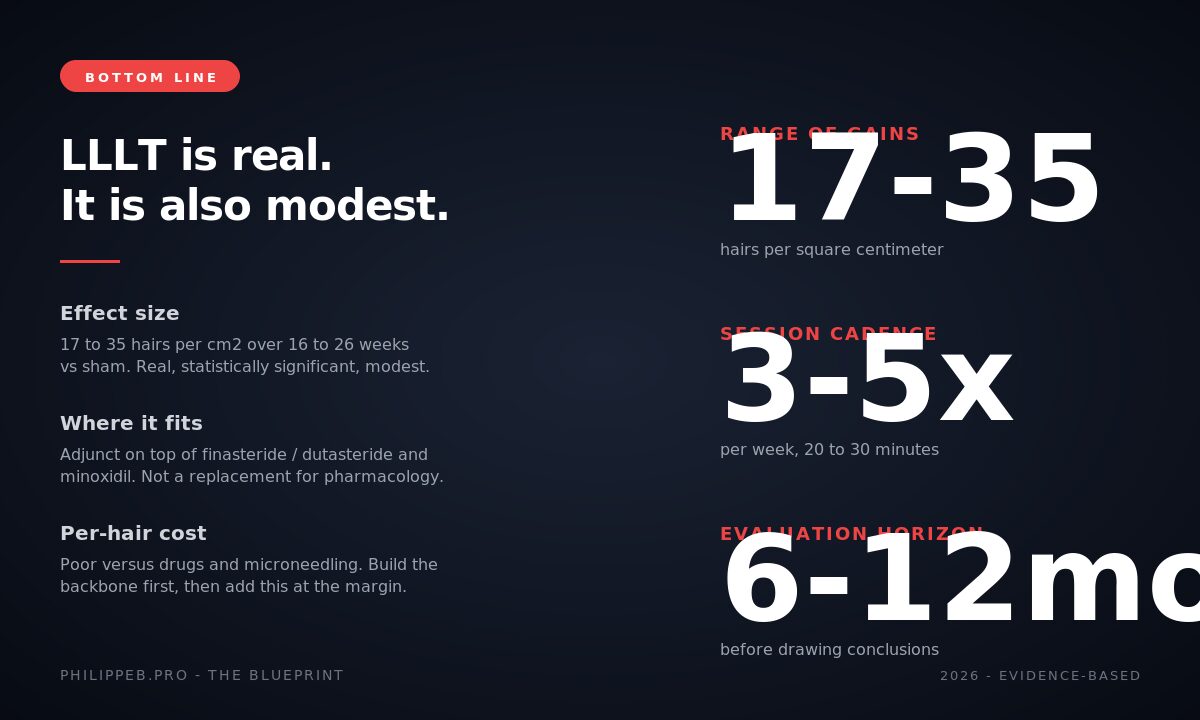
Low-level laser therapy is a legitimate but modest hair loss intervention. The trial evidence supports a real biological effect at red wavelengths around 655 nanometers, with hair count gains of roughly 17 to 35 hairs per square centimeter over 16 to 26 weeks of consistent use. The effect is smaller than what minoxidil produces, much smaller than what finasteride or dutasteride deliver, and the per-hair cost-effectiveness is poor relative to those alternatives. The right place for LLLT in a hair loss protocol is as an adjunct after the pharmacological backbone is established, not as a substitute for it.
Anyone weighing an LLLT purchase should first read the pillar piece on how hair loss works to understand why the DHT pathway is the dominant driver and why LLLT addresses none of it directly. For a deeper look at why even effective interventions can plateau, the article on why your hair loss protocol is not working covers the seven hidden reasons most men miss, and the analysis of why I do not take minoxidil demonstrates the same effect-size discipline applied to a different intervention. LLLT belongs in the same category: real, modest, and dependent on consistent long-term use. Treat it accordingly.
This article is for educational purposes only and does not constitute medical advice. Hair loss treatment decisions should be made in consultation with a qualified healthcare provider. See the site disclaimer for the full statement.
Related reading
Get my free hair-loss protocol
The exact evidence-based routine I actually use and recommend: what works, in what order, with no hype. Enter your email on the next page and I’ll send it straight to you.
Send me the free protocol →