
Rosemary Oil vs Minoxidil: What Panahi 2015 Actually Showed
Rosemary oil produced effects similar to 2 percent minoxidil at six months in Panahi 2015. Real but smaller than the headline implies. Where it actually fits in a hair loss protocol.

Rosemary oil is the natural intervention everyone has heard works as well as minoxidil. The claim traces to a single 2015 trial. Reading that trial carefully gives you a more honest answer: at six months, topical rosemary oil produced similar hair count gains to 2 percent minoxidil in a head-to-head comparison – which is real but smaller than what people usually expect from “as good as minoxidil.” It is a reasonable adjunct, not a primary therapy.
Quick answer: one decent trial, modest replication, narrow use case
Panahi et al. (2015) compared topical 2 percent rosemary oil to 2 percent minoxidil in 100 men with androgenetic alopecia over six months. Both groups showed similar increases in hair count at month six. Side effects (scalp itching) were higher in the minoxidil group. The trial supports rosemary oil as a real option – but the headline understates how mild the effect actually is, because 2 percent minoxidil is the weaker minoxidil concentration and the standard treatment dose for men is 5 percent.
The replication base for rosemary oil is thin. Murata et al. (2013) showed in a mouse model that the carnosic acid in rosemary oil promotes hair regrowth via increased dermal papilla cell activity. That is mechanism-level support, not human trial confirmation. The clinical literature for hair specifically is essentially Panahi 2015 plus secondary observational reports.
The honest framing: rosemary oil produces modest hair count improvements similar to weak minoxidil, with a better tolerance profile. It fits as an adjunct in someone who cannot or will not use minoxidil, or as a complementary topical layer in a stack. It does not replace finasteride, dutasteride, or proper-strength minoxidil for active loss.
What Panahi 2015 actually measured
The trial design matters more than the headline.
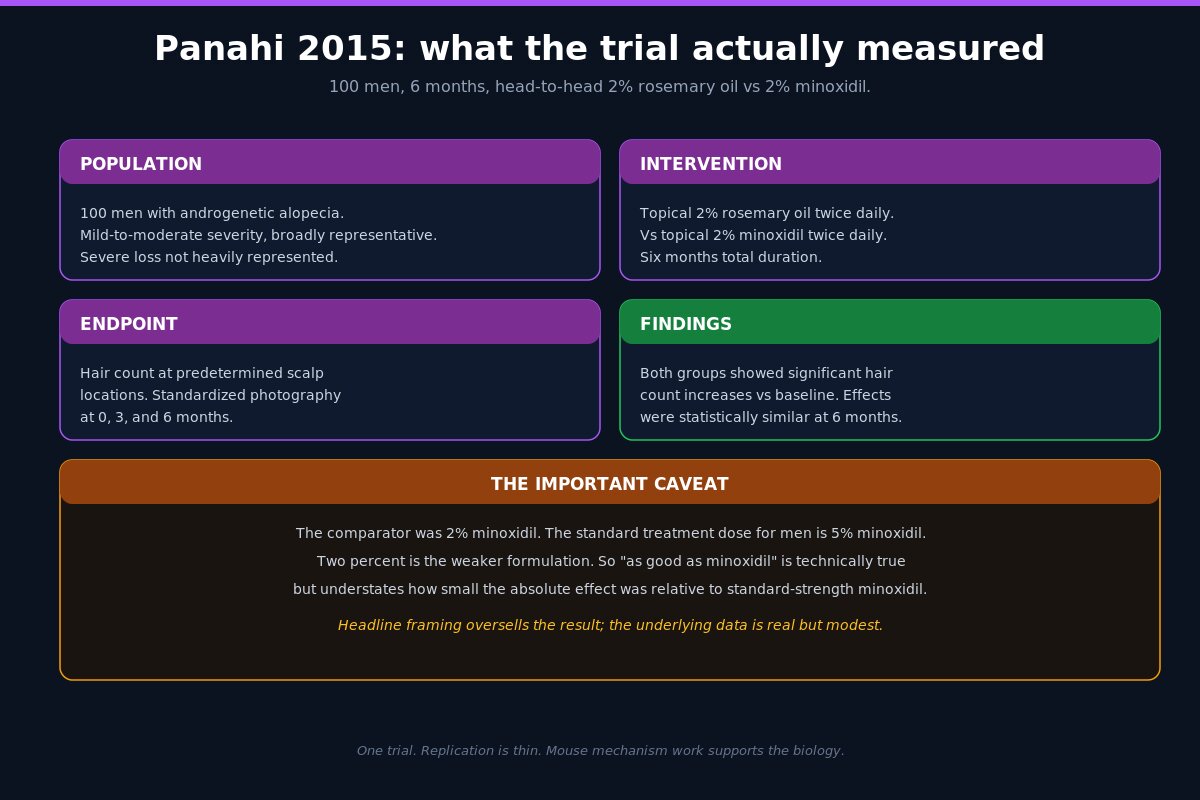
Population: 100 men with androgenetic alopecia. Mean age and Norwood stage were not heavily weighted toward severe loss. The participants were broadly representative of mild-to-moderate AGA.
Intervention: 2 percent rosemary oil applied topically twice daily, for six months. Comparator: 2 percent minoxidil applied topically twice daily.
Endpoint: Hair count at predetermined locations on the scalp at baseline, three months, and six months. Photographs were taken under standardized conditions.
Findings: At six months, both groups showed significant hair count increases versus baseline. The rosemary oil and minoxidil groups produced statistically similar improvements. The minoxidil group reported more scalp itching as a side effect.
The honest read: rosemary oil produced effects comparable to 2 percent minoxidil in this single trial. Two percent is a real minoxidil concentration but is the weaker formulation; 5 percent is the standard for men, and the dose-response curve favors 5 percent for stronger results. So “as good as minoxidil” is technically true if you take the comparator at face value, but understates how small the absolute effect was.
The mechanism: why rosemary oil might work
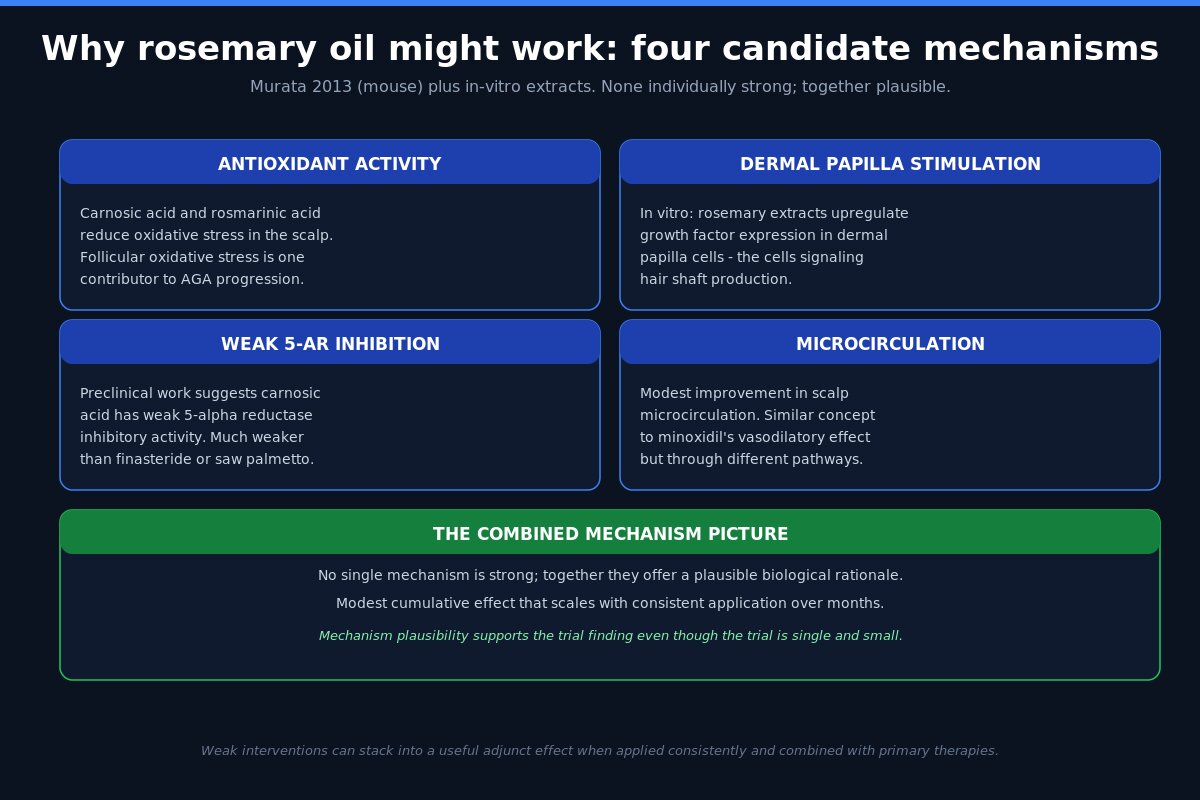
Rosemary oil contains several active compounds, most notably carnosic acid and rosmarinic acid. Murata et al. (2013) demonstrated in mouse models that carnosic acid promoted hair regrowth in testosterone-induced alopecia, with proposed mechanisms including:
Antioxidant activity. The active compounds reduce oxidative stress in the scalp, which is theoretically relevant given that follicular oxidative stress is one of the contributors to AGA progression.
Dermal papilla cell stimulation. In vitro work suggests rosemary extracts upregulate growth factor expression in dermal papilla cells – the cells at the base of the follicle that signal hair shaft production.
Mild 5-alpha reductase inhibition. Some preclinical work suggests carnosic acid has weak 5-AR inhibitory activity, similar in concept (though much weaker) to saw palmetto.
Microcirculatory effects. Rosemary oil applied topically may modestly improve scalp microcirculation, similar in concept to minoxidil’s vasodilatory mechanism but through different pathways.
None of these mechanisms are individually strong, but together they offer a plausible biological rationale for why a single human trial showed effects similar to a weak topical vasodilator.
Effect size in context
Putting the rosemary oil signal next to other topical interventions:
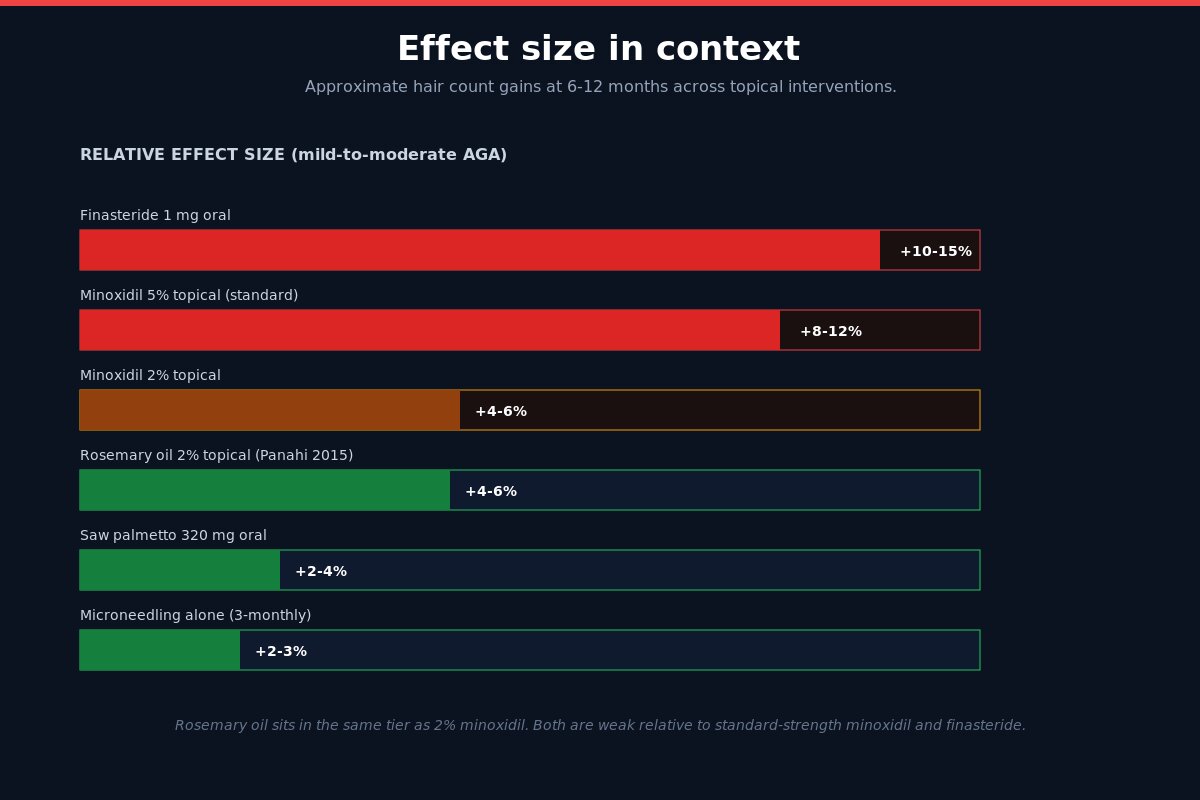
5 percent minoxidil twice daily: Reliably produces 8-15 percent hair count increases at 12 months across many trials. This is the standard topical for men.
2 percent minoxidil: Produces smaller increases, roughly 50-70 percent of the 5 percent effect. Was the original FDA-approved concentration for men before 5 percent.
Topical 2 percent rosemary oil (Panahi): Produced effects similar to 2 percent minoxidil at six months. So roughly half the strength of 5 percent minoxidil.
Microneedling alone: Modest standalone effect; bigger when combined with minoxidil or finasteride per Dhurat et al. and Abdi et al.
Finasteride 1 mg oral: Reliably produces 8-15 percent density gains plus systemic DHT suppression.
The point: rosemary oil at the dose and concentration tested produces effects in the same ballpark as the weak topical comparator, which is real but in the lower tier of options.
Watch this for the broader framing
This video covers how delivery and dose change a compound’s effect entirely. Same applies to rosemary oil: the form (essential oil versus extract), the carrier (jojoba versus alcohol versus water), the concentration, and the application method all matter. The Panahi trial used a specific formulation that is not perfectly reproduced by buying a random rosemary essential oil at the grocery store.
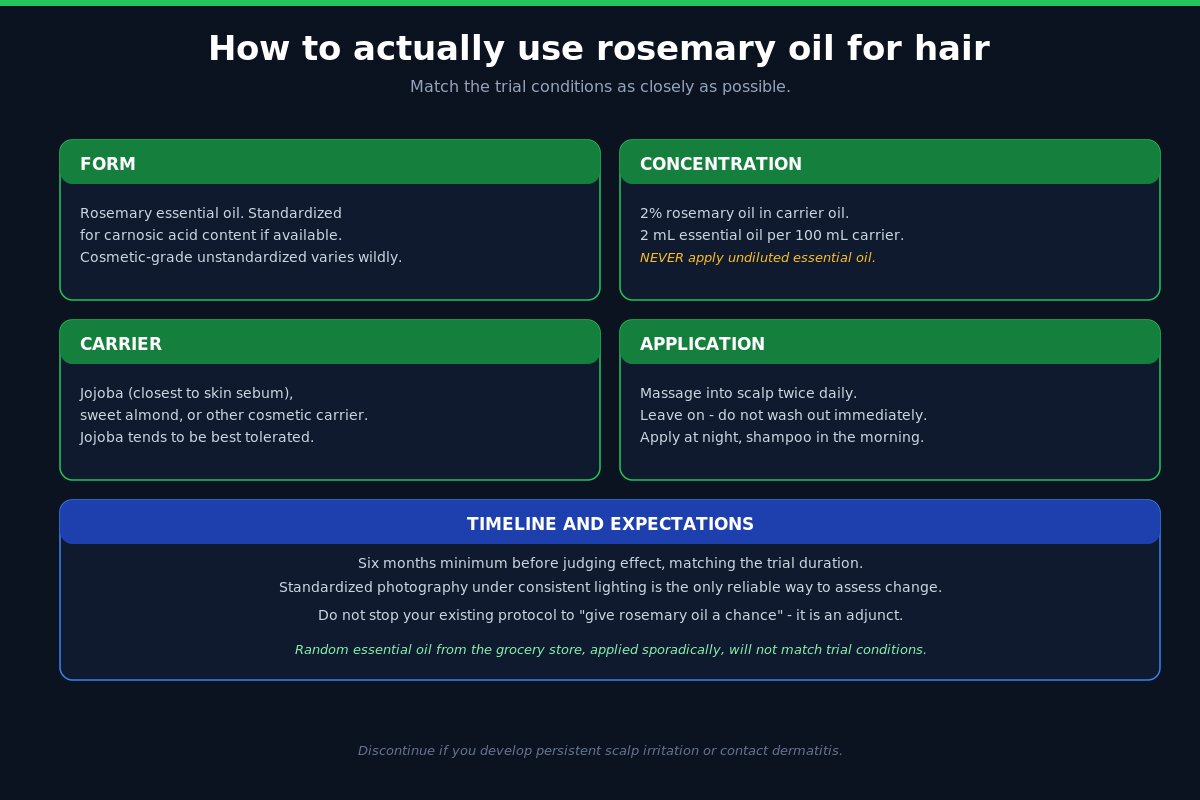
How to actually use rosemary oil for hair purposes
If you are going to try it, set it up to match the trial conditions as closely as possible.
Form: Rosemary essential oil, ideally standardized for carnosic acid content if you can find it. Cosmetic-grade rosemary oil sold without standardization is highly variable.
Concentration: 2 percent in a carrier oil. That means 2 mL rosemary oil per 100 mL carrier. Diluting essential oils is essential – undiluted essential oils on the scalp can cause contact dermatitis and irritation.
Carrier: Jojoba, sweet almond, or other light cosmetic carrier oil. Jojoba is closest to skin sebum chemically and tends to be best tolerated.
Application: Massage into the scalp twice daily. Leave on – do not wash out immediately. Many users apply at night and shampoo in the morning.
Timeline: Six months minimum before judging effect, matching the trial duration. Standardized photography is the only reliable way to assess change.
What not to do: Do not apply undiluted essential oil. Do not expect dramatic results. Do not stop your existing protocol to “give rosemary oil a chance” – it is an adjunct, not a substitute.
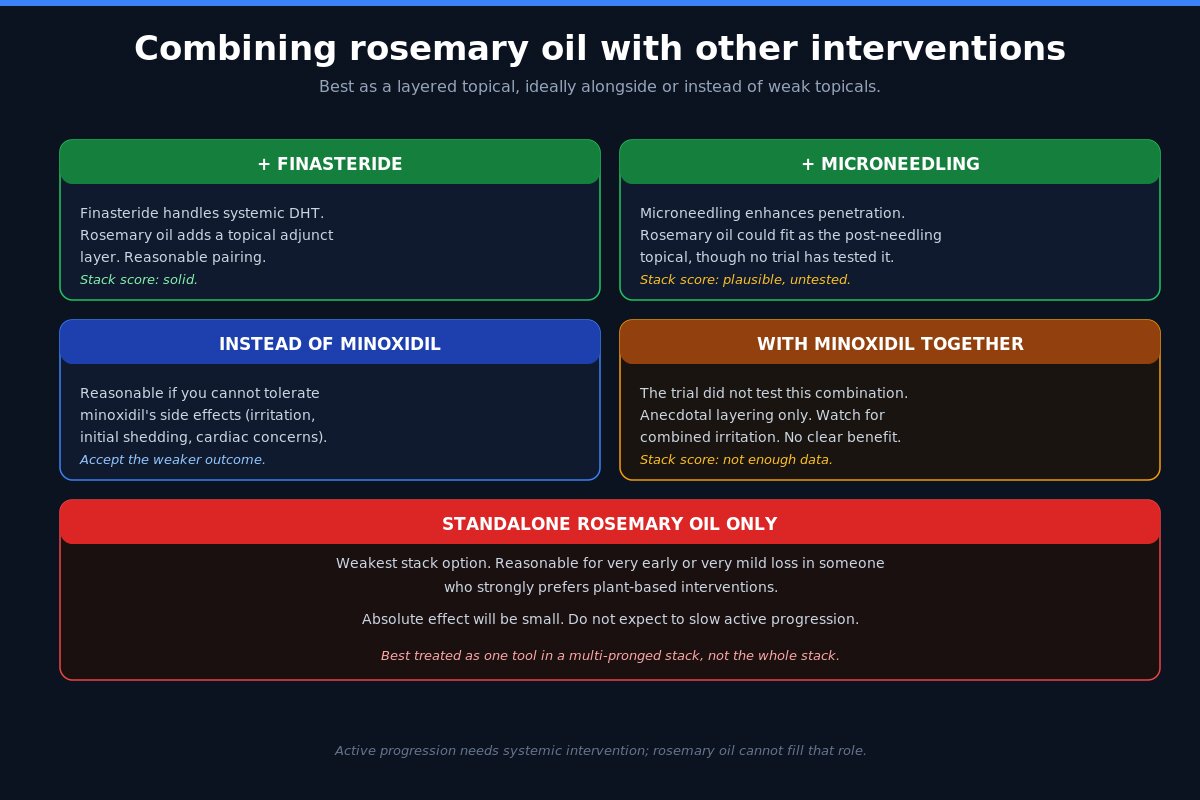
Combining with other interventions
The cleanest fit for rosemary oil is as a layered topical alongside or instead of minoxidil for someone who cannot tolerate minoxidil. Practical combinations:
Rosemary oil + finasteride. Finasteride handles the systemic DHT pathway. Rosemary oil adds a topical adjunct. Reasonable pairing.
Rosemary oil + microneedling. Microneedling enhances penetration of topicals applied afterward. Rosemary oil could fit here as the post-needling topical, though no trial has tested this combination specifically.
Rosemary oil instead of minoxidil. Reasonable if you cannot tolerate minoxidil’s side effects (scalp irritation, initial shedding, cardiac concerns at higher doses). Accept that you are choosing the weaker option.
Rosemary oil + minoxidil at the same time. The Panahi trial did not test this combination. Anecdotally, some users layer them. Not enough data to recommend or refute – if you do this, watch for contact dermatitis from the combined load on the scalp.
Standalone rosemary oil only. The weakest stack option. Reasonable for very early or very mild loss in someone strongly preferring plant-based interventions, with the understanding that the absolute effect will be small.
Where rosemary oil does not fit
Several use cases the marketing implies that the literature does not support.
Active rapid AGA progression. A man going from Norwood 2 to Norwood 4 over 24 months needs a stronger systemic intervention. Rosemary oil’s effect size is not adequate.
Severe established loss. Bald or heavily miniaturized areas will not regrow from rosemary oil. The trial enrolled mild-to-moderate AGA; severe loss was not represented.
Substitute for finasteride or dutasteride. Rosemary oil does not meaningfully suppress systemic DHT. Substituting it for an oral 5-AR inhibitor in active AGA is a substantial downgrade.
Quick fix. Hair cycle changes take months. Rosemary oil at three weeks of use will not show anything. Six months minimum applies.
What the trial does not address
Some real questions Panahi 2015 leaves open.
Long-term efficacy. The trial was six months. Whether the effect plateaus, continues, or fades after a year is unknown.
Optimal concentration. Two percent was tested. Higher or lower may produce different effects. No good dose-response data exists.
Comparison to 5 percent minoxidil. The comparator was the weaker minoxidil. Most men who use minoxidil use 5 percent, where rosemary oil’s relative performance would presumably look weaker.
Replication. One trial is one trial. Independent replication in different populations would strengthen confidence considerably.
Active formulation. Carnosic acid versus rosmarinic acid versus essential oil composition all vary by source. The trial used a specific preparation that commercial products do not always match.
Honest framing for the consumer
If you are evaluating rosemary oil as a hair intervention, the right way to think about it:
It is real. The mechanism candidates are plausible. The trial showed measurable hair count gains.
The effect size is small. Comparable to 2 percent minoxidil. Smaller than 5 percent minoxidil. Much smaller than finasteride.
The replication base is thin. One human trial plus mechanism papers. More studies would help.
It fits in a stack, not as a stand-alone. Most useful as an adjunct or as a substitute for someone who cannot use stronger options.
The application matters. Diluted properly, applied consistently, six-month minimum trial. Random essential oil from the grocery store applied sporadically will not match the trial conditions.
Patience is required. Hair cycle math is what it is. No serious topical intervention works in weeks.
Frequently asked questions about rosemary oil for hair loss
Is rosemary oil really as good as minoxidil?
The Panahi 2015 trial found rosemary oil similar to 2 percent minoxidil at six months. Two percent is the weaker minoxidil concentration; 5 percent is the standard for men. So rosemary oil is similar to weak minoxidil, not to standard-strength minoxidil. Different framing changes the answer significantly.
What concentration should I use?
Two percent rosemary oil in a carrier oil matches the trial. That is 2 mL rosemary essential oil per 100 mL carrier (jojoba is a reasonable choice). Higher concentrations have not been tested for hair purposes and increase irritation risk.
How long do I need to use it before judging?
Six months minimum, matching the trial timeline. Standardized photography under consistent lighting is the only reliable way to assess change. Mirror impressions are unreliable.
Does rosemary oil block DHT?
Some preclinical work suggests weak 5-AR inhibitory activity from carnosic acid, but the systemic DHT effect in humans is small. It does not function like finasteride or even saw palmetto in DHT suppression. Topical effects are local, not systemic.
Can I use rosemary oil with minoxidil?
The trial did not test this combination. Some users layer them anecdotally. If you do, watch for combined irritation; otherwise no specific reason to avoid pairing.
Does it work for receding hairlines?
The Panahi trial did not stratify results by hairline versus crown. Most topical interventions work better on the crown than the temples. Rosemary oil is unlikely to be exception. Hairline recession that is genuinely advanced needs more than topical adjuncts.
What are the side effects?
Properly diluted (2 percent in a carrier oil), rosemary oil is generally well tolerated. Side effects: contact dermatitis (uncommon), scalp irritation, allergic reactions in sensitized individuals. Discontinue if irritation persists. Pregnancy and breastfeeding precautions apply.
Can women use rosemary oil for hair loss?
The Panahi trial enrolled men. Female pattern hair loss is biologically similar enough that rosemary oil is reasonable to try. Effect size is likely similar to the male data – modest and adjunct-tier. Pregnancy precautions apply.
Is essential oil the same as extract?
No. Essential oil is the steam-distilled fraction (mostly volatile compounds). Extract typically refers to alcohol or oil-soluble plant material concentrated for actives like carnosic acid. The trial used a topical formulation that approximated essential-oil application; standardized extract products may have different effective dosing.
Will rosemary oil regrow hair where I have already gone bald?
No. Topical interventions including rosemary oil work on miniaturizing follicles, not on follicles that have completely terminated. Bald areas without follicle activity will not regrow from any topical.
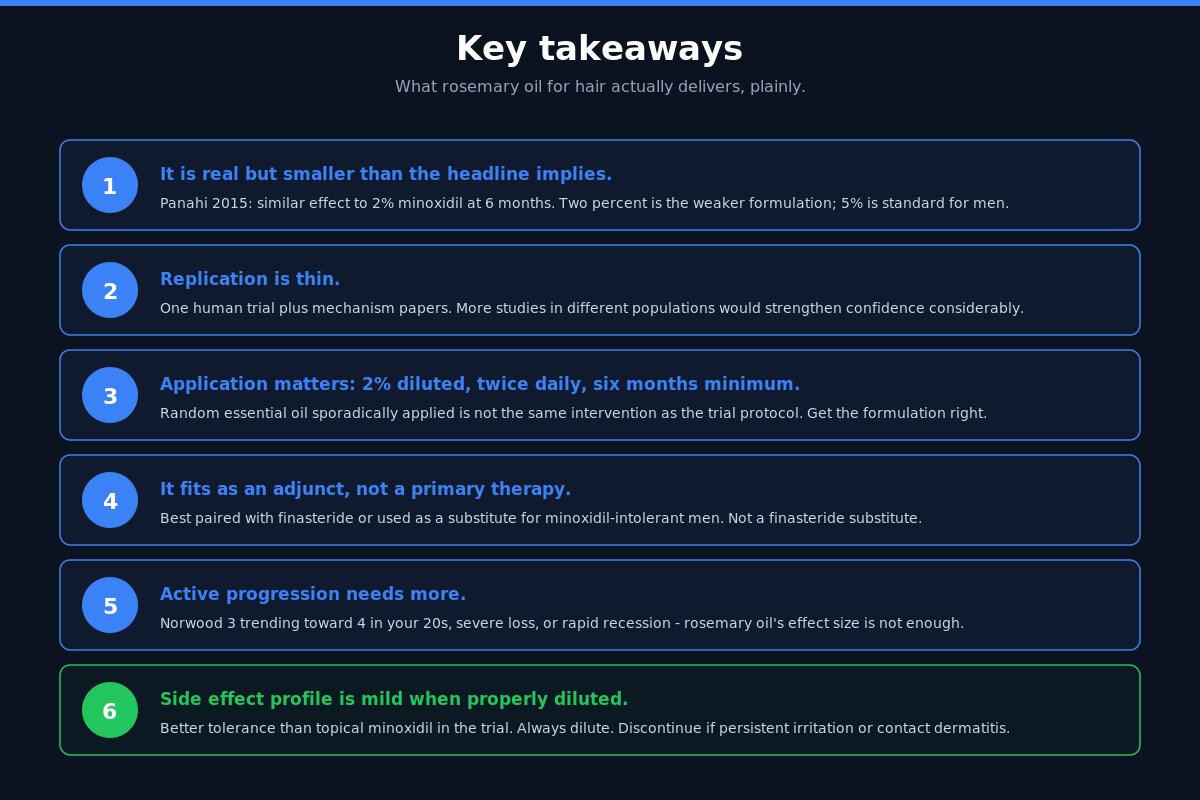
Bringing it together
Rosemary oil is a real intervention with a real but small effect for hair. Panahi 2015 is the foundation, and reading it carefully gives the honest answer: similar to 2 percent minoxidil at six months in mild-to-moderate AGA, with better tolerance. The biology of hair loss tells you that effects this small are not enough to slow active progression on their own – they fit into a larger stack, not at the head of one.
If minoxidil works for you, rosemary oil is unnecessary. If minoxidil does not work for you, the question is usually “why” before “switch to rosemary oil” – and my analysis of minoxidil long-term covers that question. For the broader pattern of what stalls hair protocols, the framework is in why your protocol may not be working. Rosemary oil belongs as a topical adjunct – layered carefully, applied consistently, judged at six months, never expected to replace stronger options.
This article is for educational purposes only and does not constitute medical advice. Hair loss has multiple potential causes and the right approach depends on your individual history, examination, and bloodwork. Speak with a qualified clinician before starting or stopping any treatment. See the full disclaimer.
About the author
Philippe Boissard
Author of Men’s Hairloss Protocol (2020), Better, Smarter, Stronger (2023), and Multi-Axis Body (2025). Researches and writes about hair loss and male physiology, citing primary literature and disclosing affiliate relationships in full. Not a medical doctor; all content is educational. More about Philippe.
Related reading
Get my free hair-loss protocol
The exact evidence-based routine I actually use and recommend: what works, in what order, with no hype. Enter your email on the next page and I’ll send it straight to you.
Send me the free protocol →
[…] Rosemary Oil vs Minoxidil: What Panahi 2015 Actually Showed […]