
Caffeine Shampoo and Topical Caffeine for Hair Loss: 12-Year Literature Review
Caffeine has plausible mechanism but a small clinical evidence base. The marketing has run ahead of the data. Format matters: serum > shampoo. The honest 12-year read on what the literature supports.

Caffeine for hair loss is one of those topics where the marketing has run far ahead of the data. Walk down any drugstore hair-care aisle and you will find shampoos, conditioners, serums, and tonics with caffeine on the label, often advertised as “scientifically proven” to combat hair loss. The underlying research is real but smaller and less applicable than the marketing suggests. The most-cited paper is from 2007 and used follicles in a petri dish, not on a head. The clinical evidence in actual humans is thin, mixed, and concentrated in a handful of small trials. This article is the honest 12-year read on what topical caffeine actually does, what the literature supports, and where caffeine fits in a real protocol.
Quick answer: does caffeine shampoo work?
Marginally, in vitro it does something. In vivo it has not been demonstrated to produce hair-count gains comparable to even minoxidil, let alone finasteride. The dose required to reach the follicle in measurable concentrations is higher than typical shampoo formulations deliver, and the contact time with the scalp during normal shampoo use is too short for meaningful absorption. As a low-cost adjunct on top of finasteride and minoxidil, caffeine shampoo is fine. As a primary intervention or as a substitute for proven therapies, it is wishful thinking. The marketing is selling more than the data has earned.
The mechanism, briefly
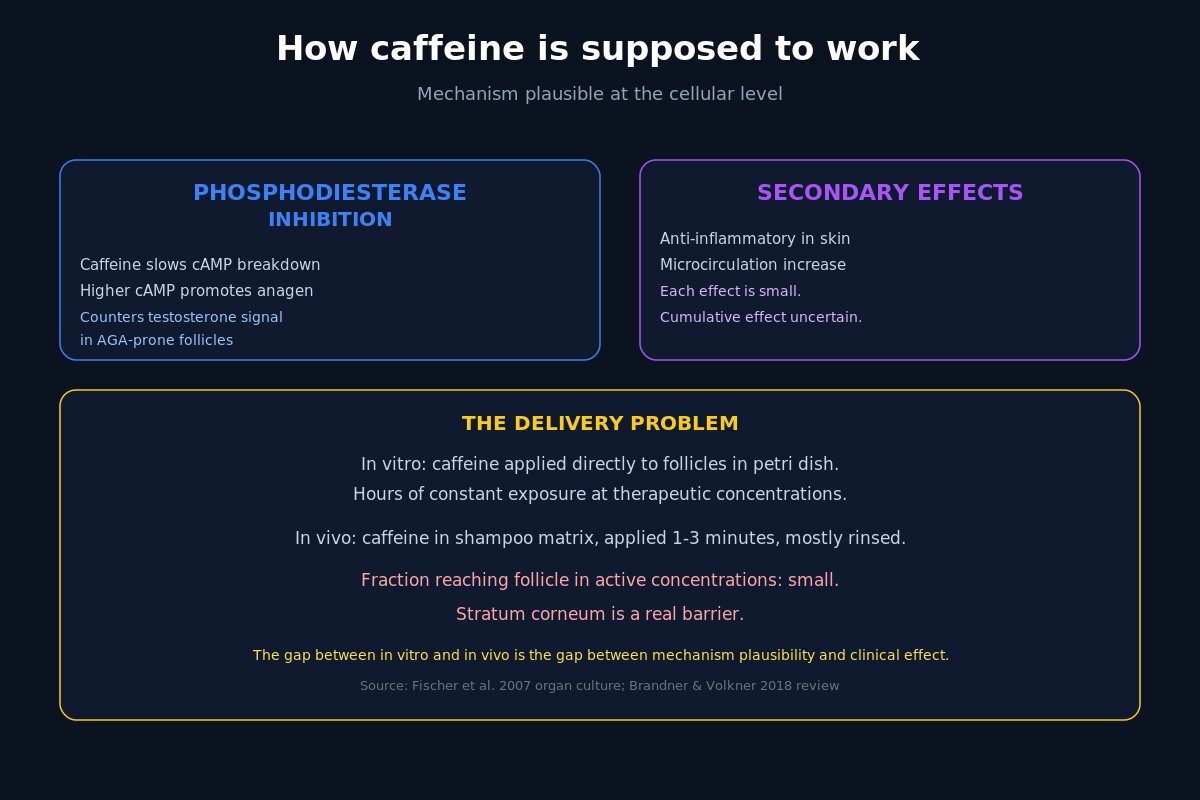
Caffeine is a phosphodiesterase inhibitor, which means it slows the breakdown of cyclic AMP inside cells. In hair follicles, elevated cAMP promotes anagen (growth) phase signals and counteracts some of the testosterone-driven miniaturization signals. Caffeine also has anti-inflammatory and microcirculation-promoting effects in skin tissue. Each of these mechanisms is plausible. None of them produces a large effect at the concentrations typical shampoo delivers to the follicle.
The challenge is the gap between what works in a controlled in vitro experiment and what works on a scalp in real life. In vitro, you can apply pure caffeine at therapeutic concentrations directly to follicles and observe effects over days. On a scalp, the caffeine is in a complex shampoo matrix, applied for 1-3 minutes, then mostly rinsed away. The fraction that actually penetrates the stratum corneum and reaches the follicle in active concentrations is small.
The Fischer 2007 study, in context
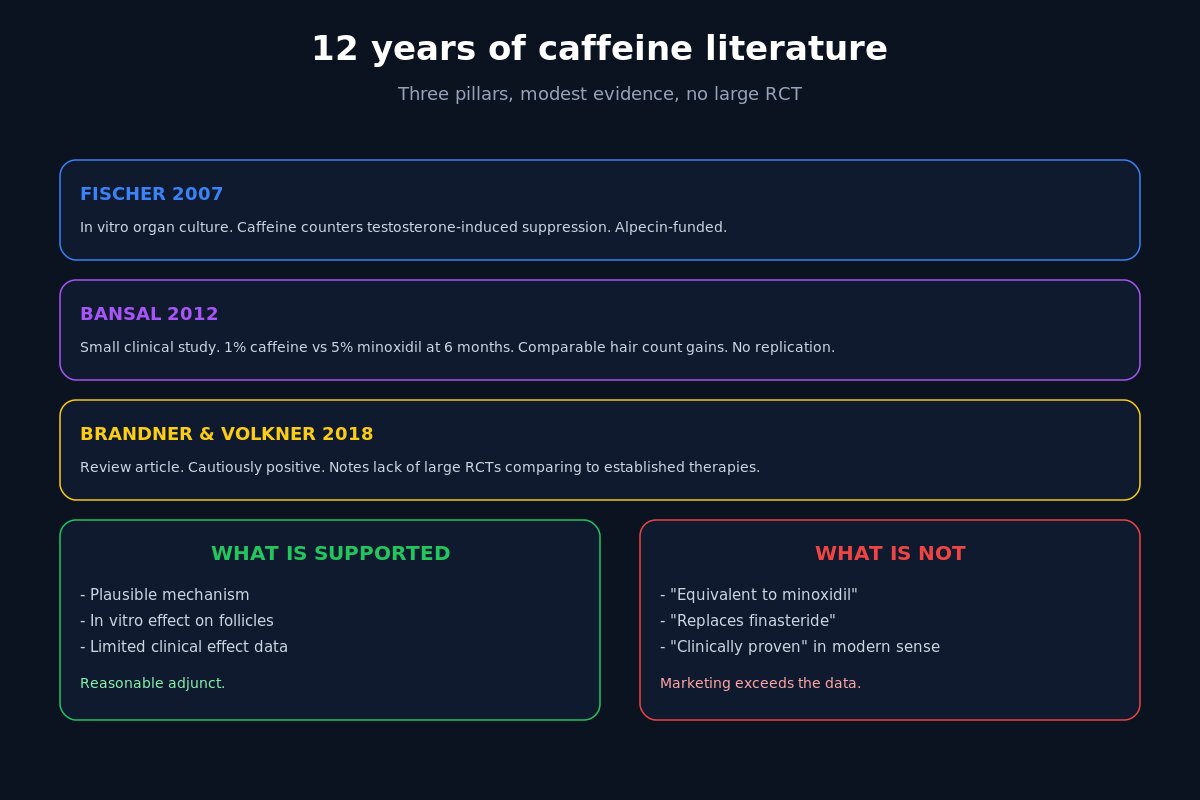
Fischer et al. 2007 is the paper most often cited to support caffeine shampoos. The study cultured human hair follicles in a petri dish, exposed them to testosterone (which suppresses growth in AGA-prone follicles), and showed that adding caffeine to the culture medium counteracted some of the testosterone-induced growth suppression. The study was funded by Alpecin, a German hair-care company that sells caffeine shampoo, and the research informed their marketing for the next two decades.
Reading the paper carefully, the effect size was modest, the concentrations used were higher than what shampoo achieves on a scalp, and the model was follicle organ culture rather than living tissue. Translating this to “shampoo with caffeine grows hair” is a leap. The study supports the mechanistic plausibility of caffeine for hair, not the clinical claim that any specific caffeine product produces measurable hair-count gains in real men.
The Bansal 2012 study and follow-ups
Bansal et al. 2012 was a small clinical study comparing 1 percent caffeine solution to 5 percent minoxidil in men with AGA over 6 months. The reported result was that caffeine produced hair-count improvements broadly comparable to minoxidil. The study has been heavily cited and has become a second pillar of caffeine marketing.
The caveats matter. The study was small, single-center, and not blinded in the way larger minoxidil trials were. The effect size for both arms was on the lower end of typical minoxidil response, raising questions about the methodology rather than confirming caffeine works as well as a 5-AR pathway intervention. The paper has not been replicated at scale. A single study showing caffeine equals minoxidil is interesting; the lack of follow-up replication in the 13 years since is telling.
The Brandner Volkner 2018 review
Brandner and Volkner published a review in 2018 covering the accumulated caffeine-and-hair literature. Their conclusion was cautiously positive: the mechanistic basis is plausible, the in vitro evidence is consistent, the in vivo evidence is suggestive but limited. They explicitly noted the lack of large randomized trials comparing caffeine formulations to established therapies, and the need for further research before clinical recommendations could be made with confidence.
The review’s tone is the honest tone for the topic: caffeine for hair is interesting but not yet established. The marketing claim that caffeine shampoo is “clinically proven” runs ahead of what the review supports. The realistic claim is that there is plausible mechanism and limited supporting clinical data.
Watch this for context
This Hair Loss Compound Works Differently – frames why mechanism matters less than effect size, and why marketing claims often outrun the underlying evidence.
Caffeine shampoo vs caffeine serum or tonic
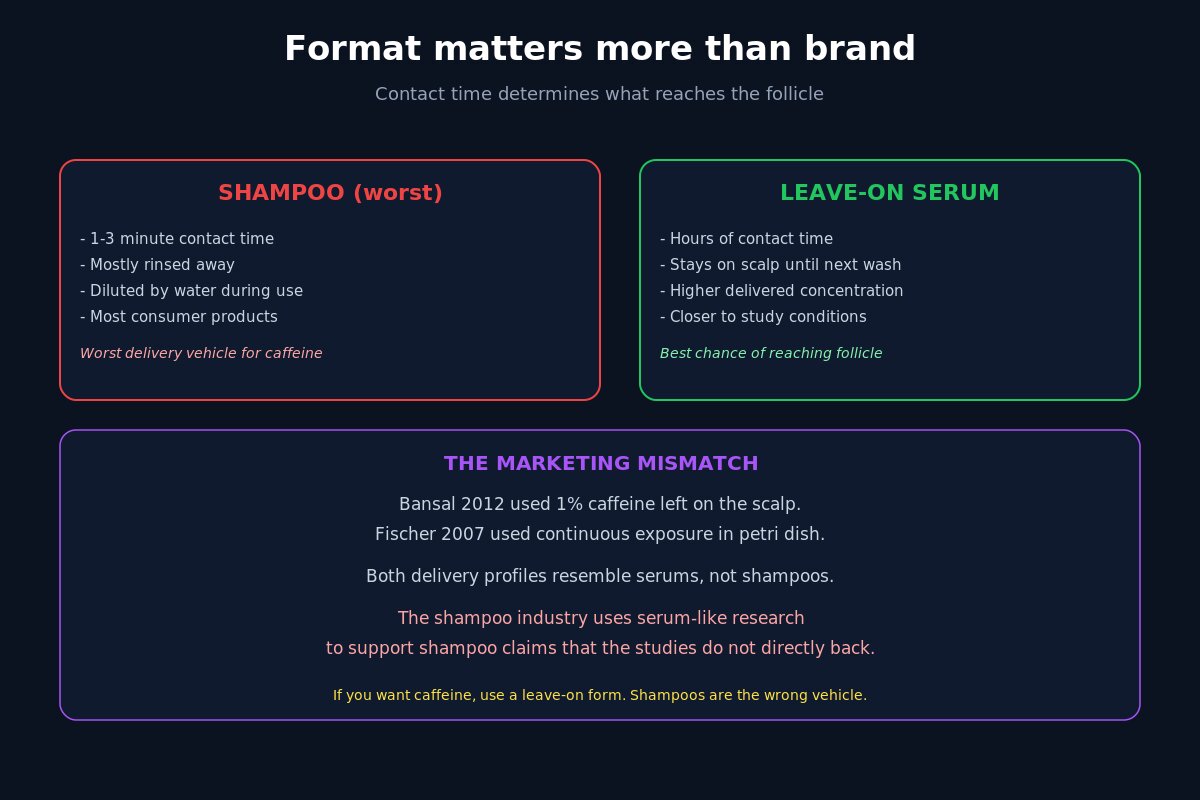
The format matters more than the brand. A caffeine shampoo with 1-3 minute contact time before rinsing is the worst delivery vehicle for caffeine to reach the follicle. A caffeine serum or tonic that is applied and left on the scalp for hours has dramatically more contact time and a chance to actually deliver caffeine through the stratum corneum. The mechanistic argument for caffeine on hair is stronger for leave-on products than for shampoos.
This is a problem because the bulk of the consumer market is shampoos, not serums. The studies that have shown effects (Bansal 2012 with a 1 percent solution applied and left on, Fischer 2007 in a petri dish where contact is constant) used delivery profiles that more resemble serums than shampoos. The shampoo industry has been benefiting from research that does not directly support shampoo claims.
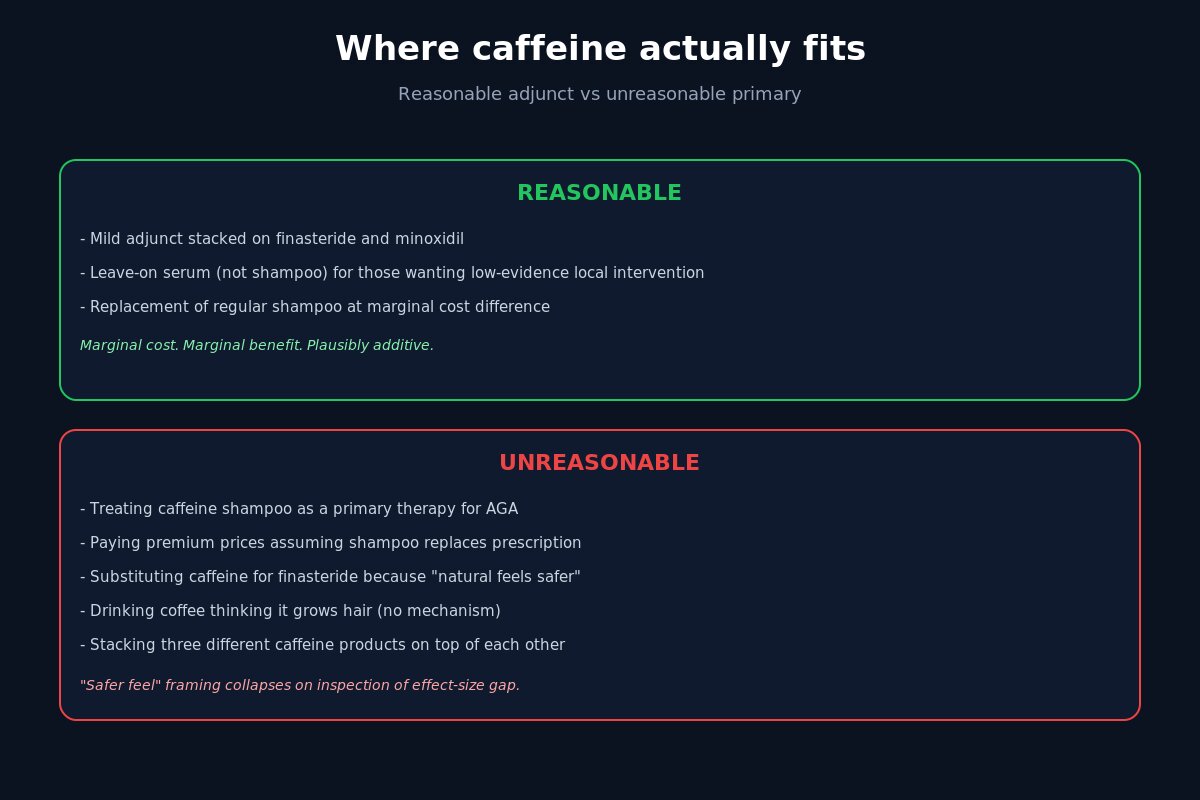
Where caffeine actually fits
The reasonable use cases for caffeine in a hair protocol are: as a mild adjunct stacked on top of finasteride and minoxidil where the marginal cost is low and the marginal upside might be small but additive; as a leave-on serum (not shampoo) for men who want to add a low-evidence local intervention; and as a substitute for nothing – never as a replacement for finasteride or minoxidil in men with progressing AGA.
Unreasonable uses include treating caffeine shampoo as a primary therapy, paying premium prices for caffeine products under the assumption that they replace prescription therapy, or substituting caffeine for established intervention because “natural ingredients” feel safer. The “safer” framing collapses on inspection because untreated AGA progression has its own quality-of-life cost that exceeds the side-effect risk of established therapies for most men.
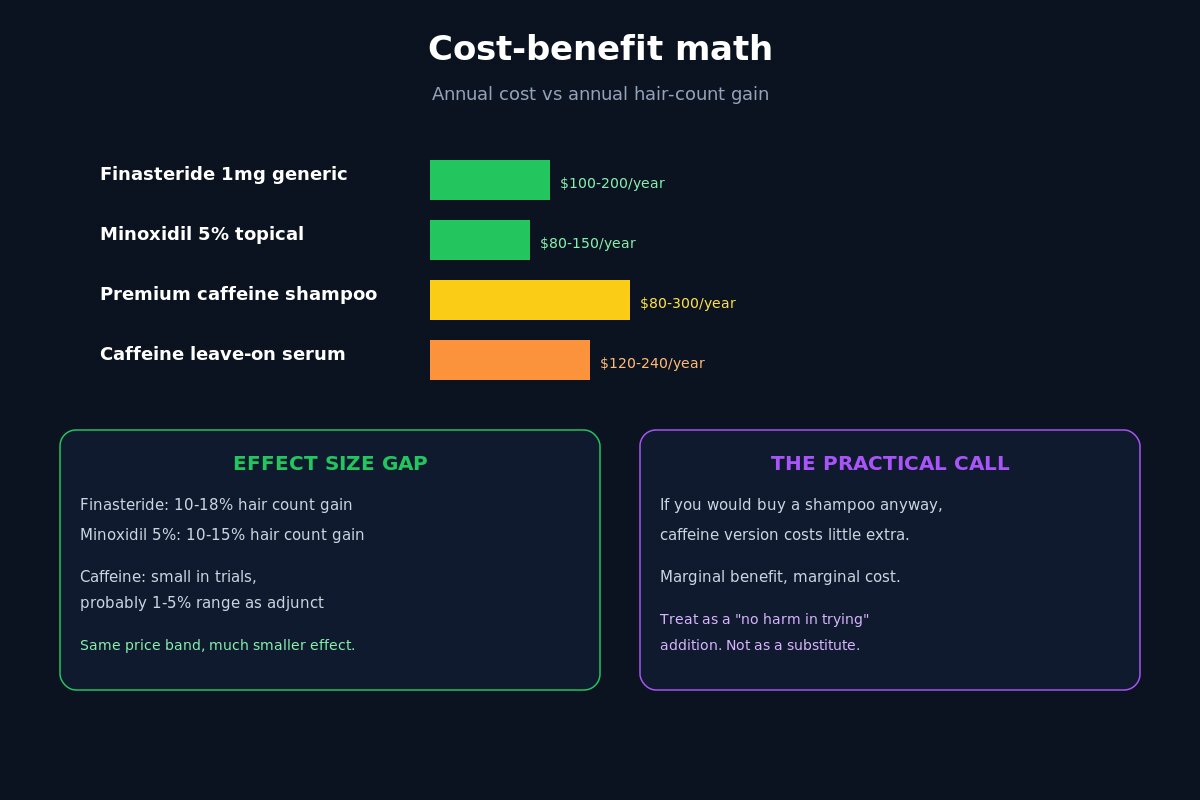
The cost-benefit math
A premium caffeine shampoo costs roughly $20-40 per bottle, lasting 1-3 months at typical use. Annual cost: $80-300. A generic finasteride 1 mg daily costs $100-200 per year. A 5 percent minoxidil topical costs $80-150 per year. The shampoo is in the same price range as finasteride or minoxidil but produces dramatically smaller effect sizes. The math does not flatter the shampoo.
If you already use a daily shampoo, switching to a caffeine version costs nothing additional in time. The marginal cost is the price difference between regular shampoo and caffeine shampoo. The marginal benefit is small but plausible. As a “no harm in trying” addition, it is fine. As a serious intervention, it is overpaying for placebo-adjacent results.
Common myths about caffeine and hair loss
The myth that caffeine shampoo is “clinically proven” overstates what the literature supports. The myth that drinking caffeine helps hair has no plausible mechanism (oral caffeine is metabolized rapidly and does not reach follicles in meaningful concentrations). The myth that caffeine shampoo replaces prescription therapy inverts the effect-size data. The myth that all caffeine products work equivalently ignores the format problem (shampoo contact time vs leave-on serum). The myth that German efficacy claims are stricter than US claims is partially true but does not change the fact that Alpecin’s marketing has expanded beyond what the original Fischer 2007 study supports. The myth that “no side effects” makes caffeine inherently better than finasteride conflates effect size and risk profile in misleading ways.
Frequently asked questions about caffeine and hair
Does caffeine shampoo really work?
Marginally, with mechanism support and limited clinical data. The effect size is dramatically smaller than minoxidil or finasteride. Reasonable as a low-cost adjunct, not a substitute for proven therapy.
Is Alpecin caffeine shampoo backed by research?
Alpecin funded the Fischer 2007 in vitro study. The research is real and the results are mechanistically interesting. The marketing claim that the product produces measurable hair-count gains in real men is a much bigger claim than the original study supports.
How long does caffeine need to be on the scalp to work?
The Fischer 2007 in vitro study used continuous exposure. Bansal 2012 used a 1 percent solution applied and left on. Typical shampoo contact time of 1-3 minutes is short by comparison. Leave-on serums likely deliver more than shampoos.
Should I switch from minoxidil to caffeine?
No. The evidence base for minoxidil is dramatically larger. Caffeine is a reasonable adjunct stacked on top of minoxidil; it is not a replacement for it.
Does drinking coffee help hair growth?
No mechanistic basis. Oral caffeine is metabolized too rapidly to reach follicles in active concentrations. The argument is for topical, not oral, caffeine.
Can caffeine shampoo cause side effects?
Rare but possible. Some users report scalp irritation. Caffeine itself is well-tolerated topically. Most reports of irritation track to other shampoo ingredients (fragrances, preservatives) rather than the caffeine.
Is caffeine better than finasteride for hair?
Not by any meaningful comparison. Finasteride has decades of randomized-trial data showing 10-18 percent hair count gains. Caffeine has small studies showing smaller and less consistent effects. They target different pathways and have completely different magnitudes of effect.
Should I add caffeine shampoo to a finasteride and minoxidil stack?
Optional. Marginal benefit, marginal cost. If you would have used a regular shampoo anyway, the price difference for caffeine is small. The expected hair-count gain on top of fin+min is small but probably not zero. Worth experimenting if you like; not worth obsessing over.
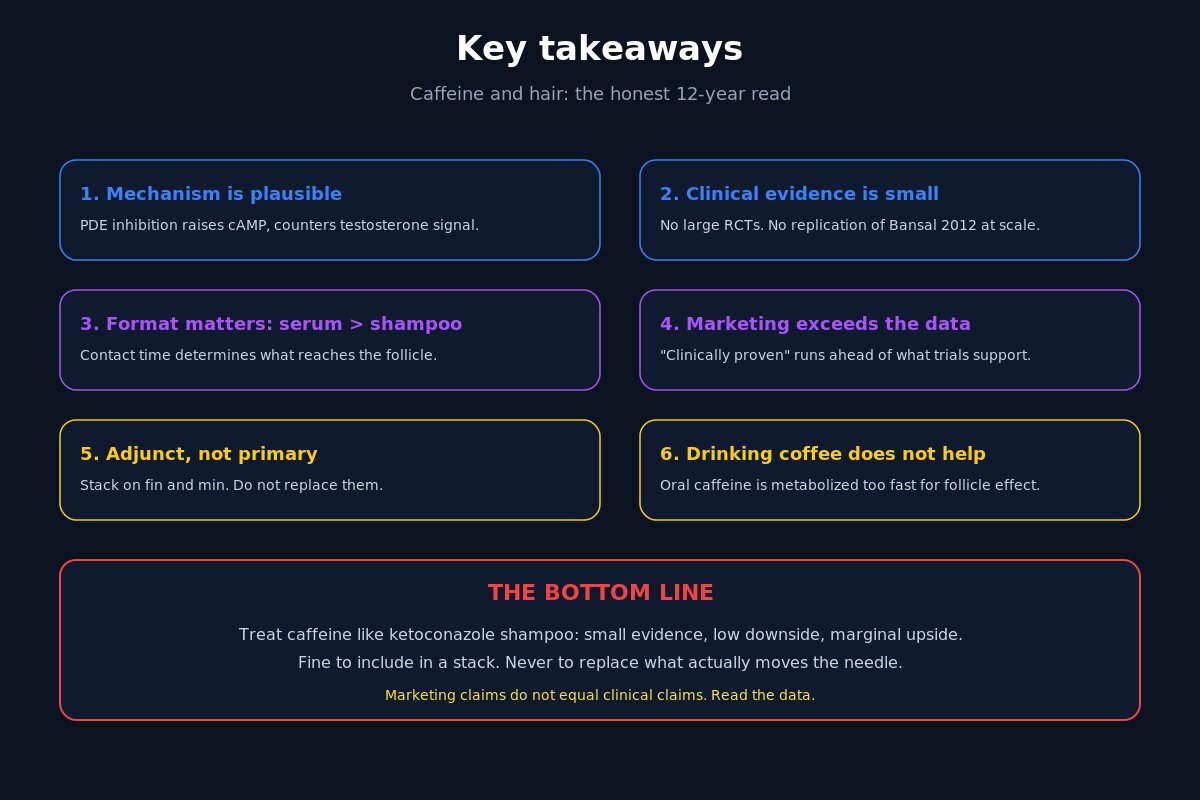
Bringing it together
Caffeine for hair has plausible mechanism, limited but suggestive in vitro evidence, and a small clinical evidence base concentrated in a few studies that have not been replicated at scale. The marketing claims for caffeine shampoos are larger than the underlying data supports. The format matters: leave-on serums likely deliver more caffeine to follicles than shampoos with 1-3 minute contact time. The reasonable role for caffeine is as a low-cost adjunct stacked on established therapies, not as a primary intervention. The unreasonable role is using caffeine shampoo as a replacement for finasteride or minoxidil because it feels “natural.” The data does not support that substitution. Treat caffeine like ketoconazole shampoo: small evidence base, low downside, marginal upside, fine to include in a stack but never to replace what actually moves the needle.
About the author
Philippe Boissard
Author of Men’s Hairloss Protocol (2020), Better, Smarter, Stronger (2023), and Multi-Axis Body (2025). Researches and writes about hair loss and male physiology, citing primary literature and disclosing affiliate relationships in full. Not a medical doctor; all content is educational. More about Philippe.
Related reading
Get my free hair-loss protocol
The exact evidence-based routine I actually use and recommend: what works, in what order, with no hype. Enter your email on the next page and I’ll send it straight to you.
Send me the free protocol →