
Diffuse Thinning vs Androgenetic Alopecia: How to Tell the Difference
Diffuse thinning and AGA shed hair the same way but have completely different causes and treatments. Pattern is the diagnostic key. Here is how to tell them apart and what to do about each.

Most people who say “I’m losing my hair” are looking at one of two completely different things. Androgenetic alopecia is a patterned, genetic, hormonal program that thins specific zones over years. Diffuse thinning is broad, often reversible, and usually has a different cause altogether: telogen effluvium, thyroid dysfunction, deficiency, or female-pattern hair loss. The treatment paths diverge dramatically. Reading the wrong diagnosis is one of the most expensive mistakes in the protocol — finasteride for thyroid disease wastes years.
Quick answer: pattern is the diagnostic key
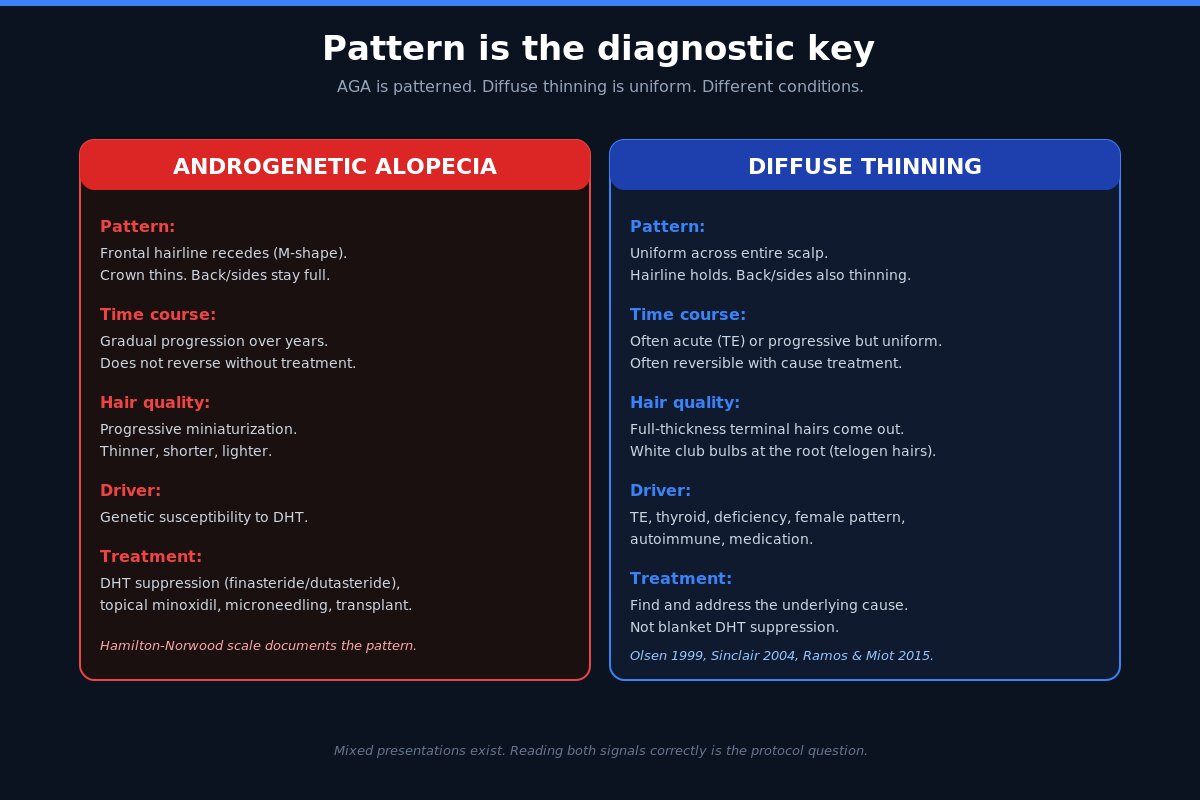
Androgenetic alopecia is patterned. The hairline retreats at the temples, the crown thins, and the back and sides stay full because they are genetically resistant to DHT. Loss is gradual over years and does not reverse without treatment. Olsen (1999) describes the male and female pattern presentations, and Sinclair (2004) details the female-specific manifestations. The Hamilton-Norwood scale exists because the pattern is consistent.
Diffuse thinning is unpatterned. Hair thins across the entire scalp uniformly, including the back and sides. The hairline holds. The crown does not selectively thin into a pattern. The cause is usually one of several diagnosable conditions – telogen effluvium, hypothyroidism or hyperthyroidism, iron deficiency, female-pattern hair loss, autoimmune dermatologic conditions. Ramos and Miot (2015) summarize the differential. Treatment of diffuse thinning starts with finding the underlying cause and addressing it – not blanket DHT suppression.
Mixed presentations exist and are common. A man with underlying AGA can have a TE episode that overlays diffuse shedding on top of pattern thinning. Reading both signals correctly is the protocol question.
The visual differences
What each looks like in the mirror, in dermatology terms.
AGA presentation. Frontal hairline recedes at the temples (“M-shape” forming). Crown shows a distinct thinning area visible from above. The bridge between hairline and crown thins last. Back and sides remain dense. Hairs in affected zones progressively miniaturize – getting shorter, thinner, lighter in color before disappearing. The Norwood-Hamilton scale documents the consistent pattern.
Diffuse thinning presentation. Loss spreads uniformly across the entire scalp. Hairline does not retreat. Crown does not selectively thin. Density loss visible from the top of the head, but in a smooth-pattern way – “the whole top got thinner” rather than “the crown got bald.” Back and sides also lose density, unlike in AGA where they stay full. Hairs come out as full-thickness terminal hairs, often with white club-shaped bulbs (telogen hairs).
Female pattern hair loss. A specific subtype with unique pattern: thinning concentrated in the central scalp/midline, with the frontal hairline often preserved, producing a “Christmas tree” widening of the central part. Sinclair 2004 staging captures this. Often stable for years and slowly progressive.
Mixed presentations. AGA + diffuse thinning produces a scalp where pattern recession is visible AND overall density is reduced everywhere. The diffuse component may resolve if the cause is treated, leaving the pattern component visible underneath.
What the differential actually contains
Diffuse thinning has a specific list of differential diagnoses worth knowing.
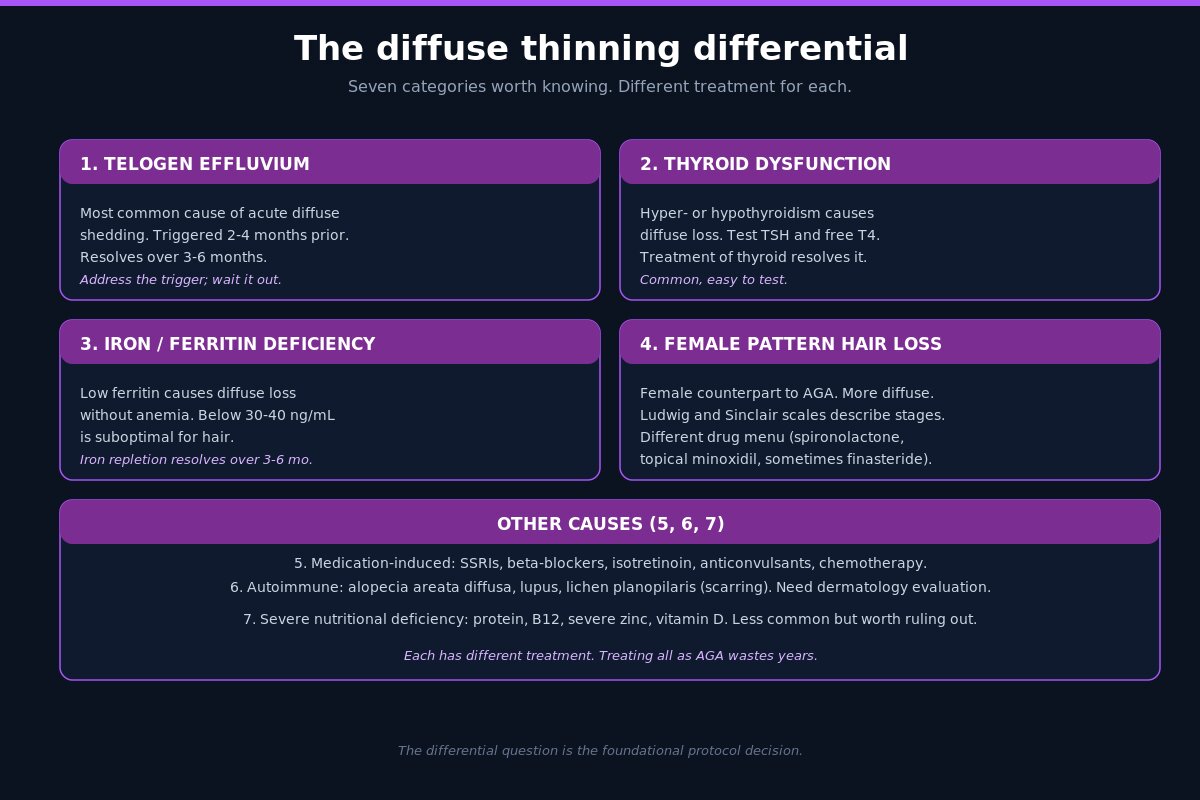
Telogen effluvium (TE). Most common cause of acute diffuse shedding. Triggered by physiological stressors (illness, surgery, severe diet, major life event) 2-4 months prior. Resolves over 3-6 months once trigger is addressed. Trost et al. and Hadshiew et al. document the clinical course. Distinct from AGA in time course and pattern.
Thyroid dysfunction. Both hyper- and hypothyroidism cause diffuse hair loss. Common cause and easy to test (TSH, free T4). Loss is gradual diffuse density reduction rather than acute shedding episode. Treatment of the thyroid resolves the hair issue.
Iron deficiency / low ferritin. Low iron stores cause diffuse hair loss without anemia. Ferritin below 30-40 ng/mL is suboptimal for hair purposes. Common in menstruating women but also present in some men. Repletion with iron supplementation resolves the loss over 3-6 months.
Female pattern hair loss. The female counterpart to AGA. More diffuse than male-pattern but still hormone-driven (androgen sensitivity). The Ludwig and Sinclair scales describe stages. Treatment options differ from male AGA – spironolactone, topical minoxidil, sometimes finasteride off-label.
Medication-induced. SSRIs, beta-blockers, isotretinoin, certain anticonvulsants, chemotherapy. Diffuse shedding starting weeks to months after medication initiation. Resolves with discontinuation in most cases, though some persist.
Autoimmune conditions. Alopecia areata diffusa (a diffuse subtype of AA), lupus-related hair loss, lichen planopilaris (scarring). Each has specific clinical features that distinguish them from AGA and standard TE. Trichoscopy and sometimes biopsy are diagnostic.
Severe nutritional deficiency. Protein restriction, B12 deficiency, severe zinc deficiency, vitamin D deficiency. Less common than iron and thyroid but worth ruling out in atypical cases.
Why getting the differential right matters
The treatments diverge sharply.
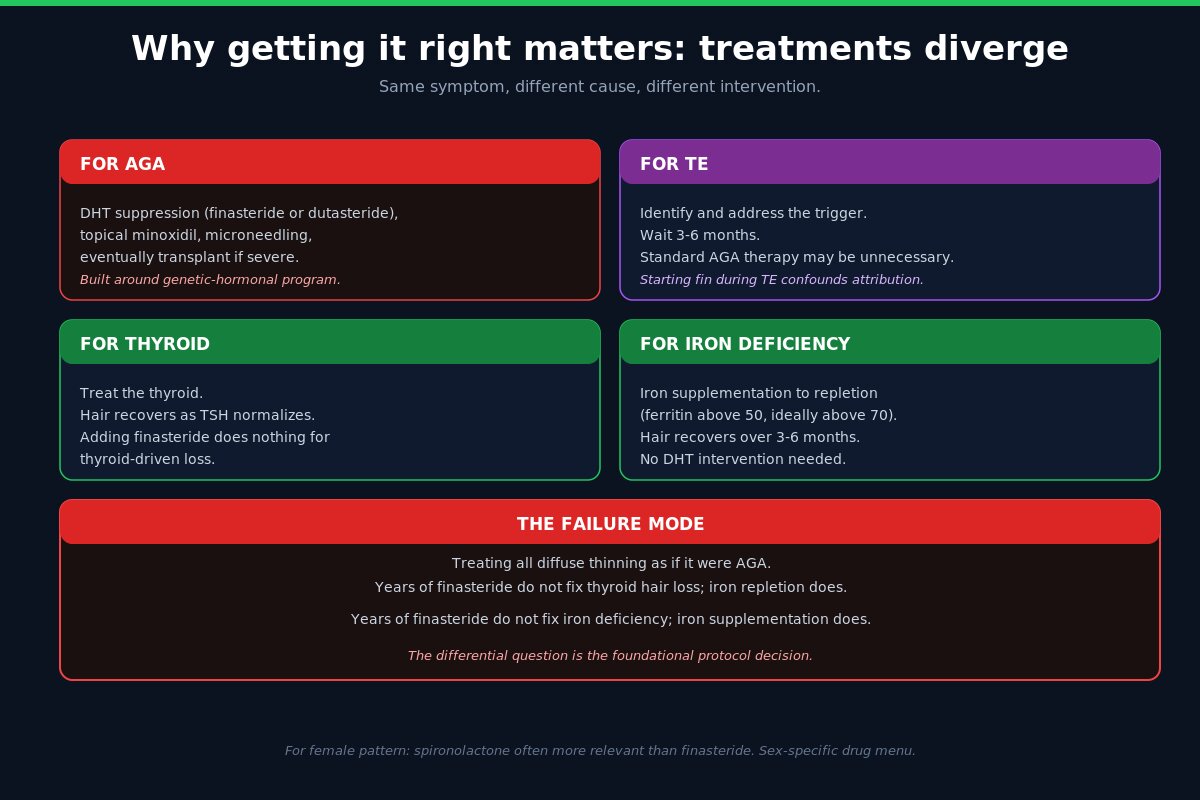
For AGA: DHT suppression (finasteride or dutasteride), topical minoxidil, microneedling, eventually transplant if severe. The whole stack is built around the genetic-hormonal program.
For TE: Identify and address the trigger. Wait 3-6 months. Standard therapy may be unnecessary if the trigger resolves. Starting AGA medications during a TE episode confounds attribution.
For thyroid dysfunction: Treat the thyroid. Hair recovers as TSH normalizes. Adding finasteride does nothing for thyroid-driven loss.
For iron deficiency: Iron supplementation to repletion (ferritin above 50, ideally above 70). Hair recovers over 3-6 months. No DHT intervention needed.
For female pattern: Different drug menu – spironolactone, possibly topical minoxidil, possibly low-dose finasteride or oral minoxidil. Standard male AGA stack does not directly translate.
For medication-induced: Discuss alternative medication with prescribing clinician. May resolve on switching or discontinuation.
Treating all diffuse thinning as if it were AGA is the failure mode. Years of finasteride do not fix thyroid hair loss; iron repletion does. The differential question is the foundational protocol decision.
Watch this for the diagnostic framing
This video covers what happens when finasteride is not working – and one major reason is that AGA was the wrong diagnosis to begin with. Diffuse thinning from thyroid, deficiency, or TE will not respond to finasteride no matter how long you take it. The diagnostic question precedes the treatment decision.
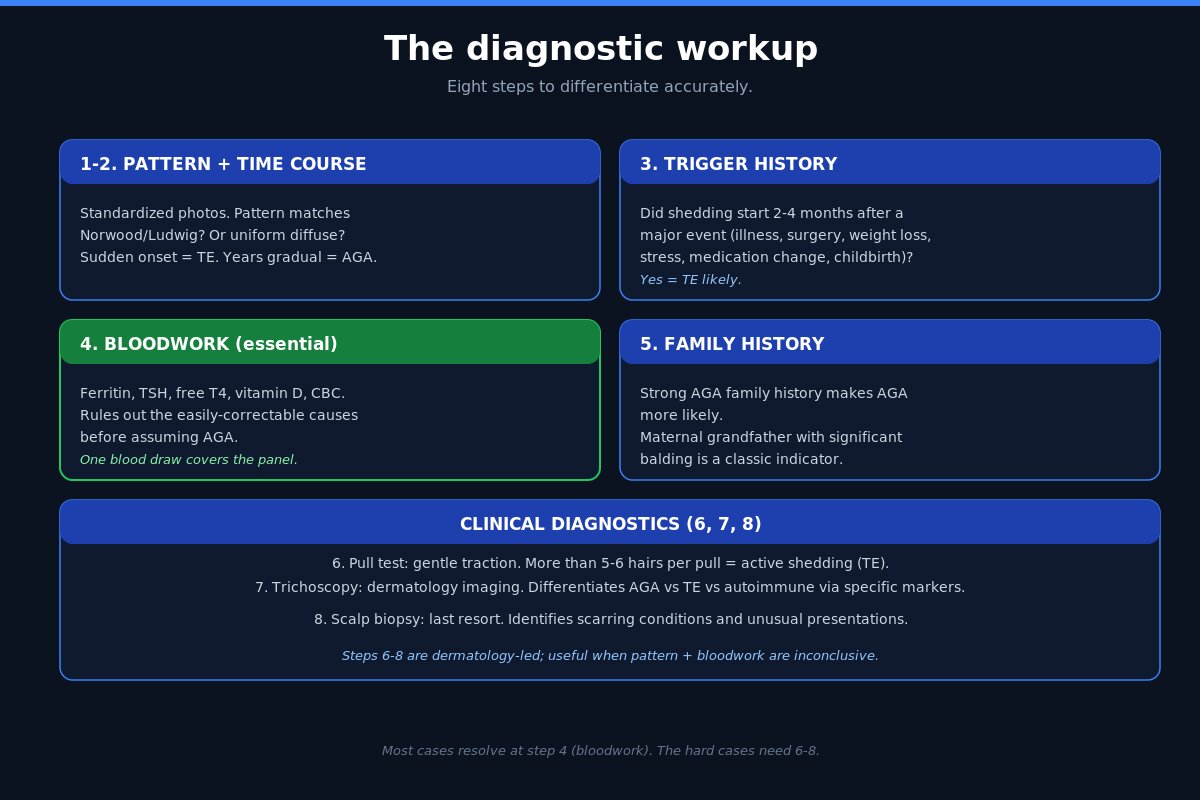
The diagnostic workup
Steps to differentiate accurately.
1. Pattern assessment. Standardized photos at multiple angles (front, sides, top-down, back). Compare to Norwood scale and Ludwig scale visuals. Patterned recession suggests AGA. Uniform diffuse loss suggests TE or thyroid or deficiency.
2. Time course. Sudden onset (weeks) suggests TE. Gradual progression over years suggests AGA or female pattern. Episodic shedding episodes overlying chronic loss suggest mixed presentation.
3. Trigger history. Did the shedding start 2-4 months after a major event (illness, surgery, weight loss, stress, medication change, childbirth)? If yes, TE is likely. AGA does not respond to triggers in this way.
4. Bloodwork. Ferritin, TSH and free T4, vitamin D, CBC. Rule out the easily-correctable causes before assuming AGA. The full panel takes one blood draw.
5. Family history. Strong AGA family history in male relatives makes AGA more likely. Maternal grandfather with significant balding is a classic indicator.
6. Pull test. Gentle traction on a small bunch of hairs. More than 5-6 hairs coming out per pull suggests active shedding (TE). Few hairs (1-2) is normal even in AGA.
7. Trichoscopy. Dermatology procedure using a polarized magnifier on the scalp. Differentiates AGA (miniaturized hairs in pattern zones, normal in donor zones) from TE (uniform thinning) from autoimmune conditions (specific signs like exclamation hairs in AA).
8. Scalp biopsy. Last-resort diagnostic when imaging and bloodwork are inconclusive. Identifies scarring conditions, alopecia areata, and unusual presentations.
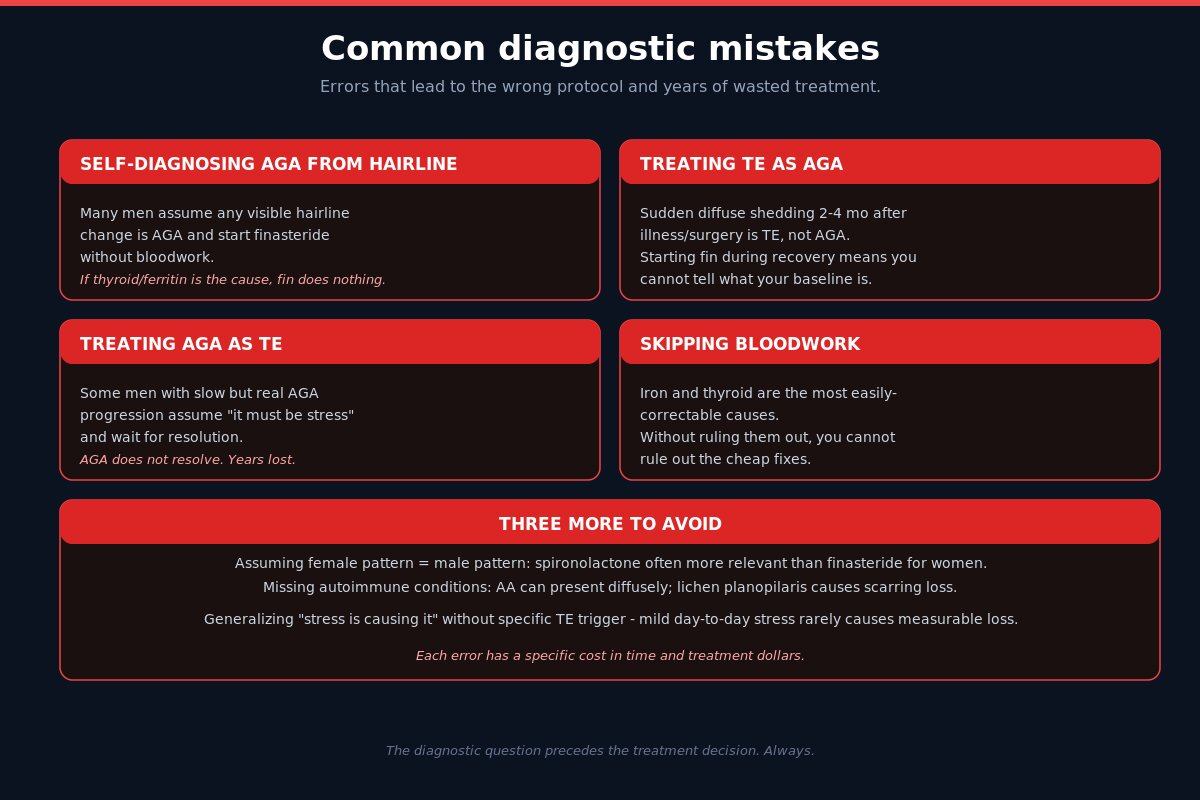
Common diagnostic mistakes
Errors that lead to the wrong protocol.
Self-diagnosing AGA from a hairline check alone. Many men assume any visible hairline change is AGA and start finasteride without bloodwork. If thyroid or ferritin is the actual cause, finasteride does nothing.
Treating TE as AGA. Sudden diffuse shedding 2-4 months after illness or surgery is TE, not AGA. Starting finasteride during the recovery means you cannot tell what your baseline is, and the recovery (which would have happened anyway) gets misattributed to the medication.
Treating AGA as TE. Some men with slow but real AGA progression assume “it must be stress” and wait for it to resolve. AGA does not resolve. Years of waiting equal years of preservable density lost.
Skipping bloodwork before treatment. Iron and thyroid are the two most easily-correctable causes. Ferritin and TSH should be on every diffuse-thinning workup. Without them, you cannot rule out the cheap fixes.
Assuming female pattern = male pattern. Female pattern hair loss responds to a different drug menu. Standard male AGA stack does not directly translate. Spironolactone is often more relevant than finasteride for female patients.
Missing autoimmune conditions. Alopecia areata can present diffusely. Lichen planopilaris can present with hairline changes. These need different treatments and time-sensitive intervention to prevent permanent scarring loss.
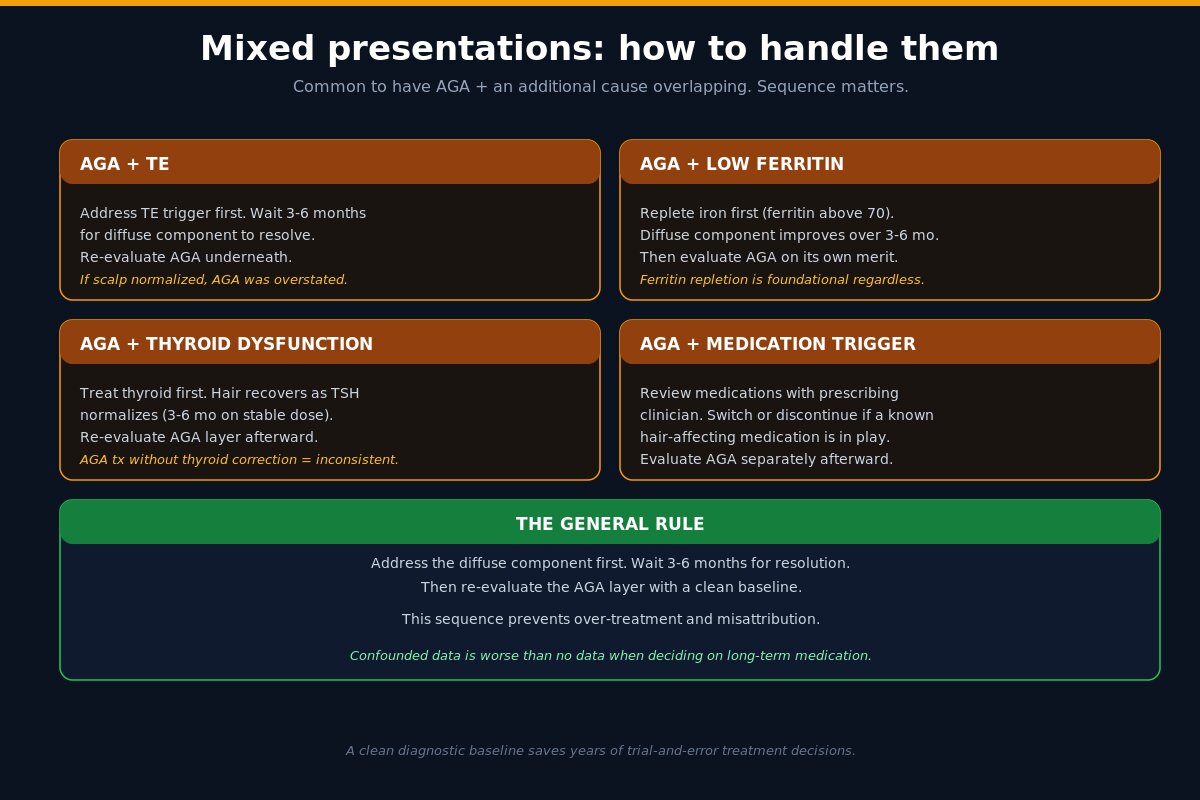
Mixed presentations and how to handle them
Not uncommon to have AGA + an additional cause overlapping. The strategic approach.
Suspected AGA + suspected TE. Address the TE trigger first. Wait 3-6 months for the diffuse component to resolve. Then re-evaluate the underlying pattern. If AGA is still visible underneath, treat that. If the scalp normalized completely, AGA was overstated.
Suspected AGA + low ferritin. Replete iron first (target ferritin above 70). The diffuse component improves over 3-6 months. Then evaluate AGA on its own merit. Ferritin repletion is foundational regardless.
Suspected AGA + thyroid dysfunction. Treat the thyroid first. Hair recovers as TSH normalizes (takes 3-6 months on stable dosing). Then re-evaluate the AGA layer. AGA treatment alone without thyroid correction will produce inconsistent results.
Suspected AGA + medication trigger. Review medications with prescribing clinician. If a known hair-affecting medication is in play, switching or discontinuing may resolve the diffuse component. AGA treatment evaluated separately afterward.
The role of the dermatologist
For atypical or unclear cases, formal dermatology evaluation matters.
When to see a dermatologist. Diffuse loss that does not fit typical TE or AGA patterns. Loss with associated scalp symptoms (itching, burning, redness). Loss accompanied by skin changes elsewhere. Family history of autoimmune conditions. Failure to respond to standard interventions.
What dermatologists do beyond what self-assessment can. Trichoscopy, scalp biopsy, prescription-strength interventions, identification of scarring conditions before they become irreversible. Worth the visit even if just for one consultation.
Cost-benefit. A dermatology visit costs $150-400 in the US, less elsewhere. Compared to years of ineffective treatment from misdiagnosis, the value is high.
Common myths and where they fail
“All hair loss is the same.” No. AGA, TE, thyroid, deficiency, and autoimmune are different conditions with different treatments. Treating them as one wastes years.
“Finasteride works for any hair loss.” No. Finasteride only addresses DHT-driven AGA. It does nothing for thyroid, iron deficiency, TE, autoimmune, or female pattern (in most cases).
“If I cannot tell the difference, just take finasteride to be safe.” Not safe. Years of finasteride for a non-AGA cause means years of side effect risk for no benefit. Bloodwork before treatment.
“Stress is making my hair fall out.” Sometimes. Severe sustained stress can drive TE. Mild day-to-day stress is rarely the cause of measurable hair loss. Look at concrete triggers (surgery, weight loss, major life events) rather than vague “stress.”
“Hair loss is genetic so nothing can be done.” Half-true. AGA is genetic but treatable. Diffuse thinning often is not genetic at all – it is correctable with proper diagnosis.
Frequently asked questions about diffuse thinning vs AGA
How do I know if I have AGA or diffuse thinning?
Pattern is the key. AGA shows frontal recession + crown thinning while back and sides stay full. Diffuse thinning affects the entire scalp uniformly. Standardized photos compared to the Norwood scale help. Bloodwork (ferritin, TSH, free T4) rules out common diffuse causes.
Can I have both at the same time?
Yes, mixed presentations are common. Address the diffuse component first (TE trigger, thyroid, iron) and re-evaluate AGA underneath after 3-6 months.
Will finasteride help if I have thyroid hair loss?
No. Finasteride suppresses DHT. Thyroid hair loss is not DHT-driven. Treating the thyroid resolves the hair issue.
Why is my dermatologist asking for bloodwork?
Standard workup. Ferritin, TSH, free T4, and CBC rule out the most common correctable causes of diffuse thinning. Without ruling these out, treatment recommendations are guesswork.
How long until I know if my hair loss is recovering or progressing?
3-6 months minimum. Hair cycle changes show on that timescale. Single-month observations are noise. Standardized photos at month 0, 3, and 6 are the diagnostic.
Can female pattern hair loss be treated like male pattern?
Some elements yes (minoxidil works for both). Others differ – spironolactone is often used for women, finasteride less commonly and at different doses. The treatment menu is sex-specific because hormonal context differs.
Is alopecia areata related to AGA?
No. Alopecia areata is autoimmune. AGA is genetic-hormonal. Different mechanisms, different treatments. Areata can sometimes present diffusely and be confused with TE on initial inspection – dermatology evaluation distinguishes them.
What if my bloodwork is normal but I am still losing hair?
Then AGA is more likely. Standard treatment (finasteride, minoxidil, microneedling) is reasonable. If pattern does not match AGA either, consider trichoscopy or biopsy for less common causes.
How quickly does TE resolve?
3-6 months once the trigger is addressed. If the trigger continues (chronic stress, ongoing medication, untreated thyroid), TE persists. Identifying and removing the trigger is the move.
Can stress cause AGA?
Stress does not cause AGA. AGA is genetic-hormonal. Severe sustained stress can accelerate AGA progression somewhat by extending the chronic-inflammation tone of the scalp, but does not initiate it. The dominant driver remains genetics and DHT.
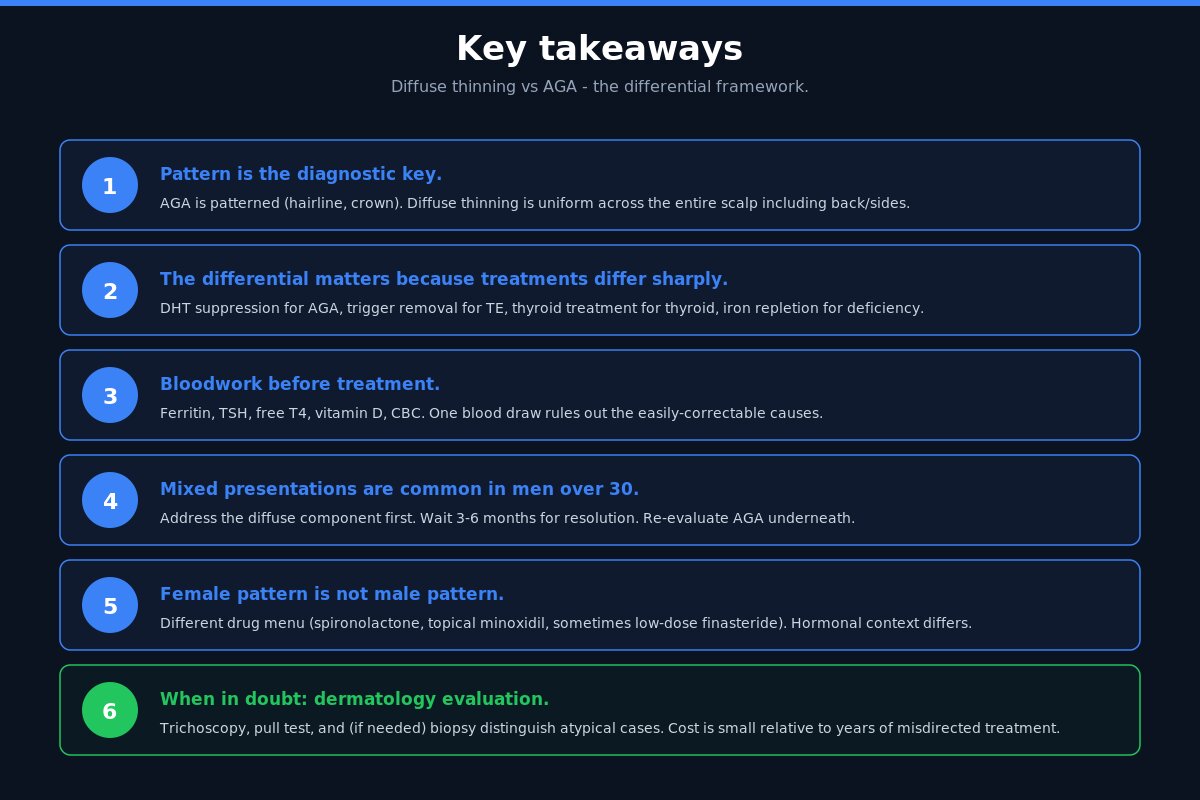
Bringing it together
The diagnostic question precedes the treatment decision. Pattern, time course, triggers, bloodwork, family history – these together separate AGA from diffuse thinning and from each cause within the diffuse category. Treating all hair loss as AGA wastes years on the wrong protocol; treating all hair loss as TE delays appropriate AGA treatment until preservable density is lost. The biology of hair loss explains why DHT-targeted intervention works for some patterns and not others.
For the diffuse-thinning side specifically, the framework for ruling out the cheap fixes (iron, thyroid, vitamin D) before assuming AGA is in the nutrient deficiency analysis, and the stress-versus-AGA differential gets its own treatment in the stress and cortisol piece. When standard AGA treatment is failing, the diagnostic recheck framework is in why your protocol may not be working.
This article is for educational purposes only and does not constitute medical advice. Hair loss has multiple potential causes and the right approach depends on your individual history, examination, and bloodwork. Speak with a qualified clinician before starting or stopping any treatment. See the full disclaimer.
About the author
Philippe Boissard
Author of Men’s Hairloss Protocol (2020), Better, Smarter, Stronger (2023), and Multi-Axis Body (2025). Researches and writes about hair loss and male physiology, citing primary literature and disclosing affiliate relationships in full. Not a medical doctor; all content is educational. More about Philippe.
Related reading
Get my free hair-loss protocol
The exact evidence-based routine I actually use and recommend: what works, in what order, with no hype. Enter your email on the next page and I’ll send it straight to you.
Send me the free protocol →
[…] Diffuse Thinning vs Androgenetic Alopecia: How to Tell the Difference […]
[…] causes diffuse shedding. Pattern loss is a different mechanism entirely, and I have written about telling diffuse thinning apart from pattern hair loss. Both can be present at once, which is exactly why people spend years treating the wrong […]