
Topical Dutasteride: The Case For and Against (Evidence Read)
Topical dutasteride is the workaround everyone thinks they want. The half-life is the catch. Here is what the published evidence actually shows and where it actually fits.



Topical dutasteride is the workaround everyone thinks they want. The pitch is intuitive: you get the strong DHT suppression of dutasteride without the systemic side-effect risk that drives some men off the oral version. The reality is more complicated. The published trial evidence is thin. The half-life of dutasteride is long enough that “topical” does not mean “non-systemic” the way many men assume. And the case for choosing topical dutasteride over topical finasteride – which has more data – is weaker than online discussion implies. This is the honest read.
Quick answer: should you use topical dutasteride?
Probably not as a first choice. Topical finasteride has more published evidence, similar local action, and a shorter half-life that makes the “topical means lower systemic exposure” argument actually hold. Topical dutasteride has trial data that fits in a small handful of papers, a half-life measured in weeks rather than hours, and the absence of any clear advantage over topical finasteride for men who want a topical 5-alpha reductase inhibitor. The men who reasonably consider it are men who failed topical finasteride and need stronger DHT suppression, and even there the reasoning is more complicated than the marketing suggests.
What topical dutasteride actually is
Dutasteride is a dual 5-alpha reductase inhibitor, blocking both type 1 and type 2 isoenzymes, where finasteride blocks predominantly type 2. Orally, dutasteride suppresses serum DHT by roughly 90 percent, where finasteride suppresses it by roughly 70 percent. The compounding pharmacy approach to topical dutasteride takes the same active and dissolves it in a vehicle, usually some combination of ethanol, propylene glycol, and a penetration enhancer, applied directly to the scalp. The theoretical goal is local DHT suppression with reduced systemic exposure.
Whether that goal is actually achieved depends on a few unknowns: how much of the topical dose is absorbed systemically, how the tissue distribution of dutasteride compares between oral and topical routes, and whether the long elimination half-life of dutasteride means cumulative systemic exposure approaches the oral route over months of use. None of these questions has a clean published answer.
The published evidence base
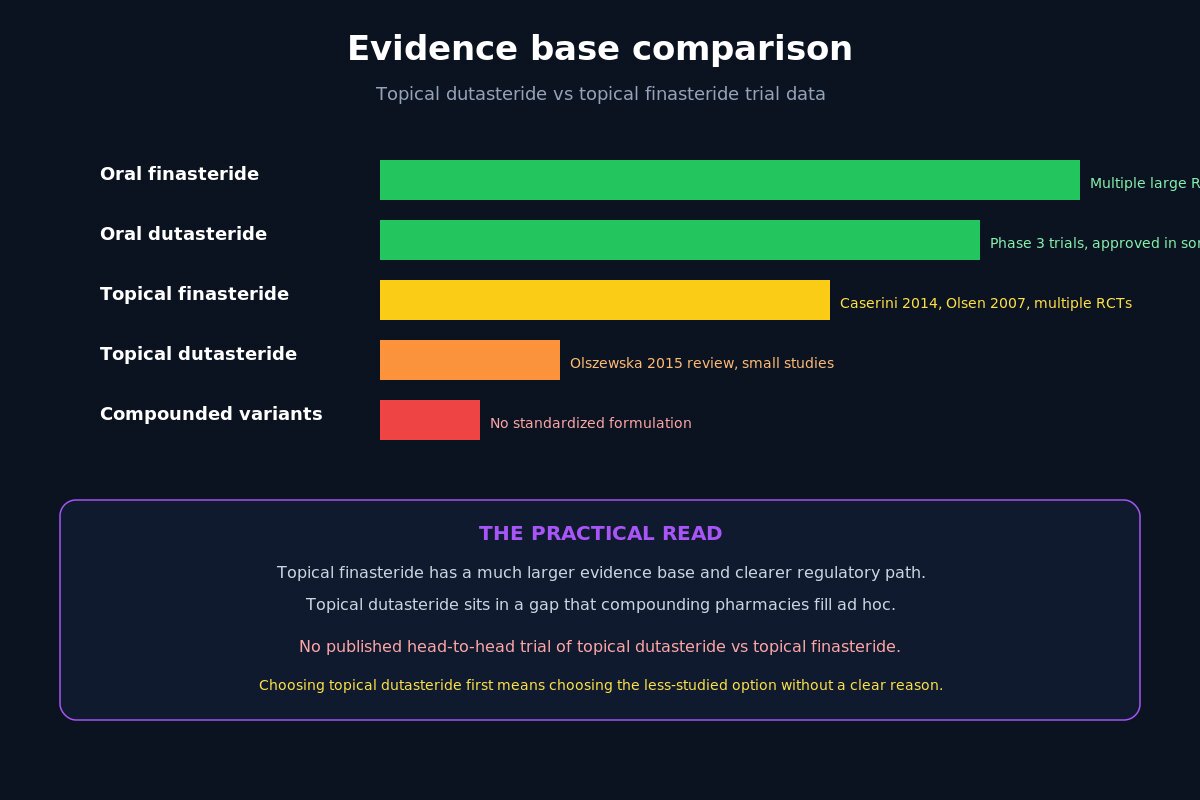
The published literature on topical dutasteride for hair loss is small. The most-cited paper is a 2015 review by Olszewska and Rudnicka summarizing the limited clinical experience, much of which comes from small single-center studies. There are pharmacokinetic studies including Pic et al. 2007 looking at absorption profiles of various topical formulations. There are case reports and dermatology review articles. There is no large randomized controlled trial of topical dutasteride for androgenetic alopecia comparable to the trials that established finasteride.
What the available data does suggest is that topical dutasteride produces measurable local effects when adequately formulated and absorbed, that systemic absorption occurs but is lower than the oral route, and that the practical effect on hair count is in the same general range as topical finasteride. None of these suggestions are settled with the rigor that would normally support a treatment recommendation.
The half-life problem
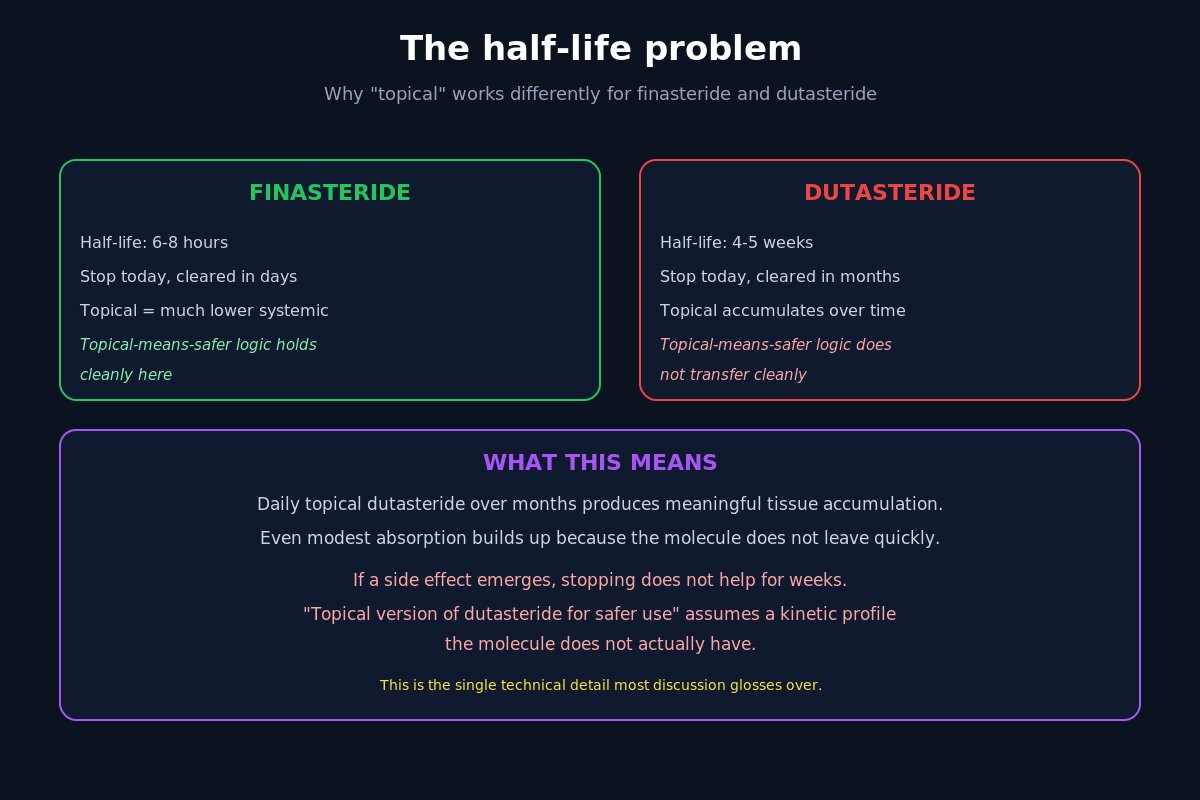
This is the technical detail that most discussion of topical dutasteride glosses over. Finasteride has a serum half-life of roughly 6 to 8 hours. Dutasteride has a serum half-life of roughly 4 to 5 weeks. After daily oral dutasteride, full clearance from the body takes months after stopping the drug. Even modest systemic absorption of topical dutasteride, applied daily over months, produces meaningful tissue accumulation that the short-half-life logic of topical finasteride does not have to deal with.
This matters because the reason many men want a topical formulation is to avoid the systemic exposure that drives sexual side effects. With topical finasteride, if a side effect emerges, you can stop and the drug clears in days. With topical dutasteride, you stop and the drug is still systemically present for weeks. The “topical version of dutasteride for safer use” framing assumes a kinetic profile that the molecule does not actually have.
Topical dutasteride vs topical finasteride
The natural comparison is to topical finasteride, which has a much larger evidence base. Multiple randomized trials including Caserini et al. 2014 and Olsen et al. 2007 have shown topical finasteride produces hair count gains comparable to oral finasteride with measurably reduced systemic DHT suppression. Topical finasteride is the topical 5-AR inhibitor with the better-established case in the published literature.
Topical dutasteride does not have a corresponding evidence base of equivalent quality. The argument for topical dutasteride over topical finasteride is mostly mechanistic – dutasteride blocks both isoenzymes, finasteride blocks one – but the practical question is whether that mechanistic difference matters for hair count outcomes in men who can adequately respond to topical finasteride. The clinical answer is unclear because the head-to-head trials have not been done.
Watch this for context
Finasteride Isn’t Working? Here’s Why – frames why escalating from finasteride to dutasteride is not always the answer, and why the topical formulation conversation deserves more nuance than it usually gets.
The case for topical dutasteride
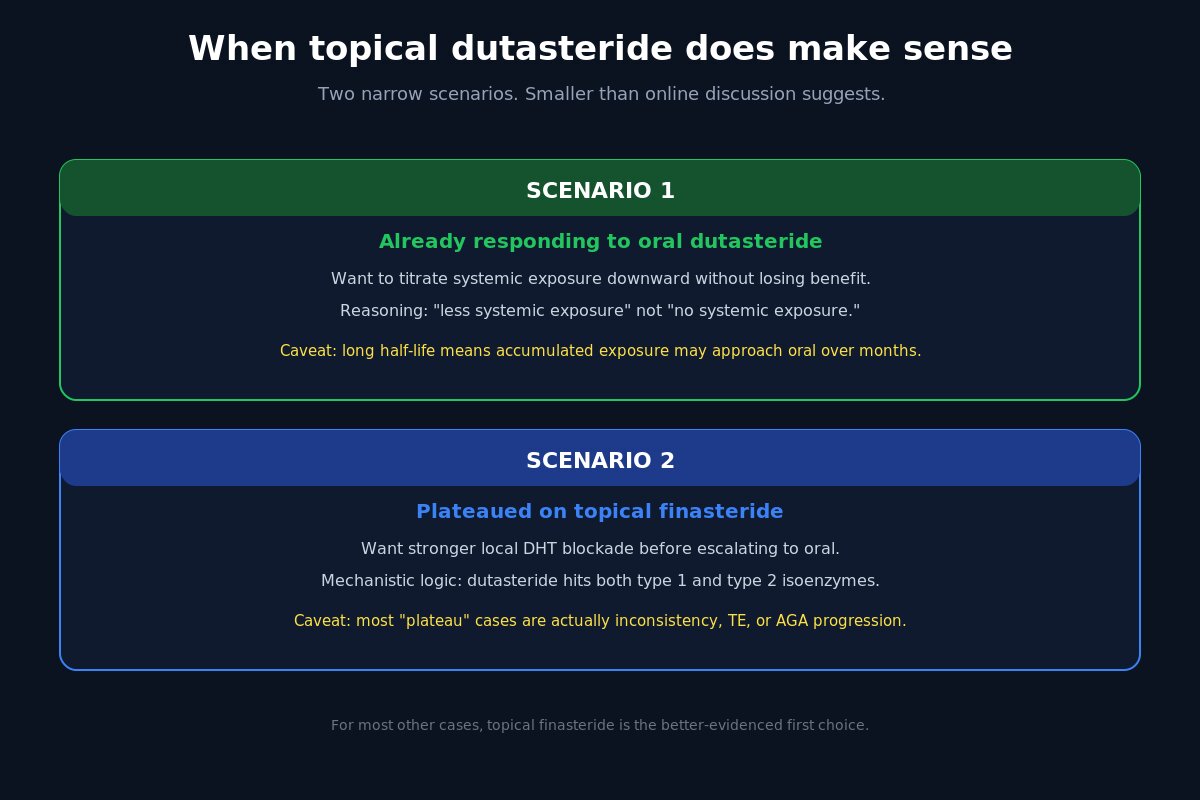
The reasonable case is for men who have responded to oral dutasteride, want to maintain that response, and want to attempt to lower systemic exposure – not eliminate it. The available data suggests topical dutasteride can produce some local DHT suppression with somewhat reduced systemic levels relative to oral, and for a man who has tolerated oral dutasteride but wants to try titrating systemic exposure downward, topical is one path. The reasoning is “less systemic exposure than oral” rather than “no systemic exposure.”
The case is also defensible for men who have plateaued on topical finasteride and want stronger local DHT blockade before escalating to oral dutasteride. This is a narrower group than the discussion would suggest because most plateau cases are not actually plateau cases – they are cases of inconsistent application, comorbid telogen effluvium, or progression of underlying AGA.
The case against topical dutasteride
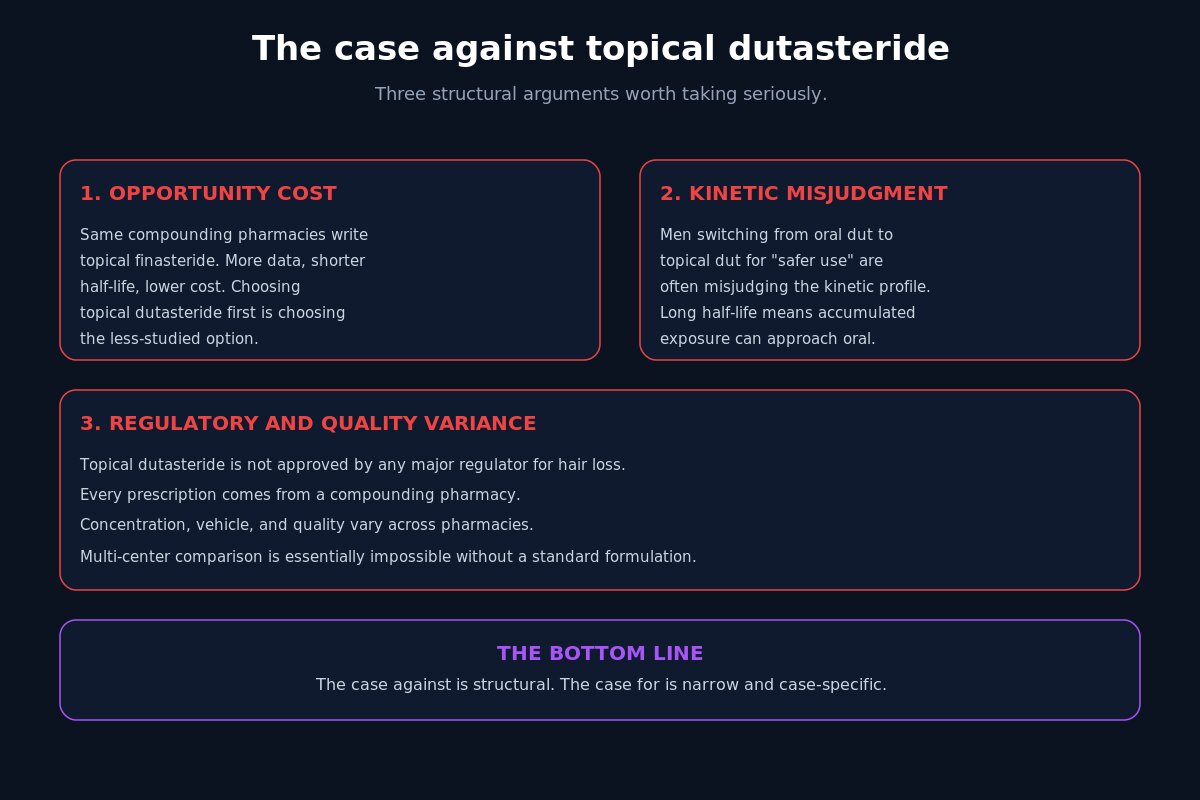
The strongest argument against topical dutasteride is opportunity cost. The same compounding pharmacy that will write topical dutasteride will write topical finasteride, and topical finasteride has a much larger evidence base, a much shorter half-life, and the same general mechanism for the type 2 isoenzyme. Choosing topical dutasteride first is choosing the less-studied option without a clear reason.
The second argument is that men who want to switch from oral dutasteride to topical dutasteride because of systemic side effects are often misjudging the kinetic profile. The half-life issue is real. Months of cumulative topical exposure can produce systemic DHT suppression that approaches oral, depending on absorption, and stopping the topical does not stop the systemic exposure for weeks afterward. The logic that worked for topical finasteride does not transfer cleanly.
The third argument is regulatory: topical dutasteride is not approved by any major regulator for hair loss. Every prescription comes from a compounding pharmacy. Concentration, vehicle, and quality vary across pharmacies. Multi-center comparison is essentially impossible because there is no standard formulation. This is a fundamentally different evidence environment from the FDA-approved oral version.
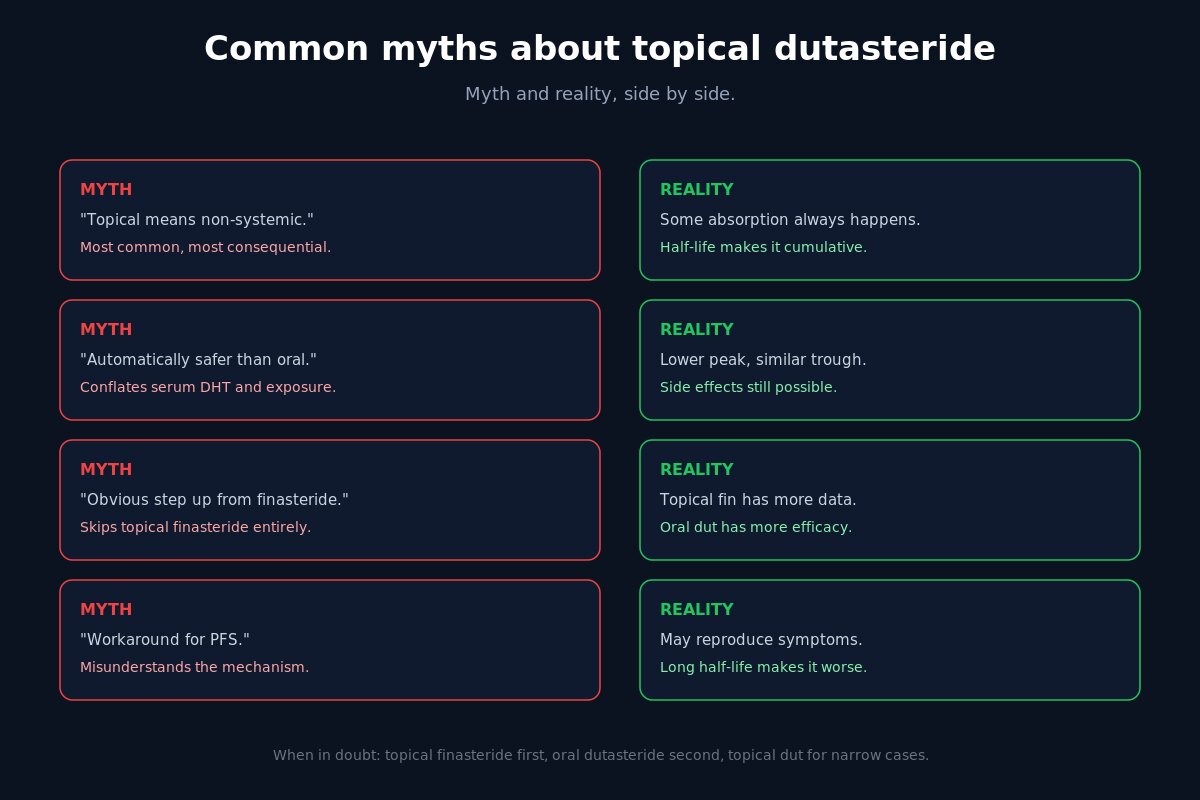
Common myths about topical dutasteride
The myth that topical means non-systemic is the most common and the most consequential. The myth that topical dutasteride is automatically safer than oral confuses serum DHT levels with systemic exposure – they are correlated but not identical. The myth that topical dutasteride is the obvious next step from oral finasteride ignores that topical finasteride has more data and that oral dutasteride has more efficacy. The myth that topical dutasteride is a workaround for post-finasteride syndrome misunderstands the mechanism: if a man developed PFS-like symptoms on oral finasteride, the topical dutasteride dose may produce enough systemic 5-AR inhibition to reproduce them, especially given the long half-life.
Frequently asked questions about topical dutasteride
Is topical dutasteride safer than oral dutasteride?
Probably somewhat lower systemic exposure, but the long half-life means cumulative exposure can approach oral levels with daily use. “Safer” depends on what you mean – if you mean lower peak serum DHT suppression at any given moment, probably yes. If you mean no systemic effects, no.
How much topical dutasteride is absorbed systemically?
The published data is limited. Estimates from small studies range widely depending on vehicle, concentration, and application volume. The honest answer is that there is no precise figure that applies to all formulations.
Can I switch from oral dutasteride to topical without losing the hair-loss benefit?
Possibly, but the data does not support a clean equivalence. Some men maintain hair count on the topical version. Others see a slow loss of benefit over months. There is no published trial that establishes the dose-response equivalence between oral and topical at the doses commonly compounded.
Why is topical finasteride more popular than topical dutasteride?
Better evidence base, shorter half-life that makes the “topical means lower systemic” logic actually hold, more standardized compounding practice, and lower cost. The popularity reflects the data, not the marketing.
Does topical dutasteride cause sexual side effects?
Yes, in some men. The systemic absorption is reduced relative to oral but not zero, and the long half-life means accumulated exposure builds over months. The side-effect profile is broadly similar to oral dutasteride but with lower frequency and severity in most reports. The published incidence numbers are unreliable because the underlying trials are too small.
How long does topical dutasteride take to work?
Same general timeline as other AR-axis interventions: 3 to 6 months for first visible effects, 9 to 12 months for stabilization. Hair-cycle physiology constrains the response timeline regardless of the route of administration.
Can I combine topical dutasteride with minoxidil?
Yes, the mechanisms are independent and additive. Most compounding pharmacies that write topical dutasteride also formulate it as a combination product with minoxidil. The combination is mechanistically sensible.
Is topical dutasteride a workaround for post-finasteride syndrome?
Probably not. PFS is poorly understood mechanistically, and the systemic 5-AR inhibition produced by topical dutasteride may reproduce the symptoms in susceptible men. The long half-life makes this risk worse than for topical finasteride. Men with prior PFS-like reactions should be very cautious about any 5-AR inhibitor regardless of route.
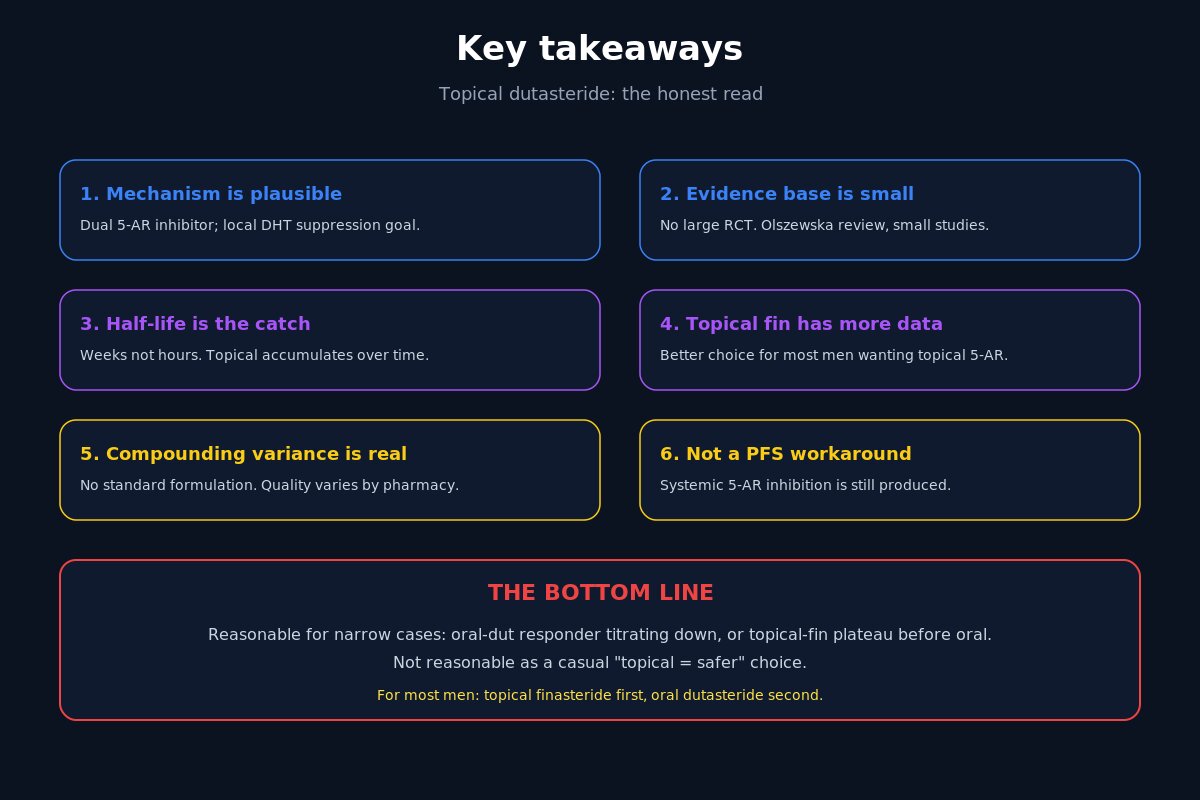
Bringing it together
Topical dutasteride is a legitimate option for a narrow set of cases – men who have responded to oral dutasteride and want to titrate down systemic exposure, or men who have plateaued on topical finasteride and want stronger local DHT blockade. For most other cases, topical finasteride is the better-evidenced first choice, and oral dutasteride is the better-evidenced step up. The half-life issue means topical dutasteride does not deliver the “topical equals safer” benefit as cleanly as men assume. The compounding-pharmacy environment means quality and dose vary across prescriptions in ways that are hard to compare. The honest case is much narrower than the marketing case.
About the author
Philippe Boissard
Author of Men’s Hairloss Protocol (2020), Better, Smarter, Stronger (2023), and Multi-Axis Body (2025). Researches and writes about hair loss and male physiology, citing primary literature and disclosing affiliate relationships in full. Not a medical doctor; all content is educational. More about Philippe.
Related reading
Get my free hair-loss protocol
The exact evidence-based routine I actually use and recommend: what works, in what order, with no hype. Enter your email on the next page and I’ll send it straight to you.
Send me the free protocol →