
The DHT Detox Supplement Myth: What Hair Vitamins Actually Do
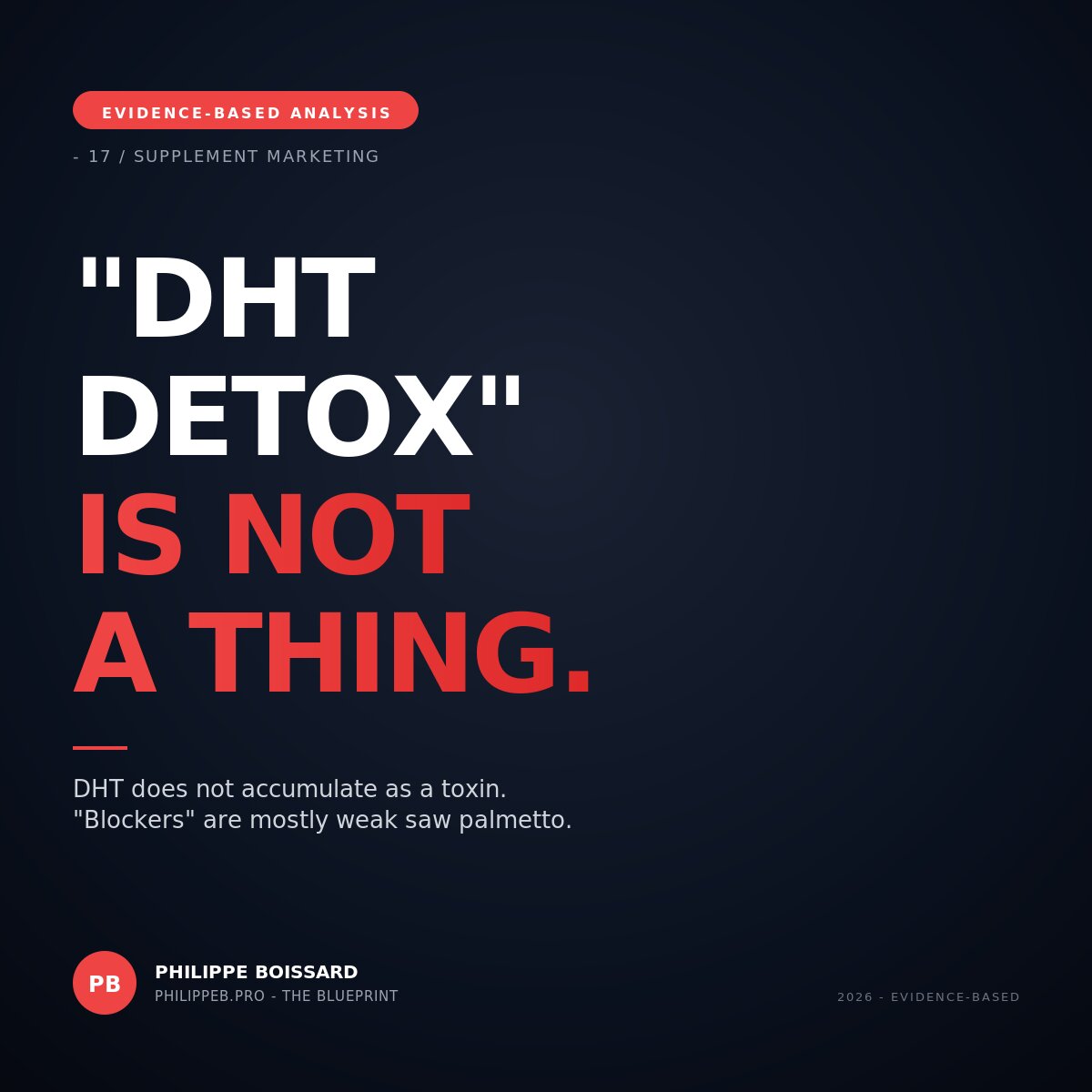
DHT detox is not a real biological process. The hair supplements selling that promise are mostly weak saw palmetto plus marketing ingredients. Here is what the labels actually contain and where these products fit.

Walk into any pharmacy or scroll any hair-loss subreddit and you will find them: bottles labeled “DHT Blocker,” “DHT Detox,” “Hair Vitality Complex.” The branding is consistent. The mechanism claims are vague. The active ingredients are usually some combination of saw palmetto, pumpkin seed oil, zinc, biotin, and a long tail of botanicals at homeopathic doses. The price is high relative to the molecular content. The marketing implies these capsules do something comparable to a real 5-alpha reductase inhibitor. They do not. This article is the honest read on what these supplements actually contain, what the evidence supports, and what the marketing is doing.
Quick answer: do DHT blocker supplements work?
Marginally, in some men, with effect sizes that are dwarfed by even the lowest dose of finasteride. The active ingredient that does the actual work in most of these formulas is saw palmetto, which has weak 5-alpha reductase inhibition supported by small clinical trials. The dose of saw palmetto in supplement products is often subtherapeutic. The other ingredients are mostly there for marketing reasons. Calling these supplements “DHT blockers” is technically defensible because saw palmetto blocks DHT a little. Calling them an alternative to finasteride is not.
What is actually in these supplements
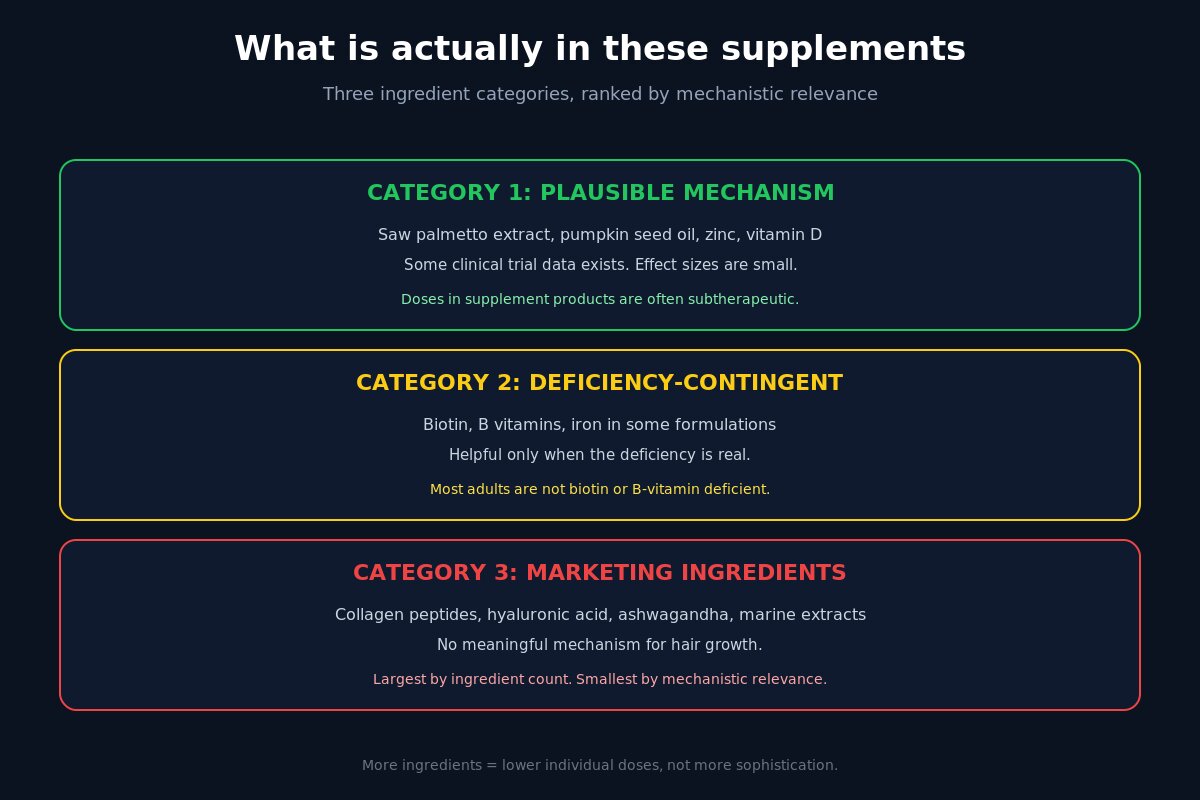
Open the label on any of the popular hair supplements – Nutrafol, Hims biotin gummies, Viviscal, Folexin, Provillus, the dozens of generic Amazon clones – and the active ingredients fall into three categories. First, ingredients with some plausible mechanistic basis: saw palmetto extract, pumpkin seed oil, zinc, vitamin D in some products. Second, ingredients that address rare deficiencies but do not affect men with adequate baseline status: biotin, B vitamins, iron in formulations that include it. Third, marketing ingredients with no meaningful mechanism for hair: collagen peptides, hyaluronic acid, ashwagandha, marine extracts, “proprietary blends” that hide doses.
The third category is the largest by ingredient count and the smallest by mechanistic relevance. The marketing logic is that more ingredients implies more sophistication. The pharmacological logic runs the opposite way: the more ingredients in a capsule, the lower the dose of any one of them, and the lower the chance any single ingredient reaches a therapeutic threshold.
The saw palmetto story
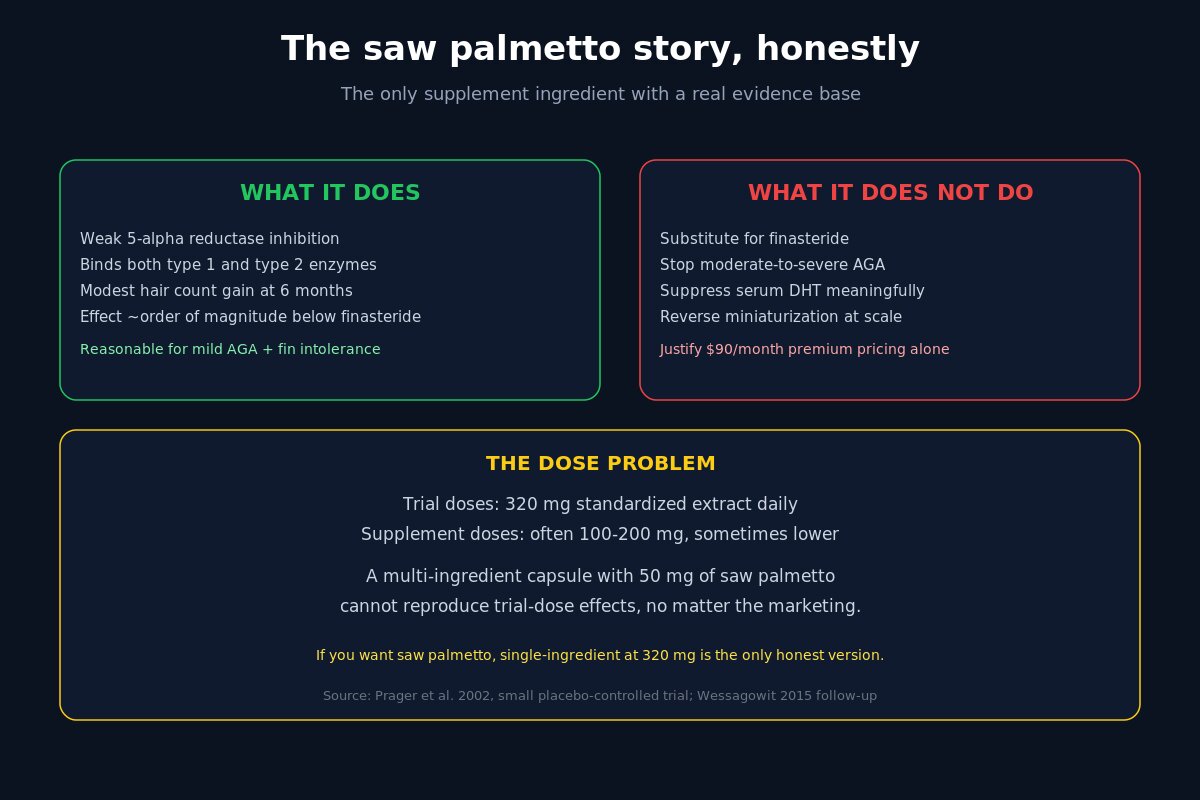
Saw palmetto extract is the only ingredient in most “DHT blocker” supplements with a plausible mechanism for hair. It is a weak 5-alpha reductase inhibitor with binding studies supporting both type 1 and type 2 enzyme inhibition at high concentrations. Small clinical trials including Prager et al. 2002 showed modest hair-count gains from oral saw palmetto over 6 months in men with mild AGA. The effect size in those trials is roughly an order of magnitude smaller than the effect size of finasteride.
Saw palmetto is reasonable as a finasteride-intolerant alternative for men with mild AGA. It is not a substitute for finasteride in men with moderate to severe AGA or in men whose AGA is progressing rapidly. The supplement industry has used the existence of saw palmetto trial data as cover for marketing claims about whole formulations whose actual saw palmetto dose is often below the doses used in those trials.
The biotin and zinc story
Biotin deficiency causes hair loss. Biotin sufficiency does not improve hair count. Most adults with normal diets have adequate biotin, and biotin supplementation in non-deficient people is mostly excreted unchanged. The reason biotin is in every hair supplement is that it is cheap, has a hair-related deficiency story, and supports a marketing claim. The reason high-dose biotin is occasionally a problem is that it interferes with several lab assays, including thyroid panels and troponin tests in cardiac emergencies.
Zinc has a similar story with one wrinkle. Zinc deficiency causes hair loss. Zinc supplementation in deficient people corrects it. Some zinc compounds inhibit 5-alpha reductase in vitro at high concentrations. Whether oral zinc supplementation produces meaningful 5-AR inhibition in vivo at typical supplement doses is unclear from the literature. Zinc is cheap, has a hair-related deficiency story, and supports a marketing claim about “blocking DHT” that is not entirely false but is not what the marketing suggests.
The proprietary blend problem
Many premium hair supplements list a “proprietary blend” with a total weight in milligrams or grams. The weight is the sum of all ingredients in the blend. The doses of individual ingredients are not disclosed. This labeling practice is legal under DSHEA. The practical consequence is that a 1500 mg blend that claims to contain “saw palmetto, pumpkin seed oil, ashwagandha, marine collagen, and 15 other ingredients” might contain 50 mg of saw palmetto and 1450 mg of cheaper filler, or the reverse. The customer cannot tell.
Brands that disclose individual doses are doing the customer a favor and usually have nothing to hide. Brands that hide behind proprietary blends are usually using the obscurity to conceal subtherapeutic doses of the headline ingredients. This is not always true. It is true often enough that proprietary blends should be treated as a yellow flag.
Watch this for context
This Hair Loss Compound Works Differently – frames why mechanism matters more than ingredient counts and why supplement marketing skips the dose conversation.
The effect size comparison
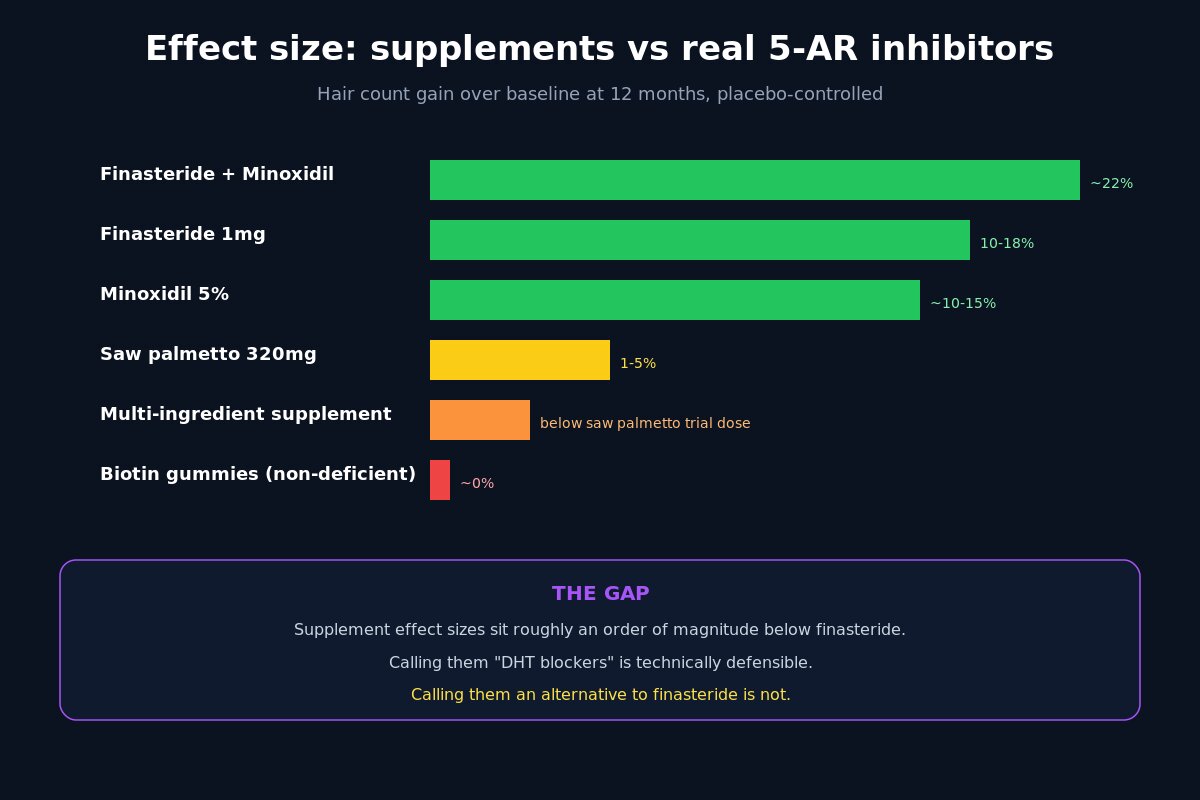
The most useful way to read a hair supplement label is to compare its expected effect size to alternatives. Finasteride 1 mg daily produces a hair-count gain in the range of 10 to 18 percent at 12 months versus baseline in placebo-controlled trials. Minoxidil 5 percent topical produces a similar range. Combined finasteride and minoxidil produce somewhat larger gains. Saw palmetto monotherapy at the doses used in clinical trials produces roughly 1 to 5 percent gain. Most “DHT blocker” supplements at typical retail doses are below the saw palmetto dose used in trials.
This is not a small difference. The supplement category as a whole sits at the low end of the saw palmetto effect range, which is itself an order of magnitude below finasteride. Calling these products “DHT blockers” while implying they are functionally comparable to a 5-AR inhibitor is the marketing problem.
The marketing framing problem
Hair loss is emotionally loaded. Men want a treatment that works. Men also want a treatment that does not require a prescription, does not have a sexual side effect risk, and feels safer than a “real drug.” The supplement industry sits in the middle of those wants. The marketing frames supplements as the natural alternative to finasteride. The framing is misleading. Finasteride is the drug with the largest evidence base. Saw palmetto is the supplement with the largest evidence base. The two are not in the same category of efficacy.
The framing problem extends to the implied risk profile. Supplements are described as “natural” and therefore safer. They are not regulated as drugs and therefore have less safety scrutiny. Adverse events from supplements exist – high-dose biotin interferes with lab tests, ashwagandha has hepatotoxicity case reports, saw palmetto has occasional GI side effects. The “supplement = safer than drug” framing collapses on closer inspection. The honest framing is “supplements have smaller effects and looser safety scrutiny,” which is a less marketable sentence.
Where supplements actually fit
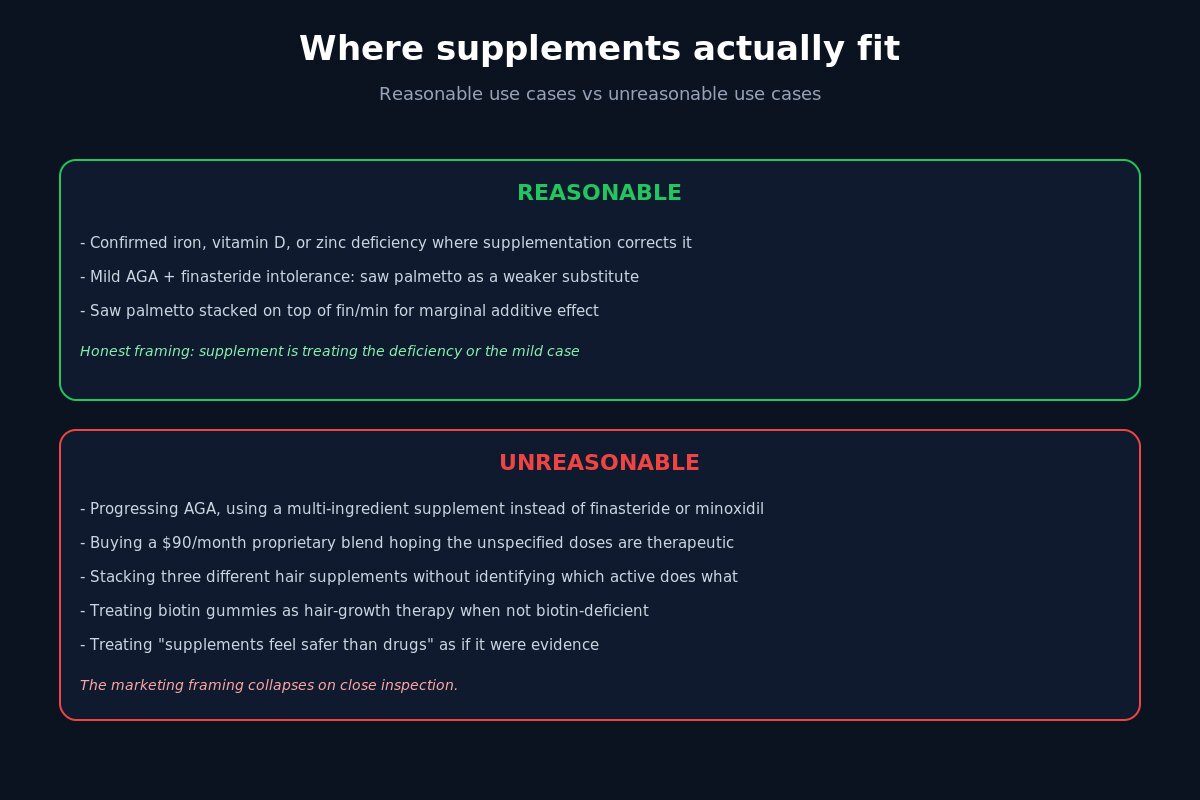
Reasonable use case 1: a man with confirmed iron, vitamin D, or zinc deficiency where supplementation corrects the deficiency. The hair improvement here is real because the deficiency was real. The supplement is treating the deficiency, not the AGA. Reasonable use case 2: a man with mild AGA who has tried finasteride and tolerated it poorly, who wants saw palmetto as a weaker substitute and accepts the smaller effect size. Reasonable use case 3: a man stacking saw palmetto on top of finasteride and minoxidil for a marginal additive effect, accepting the marginal benefit at marginal cost.
Unreasonable use case 1: a man with progressing AGA using a multi-ingredient hair supplement instead of finasteride or minoxidil because the supplement felt safer. Unreasonable use case 2: a man buying a $90/month proprietary blend hoping the unspecified doses are therapeutic. Unreasonable use case 3: a man stacking three different hair supplements on top of each other without identifying which active ingredient is doing what.
How to read a hair supplement label
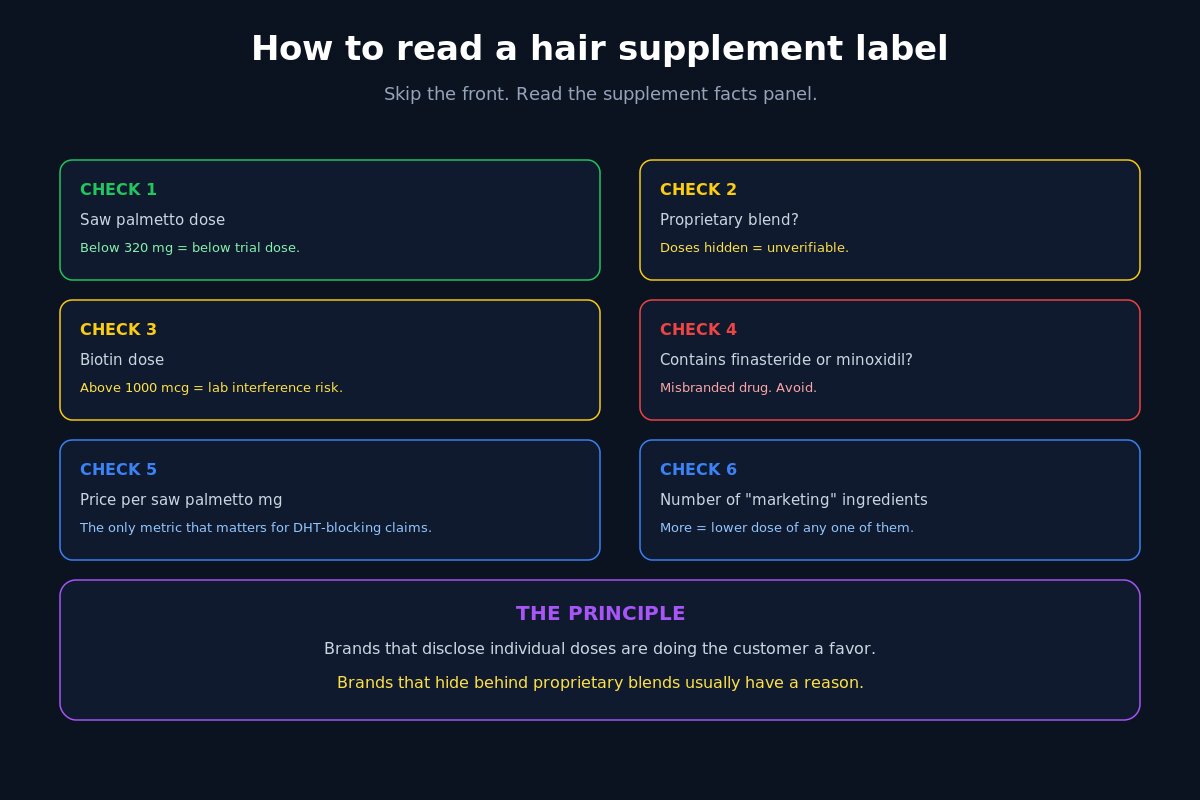
Skip the front of the bottle. Read the supplement facts panel. Identify the saw palmetto dose; if it is below 320 mg of standardized extract, the supplement is below the dose used in trials. Identify whether ingredient doses are individually listed or hidden in a proprietary blend; if hidden, treat the dose claims as unverifiable. Identify the biotin dose; if it is above 1000 mcg, you are paying for excretion and risking lab interference. Identify whether the supplement contains finasteride or minoxidil; if it does, it is a misbranded drug, which is a separate problem. Identify the price per saw palmetto milligram; this is the metric that actually matters for any DHT-blocking claim.
Common myths about DHT blocker supplements
The myth that “natural DHT blockers” approach finasteride efficacy is false; the effect size gap is roughly an order of magnitude. The myth that supplements have no side effects is false; the side-effect database is just less developed. The myth that more ingredients means a more sophisticated formula is wrong in the opposite direction; more ingredients usually means lower individual doses. The myth that biotin grows hair in non-deficient people is unsupported; biotin only matters when biotin is deficient. The myth that “DHT detox” is a meaningful biological concept is the most marketing-driven of all; DHT does not accumulate as a toxin to be detoxified, and the framing borrows from the broader supplement-marketing tradition that misuses “detox” generally.
Frequently asked questions about DHT blocker supplements
Are DHT blocker supplements as effective as finasteride?
No. The effect size gap is roughly an order of magnitude. Saw palmetto, the supplement ingredient with the largest evidence base, produces hair count gains in the 1-5% range vs finasteride’s 10-18% in placebo-controlled trials.
Does biotin grow hair?
Only in biotin-deficient people. Most adults with normal diets are not biotin deficient. High-dose biotin is mostly excreted unchanged and can interfere with several lab tests including thyroid and troponin assays.
Are proprietary blends a red flag?
A yellow flag rather than a red one. Some legitimate brands use them. But the practice allows manufacturers to hide subtherapeutic doses of headline ingredients behind cheaper filler, and brands that disclose individual doses are doing the customer a favor.
Should I take a hair supplement on top of finasteride?
The marginal benefit is small. If you have confirmed deficiencies in iron, vitamin D, or zinc, address those specifically. Otherwise the math on most multi-ingredient supplements does not justify the cost.
Is “DHT detox” a real concept?
No. DHT does not accumulate as a toxin in the body. Detoxification is not the relevant biological process. The framing is borrowed from the broader supplement-marketing tradition that misuses the word “detox” for any product that wants to imply purification.
What about pumpkin seed oil for hair?
One small clinical trial (Cho et al. 2014) showed modest hair count improvement over 24 weeks. The result has not been replicated at scale. Reasonable as part of a stack but not as a primary therapy.
Is Nutrafol better than other hair supplements?
Nutrafol has more visible marketing but the underlying ingredient panel is similar to other premium hair supplements: saw palmetto, ashwagandha, biotin, pumpkin seed oil, marine collagen. The published trial data on the specific Nutrafol formulation is limited and industry-funded. The price-per-saw-palmetto-milligram is high.
Are any hair supplements worth taking?
Single-ingredient saw palmetto at standardized 320 mg doses is the supplement most likely to do something measurable. Vitamin D, iron, and zinc are worth taking only if you are deficient. Multi-ingredient “hair vitality” formulas are mostly marketing.
Bringing it together
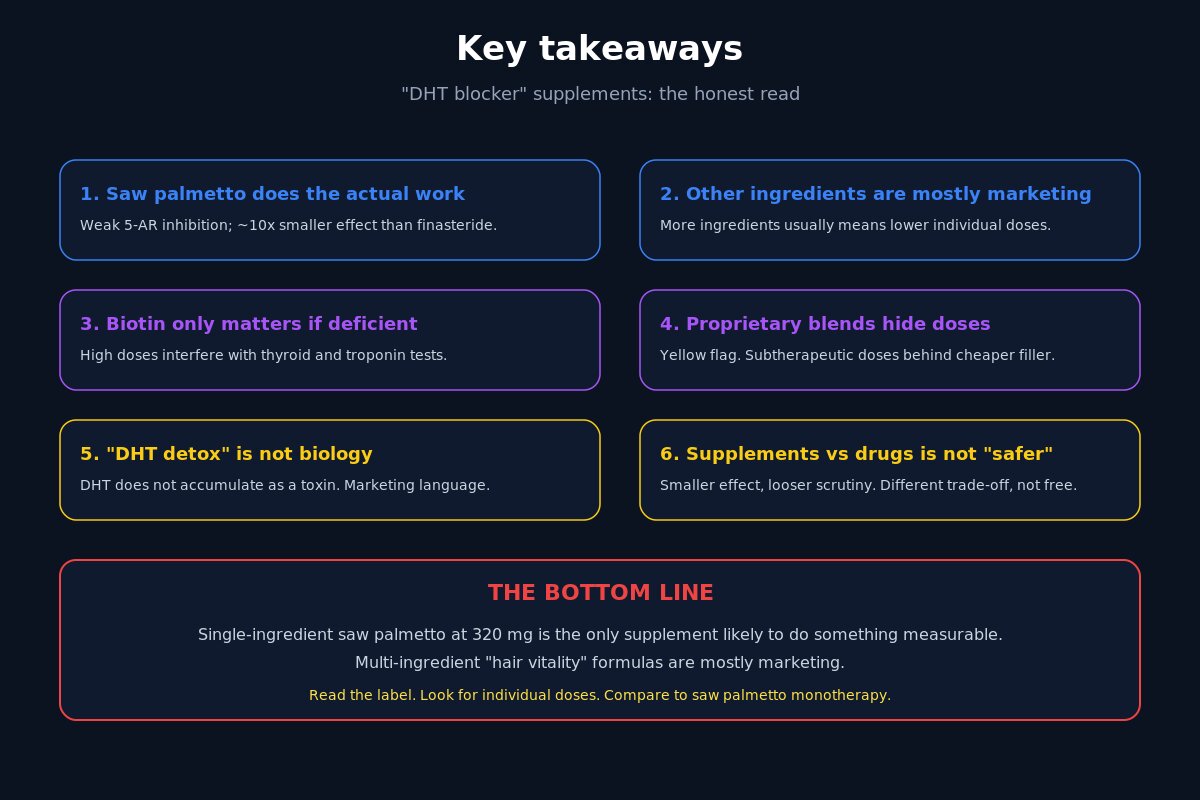
DHT blocker supplements are a category that exists because hair loss is emotionally loaded, finasteride feels scary, and supplements can be sold without prescriptions. The active ingredient doing the actual work in most of these products is saw palmetto, which is a weak 5-alpha reductase inhibitor with modest evidence behind it. The other ingredients are mostly marketing. The effect size gap between supplements and real 5-AR inhibitors is large enough that the products should be treated as different categories of intervention. The supplements have a place – mild AGA, finasteride intolerance, confirmed deficiency correction – but it is a smaller place than the marketing implies. Read the label. Look for individual doses. Compare to saw palmetto monotherapy. The honest read of the category is “weak option for narrow cases, not a finasteride substitute.”
About the author
Philippe Boissard
Author of Men’s Hairloss Protocol (2020), Better, Smarter, Stronger (2023), and Multi-Axis Body (2025). Researches and writes about hair loss and male physiology, citing primary literature and disclosing affiliate relationships in full. Not a medical doctor; all content is educational. More about Philippe.
Related reading
Get my free hair-loss protocol
The exact evidence-based routine I actually use and recommend: what works, in what order, with no hype. Enter your email on the next page and I’ll send it straight to you.
Send me the free protocol →
[…] The DHT Detox Supplement Myth: What Hair Vitamins Actually Do […]
[…] The DHT Detox Supplement Myth: What Hair Vitamins Actually Do […]
[…] The DHT Detox Supplement Myth: What Hair Vitamins Actually Do […]
[…] The DHT Detox Supplement Myth: What Hair Vitamins Actually Do […]