
TRT and Hair Loss: How to Run Both Without Wrecking Your Hairline
TRT does not cause hair loss in non-predisposed men. It accelerates AGA in men who carry the predisposition. The trade-off is real, the management is well-defined, and the men who lose the most are the ones who treated the math as an afterthought.

Testosterone replacement therapy (TRT) accelerates androgenetic alopecia in men predisposed to it. That is not the same as “TRT causes hair loss.” It is closer to “TRT increases the substrate that AGA was already going to use against you, and it does so on a timeline most men underestimate.” The trade-off is real, the management is well-defined, and the people who lose the most hair on TRT are usually the ones who treated the hair-loss math as an afterthought.
Quick answer: does TRT cause hair loss?
TRT does not cause hair loss in men with no genetic predisposition. It does accelerate androgenetic alopecia in men who carry the predisposition, by raising serum testosterone (the substrate) and consequently raising scalp DHT (the active driver of follicular miniaturization). Page et al. 2008 documented that exogenous testosterone produces dose-dependent increases in serum DHT, with magnitude depending on baseline 5-alpha reductase activity. Translated: if you were going to have AGA anyway, TRT brings the timeline forward. If you were not, it usually does not start the process.
The decision is not whether to take TRT or keep your hair. The decision is how to run both at once. The mechanism that connects them is laid out in detail in how hair loss actually works. The countermeasures are the standard AGA toolkit, scaled and timed to the TRT protocol.
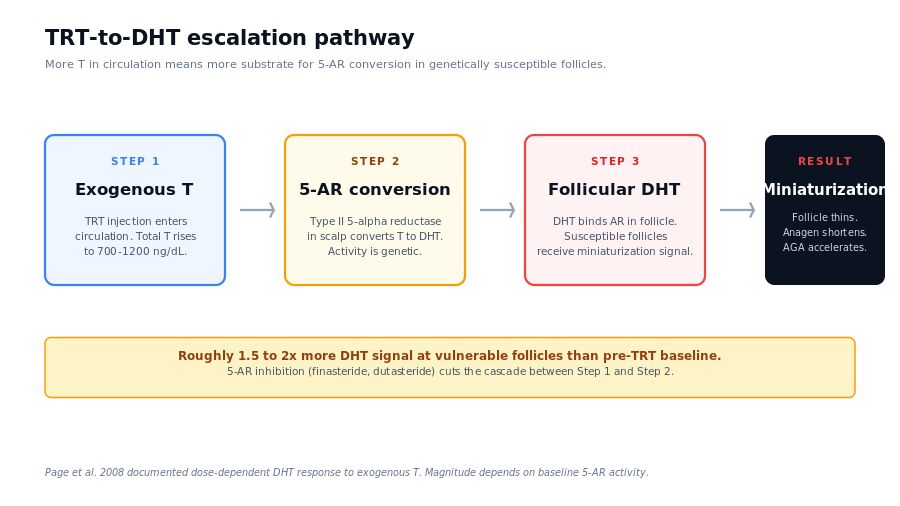
The T-to-DHT escalation pathway
Exogenous testosterone enters circulation, binds to androgen receptors directly in some tissues, and is converted to DHT by 5-alpha reductase in others. Scalp follicles in genetically susceptible men are AR-rich and 5-AR-rich. The escalation chain is short: more T in circulation means more DHT in scalp tissue means more miniaturization signal at vulnerable follicles.
- Total T baseline (untreated): typically 300-1000 ng/dL in adult men. Men starting TRT often have levels in the 200-400 ng/dL range.
- Total T on TRT (steady state): commonly 700-1200 ng/dL depending on protocol. Mid-cycle peaks higher with longer-ester injections.
- DHT response: typically rises in proportion to T. Men with high 5-AR activity see disproportionate DHT increases. Men with low 5-AR activity see modest ones.
- Scalp tissue DHT: not the same as serum DHT. Local follicular DHT is the variable that drives miniaturization. Serum DHT is a proxy, not a perfect one.
The practical consequence: an AGA-prone man on standard TRT is exposing his follicles to roughly 1.5 to 2x the DHT signal he had pre-TRT. The timeline of miniaturization compresses accordingly.
The actual numbers: how much DHT increase to expect
Numbers from clinical practice and published TRT pharmacokinetic studies:
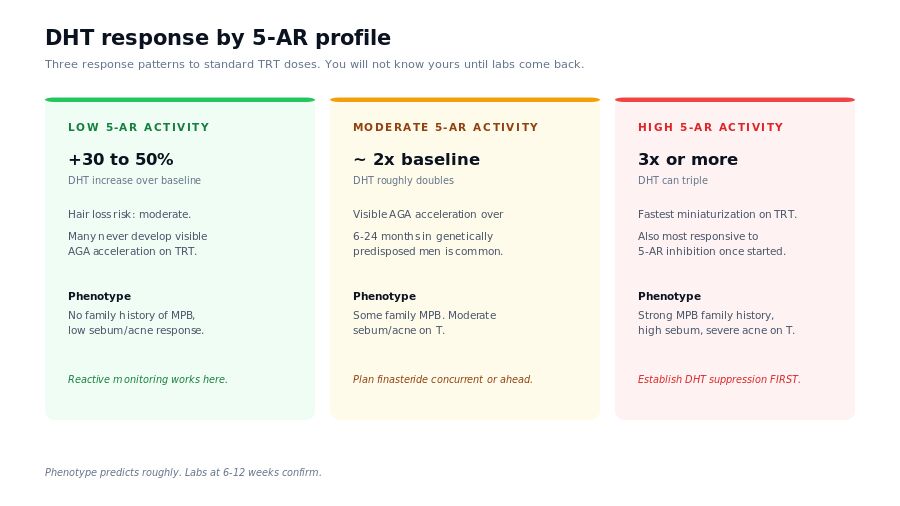
- Men with low baseline 5-AR activity: serum DHT rises roughly 30-50 percent over baseline on standard TRT doses. Hair loss risk is moderate. Many never develop visible AGA acceleration.
- Men with moderate 5-AR activity: serum DHT roughly doubles. Visible hair loss acceleration over 6-24 months in genetically predisposed men is common.
- Men with high baseline 5-AR activity: serum DHT can triple. These men experience the fastest miniaturization timelines on TRT and also tend to be the most responsive to 5-AR inhibition once it is started.
You will not know your category until you start TRT and check, but you can predict it imperfectly: family history of early MPB, oily skin and acne acceleration on T, and rapid recession in the first 3-6 months are all signals of high 5-AR activity. If you have all three, plan the AGA management before starting TRT, not after.
Who is most at risk on TRT
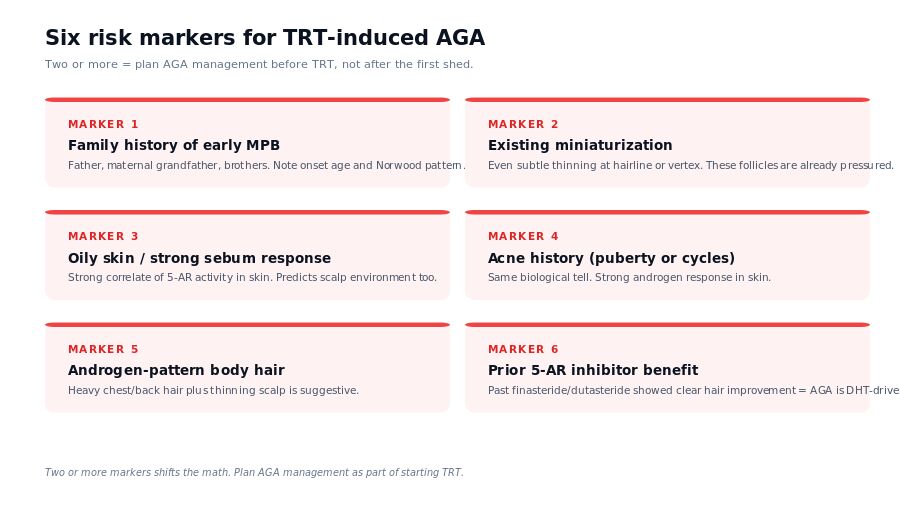
Predicting AGA acceleration on TRT is part genetics, part observable phenotype. The risk-stratification questions a clinician would ask:
- Family history of early male pattern baldness. Father, maternal grandfather, brothers. Specific Norwood patterns and onset ages.
- Existing miniaturization at the hairline or vertex. Even subtle. The follicles already in trouble are the ones TRT will pressure first.
- Oily skin, sebum response to androgens. Strong correlate of 5-AR activity in skin. Predicts how the scalp environment will respond too.
- Acne history during puberty or on prior cycles. Same biological tell.
- Body hair pattern. Heavy body hair is not a reliable predictor by itself but extreme androgen-pattern hair growth (deep chest, dense back) plus thinning scalp is suggestive.
- Prior response to oral finasteride or dutasteride. If you previously took 5-AR inhibitors and saw clear hair improvement, your AGA was DHT-driven and TRT will pressure that pathway.
The countermeasure stack: what actually works on TRT
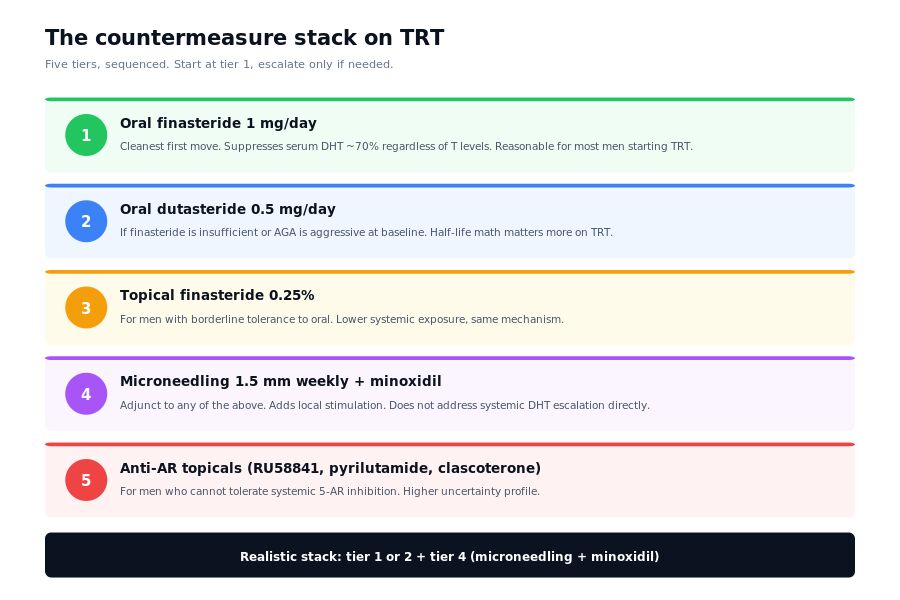
The treatment toolkit is the standard AGA toolkit, with sequencing adjusted for the TRT context. The tiers most clinicians work through:
- Tier 1: oral finasteride 1 mg/day. The cleanest first move. Suppresses serum DHT roughly 70 percent regardless of T levels. Works against the substrate increase TRT creates. Reasonable for most men starting or already on TRT who want to preserve.
- Tier 2: oral dutasteride 0.5 mg/day. If finasteride is insufficient or if the AGA presentation is aggressive at baseline. The full case for switching is in the dutasteride article. The half-life math is more important on TRT because washout takes longer if anything goes wrong.
- Tier 3: topical finasteride 0.25 percent. For men with borderline tolerance to oral. Lower systemic exposure but the same mechanism. Not a workaround if oral fin caused clear side effects that resolved on stopping.
- Microneedling 1.5 mm weekly + minoxidil. Adjunct to any of the above. Adds local follicular stimulation and topical delivery enhancement. Does not address the systemic DHT escalation but adds upside on top of 5-AR inhibition.
- Anti-AR topicals (RU58841, pyrilutamide, clascoterone). For men who cannot tolerate systemic 5-AR inhibition or who want additional local pressure. Higher uncertainty profile than the oral 5-AR inhibitors.
The realistic stack for a TRT-on man with active or anticipated AGA is oral finasteride or dutasteride plus microneedling plus topical minoxidil. The decision logic for choosing finasteride vs dutasteride applies as covered in why finasteride fails some men.
Timing and dosing: when to start what
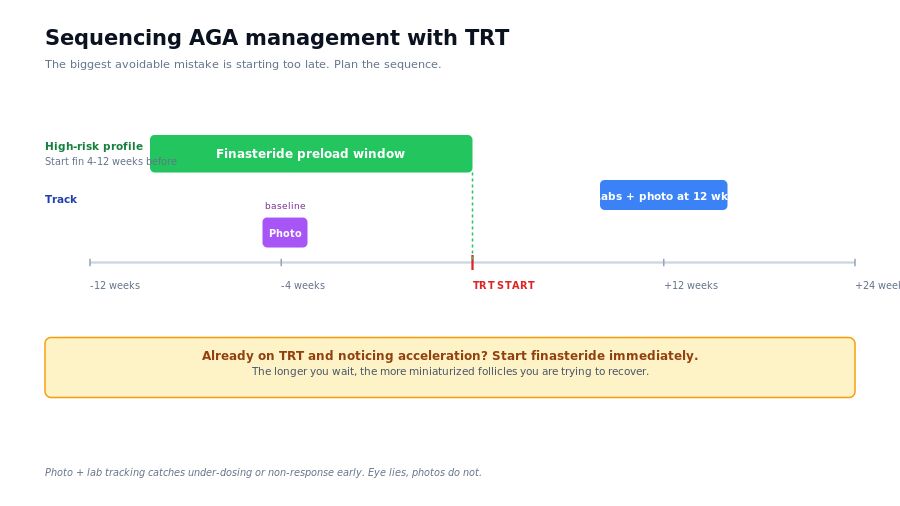
The biggest avoidable mistake is starting AGA treatment after the first major shed instead of before. Plan the sequence:
- If you have multiple risk markers, start finasteride 4-12 weeks before TRT. This gets serum DHT suppression established before T elevates. The transition is smoother. Hair count baseline is also documented before any TRT-induced changes.
- If you are already on TRT and starting to notice acceleration, start finasteride immediately. The longer you wait, the more miniaturized follicles you are trying to recover.
- Track scalp DHT or serum DHT at baseline and at 12 weeks. Lab confirmation of suppression catches under-dosing or non-response early.
- Photo protocol at 0, 12, 24, 52 weeks. Standardized lighting, angle, hair preparation. The eye lies. Photos do not.
- If switching from finasteride to dutasteride, allow 4-8 weeks for the new steady state to establish before judging. Dutasteride has a 4-5 week half-life; the full effect lags.
The “TRT will wreck my hair” reality vs hype
The internet TRT discourse has two failure modes: men who treat TRT as harmless to hair, and men who refuse TRT because they think it inevitably destroys hair. Both are wrong.
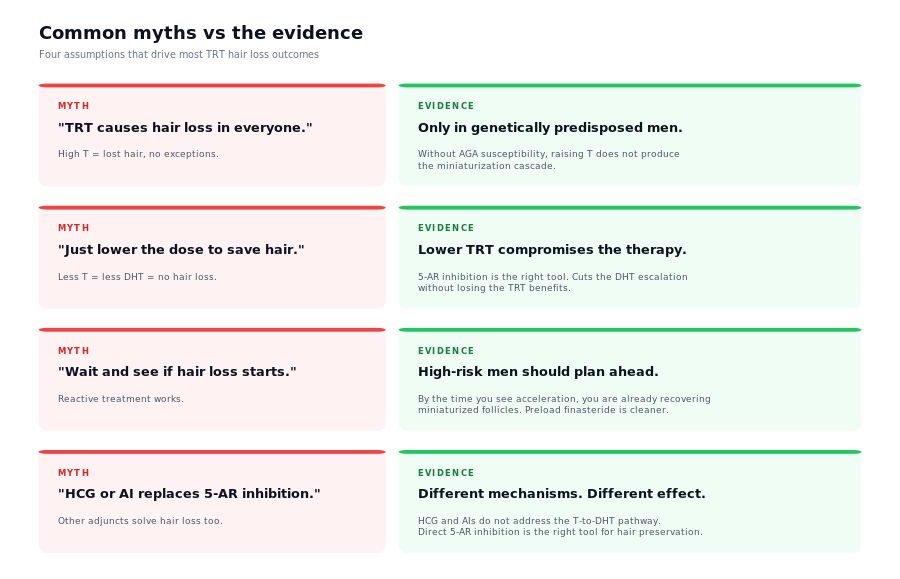
- TRT does not cause AGA in non-predisposed men. Without the genetic susceptibility, raising T does not produce the miniaturization cascade. This is the single most-misunderstood point.
- TRT does accelerate AGA in predisposed men. The timeline compresses, sometimes dramatically. Six to twenty-four months is a typical window for visible change in high-risk men starting TRT without 5-AR inhibition.
- 5-AR inhibition is highly effective at neutralizing the TRT effect on scalp DHT. Finasteride at 1 mg or dutasteride at 0.5 mg suppresses serum DHT enough to absorb the TRT-induced substrate increase in most men. Hair count outcomes on TRT + 5-AR inhibitor are often similar to non-TRT baseline.
- The men who lose the most hair on TRT are the ones who do nothing. The countermeasures work. The trade-off is manageable. The catastrophic stories almost always have “I just started TRT and decided to see what happens” in them somewhere.
The decision framework
Translating the data into a decision rule:
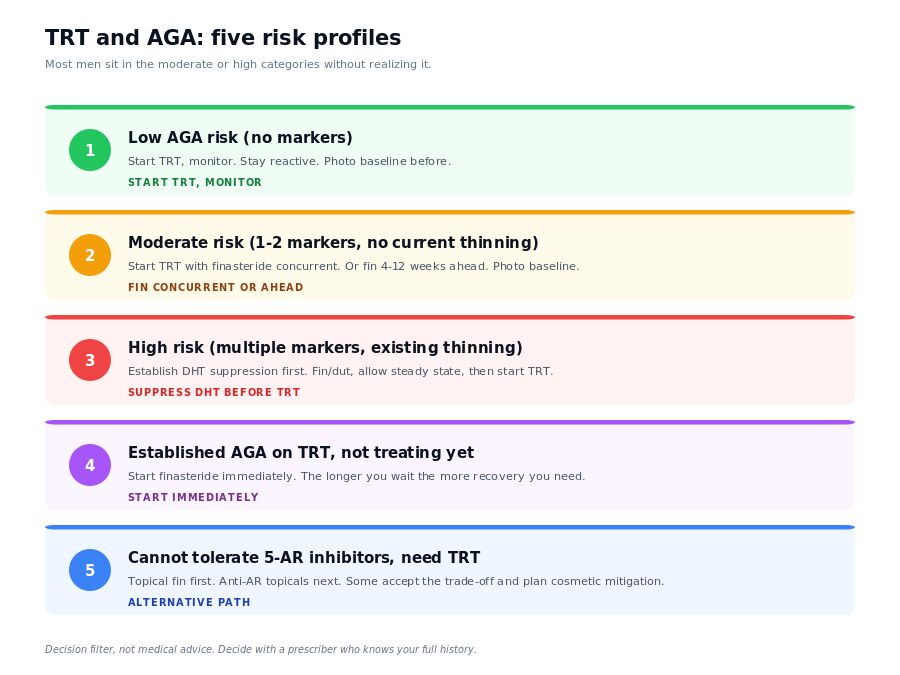
- Low AGA risk (no family history, no existing thinning, low sebum response). Start TRT, monitor. AGA risk is low and you can stay reactive.
- Moderate AGA risk (one or two markers, no current thinning). Start TRT with finasteride concurrent, or finasteride 4-12 weeks ahead. Photo baseline.
- High AGA risk (multiple markers, existing thinning). Establish DHT suppression before starting TRT. Start finasteride or dutasteride first, allow steady state, then begin TRT. Set up photo protocol and lab tracking.
- Established AGA on TRT, not treating yet. Start finasteride immediately. The longer you wait the more miniaturized follicles you are recovering. The full failure-mode analysis in why your hair loss protocol isn’t working covers the trap of “I will deal with it later.”
- Cannot tolerate 5-AR inhibitors and need TRT. Topical finasteride is a partial answer; anti-AR topicals are the next tier. The neutral coverage of post-finasteride syndrome is the most relevant background. Some men in this position end up choosing TRT and accepting accelerated hair loss as the trade-off, with cosmetic mitigation (transplant, pieces, shaved styles) downstream.
Why this video is relevant: this is the personal protocol walk-through that pairs directly with the framework above. The article lays out the mechanism, risk profile, and tier-based countermeasure stack. The video shows what running it actually looks like over time, which dosages and adjuncts are part of the day-to-day, and which questions you should be asking your prescriber. If you are between tier 1 and tier 2 in the stack and trying to decide what your next move is, watch this first.
Common myths about TRT and hair loss
Frequently asked questions about TRT and hair loss
Will TRT make me lose my hair?
Only if you are genetically predisposed to androgenetic alopecia. TRT does not initiate hair loss in non-predisposed men. In predisposed men it accelerates the timeline, sometimes dramatically. The countermeasures (oral or topical 5-AR inhibitors, microneedling, minoxidil) are highly effective at offsetting the TRT-induced DHT escalation.
Should I start finasteride before TRT?
If you have multiple AGA risk markers, yes. Starting 4-12 weeks before TRT establishes DHT suppression at steady state, smooths the transition, and gives you a clean photo baseline. If risk is low you can monitor and start reactively if you see acceleration.
How fast does hair loss start on TRT?
Variable. Men with high baseline 5-AR activity can see visible miniaturization in 3-6 months. Lower-risk men may go a year or more before noticing changes, if they notice at all. Photo tracking detects changes before the eye does.
Does dutasteride work better than finasteride on TRT?
For men whose AGA on TRT is aggressive or finasteride-resistant, yes. Dutasteride suppresses serum DHT roughly 90 percent versus 70 percent for finasteride and hits both 5-AR isoenzymes. The trade-off is the longer half-life, which matters more when stacked with TRT pharmacokinetics.
Can topical finasteride alone protect my hair on TRT?
Topical 0.25 percent suppresses serum DHT roughly 50 percent versus 70 percent for oral. Whether that is sufficient depends on your TRT dose and 5-AR activity. For high-risk profiles, oral finasteride is more reliable. Topical is a reasonable second-line option for men with borderline oral tolerance.
Does TRT timing within the week affect hair loss?
Probably negligibly. Long-ester injections produce relatively stable T levels with mild peak-trough variation. The cumulative steady-state T exposure is what drives DHT, not the day-of-week timing.
What about HCG, gonadorelin, or aromatase inhibitors?
HCG and gonadorelin support endogenous testicular function but contribute to overall T (and therefore DHT). Aromatase inhibitors lower estradiol and shift T balance, with mixed effects on hair-relevant pathways. None of these substitutes for direct 5-AR inhibition if hair preservation is the goal.
If I stop TRT will my hair come back?
Partially. Follicles that have not yet fully miniaturized may recover toward baseline once DHT signaling drops. Fully miniaturized follicles will not return without active treatment. The earlier you start protective treatment, the more salvageable hair you have if TRT later changes.
Bringing it together
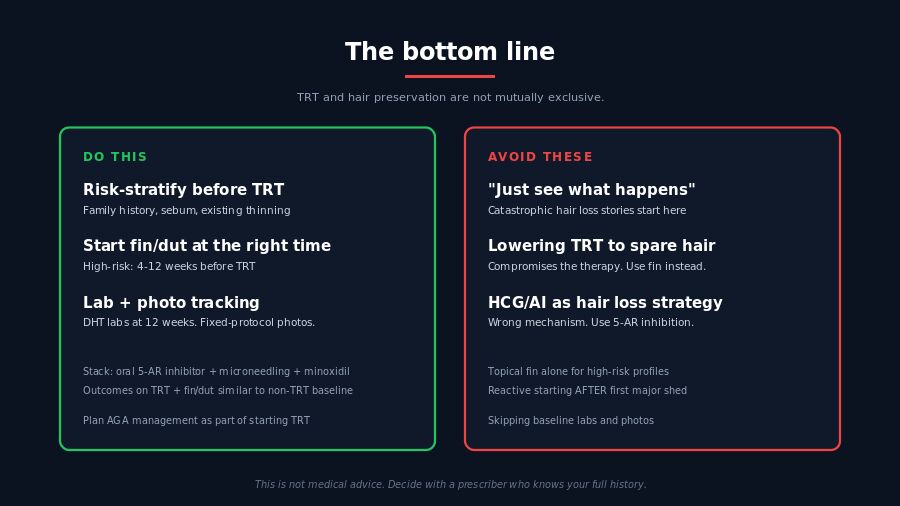
TRT and hair preservation are not mutually exclusive. They require alignment of two protocols that interact at the DHT pathway. The men who keep their hair on TRT are the ones who treated AGA management as part of starting TRT, not as a problem to deal with after the first shed. The countermeasures are well-defined: 5-AR inhibition (oral finasteride or dutasteride), enhanced where useful by topical finasteride, microneedling, and minoxidil. Sequencing matters more than completeness. Lab tracking and photo protocols catch problems early.
If you are still working out the foundation, the pillar guide on how hair loss actually works covers the DHT pathway. The deep dive on why finasteride fails some men covers the failure modes that apply regardless of TRT context. The neutral coverage of post-finasteride syndrome is the most relevant background if 5-AR tolerance is a concern. And if you are stacking interventions, why your hair loss protocol isn’t working covers the seven failure modes most men miss.
This article is not medical advice. It is a synthesis of clinical pharmacology and peer-reviewed literature aimed at informing your conversation with a qualified prescriber. TRT and 5-AR inhibitor decisions should be made with a clinician who can evaluate your full medical history, contraindications, and individual risk profile. See the full disclaimer.
Related reading
About the author
Philippe Boissard
Author of Men’s Hairloss Protocol (2020), Better, Smarter, Stronger (2023), and Multi-Axis Body (2025). Researches and writes about hair loss and male physiology, citing primary literature and disclosing affiliate relationships in full. Not a medical doctor; all content is educational. More about Philippe.
Get my free hair-loss protocol
The exact evidence-based routine I actually use and recommend: what works, in what order, with no hype. Enter your email on the next page and I’ll send it straight to you.
Send me the free protocol →