
Post-Finasteride Syndrome: What the Evidence Actually Shows

Post-Finasteride Syndrome (PFS) is one of the most polarized topics in men’s health. This article does not take a position on whether PFS is best characterized as a discrete syndrome, a heterogeneous symptom cluster, or something in between. The goal is to lay out what the peer-reviewed literature documents, what regulators have done, what patient communities report, and where mainstream dermatology and reviewers remain skeptical – so you can make a more informed decision about finasteride if you are considering it, or about next steps if you are already affected.
Quick answer: what is Post-Finasteride Syndrome?
Post-Finasteride Syndrome is a term used to describe a cluster of sexual, neurological, and physical symptoms reported by some men after stopping finasteride – the FDA-approved 5-alpha reductase inhibitor used to treat male pattern baldness and benign prostatic hyperplasia. The defining feature, as described in patient reports and case-series literature, is that the symptoms persist after the drug has been discontinued and cleared from the body. The most commonly reported symptoms are persistent erectile dysfunction, reduced libido, depressive or anxious mood states, and cognitive issues sometimes described as “brain fog.”
Whether PFS is a single causal entity, a collection of related but distinct conditions, or in some cases the surfacing of pre-existing vulnerabilities, is currently contested in the medical literature. What is not contested is that some users describe persistent symptoms after stopping the drug, that regulators in multiple jurisdictions have updated finasteride labeling to reflect possible persistent side effects, and that quality of life for affected individuals can be significantly impaired. The rest of this article walks through each piece of that picture in turn.
Brief history: how the term emerged
Finasteride was approved by the FDA in 1992 for benign prostatic hyperplasia (Proscar, 5 mg) and in 1997 for male pattern baldness (Propecia, 1 mg). The original Phase 3 trials acknowledged sexual side effects in a minority of users, but framed them as reversible upon discontinuation. Through the early 2000s, individual case reports and online communities began describing symptoms that did not resolve after stopping the drug.
The term “Post-Finasteride Syndrome” entered broader use following work by Michael Irwig and colleagues, who published a series of case reports in 2011 and 2012 describing persistent sexual dysfunction in young, otherwise-healthy men who had taken finasteride for hair loss. In 2012, the FDA updated the Propecia label to acknowledge reports of persistent erectile dysfunction continuing after discontinuation. Other regulators – including the UK MHRA and Health Canada – subsequently issued similar advisories. The PFS Foundation, a patient-led nonprofit, was established to fund research and advocacy.
From there, the literature expanded – both supportive and skeptical. Today PFS sits in a recognizable but unresolved place in the medical landscape: regulators acknowledge possible persistent effects in their labeling, multiple peer-reviewed papers document real symptoms in real patients, and at the same time the dermatology and urology communities remain divided on prevalence, mechanism, and even whether PFS is best classified as a single syndrome.
The reported symptom clusters
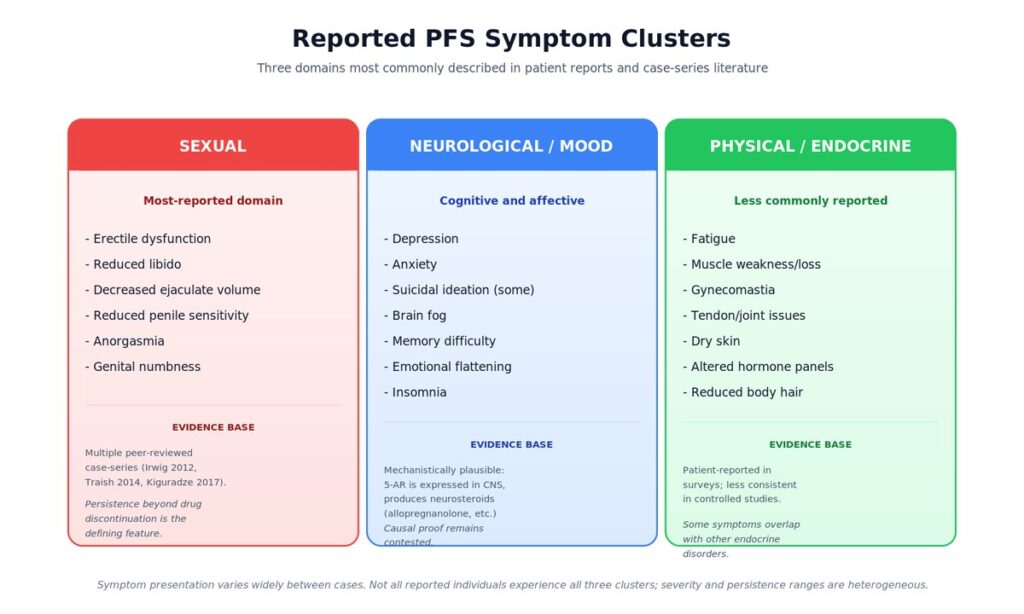
Reports of PFS symptoms cluster into three broad domains. Not every individual reports symptoms in all three, and severity varies widely.
Sexual symptoms
The most consistently reported and most studied cluster. Documented in the case-series literature includes erectile dysfunction, reduced libido, decreased ejaculate volume, reduced penile sensitivity, anorgasmia, and genital numbness. Irwig’s 2012 paper in the Journal of Sexual Medicine described 71 men aged 21 to 46 with persistent sexual side effects continuing for 40 months on average after discontinuation. Larger registry analyses have followed, including Kiguradze et al. (2017), which reported a higher rate of persistent erectile dysfunction associated with 5-alpha reductase inhibitor exposure compared to non-users in a large pharmacy database.
Neurological and mood symptoms
The second cluster. Reports include depression, anxiety, suicidal ideation in some severe cases, brain fog, memory difficulty, emotional flattening, and insomnia. The mechanistic argument here rests on the observation that 5-alpha reductase is expressed in the central nervous system, where it produces neurosteroids – allopregnanolone, dihydroprogesterone, and others – that modulate GABAergic signaling and influence mood, sleep, and cognition. CSF biomarker work by Melcangi and colleagues has shown altered neurosteroid profiles in some PFS patients. The causal link from those biomarker shifts to specific symptoms remains an active area of research.
Physical and endocrine symptoms
The third cluster, less commonly emphasized but consistently present in patient surveys. Reports include persistent fatigue, muscle weakness or muscle loss, gynecomastia, tendon and joint complaints, dry skin, altered hormone panels (including total and free testosterone, SHBG, and gonadotropins), and reduced body hair. These symptoms overlap substantially with several other endocrine and metabolic conditions, which is one reason this cluster is harder to attribute confidently to PFS specifically without thorough work-up.
Where the evidence stands: documented vs contested
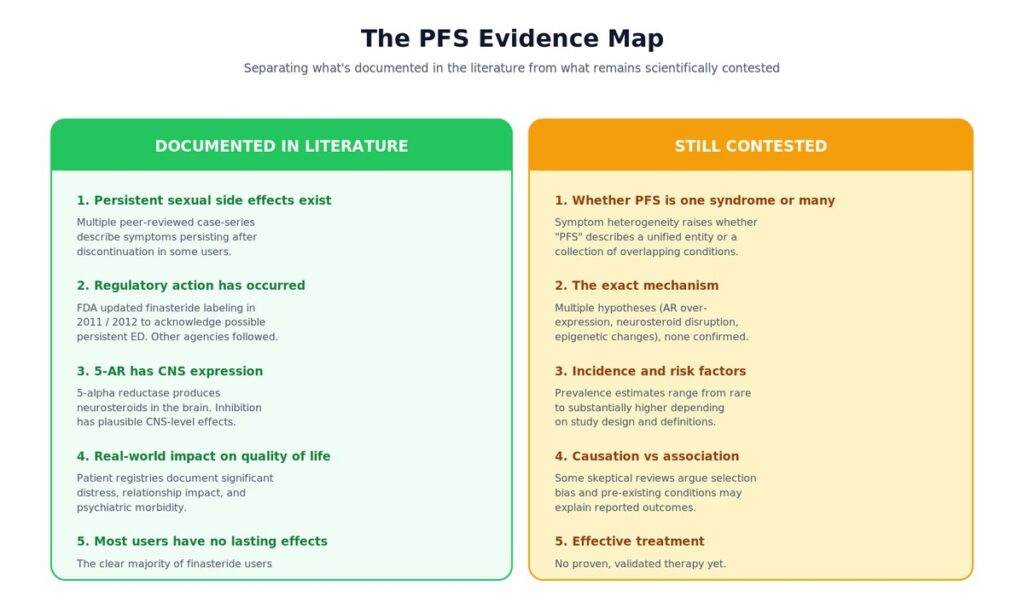
The most useful way to navigate the PFS literature is to separate what is well-documented from what remains contested. Both lists are real – and being honest about both is what allows for a balanced view.
What is documented
Multiple peer-reviewed case-series describe symptoms persisting after finasteride discontinuation in some users. Regulatory agencies in the United States, the United Kingdom, Italy, Sweden, Canada, and elsewhere have updated finasteride product labeling to reference reports of persistent sexual or neurological side effects. The mechanistic plausibility for CNS effects is supported by the known role of 5-alpha reductase in neurosteroid synthesis. And the impact on quality of life – including significant psychiatric morbidity in severely affected individuals – is documented in patient registries.
At the same time, it is also documented that the clear majority of finasteride users do not report persistent side effects after stopping. The 1-mg cosmetic dose used for hair loss has been used by millions of men globally, and only a minority describe lasting symptoms. Whether that minority is small or substantial depends entirely on which study you cite and how the data is collected.
What remains contested
Several substantive scientific questions are still open. First, whether “PFS” describes a unified causal entity or a heterogeneous collection of overlapping conditions – some plausibly drug-related, some plausibly not. Second, the actual mechanism of any persistent effect (more on hypotheses below). Third, the true incidence and risk-factor profile, where prevalence estimates range from rare to substantially more common depending on study design and case definition. Fourth, the question of causation versus association: some skeptical reviewers argue that pre-existing endocrine, sexual, or psychiatric conditions, combined with selection bias in patient registries, may explain a meaningful portion of reported outcomes. And fifth, treatment – there is currently no proven, validated therapy.
The honest summary is that PFS is real enough for regulators to acknowledge, plausible enough mechanistically that the dismissive view does not survive contact with the neurosteroid literature, and unresolved enough that confident claims about prevalence or universal mechanism are not supportable from the current evidence.
Proposed mechanisms
If PFS is real and persistent in at least some users, what’s actually happening biologically? There are four leading hypotheses currently discussed. None has been definitively confirmed.
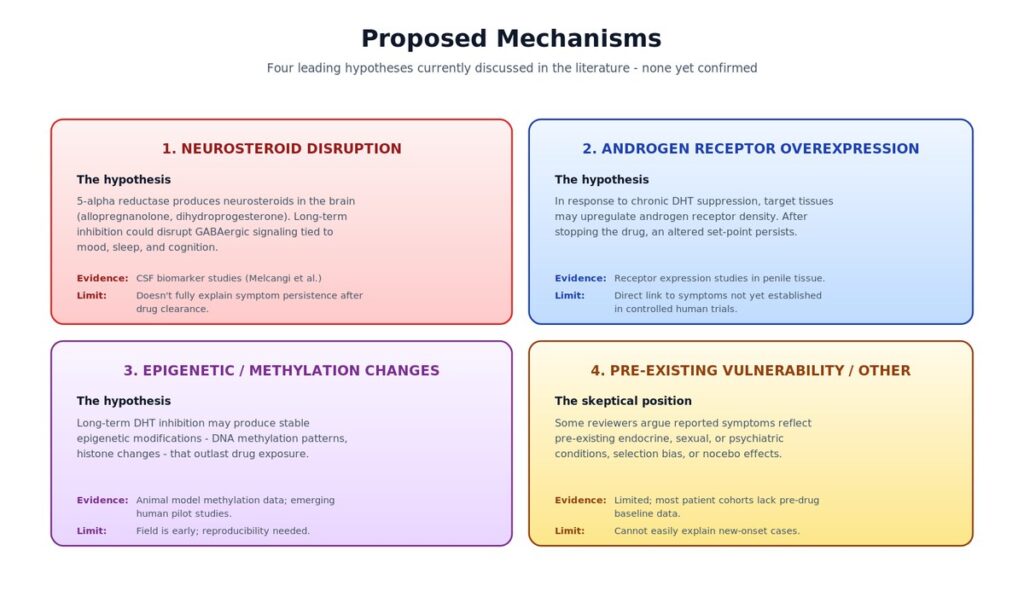
Neurosteroid disruption. 5-alpha reductase is not only relevant for hair and prostate. The same enzyme produces neurosteroids in the central nervous system – allopregnanolone, dihydroprogesterone, others – that modulate GABA-A receptor activity and influence mood, anxiety, sleep, and cognition. Long-term inhibition could disrupt this signaling. Melcangi’s CSF work showing altered neurosteroid profiles in some patients supports this hypothesis. The unresolved question is why symptoms would persist after the drug clears.
Androgen receptor overexpression and altered set-point. When DHT levels are chronically suppressed, target tissues may upregulate androgen receptor density as a compensatory response. After stopping the drug, the receptor profile and signaling balance may not return cleanly to baseline. Studies in penile and other tissues have looked for receptor expression changes; the direct link from those changes to specific symptoms in humans is not yet firmly established.
Epigenetic and methylation changes. The most speculative but increasingly studied hypothesis. Long-term hormonal manipulation could produce stable epigenetic modifications – DNA methylation and histone changes that outlast drug exposure and may persist indefinitely. Animal model data and emerging human pilot work suggest the mechanism is at least biologically possible. Whether it explains real-world PFS cases requires more reproducible human studies.
Pre-existing vulnerability and other explanations. The skeptical position. Some reviewers argue that reported symptoms in PFS cohorts can be explained by pre-existing endocrine, sexual, or psychiatric conditions that surfaced or were exacerbated during finasteride use, by selection bias in self-reported registries, or by nocebo effects amplified by online community awareness of the condition. Most patient cohorts lack pre-drug baseline data, which limits the ability to test this hypothesis cleanly. The skeptical view cannot, however, easily explain new-onset cases in young men with no documented history of the relevant conditions.
It is plausible that more than one of these mechanisms is operating in different subsets of affected individuals – which is one of several reasons “PFS” may turn out to be more useful as a descriptive umbrella than as a single diagnostic entity.
Risk factors and demographics
Patient registries and case-series suggest some patterns – though all of these are observations from selected populations rather than confirmed risk factors from controlled studies.
- Age at first use. Younger men taking finasteride for hair loss appear over-represented in PFS reports compared to older men taking it for BPH. This is partly because younger men are more sensitive to disruptions of sexual function and partly because the cosmetic-use population skews younger overall.
- Duration of exposure. Reports include both very short courses (days to weeks) and very long courses (years). Duration alone does not appear to cleanly predict outcome.
- Pattern of symptom onset. Some users report symptoms emerging during use that did not resolve after stopping; others report symptoms emerging only after discontinuation. Whether these are the same condition is unclear.
- Existing baseline. Pre-existing sexual or psychiatric history may or may not be a risk factor depending on how the question is asked.
What is generally accepted across the literature is that the absolute risk of persistent side effects in any individual finasteride user is low. What is contested is exactly how low – and whether even a low absolute risk is acceptable for a cosmetic indication, given the severity of reported outcomes in affected individuals.
Practical implications: if you are considering finasteride
The intent here is not to push you toward or away from the drug. Finasteride remains the only oral FDA-approved treatment for male pattern baldness, and for many users it produces excellent results without lasting side effects. PFS, if it is a discrete entity, occurs in a minority of users. The decision is genuinely yours and should be made with a qualified clinician.
That said, a few principles emerge from how the evidence has accumulated:
- Make the decision an informed one. The risk profile of the 1-mg cosmetic dose is not zero. The current product labeling reflects that. If your clinician dismisses the possibility of persistent side effects entirely, that does not reflect what regulators or the literature currently acknowledge.
- Establish a baseline. If you do choose to start, having pre-drug data on sexual function, mood, sleep, libido, and a basic hormone panel is enormously useful if you ever need to assess whether something has changed. Most PFS cohorts have no baseline data; you can collect your own in a few hours.
- Be alert to early symptoms. Side effects that emerge during use and do not resolve after stopping are the defining pattern of concern. If you experience them, stopping early may be more important than completing a full course.
- Consider alternative routes to the same therapeutic goal. Topical anti-androgens and other hair loss strategies that do not produce the same systemic 5-AR inhibition profile are increasingly available. They are not all proven equivalent in efficacy, but they sit on a different risk profile.
For broader context on why finasteride does not work uniformly even when it is producing the lab outcome it is supposed to produce, I have a separate piece on why finasteride fails some men even when it is working. And for the complete biological context behind hair loss treatment decisions in general – including why the receptor itself, rather than only the upstream hormone, is increasingly the target of newer compounds – the pillar piece on how hair loss actually works is the foundational read.
Watch: the broader finasteride conversation
If you’d rather watch a related discussion, the video below covers why finasteride does not always produce the outcomes users expect – which is the broader context in which the PFS conversation sits:
Alternatives with different risk profiles
One of the practical reasons the PFS conversation matters is that it has accelerated interest in hair loss strategies that do not involve oral, systemic 5-alpha reductase inhibition. None of these are perfect substitutes for finasteride in efficacy or risk profile, but they offer different trade-offs.
- Topical finasteride. Same molecule, applied locally. Available in compounded formulations and increasingly in commercial preparations. Some studies suggest reduced systemic exposure compared to oral, but it is not zero – and PFS-like reports do exist with topical use.
- Topical anti-androgens. Compounds that work at the receptor rather than upstream of it. Clascoterone (CB-0301), originally FDA-approved for acne and now in late-stage trials for hair loss, is the most clinically advanced option. Research compounds like RU58841 and pyrilutamide work via similar mechanisms.
- Ketoconazole shampoo. Mild local anti-androgen activity plus anti-inflammatory effects. Lower efficacy than systemic anti-androgens, but very low systemic risk profile.
- Microneedling. Mechanical rather than hormonal. Activates wound-healing and stem-cell pathways. No endocrine or sexual side-effect profile.
- Stem-cell-activating research compounds. Newer category, not FDA-approved. PP405 and related compounds (such as JXL069) target follicular metabolism rather than the androgen axis.
None of these is risk-free. Each has its own efficacy and side-effect profile that has to be weighed individually. The point is simply that finasteride is no longer the only mechanism-based option for someone treating male pattern baldness.
Frequently asked questions
How common is Post-Finasteride Syndrome?
Estimates vary substantially. Industry-funded studies tend to report low incidence of persistent side effects (often well under 1%); patient-registry analyses and some independent studies report higher numbers. The honest answer is that prevalence is not currently known to a useful precision. What is consistent is that the absolute number is a minority of users.
Is PFS officially recognized?
Regulators in multiple countries, including the FDA, MHRA, and Health Canada, have updated finasteride labeling to acknowledge reports of persistent sexual side effects. PFS as a distinct diagnostic entity is not yet codified in major diagnostic manuals, and the dermatology and urology fields remain divided on whether it is best classified as a single syndrome or as a heterogeneous collection of conditions. There is no validated diagnostic test.
If PFS exists, can it be treated?
There is no proven, validated therapy. Various interventions have been tried in case reports – including PDE5 inhibitors for sexual symptoms, antidepressants for mood, hormone modulation, and various supplements – with mixed and inconsistent results. Patients with significant symptoms typically benefit from working with clinicians familiar with the condition, who can address each symptom domain on its own terms.
Does dutasteride carry the same risk?
Dutasteride inhibits both 5-alpha reductase Type I and Type II (versus finasteride’s primary action on Type II) and is more potent in DHT suppression overall. Reports of persistent side effects exist with dutasteride as well; whether it is qualitatively different from finasteride in PFS risk is not well established.
Does topical finasteride avoid the risk?
Topical formulations produce less systemic absorption than oral – but absorption is not zero. PFS-like symptoms have been reported with topical use, though less frequently than with oral. The risk reduction is real but partial.
Can symptoms eventually resolve?
Some patients describe gradual improvement over months or years. Others describe persistent or even progressive symptoms. There is no reliable way to predict trajectory in advance.
Should I stop finasteride if I am taking it now?
That is a decision to make with your clinician based on your individual situation. Many users tolerate finasteride well long-term. The principle to take from PFS literature is that any new persistent symptoms – sexual, mood, cognitive – that emerge during use and do not improve are worth investigating sooner rather than later, ideally in conversation with a clinician who is informed about the condition.
Bringing it together
Post-Finasteride Syndrome is a topic that rewards a careful, balanced approach. The patient experiences are real. The regulatory acknowledgments are real. The mechanistic plausibility – particularly via the neurosteroid pathway – is real. At the same time, the prevalence is a minority of users, the syndrome boundaries are not yet sharply defined, and the field still lacks a confirmed mechanism, a validated diagnostic, or a proven treatment.
For someone considering finasteride, the right approach is to make an informed decision with full awareness of the risk profile – which means neither ignoring the PFS literature nor letting it dominate the decision out of proportion to the absolute incidence. For someone affected, the right approach is to find a clinician familiar with the condition and to work systematically through each symptom domain. And for the broader hair loss community, the right approach is to take both sides of the conversation seriously: acknowledging the patients whose symptoms are real, while also acknowledging the men who have used finasteride safely and effectively for decades.
The biology behind hair loss, and behind every treatment that targets it, is covered in depth in how hair loss actually works. If you are weighing finasteride specifically, that piece is the most useful next read.
Disclaimer: This article is for educational and informational purposes only. It is not medical advice and is not a substitute for evaluation by a qualified healthcare professional. Studies and sources referenced include Irwig et al. (2011, 2012), Traish et al. (2014, 2018), Kiguradze et al. (2017), Trost et al. (2018), Melcangi et al. (multiple), as well as FDA, MHRA, and Health Canada labeling updates and PFS Foundation literature. Skeptical and counter-perspectives include peer-reviewed reviews questioning syndrome boundaries and prevalence estimates. The author has no position on whether PFS is best characterized as a discrete syndrome and presents this material as a neutral overview only. (c) Philippe Boissard – philippeb.pro
About the author
Philippe Boissard
Author of Men’s Hairloss Protocol (2020), Better, Smarter, Stronger (2023), and Multi-Axis Body (2025). Researches and writes about hair loss and male physiology, citing primary literature and disclosing affiliate relationships in full. Not a medical doctor; all content is educational. More about Philippe.
Get my free hair-loss protocol
The exact evidence-based routine I actually use and recommend: what works, in what order, with no hype. Enter your email on the next page and I’ll send it straight to you.
Send me the free protocol →