
Dutasteride vs Finasteride for Hair Loss: What the Evidence Shows
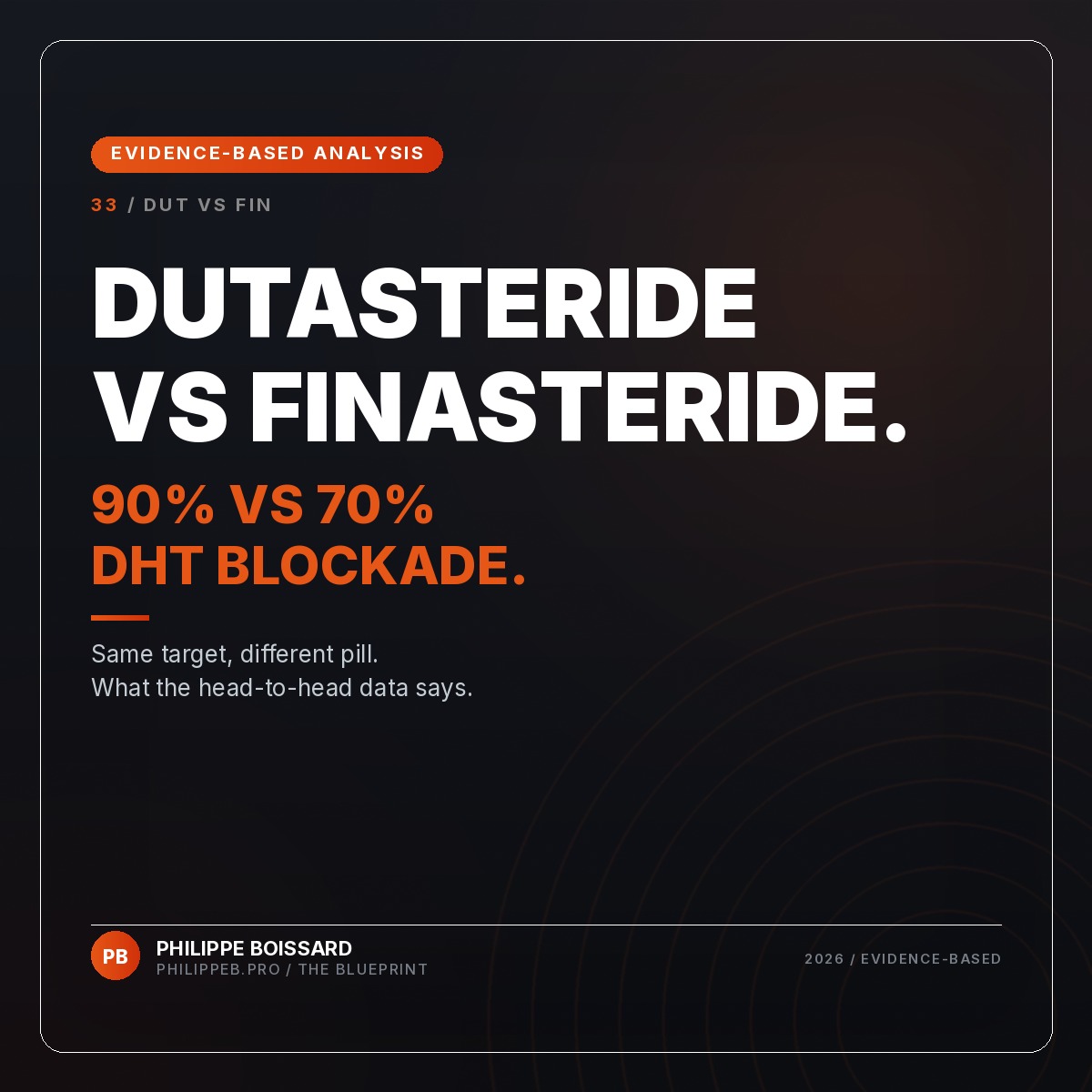
Dutasteride suppresses about 90 percent of DHT versus roughly 70 percent for finasteride. Here is what the head-to-head trials actually found, and the catch.

A reader messaged me last month asking if he should “upgrade” from finasteride to dutasteride. Fair question. The honest answer is that dutasteride is the stronger DHT blocker on paper, the head-to-head trials back that up, and that extra strength comes with tradeoffs most threads never mention.
Let me get straight to it. Both drugs work the same way: they shrink the amount of dihydrotestosterone (DHT) reaching your follicles. DHT is the androgen that miniaturizes hair in men who are genetically sensitive to it. Lower the DHT, slow the miniaturization. The difference between the two is how completely they switch it off.
The mechanism, in one diagram
Your body converts testosterone into DHT using an enzyme called 5-alpha-reductase. There are two main types. Finasteride blocks type II only. Dutasteride blocks both type I and type II. That single fact explains almost everything that follows.
Because dutasteride covers both enzymes, it suppresses serum DHT by roughly 90 percent. Finasteride, hitting only type II, lands around 70 percent.[1] That gap is the entire case for dutasteride.
What finasteride does on its own (the baseline)
Before crowning a winner, it helps to see how good finasteride already is, because it is the most studied hair-loss drug we have. The pivotal work here is Kaufman and colleagues, 1998, and the five-year follow-up that came after.[2] Over 1,500 men with vertex thinning were randomized to finasteride 1 mg or placebo. In the treated group, hair count rose by a mean of 88 hairs (in a roughly one-inch target circle) at two years. By year five it had settled back to about 38 hairs above baseline. The placebo group, meanwhile, dropped 239 hairs over the same five years.
Read that last number again. The headline isn’t only the regrowth. It’s the loss you don’t take. A man on placebo shed close to 240 hairs in that little circle while the treated man stayed well above where he started. Most of finasteride’s value is defense, not offense.
Head to head: does dutasteride win?
Now the comparison. A 2019 systematic review and meta-analysis pooled three randomized trials, 576 men, over 24 weeks.[3] Dutasteride came out ahead on total hair count, with a mean difference of 28.57 hairs in its favor (95% confidence interval 18.75 to 38.39). It also beat finasteride on investigator photographic assessments. An earlier dose-ranging trial by Gubelin Harcha and colleagues, 2014, found dutasteride 0.5 mg significantly outperformed finasteride 1 mg on hair count and width at week 24.[4]
So yes, in the trials we have, dutasteride regrows somewhat more hair than finasteride. That is a real, measured edge. Here is where I show the seams: these were 24-week studies. Twenty-four weeks. Hair-loss decisions play out over decades, and we simply don’t have dutasteride-versus-finasteride data running anywhere near that long. A 28-hair edge at six months is meaningful, but I won’t pretend it tells us what year ten looks like.
| Finasteride 1 mg | Dutasteride 0.5 mg | |
|---|---|---|
| Enzyme blocked | Type II | Type I and II |
| Serum DHT drop | ~70% | ~90% |
| Half-life | ~6 hours | ~4 to 5 weeks |
| FDA approved for hair loss | Yes | No (off-label in US) |
| Trial hair-count edge | Reference | +~28 hairs at 24 wk |
The catch nobody puts in the thread
Dutasteride’s long half-life is the detail that changes the calculation. Finasteride clears your system in hours. Dutasteride hangs around for weeks, roughly four to five.[1] If you tolerate it, that’s a non-issue. If you get a side effect you don’t like, you can’t just stop and reset by the weekend. It’s the difference between a light switch and a dimmer that takes a month to fade. That tradeoff, not the efficacy, is what I’d actually weigh.
Two more honest points. Dutasteride is approved for male pattern hair loss in South Korea and Japan, but in the US it’s prescribed off-label for hair (its on-label use is enlarged prostate). And the side-effect profiles in the trials looked broadly similar between the two drugs, though the discourse around persistent sexual side effects is heated and the long-term data are thinner than either camp admits.
My read: finasteride is the sensible default, and it’s enough for a lot of men. Dutasteride is the option I’d consider for someone who’s been consistent on finasteride, given it real time, and is still slowly losing ground. More suppression for a clear reason, not as a reflex upgrade.
So which should you pick?
If you’re early and just starting, finasteride. It’s FDA-approved for this exact use, decades of data sit behind it, and it’s easy to stop if it doesn’t agree with you. If you’ve run finasteride properly for a year or more and the mirror still says you’re slipping, dutasteride is a reasonable next conversation to have with a prescriber, with the half-life caveat fully in view. Neither drug regrows a slick-bald crown, and neither is a substitute for catching this early. The follicle you keep is worth far more than the one you’re trying to coax back.
I go deeper on the mechanisms, the dosing, and where the evidence is genuinely shaky in my review and across philippeb.pro.
I’m Philippe Boissard, a hair-loss and male-physiology researcher and author (M.Sc., Aalborg University). I published a comparative review of finasteride and dutasteride in androgenetic alopecia, openly available at doi.org/10.5281/zenodo.20507736. More of my work is at philippeb.pro.
This article names prescription medication. Education, not medical advice.
References
- Zhou Z, et al. The efficacy and safety of dutasteride compared with finasteride in treating men with androgenetic alopecia: a systematic review and meta-analysis. Clin Interv Aging, 2019. tandfonline.com
- Finasteride Male Pattern Hair Loss Study Group. Long-term (5-year) multinational experience with finasteride 1 mg in the treatment of men with androgenetic alopecia. Eur J Dermatol, 2002. pubmed.ncbi.nlm.nih.gov/11809594
- Zhou Z, et al. Dutasteride vs finasteride meta-analysis (3 RCTs, 576 men). Clin Interv Aging, 2019. pubmed.ncbi.nlm.nih.gov/30863034
- Gubelin Harcha W, et al. A randomized, active- and placebo-controlled study of different doses of dutasteride versus placebo and finasteride in men with androgenetic alopecia. J Am Acad Dermatol, 2014. sciencedirect.com
Get my free hair-loss protocol
The exact evidence-based routine I actually use and recommend: what works, in what order, with no hype. Enter your email on the next page and I’ll send it straight to you.
