
4 Topical Finasteride Alternatives That Skip the Sexual Side Effects
Four topical alternatives to oral finasteride, each graded honestly: topical finasteride, topical dutasteride, RU58841, and clascoterone. The real evidence, no hype.

4 Topical Finasteride Alternatives That Skip the Sexual Side Effects
A guy emails me roughly once a week with the same knot in his stomach. He’s losing his hair, he knows oral finasteride works, and he’s terrified of the one thing the forums won’t stop talking about: what it might do below the belt. He wants the benefit without the bet. So the real question isn’t “does finasteride work.” It’s “can I get the same DHT control on my scalp without flooding my bloodstream?” The honest answer is: partly, and it depends which option you pick.
Quick context on me, because it should shape how you read this. I’m on dutasteride myself, the heavier hammer, so I’m not here to scare anyone off systemic drugs. I just think the topical route is the most under-explained corner of this whole field, and the marketing around it is a mess. Let’s grade four options the way I’d want a friend to grade them. Mechanism first, real numbers, and the limitation named in the same breath.
Why “topical” is even a thing
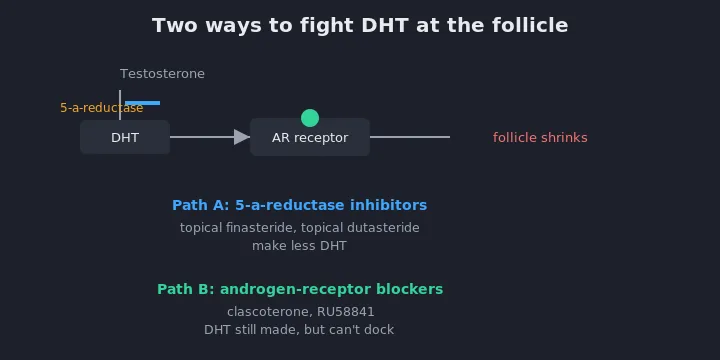
Male pattern hair loss is driven mostly by DHT, a potent androgen your body builds from testosterone using the enzyme 5-alpha-reductase. DHT binds the androgen receptor inside scalp follicle cells and, in genetically wired men, slowly shrinks those follicles down to peach fuzz.[5] Oral finasteride blocks that enzyme everywhere in your body at once, which is why it works and also why a small slice of men feel it sexually. The topical idea is simple. Put the drug on the scalp, hit the follicle, and keep most of it out of the blood. Think of it like watering one plant with a dropper instead of flooding the whole garden.
Option 1: Topical finasteride (the best-evidenced choice)
This is the one with actual phase 3 data behind it, and the data is genuinely good. In a 24-week double-blind trial across 45 European sites, Piraccini and colleagues (2022) randomized 458 men to topical finasteride spray or placebo. Topical finasteride beat placebo on hair count by a clear margin (adjusted mean change of 20.2 versus 6.7 hairs in the target area), and crucially, the effect was numerically similar to oral finasteride.[1] So far, so familiar.
Here’s the part that matters for the man in my inbox. Peak plasma finasteride was over 100 times lower with the topical than the oral. And the drop in blood DHT was 34.5% with topical versus 55.6% with oral.[1] That gap is the whole pitch. You still suppress some systemic DHT, so this is not a free pass, but you suppress a lot less of it while getting comparable hair growth on the scalp. A separate phase 3 trial in Chinese men (Zhou et al., 2025) reached the same conclusion: more hair growth than placebo, good tolerability over 24 weeks.[2]
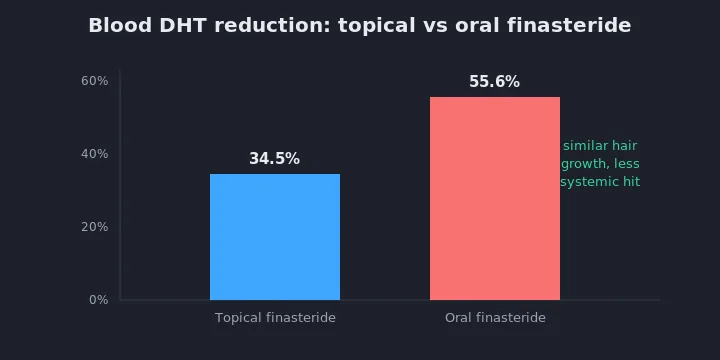
My grade: A. This is the option with the strongest evidence and the cleanest logic. If you want the finasteride benefit with a reduced systemic footprint, start here. Just don’t believe anyone who tells you the systemic effect is zero. A third of your blood DHT still goes away.
Option 2: Topical dutasteride (stronger, thinner evidence)
Dutasteride blocks both forms of 5-alpha-reductase, not just one, so orally it suppresses DHT harder than finasteride and tends to grow a bit more hair.[3] The topical version is the natural next thought: more DHT blockade at the follicle, hopefully still kept off the bloodstream. The problem is that the human evidence is much thinner. Most of what exists is small studies, mesotherapy injections, and microneedling-assisted delivery rather than large randomized trials of a simple topical solution.[4]
There’s also a pharmacology wrinkle worth knowing. Dutasteride has a famously long half-life and binds the enzyme more tenaciously than finasteride does, so the “stays on the scalp” promise is harder to guarantee. Whatever does get absorbed lingers. I’m not saying it doesn’t work. I’m saying we don’t have a phase 3 trial telling us how well it works topically or exactly how much systemic suppression you’re really avoiding.
My grade: B-minus. Plausible mechanism, real but limited data, more uncertainty on the systemic side than topical finasteride. A reasonable second-line choice if you’ve discussed it with a prescriber, not a first pick on evidence alone.
Option 3: RU58841 (the strong anecdote with no human RCT)
Now we get to the one people whisper about. RU58841 is a topical antiandrogen, meaning it doesn’t reduce DHT at all. It sits on the androgen receptor in the follicle and blocks DHT from docking. The appeal is obvious: if it stays local, you could theoretically block androgens at the scalp without touching DHT or testosterone anywhere else in the body. The forum testimonials are genuinely striking.
And here’s where I have to be blunt, because almost nobody selling it will be. There are no published human randomized controlled trials of RU58841 for hair loss. None. The compound was studied in animal models decades ago, the original development was dropped, and what circulates today is research-grade powder from unregulated suppliers with no clinical safety data, no standardized dosing, and no long-term human follow-up.[5] The anecdotes might be pointing at something real. They might also be selection bias, placebo, and the fact that people who try it are often stacking minoxidil on top. We simply do not know.
RU58841 is sold as a “research chemical,” not an approved drug. There is no published human RCT, no regulated manufacturing, and no long-term safety data. Strong anecdotes are not the same as evidence, and I won’t pretend they are.
My grade: incomplete, leaning caution. The mechanism is elegant and the idea is exciting. The evidence base for humans is effectively empty. I can’t grade something honestly when the trials don’t exist.
Option 4: Clascoterone / Breezula (the most interesting newcomer)
Clascoterone (cortexolone 17-alpha-propionate) is the option I find most scientifically interesting, because it attacks the problem from a different angle. Like RU58841, it’s a topical androgen-receptor antagonist, so it blocks DHT at the follicle rather than lowering it. Unlike RU58841, it has a real clinical program behind it. It’s already approved as a topical for acne, and in lab work it inhibited androgen-receptor-driven activity in scalp dermal papilla cells with potency comparable to finasteride, while outperforming another antiandrogen at calming the inflammatory signaling DHT triggers in those cells.[6]
It has been run through phase 2 testing for androgenetic alopecia under the name Breezula, and that’s exactly the right framing to keep. Phase 2 means the early human signal is encouraging enough to justify larger trials, not that the case is closed. A clever local mechanism plus an existing safety record from its acne use is a promising combination, and because it doesn’t lower DHT at all, the theoretical systemic-sexual risk is low. We still need the bigger, longer hair-loss trials to land before I’d call it proven.
My grade: B-plus, and rising. Best-in-class mechanism for the side-effect-averse, real clinical program, low theoretical systemic risk. The grade goes up the moment the larger trials confirm the phase 2 signal.
How they stack up
| Option | How it works | Human evidence | Systemic DHT hit |
|---|---|---|---|
| Topical finasteride | Lowers DHT | Phase 3 RCTs | Low (about 35%) |
| Topical dutasteride | Lowers DHT (both enzymes) | Small studies only | Uncertain |
| RU58841 | Blocks the receptor | No human RCT | Theoretically near-zero, unproven |
| Clascoterone | Blocks the receptor | Phase 2, acne-approved | Theoretically very low |
My bottom line
If you want the most proven path with a smaller systemic footprint, topical finasteride is the clear answer right now, and the phase 3 numbers back it. If you’re allergic to even a third of your blood DHT going away, clascoterone is the most credible receptor-blocking route, with RU58841 sitting one tier below it purely because the human trials don’t exist yet. Topical dutasteride is a plausible middle option that’s waiting on better data. Notice what I didn’t do: I didn’t rank by how loud the internet is about each one. Rank by the evidence, take the systemic-side-effect worry seriously, and you end up with a short, sane list instead of a panic.
If you want the order I’d actually run these in, plus the supporting routine, that’s in my free protocol below. And if you want the deeper science, more of my work lives at philippeb.pro.
I’m Philippe Boissard, a hair-loss and male-physiology researcher and author (M.Sc., Aalborg University). I published a comparative review of finasteride and dutasteride in androgenetic alopecia, openly available at doi.org/10.5281/zenodo.20507736. More of my work is at philippeb.pro.
This article names prescription medication. Education, not medical advice.
References
- Piraccini BM, Blume-Peytavi U, Scarci F, et al. Efficacy and safety of topical finasteride spray solution for male androgenetic alopecia: a phase III, randomized, controlled clinical trial. J Eur Acad Dermatol Venereol, 2022. doi.org/10.1111/jdv.17738
- Zhou C, Yang B, Zeng H, et al. Efficacy and safety of topical finasteride spray solution in Chinese men with androgenetic alopecia: a phase III randomized study. Chin Med J (Engl), 2025. doi.org/10.1097/CM9.0000000000003495
- Ding Y, Wang C, Bi L, et al. Dutasteride for the treatment of androgenetic alopecia: an updated review. Dermatology, 2024. doi.org/10.1159/000541395
- Alsalhi W, Alalola A, Randolph M, Gwillim E, Tosti A. Novel drug delivery approaches for the management of hair loss. Expert Opin Drug Deliv, 2020. doi.org/10.1080/17425247.2020.1723543
- Kaufman KD. Androgens and alopecia. Mol Cell Endocrinol, 2002. doi.org/10.1016/s0303-7207(02)00372-6
- Rosette C, Rosette N, Mazzetti A, Moro L, Gerloni M. Cortexolone 17-alpha-propionate (clascoterone) is an androgen receptor antagonist in dermal papilla cells in vitro. J Drugs Dermatol, 2019. pubmed.ncbi.nlm.nih.gov/30811143
Get my free hair-loss protocol
The exact evidence-based routine I actually use and recommend: what works, in what order, with no hype. Enter your email on the next page and I’ll send it straight to you.
