
How to Keep Your Hair on TRT: A Practical Protocol
TRT can unmask male pattern hair loss by raising scalp DHT. Here is the mechanism, who is actually at risk, and a practical protocol to keep your hair on testosterone.

How to Keep Your Hair on TRT: A Practical Protocol
Six weeks into testosterone replacement, a guy feels incredible. Energy is back, mood is up, the gym numbers are climbing. Then he runs his fingers through his hair in the shower and a few too many strands come away. Now he’s caught in a horrible little trade: feel like himself again, or keep his hairline. Here’s the thing almost nobody tells him up front. He probably doesn’t have to choose. But he does have to plan.
I research male physiology and hair loss, and TRT-and-hair is one of the most predictable scares I see. Predictable because the mechanism is well understood, and because the men who panic about it usually could have prevented the whole thing if someone had explained it on day one. So let’s do that.
Why TRT touches your hair at all
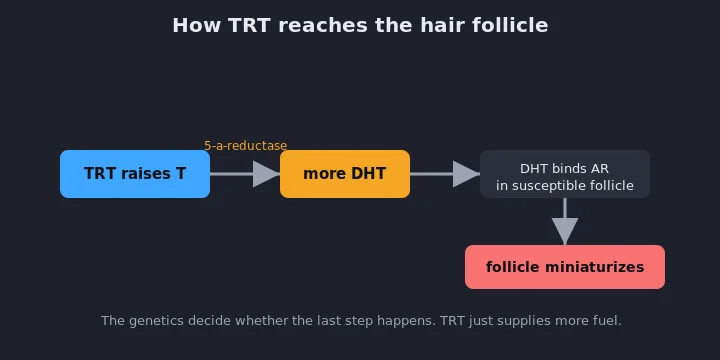
Testosterone itself isn’t the main villain for your scalp. The villain is what your body makes from it. The enzyme 5-alpha-reductase converts testosterone into dihydrotestosterone (DHT), a far more potent androgen, and DHT is the molecule that miniaturizes scalp follicles in men who are genetically wired for it.[1] When you go on TRT, you raise your testosterone, which means more raw material feeding that enzyme, which means more DHT reaching the scalp. If you carry the pattern-baldness genetics, TRT doesn’t create new hair loss out of nowhere. It pulls the timeline forward and presses the gas.
That’s the honest framing. TRT unmasks and accelerates a process you were already prone to. The clearest real-world demonstration of this comes from transgender men starting testosterone, where androgenetic alopecia is one of the most common effects of treatment, and where finasteride has been used to manage it.[2] Same hormone, same enzyme, same outcome.
Who is actually at risk (and who can relax)
Not every man on TRT loses hair, and the difference is mostly written in your genes. Two factors matter most. First, do you have the family history of male pattern baldness. Second, how sensitive are your androgen receptors, which is partly governed by a stretch of repeating code in the androgen-receptor gene called the CAG repeat. Shorter CAG repeats tend to mean a more sensitive receptor, and studies have linked shorter repeats to androgenetic alopecia.[3] Translation: a man with a sensitive receptor and a balding family will feel TRT in his hairline. A man with neither may sail through on the same dose.
Here’s my homemade way to picture it. Your follicles are like smoke detectors, and DHT is the smoke. TRT turns up the smoke. Whether the alarm goes off depends on how touchy your particular detectors are, and that touchiness is mostly inherited. You can’t change the detector. But you absolutely can manage the smoke.
The protocol: how to keep your hair on TRT
This is the practical core. The logic is simple: keep the testosterone benefits, blunt the DHT signal at the scalp, and add growth support if you want insurance. Here’s the order I’d think it through.
1. The foundation: a 5-alpha-reductase inhibitor
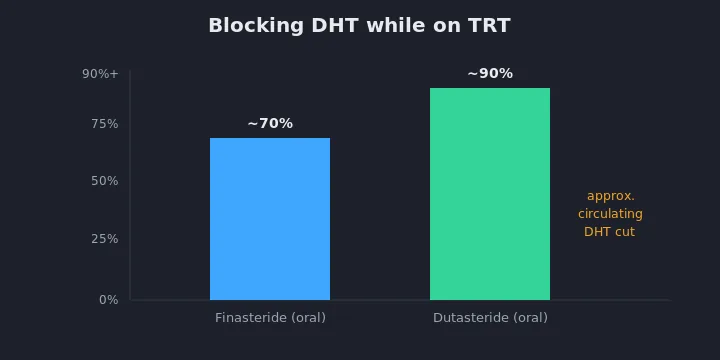
The single most effective move is to add a 5-alpha-reductase inhibitor, finasteride or dutasteride, alongside your TRT. These block the conversion of testosterone to DHT, so even with higher testosterone you keep DHT down. Finasteride cuts circulating DHT by roughly 70%, dutasteride by more, and both reliably slow or reverse pattern loss in men.[1] This is the pairing that lets most men have both: the testosterone and the hair. In the transgender-men case series, low-dose finasteride alongside testosterone improved hair without derailing the masculinizing effects people wanted.[2]
A common worry: “won’t blocking DHT cancel my TRT benefits?” For most men, no. DHT matters for some functions, but the bulk of testosterone’s effects on muscle, mood, and energy don’t depend on the DHT pathway you’re blocking at the scalp. Discuss the trade-offs with your prescriber, but don’t assume the two cancel out.
2. The side-effect-averse route: topical antiandrogens
If you’re one of the men who’s nervous about systemic DHT reduction, there’s a gentler lane. Topical finasteride lowers scalp DHT while keeping far more of it in your bloodstream than the oral version does, with comparable hair results in trial data. Topical androgen-receptor blockers like clascoterone work locally at the follicle without lowering your DHT at all. The trade-off is that the receptor-blocker evidence base is younger and thinner than the oral 5-alpha-reductase data. I cover those options in depth in my topical-alternatives piece, but the headline is: you have a low-systemic option if you want one.
3. The add-ons: minoxidil and microneedling
These don’t touch DHT at all, which is exactly why they pair well with the steps above. They’re growth stimulators, not androgen blockers, so you can stack them on top. Topical minoxidil has solid randomized evidence for increasing hair count.[4] Microneedling, done properly, has been shown to boost results when combined with minoxidil: in a controlled study, the microneedling-plus-minoxidil group dramatically outperformed minoxidil alone over 12 weeks.[5] Think of these as the offense to the 5-alpha-reductase inhibitor’s defense.
What I’d actually do
If it were me starting TRT with any balding history, I’d line up the 5-alpha-reductase inhibitor before or at the same time as the testosterone, not as a panicked reaction three months later once shedding has started. Prevention beats rescue in this game, because hair you keep is far easier than hair you have to coax back. If systemic DHT reduction worried me, I’d lean topical. And I’d add minoxidil, with microneedling if I were willing to be consistent, as growth insurance.
“TRT and a full head of hair are not enemies. The man who loses both usually lost them by waiting, not by choosing testosterone.”
My bottom line
TRT raises testosterone, testosterone feeds DHT, and DHT is what thins genetically susceptible scalps. That’s the whole chain, and every link in it is manageable. Block the DHT with a 5-alpha-reductase inhibitor, go topical if you’re side-effect-shy, and add growth support on top. Do it early, before the shedding teaches you the lesson the hard way. You don’t have to pick between feeling like yourself and looking like yourself. You have to plan for both. Most men who lose this fight lost it to procrastination, not pharmacology.
The exact sequence I’d run, with dosing logic and the add-on order, is in my free protocol below. More of my hair-science work is at philippeb.pro.
I’m Philippe Boissard, a hair-loss and male-physiology researcher and author (M.Sc., Aalborg University). I published a comparative review of finasteride and dutasteride in androgenetic alopecia, openly available at doi.org/10.5281/zenodo.20507736. More of my work is at philippeb.pro.
This article names prescription medication. Education, not medical advice.
References
- Kaufman KD. Androgens and alopecia. Mol Cell Endocrinol, 2002. doi.org/10.1016/s0303-7207(02)00372-6
- Tominaga Y, Kobayashi T, Matsumoto Y, et al. The safety and efficacy of finasteride for transgender men with androgenetic alopecia: a case series. J Med Case Rep, 2025. doi.org/10.1186/s13256-025-05562-y
- Sawaya ME, Shalita AR. Androgen receptor polymorphisms (CAG repeat lengths) in androgenetic alopecia, hirsutism, and acne. J Cutan Med Surg, 1998. doi.org/10.1177/120347549800300103
- van Zuuren EJ, Fedorowicz Z, Schoones J. Interventions for female pattern hair loss. Cochrane Database Syst Rev, 2016. doi.org/10.1002/14651858.CD007628.pub4
- Dhurat R, Sukesh M, Avhad G, et al. A randomized evaluator blinded study of effect of microneedling in androgenetic alopecia: a pilot study. Int J Trichology, 2013. pubmed.ncbi.nlm.nih.gov/23960389
- Traish AM. Negative impact of testosterone deficiency and 5-alpha-reductase inhibitors therapy on metabolic and sexual function in men. Adv Exp Med Biol, 2017. doi.org/10.1007/978-3-319-70178-3_22
Get my free hair-loss protocol
The exact evidence-based routine I actually use and recommend: what works, in what order, with no hype. Enter your email on the next page and I’ll send it straight to you.
