
Botox for Hair Loss: Does It Actually Work?
Botox scalp injections for hair loss: the tension and perfusion theories, the actual mechanism, and what the small, weak studies really show. An honest, evidence-first breakdown.

Botox for Hair Loss: Does It Actually Work?
A patient walks into a clinic, pays a few hundred dollars, and gets the same wrinkle-relaxer that smooths foreheads injected across his scalp, hoping it’ll regrow his hairline. It sounds like the kind of thing I’d debunk in one paragraph. And yet there’s a real, published, if shaky, body of evidence behind botulinum toxin for hair loss, plus a mechanism that isn’t crazy. So let me do the thing I do best: take the idea seriously, then show you exactly how thin the actual data is.
Why anyone thought to try this
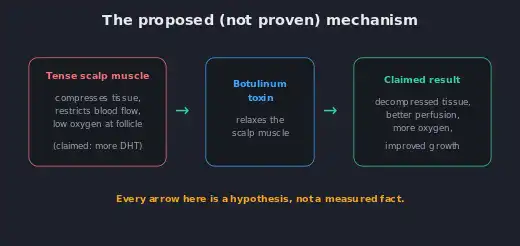
The theory rests on the scalp’s anatomy. The top of your head is covered by a layer of muscle and a tough sheet of connective tissue, and beneath that runs a relatively poor blood supply compared with the rest of your skin. The hypothesis goes: chronic tension in those scalp muscles squeezes the tissue, reduces blood flow and oxygen to the follicles, and creates a low-perfusion, possibly higher-DHT environment that favors miniaturization. Botulinum toxin relaxes muscle. Relax the scalp, the thinking goes, and you decompress the tissue, improve perfusion, and give follicles a better neighborhood to grow in.
There’s a second, more speculative arm to the theory. Some proponents argue that better oxygenation shifts the local conversion of testosterone away from DHT, since one of the enzymes involved behaves differently under low oxygen. Picture the scalp like a garden hose with someone standing on it. The water (blood) is there, but the pressure at the far end (the follicle) is throttled. Botox, in theory, lifts the foot off the hose. It’s a tidy story. The question is whether the data backs it.
What the actual studies show
This is where I have to be the buzzkill, and the numbers do the work for me. The evidence base for botulinum toxin in androgenetic alopecia is small, mostly uncontrolled, and concentrated in a handful of papers.
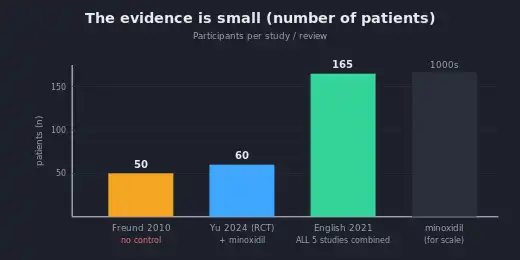
The study everyone cites first is Freund and Schwartz, 2010, a pilot in Plastic and Reconstructive Surgery. They injected 50 men with 150 units of botulinum toxin A across the scalp muscles and followed them over roughly 60 weeks, reporting a response in about 75% of participants and a meaningful increase in hair count.[1] Sounds great until you read the design: no control group, no placebo, no blinding. It’s a single-arm pilot. In hair research, where the placebo response and seasonal shedding cycles are large, an uncontrolled study can’t tell you the drug did the work.
A 2021 systematic review by English and Ruiz pulled together everything that existed.[2] The whole literature at that point was five clinical studies, four prospective cohorts and a single randomized trial, totaling just 165 men. Across them, response rates ran 75 to 79%, and intramuscular injection studies reported hair-count changes of about 18 to 21%. But the authors were blunt: no study had a proper control group, the participant numbers were tiny, and the methodological quality scores were low. Their conclusion was that large randomized trials are needed before anyone should believe this works.
The newer trials don’t settle it
Things have inched forward. Yu and colleagues ran a randomized controlled trial in 2024 in 60 men, comparing botulinum toxin plus topical minoxidil against minoxidil alone, and reported that the combination group did significantly better on hair growth and quality-of-life scores at four and six months.[3] That’s a real RCT, which is progress. But read it carefully: it tested botox plus minoxidil versus minoxidil alone. It can’t cleanly isolate what the toxin did by itself, and it’s still only 60 men at a single center.
Then there’s a triple-blind randomized trial by Melo and colleagues in 2024, published in the Journal of the American Academy of Dermatology, which is exactly the kind of rigorous design the field needed.[4] A broader review of current AGA treatment options likewise lists botulinum toxin among the experimental approaches with limited supporting evidence, alongside the well-established minoxidil and finasteride.[5] The picture across the better-designed work is consistent and underwhelming: signals exist, effect sizes are modest at best, and nobody has shown botox alone reliably beats placebo at the scale we’d demand of a real treatment.
A useful gut check: finasteride and minoxidil were each tested in thousands of patients in placebo-controlled trials before they earned their reputations. Botulinum toxin for hair loss has been studied, generously, in a few hundred. That gap in evidence is the whole story.
So, does it work?
My honest answer: probably a little, maybe, for some people, and nowhere near enough proof to recommend it as a serious treatment. The mechanism is biologically plausible, which is more than you can say for most clinic gimmicks. A handful of studies show positive signals. But every one of those studies is small, most lack proper controls, and the cleaner trials test it bolted onto minoxidil rather than on its own. That’s not the profile of a treatment I’d build a plan around. It’s the profile of an interesting hypothesis that hasn’t earned its claims yet.
| Question | Honest answer (June 2026) |
|---|---|
| Is there a real mechanism? | Plausible, but the key steps are unproven in humans. |
| Is the evidence strong? | No. About 165 patients across 5 small, mostly uncontrolled studies. |
| Do newer RCTs settle it? | No. They mostly test botox plus minoxidil, not botox alone. |
| Would I use it as a primary treatment? | No. The proven tools come first. |
| Is it dangerous? | Generally well tolerated in the studies, but it costs money and time. |
“Botulinum toxin for hair loss is a plausible idea wearing borrowed credibility. The mechanism is interesting. The evidence is a few hundred patients in studies that mostly can’t tell the drug from the placebo. Interesting is not the same as proven.”
Here’s my personal-fingerprint rule, and I say it on the channel constantly: do the boring things that have thousands of patients behind them before you spend money on the exciting thing that has a few dozen. If your DHT isn’t controlled and you’re not on a proven grower, botox in your scalp is fixing the roof before you’ve poured the foundation. If you’ve already got the fundamentals locked and you want to experiment with an adjunct under a good dermatologist, that’s a defensible personal choice, just go in knowing the evidence is thin. For how I’d build the foundation first, the rest of my work is at philippeb.pro.
I’m Philippe Boissard, a hair-loss and male-physiology researcher and author (M.Sc., Aalborg University). I published a comparative review of finasteride and dutasteride in androgenetic alopecia, openly available at doi.org/10.5281/zenodo.20507736. More of my work is at philippeb.pro.
This article names prescription medication. Education, not medical advice.
References
- Freund BJ, Schwartz M. Treatment of male pattern baldness with botulinum toxin: a pilot study. Plast Reconstr Surg, 2010. doi.org/10.1097/PRS.0b013e3181ef816d
- English RS, Ruiz S. Use of Botulinum Toxin for Androgenic Alopecia: A Systematic Review. Skin Appendage Disord, 2021. doi.org/10.1159/000518574
- Yu L, Moorthy S, Li X, et al. Assessing the efficacy and quality of life improvements of botulinum toxin type A with topical minoxidil versus topical minoxidil in male androgenetic alopecia: a randomized controlled trial. Arch Dermatol Res, 2024. doi.org/10.1007/s00403-024-03258-9
- Melo DF, Müller-Ramos P, Cortez de Almeida RF, et al. Efficacy of botulinum toxin in male androgenetic alopecia: A triple-blind, randomized clinical trial. J Am Acad Dermatol, 2024. doi.org/10.1016/j.jaad.2024.07.1464
- Kaiser M, Abdin R, Gaumond SI, Issa NT, Jimenez JJ. Treatment of Androgenetic Alopecia: Current Guidance and Unmet Needs. Clin Cosmet Investig Dermatol, 2023. doi.org/10.2147/CCID.S385861
Get my free hair-loss protocol
The exact evidence-based routine I actually use and recommend: what works, in what order, with no hype. Enter your email on the next page and I’ll send it straight to you.
