
Laser Caps for Hair Loss (LLLT): Hype or Help?
Do laser caps (LLLT) really regrow hair? The real RCT numbers from Jimenez and Lanzafame, the mechanism, the device-funding conflicts, and an honest verdict.

Laser Caps for Hair Loss (LLLT): Hype or Help?
A reader emailed me a photo of his new laser cap sitting on a shelf next to his minoxidil bottle. It cost him more than 800 dollars. His question was blunt: did I just buy a very expensive hat, or does this thing actually do something? The honest answer is somewhere in the middle, and it is more interesting than either the marketing or the cynics will tell you.
Low-level laser therapy, or LLLT, is one of the few hair-loss treatments where the device companies funded the trials, the trials are real, and the results are positive but modest. That combination makes people suspicious, and they should be. Let me walk through the mechanism, the actual randomized-controlled-trial numbers, who paid for them, and where I land.
What a laser cap is actually doing to your scalp
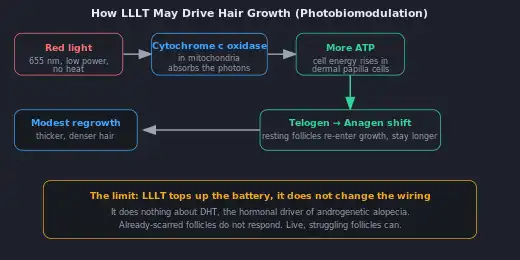
Forget the word “laser” for a second. These devices are not cutting anything. They emit red light, usually right around 650 to 660 nanometers, at a low power that produces no meaningful heat. The proper name for the field is photobiomodulation, which is a clumsy word but an accurate one. Light is modulating cell behavior, not burning tissue.
The leading mechanism runs through your mitochondria. Inside the energy-producing machinery of each cell sits an enzyme called cytochrome c oxidase. It happens to absorb red and near-infrared light very efficiently. When that light hits it, the enzyme appears to work faster, which nudges up ATP production, the cell’s energy currency. More energy in the dermal papilla cells at the base of a follicle seems to push borderline follicles out of the resting telogen phase and into the active anagen growth phase, and to keep them there longer.
Here is my one homemade analogy for the whole article. A miniaturizing follicle is like a flashlight with a tired battery. The bulb still works, but the light is dim and flickering. LLLT does not replace the bulb and it does not fix the wiring. It tops up the battery. If the bulb is mostly fine and just under-powered, you get a brighter beam. If the bulb is already burnt out, fresh charge does nothing.
That analogy matters because it predicts who responds. LLLT helps follicles that are struggling but alive. It does almost nothing for areas that are already slick and scarred. Mechanism first, and that mechanism is falsifiable: if the cytochrome c oxidase story is right, the effect should be biggest in early-to-moderate thinning and negligible in advanced baldness. That is roughly what the trials show.
The trials, the real numbers, and who paid
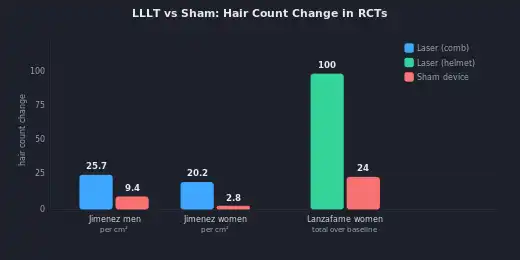
The headline trial is Jimenez and colleagues, 2014, published in the American Journal of Clinical Dermatology.[1] This was a multicenter, randomized, double-blind, sham-device-controlled study, which is the design you want. Real laser combs versus a fake comb that looked identical, in sealed packets, with blinded evaluators reading masked photos. They enrolled 128 men and 141 women and treated them three times a week for 26 weeks.
The result, according to PubMed: terminal hair density rose by roughly 20 to 26 hairs per square centimeter in the laser groups, compared with about 1.6 to 9.4 in the sham groups, and the difference was statistically significant (p less than 0.0001 in several arms).[1] That is a genuine effect. It is also a modest one. Twenty extra hairs per square centimeter is visible over months, not a transformation.
The other often-cited trial is Lanzafame and colleagues, 2014, in Lasers in Surgery and Medicine.[2] This one ran a helmet-style device, the TOPHAT655, in 47 women, every other day for 16 weeks. The active group gained about 100 hairs over baseline versus about 24 in the sham group (p less than 0.0001), which the authors framed as a 37 percent increase in hair growth over placebo.[2] A companion design tested the same parameters in men with comparable results. The caveat the authors state plainly: it was a small, short study.
Now the part the brochures skip. These trials were largely funded by the device makers, and several authors had financial ties to the manufacturers. That does not make the data fake. Sham-controlled, double-blind designs are exactly what you build to protect against bias, and these used them. But industry funding consistently nudges published results toward the positive, so I read device-funded trials with a slightly raised eyebrow. The honest move is to disclose it, which I am doing, and then to lean harder on the independent meta-analyses.
Does it survive independent review?
Mostly, yes. Adil and Godwin published a systematic review and meta-analysis in JAAD in 2017 that pooled good-and-fair-quality randomized trials and ran separate analyses for each treatment.[3] LLLT in men came out significantly better than placebo (p less than 0.00001), sitting alongside minoxidil and finasteride as a treatment with real evidence behind it. That review was not funded by a laser company, which is why I weight it heavily.
A 2021 systematic review and meta-analysis in The Journal of Clinical and Aesthetic Dermatology looked specifically at FDA-cleared home-use devices and pooled seven double-blind randomized trials.[4] It found a significant increase in hair density for LLLT versus sham, with a standardized mean difference of 1.27 (95% CI 0.99 to 1.64), across both comb and helmet designs in men and women. A standardized mean difference above 1 is a large effect statistically, though the absolute hair counts behind it are still in the modest range we saw above.
The most useful recent piece for real life is Mawu and colleagues, 2025, in Lasers in Medical Science.[5] They pooled seven randomized trials comparing LLLT plus topical minoxidil against minoxidil alone. The combination won: a mean difference of about 6.6 more hairs per square centimeter in density, slightly thicker hair shafts, and higher patient satisfaction, with no extra side effects. That is the key finding. LLLT earns its place as an add-on, not a solo act.
My read: laser caps are help, not hype, but small help that you stack on top of real treatment. The independent meta-analyses are positive. The effect size in absolute hairs is modest. And the cleanest evidence shows LLLT shining brightest when it rides alongside minoxidil rather than replacing it. If you have early-to-moderate thinning, you already use the basics, and you will genuinely commit to wearing the thing several times a week for at least six months, it is a reasonable addition. If you expect it to halt loss on its own, you will be disappointed.
Comb versus helmet, and what actually matters
People agonize over the device. Comb, band, or full helmet. The honest truth from the device meta-analysis is that both comb and helmet types showed benefit, so the form factor is less important than two boring things: total coverage and adherence.[4] A helmet covers the whole scalp passively while you do something else. A comb you have to drag methodically across every region, every session, or you under-treat the back half of your head without noticing. For most people, the hands-free device wins purely because they actually use it.
Worth knowing about the literature itself: a 2016 review in Experimental Dermatology went through 90 reports and found major inconsistencies in the light parameters used, plus uncertainty about which photoreceptors are even doing the work.[6] The mechanism is plausible and the trials are positive, but the field has not nailed down the optimal wavelength, dose, or schedule. That is a real limitation, and it is why dosing recommendations vary so much between brands.
| Factor | What the evidence supports |
|---|---|
| Wavelength | Around 650 to 660 nm (red light) is what the positive RCTs used |
| Schedule | Several sessions per week; trials ran 16 to 26 weeks before reading results |
| Best candidate | Early-to-moderate thinning, follicles still alive |
| Best use | Add-on to minoxidil, not a replacement |
| Realistic gain | Roughly 20 hairs per cm² in the strongest comb RCT |
| What it ignores | DHT, the hormonal driver. LLLT does nothing there |
The honest caveat list
I try to show the seams in everything I publish, so here are the legitimate weaknesses.
Industry funding. Most of the foundational trials were paid for by device manufacturers, and several authors disclosed financial ties.[1][2] The designs were sound, but the funding pattern means independent replication carries more weight than any single company-sponsored result.
Short timelines and modest effects. Jimenez ran 26 weeks, Lanzafame ran 16.[1][2] We do not have multi-year data showing LLLT sustains hair the way the five-year finasteride data do. And the gains, while real and significant, are small in absolute terms.
Parameter chaos. The 2016 review documented wide inconsistency in wavelength, dose, and schedule across studies, so translating “LLLT works” into “do exactly this” is harder than it sounds.[6]
It does nothing about DHT. This is the one I keep coming back to. Androgenetic alopecia is driven by dihydrotestosterone acting on genetically sensitive follicles. LLLT raises cellular energy; it does not touch the hormone. Run a laser cap while leaving the androgen driver unaddressed and you are charging the battery while the wiring keeps corroding.
So, hype or help?
Help, with an asterisk. The independent meta-analyses are positive, the mechanism is biologically reasonable, and the strongest practical data show LLLT adding measurable density on top of minoxidil.[3][4][5] That is more than you can say for most things sold to balding men. But it is an adjunct, the effect is modest, the trials were device-funded, and it ignores the hormonal root of the problem entirely.
If I were advising the reader with the 800-dollar hat on his shelf, I would say this. Treat the driver first. Get minoxidil right, address DHT if appropriate, consider microneedling. Then, if you want one more legitimate lever and you will actually wear the cap, add it. It is not a very expensive hat. It is a modest, evidence-backed multiplier that only earns its price if everything underneath it is already in place. More on building that full stack at philippeb.pro.
Get my free hair-loss protocol
The exact evidence-based routine I actually use and recommend: what works, in what order, with no hype. Enter your email on the next page and I’ll send it straight to you.
I’m Philippe Boissard, a hair-loss and male-physiology researcher and author (M.Sc., Aalborg University). I published a comparative review of finasteride and dutasteride in androgenetic alopecia, openly available at doi.org/10.5281/zenodo.20507736. More of my work is at philippeb.pro.
This article names prescription medication. Education, not medical advice.
References
- Jimenez JJ, et al. Efficacy and safety of a low-level laser device in the treatment of male and female pattern hair loss: a multicenter, randomized, sham device-controlled, double-blind study. Am J Clin Dermatol, 2014. doi.org/10.1007/s40257-013-0060-6
- Lanzafame RJ, et al. The growth of human scalp hair in females using visible red light laser and LED sources. Lasers Surg Med, 2014. doi.org/10.1002/lsm.22277
- Adil A, Godwin M. The effectiveness of treatments for androgenetic alopecia: a systematic review and meta-analysis. J Am Acad Dermatol, 2017. doi.org/10.1016/j.jaad.2017.02.054
- Lueangarun S, et al. A systematic review and meta-analysis of randomized controlled trials of FDA-approved, home-use, low-level light/laser therapy devices for pattern hair loss. J Clin Aesthet Dermatol, 2021. pubmed.ncbi.nlm.nih.gov/34980962
- Mawu FO, et al. Comparative efficacy and safety of LLLT and topical minoxidil combination vs topical minoxidil monotherapy in androgenetic alopecia: a systematic review and meta-analysis of RCTs. Lasers Med Sci, 2025. doi.org/10.1007/s10103-025-04593-7
- Mignon C, et al. Photobiomodulation devices for hair regrowth and wound healing: a therapy full of promise but a literature full of confusion. Exp Dermatol, 2016. doi.org/10.1111/exd.13035
