
Combination Therapy Stacks: How to Build a Hair Loss Protocol
Stacking is logical only when you build it in layers. Systemic + local + adjunct, added one at a time. The men who get the best results from combination therapy run fewer interventions, more organized.


The reflex when hair loss is progressing is to pile on every intervention that has ever shown a positive result. Finasteride, minoxidil, microneedling, dutasteride, ketoconazole, scalp massage, peptides, supplements, derma-roller, red light, the latest topical from a Reddit thread. The reasoning is intuitive: more is better, and stacking redundant mechanisms creates a safety margin against any single one failing. The reasoning is also wrong, in important ways. Stacking has a logic. Stacking everything at once breaks that logic. This article walks through how to actually build a combination protocol – what to start with, what to add when, what is mechanistically additive vs duplicative, and why the men who get the best results from combination therapy are usually running fewer interventions, not more.
Quick answer: how should you actually stack?
Build the stack in sequenced layers, not all at once. Layer one is the systemic foundation: finasteride 1 mg daily. Layer two is the local growth driver: minoxidil 5 percent topical or 2.5-5 mg oral. Layer three is the adjunct that amplifies layer two: microneedling at 1.5 mm weekly, plus ketoconazole 2 percent shampoo two to three times per week. Layer four is escalation if the first three plateau after 18-24 months: dutasteride replacing finasteride, or a topical AR antagonist added on top. Most men only need layers one through three. The men who try to start at layer six on day one cannot tell what is working and have no fallback options if something goes wrong.
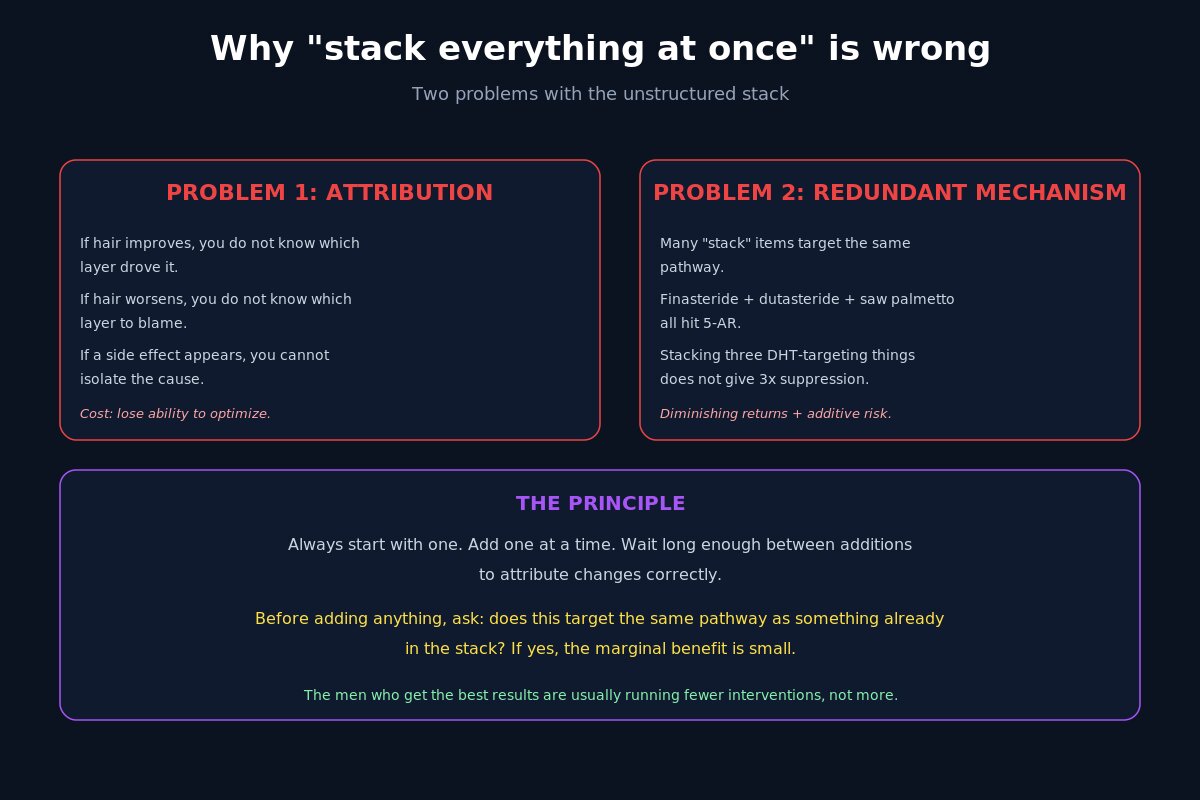
Why “stack everything” is usually wrong
The problem with running six interventions simultaneously is attribution. If your hair improves, you do not know which intervention drove the improvement, which means you cannot drop the redundant ones. If your hair worsens, you do not know which intervention to blame, which means you might quit the one that was actually helping. If a side effect appears, you cannot easily isolate the cause, which forces you to stop everything and re-introduce one at a time. The cost of running an unstructured stack is that you lose the ability to optimize.
The deeper problem is mechanistic. Many of the items on the typical Reddit stack target the same pathway. Finasteride and dutasteride both inhibit 5-alpha reductase. Saw palmetto inhibits the same enzyme weakly. Topical anti-androgens (clascoterone, pyrilutamide, RU58841) work downstream of the same enzyme. Stacking three different DHT-targeting interventions does not produce three times the DHT suppression; it produces somewhat more suppression with diminishing returns and additive side-effect risk. The math on adding a fifth DHT-axis intervention is rarely good.
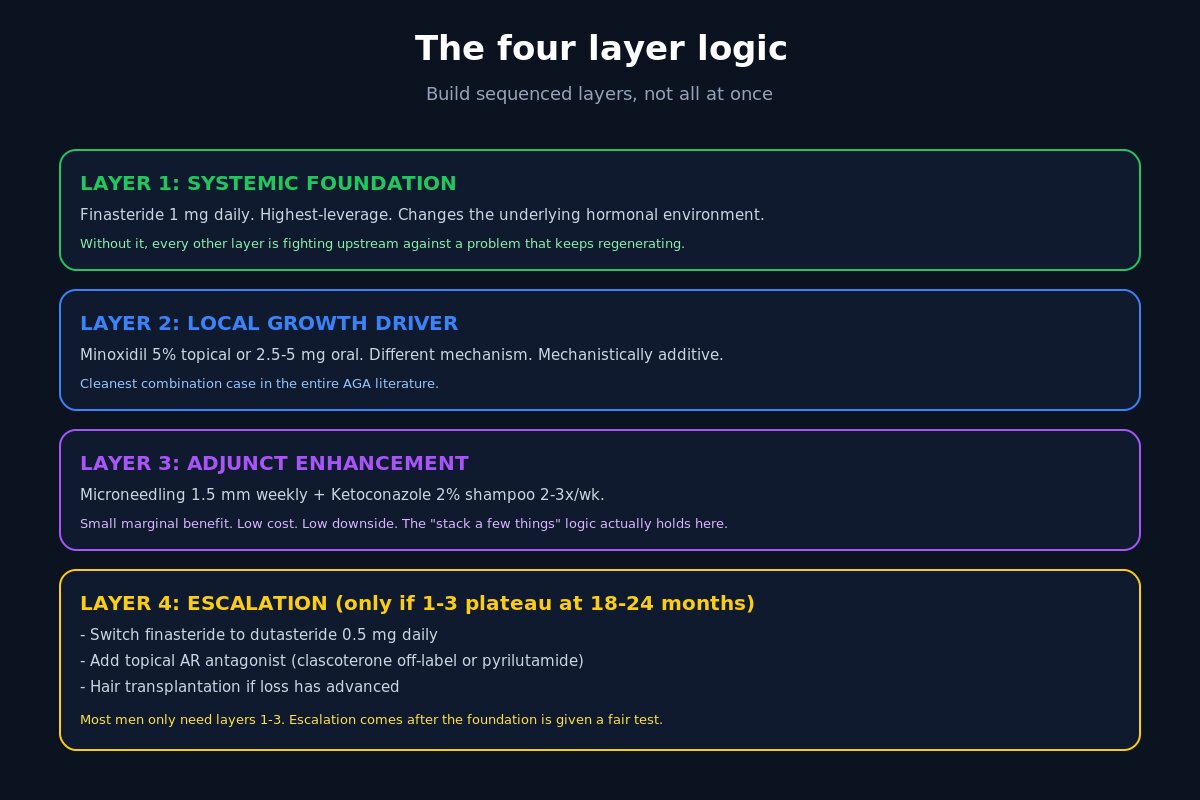
The three layer logic of a real protocol
Layer one is systemic. The systemic layer is the highest-leverage intervention because it changes the underlying hormonal environment driving AGA. Finasteride 1 mg daily is the canonical foundation. Dutasteride is a stronger version of the same intervention. The systemic layer addresses the root cause and protects every follicle on the scalp simultaneously. Without it, the rest of the protocol is fighting upstream against a problem that keeps regenerating.
Layer two is local growth-driving. Minoxidil works through a completely different mechanism than finasteride – vasodilation and growth-phase extension – which makes it mechanistically additive rather than duplicative. The trial data on combined finasteride + minoxidil consistently shows better hair count outcomes than either monotherapy. This is the cleanest case for combination therapy in the entire AGA literature.
Layer three is adjunct enhancement. Microneedling improves topical drug delivery and triggers growth-factor signaling. Ketoconazole shampoo provides weak local anti-inflammatory and possibly weak DHT inhibition. Both add a small marginal benefit on top of layers one and two without targeting the same pathway. This is where the “stack three or four things” logic actually holds up.
Layer four is escalation. Used only after layers one through three have been given the full 18-24 month evaluation window and found inadequate. Dutasteride replacing finasteride. Topical AR antagonist (clascoterone off-label, pyrilutamide if available) added on top. Hair transplantation if loss has advanced enough to make medical-only optimization a holding pattern.
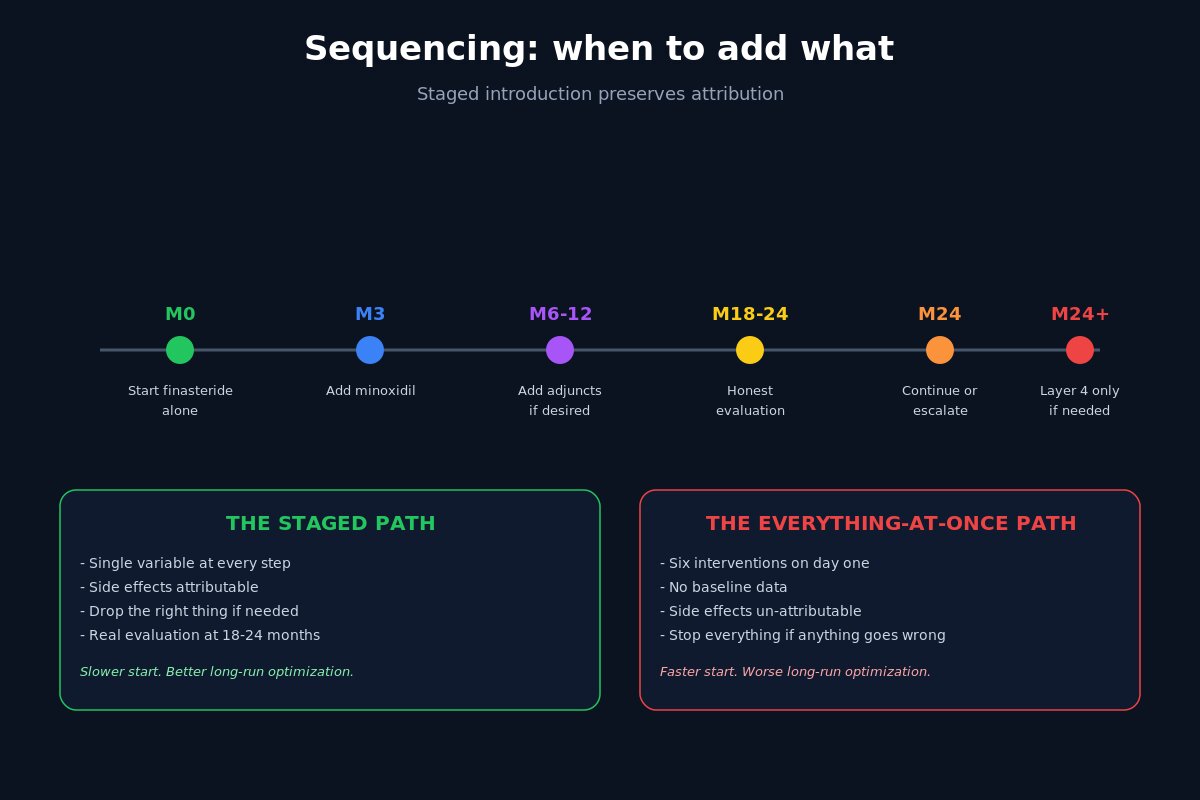
Sequencing: when to add what
Month 0 to 3: start with finasteride alone. Single-variable evaluation period. Learn whether you tolerate it. Take baseline photos.
Month 3 to 6: add minoxidil. By now you have a clean baseline of finasteride alone, so any incremental change after adding minoxidil can be attributed to the addition. The combined response wave hits in months 6-12.
Month 6 to 12: add adjuncts if desired. Microneedling and ketoconazole shampoo are low-risk additions. The marginal benefit is small but the cost is low. Adding them this far in lets you separate their contribution from the foundational pillars.
Month 18 to 24: evaluate. If the protocol is working, continue indefinitely. If it has plateaued (per the diagnostic in the plateau article), consider escalation. Do not escalate at month 6.
Month 24+: escalation if needed. Switch finasteride to dutasteride. Add topical AR antagonist. Consider hair transplant if loss has advanced. These are the moves that come after the foundation has been given a fair test.
Watch this for context
How I Keep My Hair on TRT – frames how the stack actually fits together when you are dealing with a real biological system, not a list of interventions.
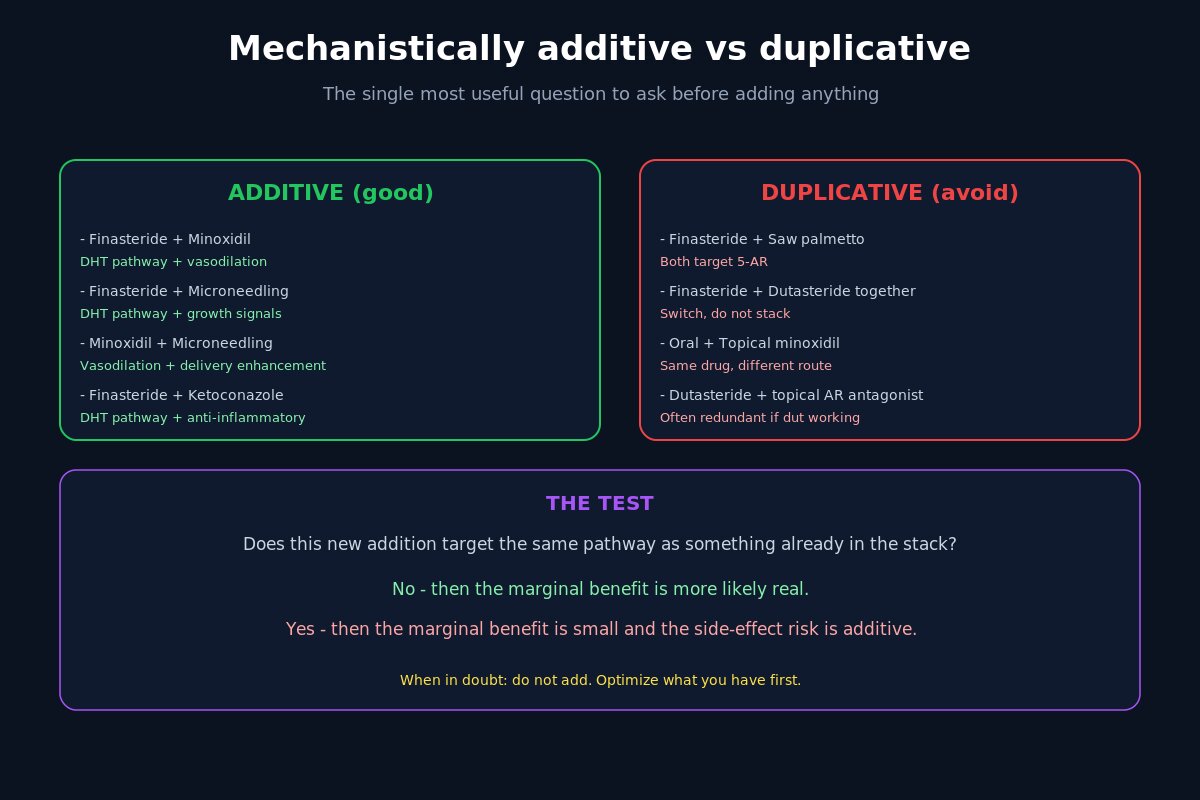
Mechanistically additive vs duplicative
The single most useful question to ask before adding anything to your stack is whether the new addition targets the same pathway as something already in the stack. If yes, the marginal benefit is small and the side-effect risk is additive. If no, the marginal benefit is more likely to be real.
Mechanistically additive combinations include: finasteride + minoxidil (DHT pathway + vasodilation), finasteride + microneedling (DHT pathway + growth factor signaling), minoxidil + microneedling (vasodilation + delivery enhancement), finasteride + ketoconazole (DHT pathway + anti-inflammatory). Each of these pairs targets distinct mechanisms.
Mechanistically duplicative combinations include: finasteride + saw palmetto (both target 5-AR), finasteride + dutasteride simultaneously (both target 5-AR; this is replacement not addition), dutasteride + topical AR antagonist (5-AR inhibition + downstream AR blockade is debatable – sometimes additive in plateau cases, often redundant if dutasteride is working), oral minoxidil + topical minoxidil (same mechanism, same drug, just different route).
Common stacking mistakes
Starting four interventions on day one. This loses the attribution. Always start with one and add one at a time.
Stacking three DHT-axis interventions. Finasteride + saw palmetto + ketoconazole all target the same general pathway. The saw palmetto contribution is dwarfed by the finasteride; the ketoconazole DHT effect is too weak to matter relative to the finasteride. The right way to think about ketoconazole in a stack is as anti-inflammatory adjunct, not as DHT blocker.
Adding supplements with no clear mechanism. The “hair vitamin” category is mostly ingredient-stacking marketing. Adding a multi-ingredient supplement on top of an already-working finasteride/minoxidil stack rarely produces measurable benefit and complicates side-effect attribution.
Switching brands or routes mid-evaluation. If you are 8 months into oral finasteride and switch to topical, you have just reset your evaluation timeline. Do not change the route or brand of any layer-one or layer-two intervention until you have completed at least one 18-24 month cycle on it.
Escalating without confirming plateau. The plateau diagnostic from the previous article applies. Most men who escalate at month 9 are doing so on insufficient data; most plateaus at that point are between-waves gaps.
The minimum viable stack
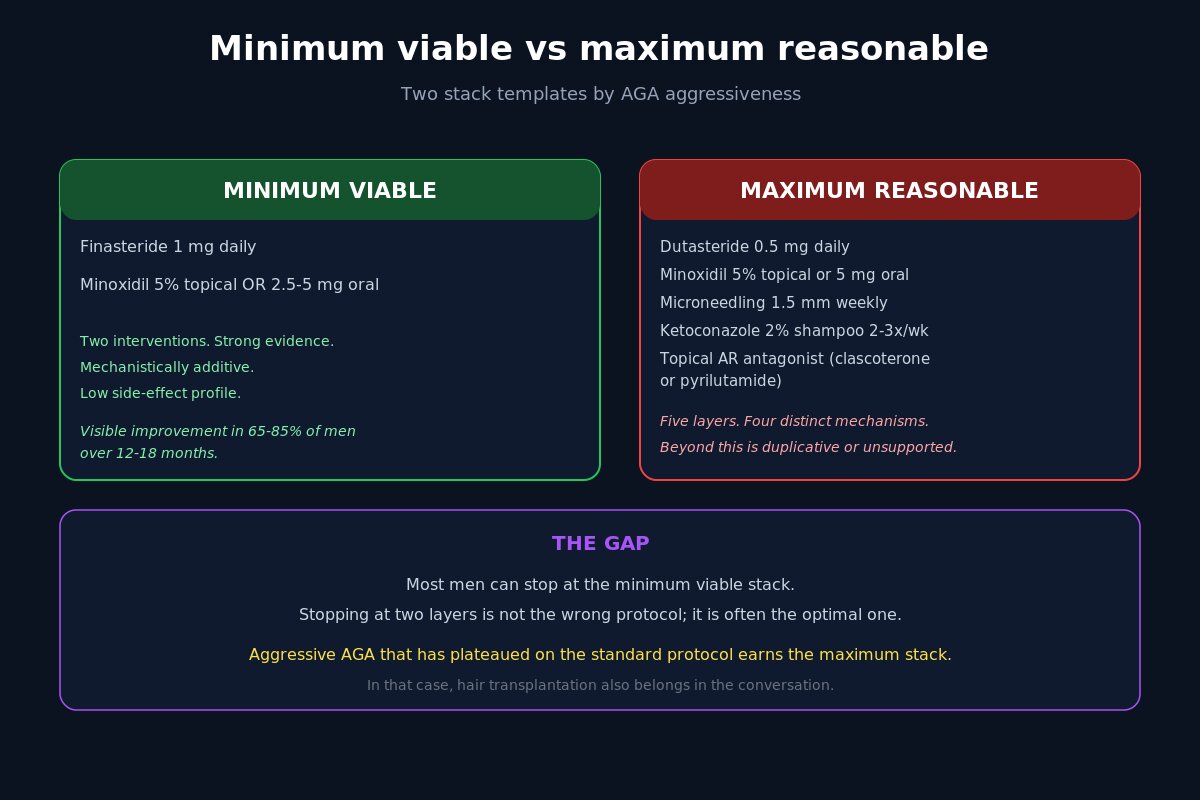
For most men with confirmed AGA, the minimum viable stack is finasteride 1 mg daily + minoxidil topical or oral. That is two interventions, both with strong evidence, mechanistically additive, low side-effect profile in most men. This protocol produces visible improvement in roughly 65 to 85 percent of men over 12-18 months. Adding microneedling and ketoconazole to this is reasonable but produces marginal improvement, not transformation. Stopping at two layers is not the wrong protocol; it is often the optimal one.
The maximum reasonable stack
For aggressive AGA that has plateaued on the standard protocol, the maximum reasonable stack is dutasteride 0.5 mg daily + minoxidil 5 mg oral or 5 percent topical + microneedling 1.5 mm weekly + ketoconazole 2 percent shampoo 2-3x/week + topical AR antagonist (clascoterone or pyrilutamide). That is five layers targeting four distinct mechanisms (5-AR inhibition, vasodilation, delivery enhancement, AR receptor blockade). Anything beyond this is duplicative or unsupported by evidence. Most men in this category should also be considering hair transplantation as the cosmetic option rather than continuing to add medical layers.
Common myths about hair loss combination therapy
The myth that more is always better ignores attribution and additive side-effect risk. The myth that “natural” supplements are zero-risk additions ignores their actual side-effect databases. The myth that you should stack everything at once and let it sort itself out wastes the diagnostic value of staged introduction. The myth that running both oral and topical finasteride is mechanistically additive misses that they are the same drug. The myth that PRP, exosomes, LLLT, scalp massage, peptides, and rosemary oil all belong in the standard stack treats every published positive result as equally weighted; the trial-data hierarchy actually puts a substantial gap between finasteride/minoxidil and almost everything else.
Frequently asked questions about combination therapy
Should I start with finasteride and minoxidil at the same time?
It is reasonable but you lose attribution. The cleaner path is finasteride first for 3 months, then add minoxidil. If you start both on day one and develop a side effect, you cannot easily isolate the cause.
Can I take finasteride and dutasteride together?
Mechanistically redundant. Dutasteride blocks both 5-AR isoenzymes; finasteride blocks one of them. Taking both produces marginally more 5-AR inhibition with much higher side-effect risk. The proper move is to switch from finasteride to dutasteride, not stack them.
Is microneedling worth adding to the stack?
Yes, as a layer-three adjunct. The mechanism is mostly minoxidil-amplification (better penetration, growth-factor signaling). Use 1.5 mm depth, weekly. Low downside, modest upside.
Should I add saw palmetto on top of finasteride?
Probably not. Saw palmetto inhibits the same 5-AR enzymes that finasteride does, much more weakly. Adding it on top of finasteride produces no measurable additional benefit and complicates the stack.
How long should I run a combination protocol before evaluating?
18 to 24 months. Hair-cycle physiology constrains the response timeline regardless of how many layers are in the stack. Earlier evaluation produces unreliable conclusions about which layers are helping and which are not.
Is oral or topical minoxidil better in a stack?
Both work. Topical has more local action and fewer systemic effects but compliance is harder. Oral has better compliance and broader systemic effect (hair on body and beard often grows too). Pick the one you will actually use consistently.
What about PRP, exosomes, LLLT in a stack?
Layer three to four optional adjuncts at best. None has the evidence base of finasteride or minoxidil. Worth considering if you have plateaued on the standard protocol and want to try something with at least some published positive trials.
How do I know which layer to drop if a side effect appears?
This is exactly why staged introduction matters. If you added minoxidil at month 3 and a side effect appeared at month 4, the suspect is the most-recently-added layer. Drop that one first, observe for 2-4 weeks, then decide whether to reintroduce or replace.
Bringing it together
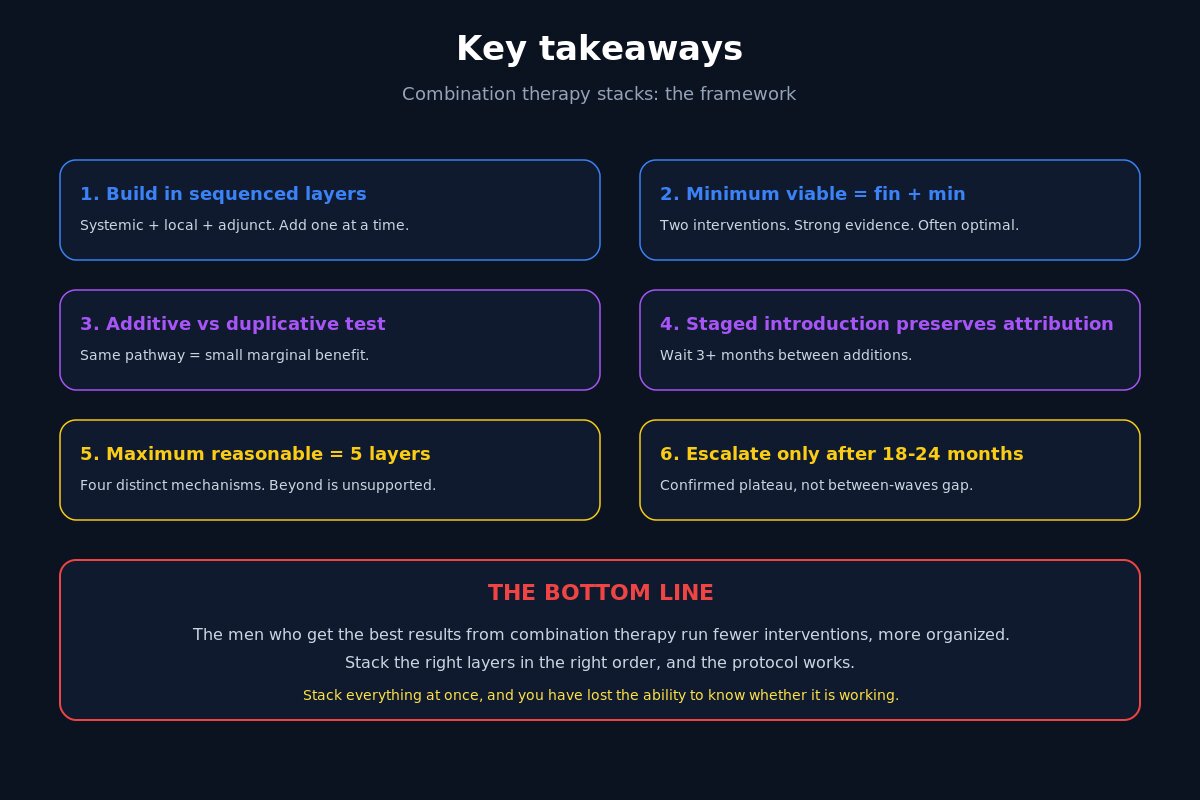
Combination therapy works when each layer targets a distinct mechanism and is added one at a time with a clear evaluation window. The minimum viable stack is finasteride plus minoxidil, which is enough for most men with AGA. The maximum reasonable stack adds microneedling, ketoconazole, and possibly a topical AR antagonist. Everything beyond that is duplicative or weakly supported. The men who get the best results from combination therapy are usually running fewer interventions than the Reddit threads suggest, in a more organized way, with attribution preserved at every step. Stack the right layers in the right order, and the protocol works. Stack everything at once, and you have lost the ability to know whether it is working.
About the author
Philippe Boissard
Author of Men’s Hairloss Protocol (2020), Better, Smarter, Stronger (2023), and Multi-Axis Body (2025). Researches and writes about hair loss and male physiology, citing primary literature and disclosing affiliate relationships in full. Not a medical doctor; all content is educational. More about Philippe.
Related reading
Get my free hair-loss protocol
The exact evidence-based routine I actually use and recommend: what works, in what order, with no hype. Enter your email on the next page and I’ll send it straight to you.
Send me the free protocol →