
Clascoterone (Breezula) Phase 3 Update: Scalp 1 vs Scalp 2 and What It Means
What the Cosmo Pharmaceuticals Scalp 1 (5.39x) and Scalp 2 (1.68x) Phase 3 readouts actually show for clascoterone in male hair loss, and where the topical AR antagonist sits relative to RU58841, pyrilutamide, finasteride, and minoxidil heading into the 2026 approval window.


Clascoterone is the first topical androgen receptor antagonist with a real Phase 3 dataset in male pattern hair loss, and the headline numbers from the Scalp 1 and Scalp 2 trials are the most decisive non-finasteride data the field has seen in twenty years. Cosmo Pharmaceuticals reported in 2025 that the 5 percent solution drove a 5.39-fold relative improvement in target area hair count over vehicle in one trial and a 1.68-fold improvement in the other across roughly 1,465 randomized patients. That spread is the story. The drug works, but the size of the win depends on which trial you read, and the regulatory path now hinges on a 12 month safety follow-up that completes in spring 2026. This article is a clean read on what the Phase 3 data actually showed, where clascoterone fits relative to RU58841 and pyrilutamide, and how to think about it before it is approved.
Quick answer: does clascoterone work for hair loss?
Yes, with statistically significant Phase 3 evidence and a mechanism that targets DHT at the receptor rather than blocking 5-alpha reductase upstream. In Cosmo Pharmaceuticals reporting on the Scalp 1 and Scalp 2 trials, clascoterone 5 percent solution produced relative improvements in target area hair count of 5.39 times vehicle in one trial and 1.68 times vehicle in the other, with both results reaching statistical significance and a safety profile materially cleaner than oral 5-AR inhibitors. The drug is not yet approved for hair loss. Cosmo plans regulatory submissions in the United States and Europe after a 12 month safety follow-up wrapping in spring 2026.
The practical translation is that clascoterone is a strong candidate to become the first new mechanism-class hair loss drug since finasteride was approved in 1997, that the magnitude of effect appears comparable to topical minoxidil with a different and arguably cleaner side-effect profile, and that the variance between the two trials is larger than usual and deserves attention before treating clascoterone as a finasteride replacement.
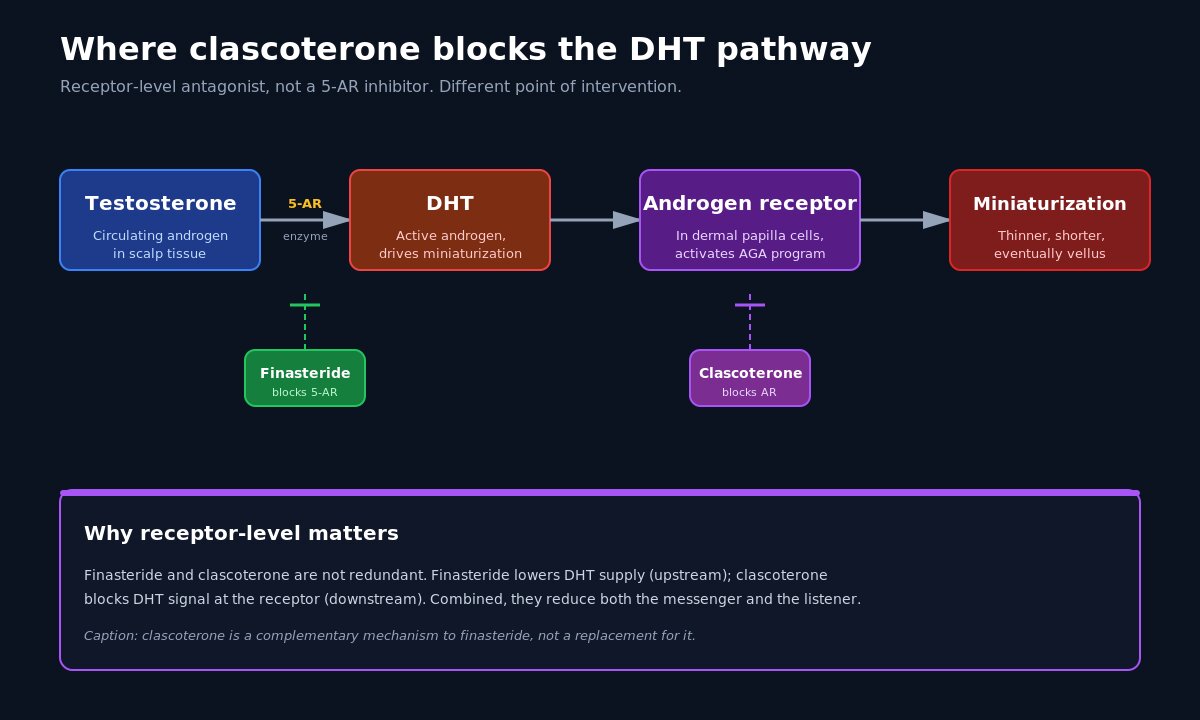
How clascoterone works at the receptor
Clascoterone is a topical androgen receptor antagonist. It binds to the same receptor that DHT binds to inside dermal papilla cells and blocks DHT from triggering the downstream signaling that drives follicular miniaturization. This is the same target as RU58841 and pyrilutamide. It is a different target from finasteride and dutasteride, which sit upstream of DHT by inhibiting the 5-alpha reductase enzyme that converts testosterone to DHT. The receptor-level approach has been an obvious target for decades, but turning it into a drug that does not produce systemic anti-androgenic effects has been the engineering problem.
Clascoterone solves the systemic exposure problem by being designed for rapid local metabolism. The compound is a steroidal anti-androgen built on a cortexolone backbone (the molecule is also known as cortexolone-17-alpha-propionate, see Trifu et al. 2011 for the early acne data). Once absorbed into the skin it is rapidly hydrolyzed into cortexolone, an inactive metabolite. The half-life in the bloodstream is short, peripheral receptor occupancy is minimal, and standard endocrine markers do not move meaningfully in dosed subjects. This is why clascoterone is already approved as Winlevi for acne in the United States with no detectable systemic anti-androgen effects in trials, and why the hair loss program does not carry the same post-finasteride syndrome concerns that have shadowed oral 5-AR inhibitors. For background on the broader pathway, see how hair loss actually works.
The Scalp 1 and Scalp 2 Phase 3 results
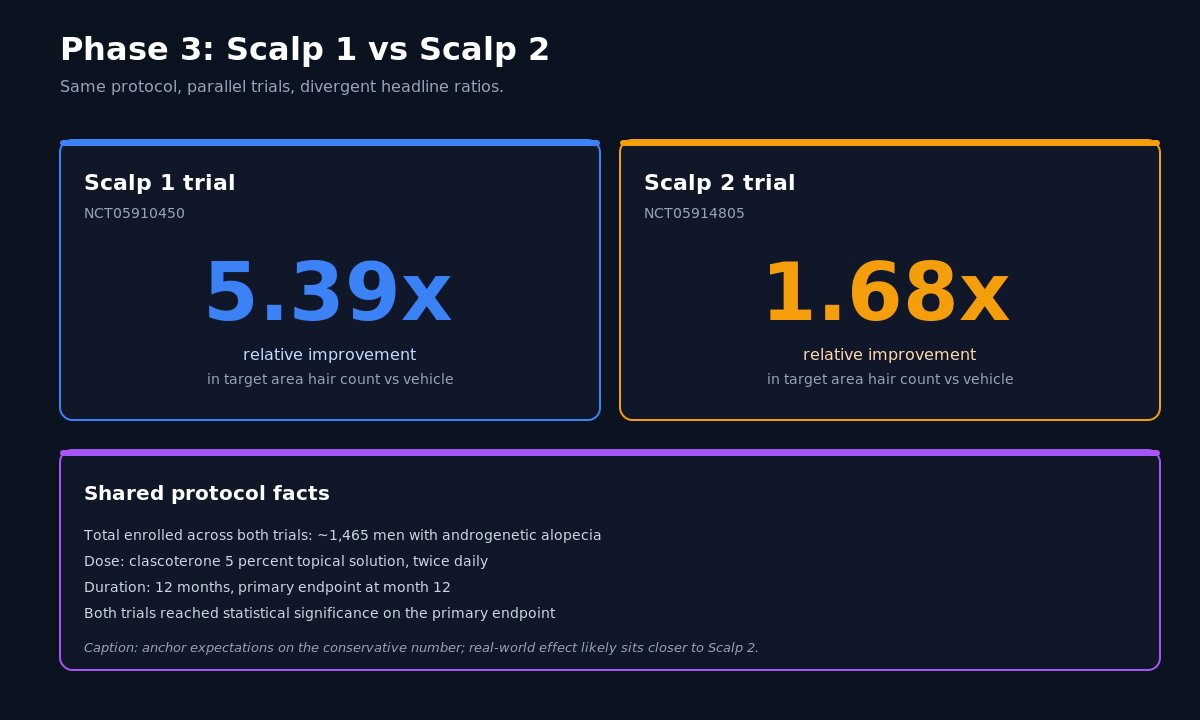
The Phase 3 program enrolled approximately 1,465 men with androgenetic alopecia in two identical, parallel, vehicle-controlled studies (Scalp 1: NCT05910450, Scalp 2: NCT05914805). Patients applied clascoterone 5 percent solution or placebo vehicle to the scalp twice daily for 12 months. The primary endpoint was change from baseline in target area hair count at month 12. Cosmo Pharmaceuticals reported topline data from both trials in late 2025.
In Scalp 1, clascoterone 5 percent produced a 5.39-fold relative improvement in target area hair count compared to vehicle. In Scalp 2, the same dose produced a 1.68-fold relative improvement. Both numbers were statistically significant. The honest read on the spread is that the underlying biology probably falls between the two trials and that real-world response will likely sit closer to the Scalp 2 number than the Scalp 1 headline. Clinical trial protocols are tightly controlled, and even small differences in patient selection, baseline severity, or local site practices can produce a 2-3x divergence in measured effect size. The Scalp 2 result is the one to anchor expectations on.
Both trials reported safety profiles consistent with the existing acne label. The most common adverse events were local skin reactions: erythema, scaling, mild irritation. Systemic adverse events were rare and not statistically different from vehicle. The endocrine markers (testosterone, free testosterone, LH, FSH, SHBG) did not change meaningfully in the active arms, mirroring the absence of systemic effects already documented in the acne program.
Comparing clascoterone to existing therapies
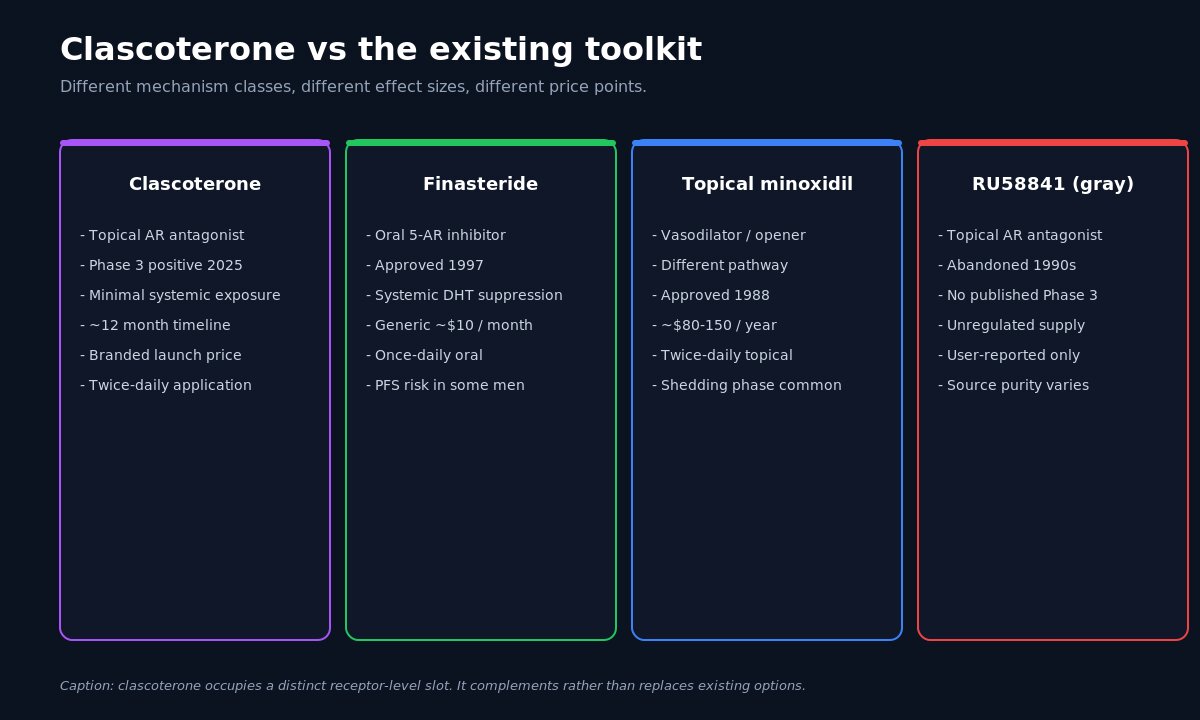
The honest comparison is to topical minoxidil, not to oral finasteride. Topical finasteride and oral finasteride sit at the upstream end of the pathway and produce systemic DHT suppression of 30-70 percent depending on dose. Clascoterone leaves systemic DHT untouched and works only at the receptor inside the scalp. The magnitude of clinical effect from clascoterone Scalp 2 is roughly comparable to what minoxidil monotherapy produces in trials, though the comparison is indirect because no head-to-head trial has been conducted.
The case for clascoterone over finasteride is that it does not carry post-finasteride concerns, does not affect systemic hormone levels, and works through a complementary mechanism that can stack on top of finasteride. The case for finasteride over clascoterone is that finasteride has 28 years of post-marketing data, predictable response rates, and a generic price under $10 per month at most pharmacies. Clascoterone for hair loss will be branded, expensive at launch, and will require twice-daily application for the foreseeable future. For men who are responding to finasteride and tolerating it, clascoterone will be most useful as an add-on for incremental gains, not as a switch. For background on switching mechanisms, see when to switch from finasteride to dutasteride.
The case for clascoterone over topical minoxidil is the side-effect profile (no shedding phase, no risk of edema or palpitations, no scalp dependence in the same way), the mechanism specificity (it is targeting the actual driver of AGA, not just stimulating anagen entry through unclear pathways), and the cleaner safety story for long-term use. The case for topical minoxidil over clascoterone is price, availability today, and a 30+ year track record. For more on minoxidil tradeoffs, see why I stopped using minoxidil.
Clascoterone vs RU58841 vs pyrilutamide

All three are topical androgen receptor antagonists. The differences matter for sourcing, evidence, and regulatory status. RU58841 is the oldest of the three. It was developed by Roussel Uclaf in the 1980s as a non-steroidal anti-androgen, was tested in animal hair-loss models, and was abandoned by the original developer before reaching late-stage human trials. It has been available on the gray market for two decades and has substantial user-reported data but no published modern Phase 3 trial in any indication. The supply chain is unregulated, purity varies by source, and there is no FDA path for it. For a deeper read on legality and sourcing, see the RU58841 evidence and sourcing piece.
Pyrilutamide (KX-826) is the Kintor Pharma compound that completed Phase 3 trials in China with mixed results. The earlier dose-finding studies were positive, the Phase 3 readout was disappointing on the primary endpoint, and the regulatory path outside China is uncertain. Pyrilutamide is the closest direct analog to clascoterone in that it was designed as a topical AR antagonist with limited systemic exposure, but the published efficacy data for clascoterone is now stronger than what pyrilutamide has shown.
Clascoterone is the only one of the three with a positive Phase 3 readout in male pattern hair loss from a regulated trial program with FDA dialogue ongoing. It is also the only one with an existing approved product (Winlevi for acne) demonstrating the safety profile in commercial use. If you are choosing between unregulated RU58841 today and waiting 12-24 months for clascoterone approval, the calculus depends entirely on how aggressive your hair loss is and how much regulatory comfort matters to you.
Watch this for context
This Hair Loss Compound Works Differently frames why mechanism class matters more than marketing class. The video walks through why a topical receptor antagonist sits in a different category from a 5-AR inhibitor and why combining the two is more interesting than substituting one for the other. It is the right pairing for a clascoterone read because the central question is not “does it work” but “how does it fit alongside what already works.”
Why the trial-to-trial variance is large
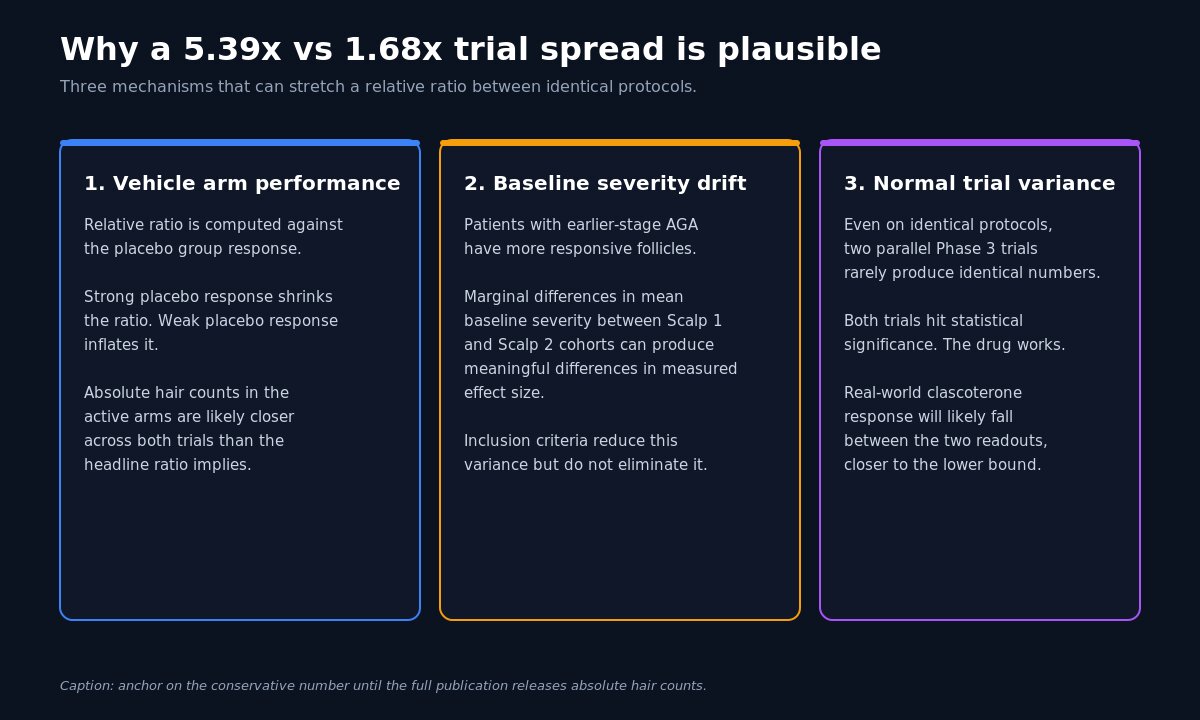
A 5.39-fold improvement in one Phase 3 trial and a 1.68-fold improvement in a parallel trial run on the same protocol is a wider spread than the field is used to seeing. This is the single most important number to interrogate before treating the topline data as decisive. Three plausible explanations sit on the table.
First, vehicle-arm performance. The relative ratio is computed against the placebo group’s hair count change. If one trial’s placebo arm did unusually well (regression to the mean, seasonal shedding patterns, more attentive site staff), the relative improvement number compresses. If the other trial’s placebo arm did poorly (stronger shedding, less compliant patients), the relative improvement number expands. The absolute hair count gain in the active arms across both trials is probably narrower than the 5.39 vs 1.68 spread suggests.
Second, baseline severity. Patients with more advanced AGA at baseline have less responsive follicles. Patients in earlier-stage AGA have more responsive follicles. If Scalp 1 enrolled a marginally less-advanced cohort than Scalp 2, the same drug would produce a larger measured effect. The Phase 3 inclusion criteria do not eliminate this variance, they just reduce it.
Third, normal trial variance. Even on identical protocols, two parallel Phase 3 trials can produce numerically different outcomes. The relevant question is whether both trials hit statistical significance on the same primary endpoint, and Cosmo has stated that they did. The drug works. The exact effect size will be clearer once the full publication is available with absolute numbers, confidence intervals, and responder analysis. Until then, the conservative read is that real-world clascoterone performance probably tracks the Scalp 2 number, not the Scalp 1 headline.
What clascoterone does not solve
Clascoterone is a receptor-level intervention. It does not address the upstream drivers of androgen signaling, does not regrow scarred follicles, and does not produce the kind of dramatic restoration that consumer marketing for “next generation” hair drugs sometimes implies. The Scalp 2 effect size is meaningful but in the same range as topical minoxidil. The data does not support framing clascoterone as a hair-cloning replacement, an alternative to transplant for advanced loss, or a “set and forget” solution.
The cessation question applies the same way it does to any androgen-pathway drug. If you stop clascoterone, the receptor-level block ends within days, DHT signaling resumes, and the underlying AGA progression resumes from where it would have been without treatment. The benefit of clascoterone holds only as long as application continues. This is the same constraint as finasteride, dutasteride, minoxidil, and every other long-term hair loss therapy. It is not a flaw of clascoterone specifically, but it is a constraint that needs to be priced into the lifetime cost-benefit decision. For the broader pipeline view, see the hair cloning pipeline 2026 reality check.
How to think about clascoterone before approval
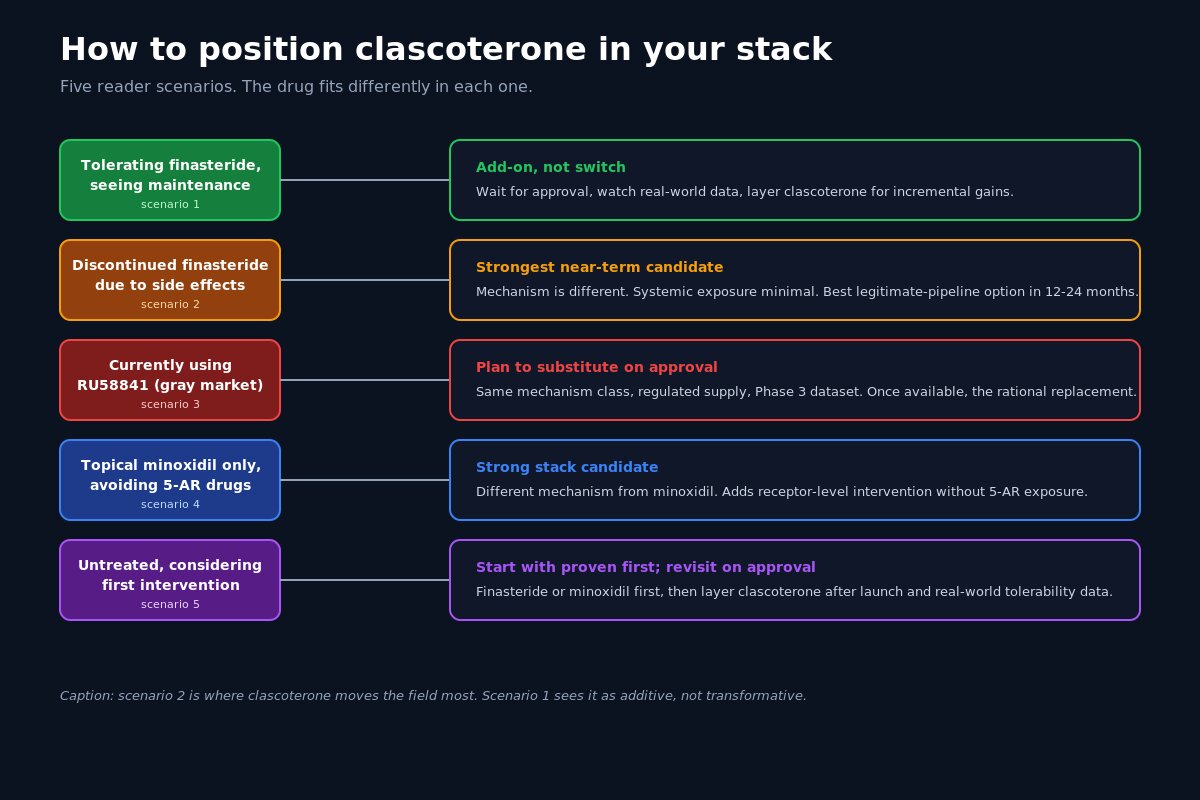
Three positions are reasonable. First, if you are tolerating finasteride and seeing maintenance or growth, clascoterone is best framed as a future add-on for an extra increment of effect, not a replacement. Wait for approval, see real-world data, and consider stacking it.
Second, if you have stopped finasteride due to side effects (or are unwilling to start it because of post-finasteride syndrome concerns), clascoterone is the most promising legitimate-pipeline option in the next 12-24 months. The mechanism is different, the systemic exposure is minimal, and the trial program has documented absence of endocrine effects. For the side-effect literature on oral 5-AR inhibitors, see the post-finasteride syndrome read.
Third, if you are using gray-market RU58841 today, clascoterone is the same mechanism class with a regulated supply chain, a Phase 3 dataset, and an FDA approval pathway. Once available, it is the rational substitute. Until available, the choice between continuing RU58841 or pausing the AR-antagonist arm of a stack depends on individual progression speed and risk tolerance.
Common myths about clascoterone
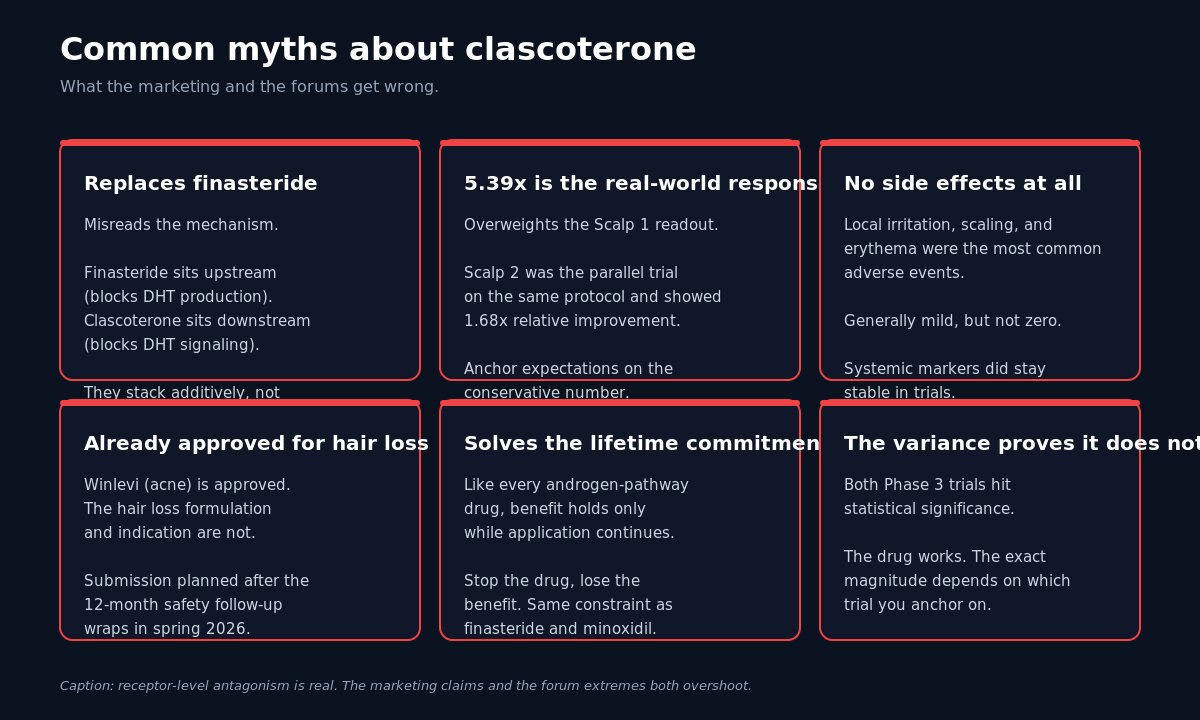
The myth that clascoterone replaces finasteride misreads the mechanism. They target different points in the same pathway and stack additively rather than substituting. The myth that the 5.39x headline is the expected real-world response overweights the Scalp 1 trial and underweights the Scalp 2 trial that more conservatively anchors expectations. The myth that clascoterone has no side effects ignores that local irritation, scaling, and erythema were the most common AEs in the trial program, even though they were generally mild. The myth that clascoterone is FDA approved for hair loss today conflates the existing acne approval (Winlevi, on label) with the pending hair loss submission (still subject to safety follow-up and review). The myth that clascoterone solves the lifetime treatment commitment problem misunderstands that any androgen-pathway drug requires continued application to maintain the benefit. The myth that the Cosmo data is suspicious because of the trial-to-trial variance overweights the headline ratio at the expense of the absolute hair count and statistical significance, both of which were positive in both trials.
Frequently asked questions about clascoterone
When will clascoterone be approved for hair loss?
Cosmo Pharmaceuticals plans to complete the 12-month safety follow-up in spring 2026, then file regulatory submissions in the United States and Europe. The earliest plausible approval window is late 2026 to 2027, depending on FDA review timelines and any required additional data.
How does clascoterone compare to finasteride?
Different mechanism, different effect size, different safety profile. Finasteride blocks DHT production systemically. Clascoterone blocks DHT signaling locally at the receptor. Finasteride has more aggregate effect on hair count in head-to-head terms but carries systemic side effects in some men. Clascoterone is closer in effect size to topical minoxidil and has minimal systemic exposure.
Can clascoterone replace finasteride?
For men who do not tolerate finasteride, it is the most promising replacement candidate in the pipeline. For men who tolerate and respond to finasteride, clascoterone is more naturally framed as an add-on for incremental gain than as a switch.
Is clascoterone safer than finasteride?
The safety profile in trials is materially cleaner for systemic effects. Local skin reactions are the dominant adverse event. Systemic endocrine markers do not change. Whether this translates to a clearer safety story over decades of post-marketing use will be visible only after broad commercial use, but the trial data points clearly in that direction.
Can I use clascoterone with finasteride or minoxidil?
Mechanistically yes. Finasteride works upstream, clascoterone works at the receptor, minoxidil works through a separate growth-stimulating pathway. The three are non-overlapping mechanisms and can be stacked. The combined trial data does not exist yet, but theoretical additive benefit is well-grounded.
What is the difference between clascoterone and Winlevi?
They are the same active molecule. Winlevi is the brand name for clascoterone 1 percent cream approved for acne in the United States. The hair loss product uses a 5 percent solution formulation and a different vehicle better suited to scalp application. Same mechanism, different concentration, different vehicle.
How does clascoterone compare to RU58841?
Same mechanism class. Clascoterone has a regulated Phase 3 dataset and an FDA approval pathway. RU58841 has decades of user-reported data but no published modern trials and no regulatory pathway. Once clascoterone is approved, it is the rational substitute for RU58841 for most users.
Will clascoterone work for women?
The Phase 3 program enrolled men. A female pattern hair loss program is plausible given that female AGA also runs through androgen receptor signaling, but no data is available yet and the regulatory submission for the female indication will likely follow the male indication by years.
How is clascoterone applied?
Twice daily topical application of the 5 percent solution to the affected scalp area. Same general application pattern as topical minoxidil. The exact volume and instructions will be defined by the final approved label.
How long until I see results from clascoterone?
The Phase 3 endpoint was 12 months. Most hair loss interventions show partial effect at 4-6 months and the full effect at 12 months. Expect a similar timeline. Like all hair loss therapies, the cessation of treatment results in loss of benefit.
Bringing it together
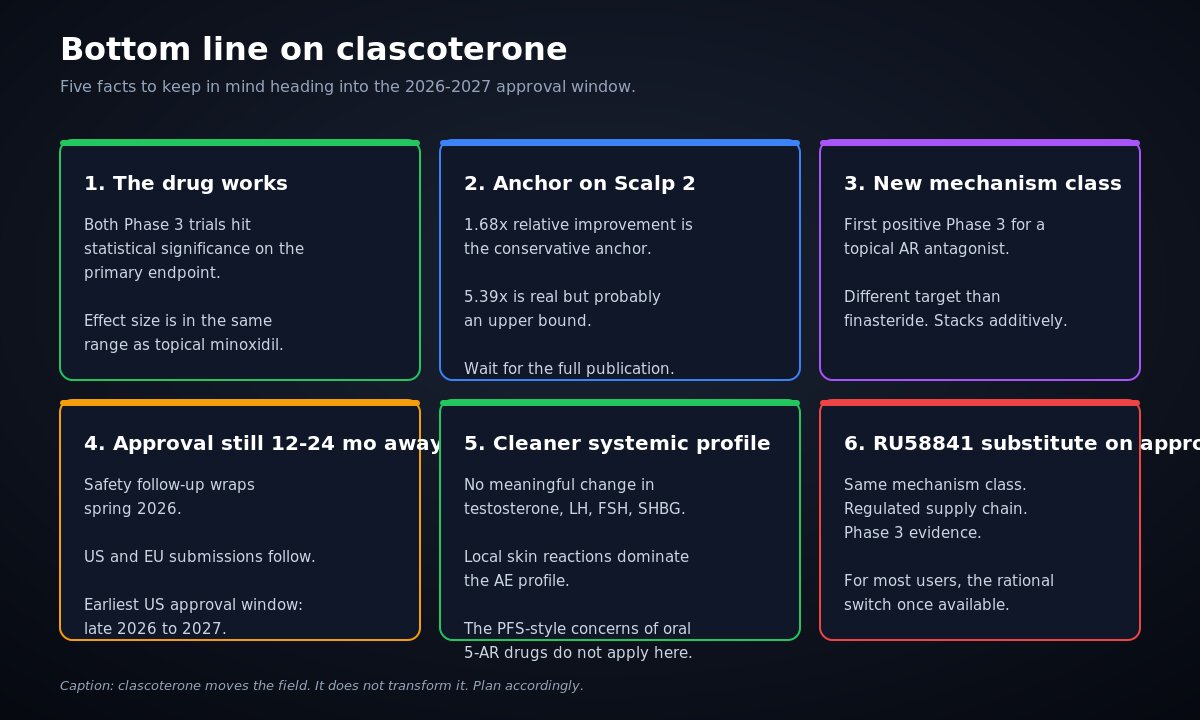
Clascoterone is the most consequential hair loss drug to reach Phase 3 in two decades. The Scalp 2 number anchors realistic expectations: meaningful, comparable to topical minoxidil in effect size, with a cleaner systemic safety profile than oral 5-AR inhibitors. The Scalp 1 headline of 5.39x is real but probably an upper bound. The drug does not replace finasteride for men who tolerate it and stacks additively for men who want incremental gains. The drug does displace RU58841 once approved by offering the same mechanism with regulatory backing. The 12-month safety follow-up completing in spring 2026 is the next checkpoint, with U.S. and European submissions following. For the broader treatment landscape, see the earlier clascoterone deep dive, the finasteride non-responder analysis, and the protocol troubleshooting guide for context on where a new mechanism fits in a real-world stack.
This article is for informational purposes only and does not constitute medical advice. Hair loss treatment decisions should be made in consultation with a qualified clinician familiar with your medical history. See the disclaimer for full terms.
Related reading
Get my free hair-loss protocol
The exact evidence-based routine I actually use and recommend: what works, in what order, with no hype. Enter your email on the next page and I’ll send it straight to you.
Send me the free protocol →