
RU58841 vs Finasteride: How the Topical Anti-Androgen Compares
RU58841 vs finasteride: how a topical anti-androgen compares to oral finasteride on DHT blockade, regrowth potential, and systemic risk. An evidence-based breakdown.

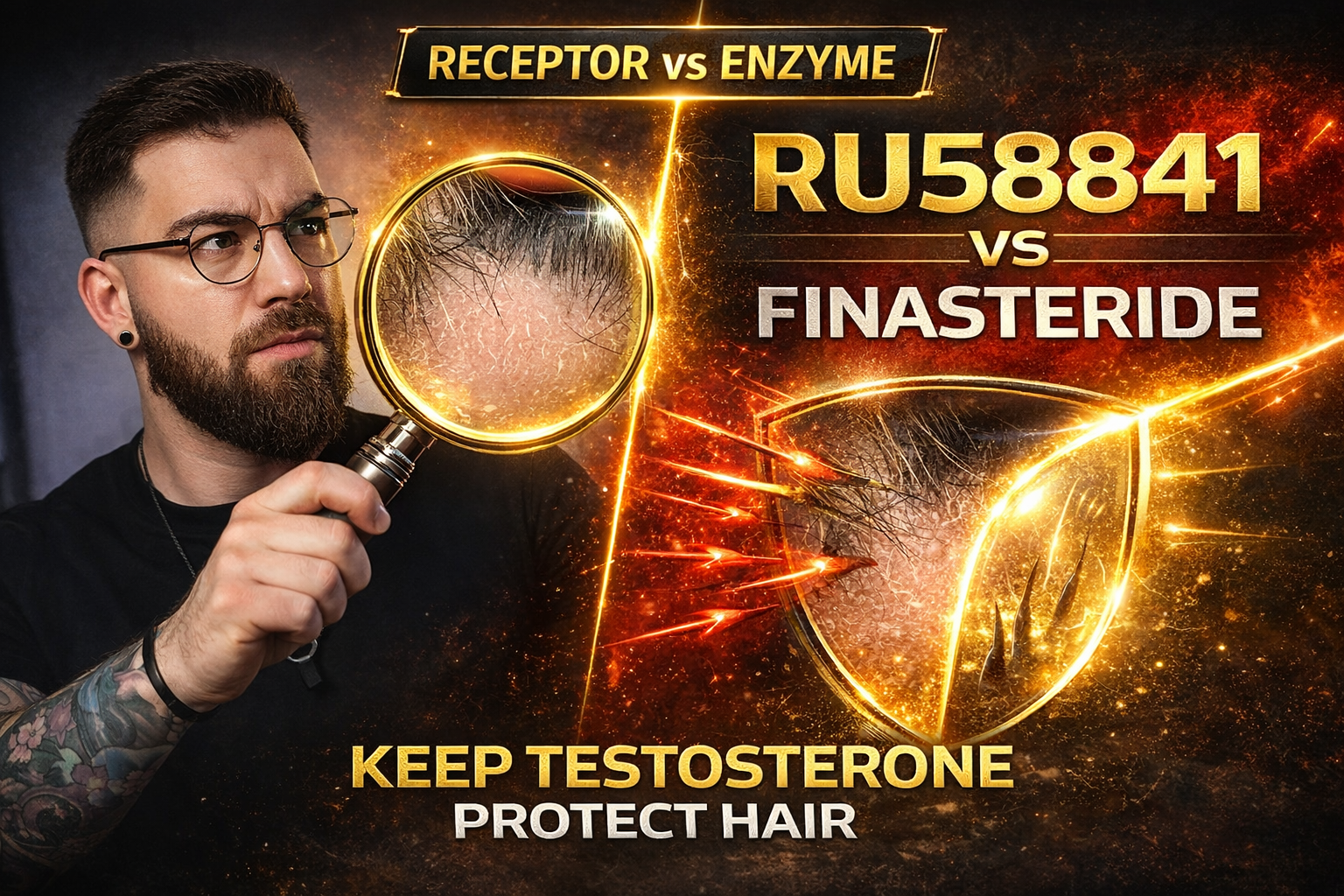
RU58841 vs. Finasteride: Mechanism and Efficacy Compared
By Philippe | Philippe’s Blueprint
In the world of androgenic alopecia (AGA) prevention, the “Standard of Care” often stops at 5α-reductase inhibitors like Finasteride. While effective for the general population, for the reader, specifically the man concerned with athletic performance, neurosteroid health, and maximum androgenic signaling everywhere but the scalp, finasteride works through a blunter, system-wide mechanism.
The debate isn’t just about “which one grows more hair.” The real question is: Do you want to lower DHT production across the whole body, or block DHT only at the receptor in the scalp?
This analysis compares the pharmacodynamics, binding affinity, and systemic impact of RU58841 (the receptor antagonist) versus finasteride (the enzyme inhibitor), and where each one fits.
1. The Mechanism of Action (MoA): A Fundamental Divergence
To understand efficacy, we must first understand the biological pathway of miniaturization.
- The Culprit: Dihydrotestosterone (DHT) binds to the Androgen Receptor (AR) in the hair follicle dermal papilla.
- The Result: This binding triggers TGF-β1 and other inflammatory cytokines, shortening the anagen (growth) phase and miniaturizing the follicle.
Finasteride: The Systemic “Nuke”
Finasteride is a Type II 5α-reductase inhibitor. It works upstream.
- Mechanism: It disables the enzyme responsible for converting Testosterone into DHT.
- Result: Circulating serum DHT drops by ~70%. Scalp DHT drops similarly.
- The Flaw: It relies on systemic deprivation. By crushing DHT levels body-wide, you are altering a primary hormonal cascade. For men on TRT or those maximizing natural testosterone, this dulls the androgenic “edge” necessary for libido, aggression, and neurological drive. Furthermore, it leaves the Androgen Receptor (AR) itself naked and vulnerable to remaining androgens (including Testosterone itself, which can still miniaturize sensitive follicles in the “Deadzone”).
RU58841: The Local “Shield”
RU58841 is a non-steroidal anti-androgen (NSAA). It works at the target.
- Mechanism: It competes directly for the Androgen Receptor. It has no hormonal activity itself; it is a silent antagonist.
- Result: It occupies the receptor site on the hair follicle. When DHT (or Testosterone) arrives, the “lock” is already filled. The key cannot enter. No signal is sent. No miniaturization occurs.
- The Advantage: It allows for high circulating androgens (great for muscle, mood, and libido) while strictly protecting the scalp tissue locally.
2. Binding Affinity & Potency Data
The most common criticism of topical anti-androgens is that they are “too weak” to compete with endogenous DHT. The data on RU58841 suggests otherwise.
In comparative binding assays, the affinity of a compound for a receptor is measured by its dissociation constant ($K_d$). A lower number means tighter binding.
- Testosterone: High affinity.
- DHT: Very high affinity (approx. 2-3x that of Testosterone).
- RU58841: Demonstrates a binding affinity ($K_d$ ≈ 1.1–2.0 nM) comparable to potent systemic anti-androgens like Hydroxyflutamide.
The “Brouwer & van der Schoot” Standard: In the landmark macaque studies, the closest biological proxy to human androgenic alopecia, RU58841 demonstrated exceptional dose-dependent regrowth. Unlike Finasteride, which struggles to regrow hair in the frontal hairline (the notorious “M-Shape” recession), RU58841 showed significant anagen maintenance in the frontal scalp.
Why? The frontal hairline is densely packed with Androgen Receptors. Even if Finasteride lowers DHT by 70%, the remaining 30% (plus scalp Testosterone) is often enough to continue miniaturizing these highly sensitive follicles. RU58841, by blocking the receptor itself, blocks all androgens at the follicle, regardless of circulating DHT levels.
3. The “Side Effect” Calculus: Neurosteroids vs. Metabolites
This is the deciding factor for many in the “Blueprint” community.
The Finasteride Risk (Systemic): By inhibiting 5AR, Finasteride prevents the synthesis of neurosteroids like Allopregnanolone, a potent modulator of GABA-A receptors in the brain. This is the biological basis for the mood instability, “brain fog,” and depressive symptoms reported in a subset of users (Post-Finasteride Syndrome).
The RU58841 Risk (Local/Systemic Leakage): The safety profile of RU58841 relies on its metabolic pathway.
- Application: Applied topically to the scalp.
- Absorption: Penetrates the stratum corneum to reach the follicle.
- Systemic Entry: If it enters the bloodstream, it is rapidly metabolized into RU58841-BP (Cyano-nilutamide).
- The Safety Valve: RU58841-BP has vastly lower binding affinity (~1%) compared to the parent compound. Even if it “leaks” into your system, it is biologically inert regarding your hormonal axis.
Note: Systemic side effects (chest tightness/fatigue) are anecdotal but possible if applied to broken skin (e.g., immediately after microneedling) or used in excessive dosages (>100mg).
4. The Verdict: Optimization vs. Preservation
Choose Finasteride If:
- You want a “set it and forget it” daily pill.
- You are not concerned with maximizing systemic DHT for athletic performance.
- You are primarily treating diffuse thinning on the vertex/crown (where Finasteride is most effective).
- Cost is the primary constraint (generic Finasteride is cheap).
Choose RU58841 If:
- You are the “Scientist/Athlete”: You want to keep your serum androgens high for gym performance/TRT optimization but protect your hair.
- You are fighting the “Deadzone”: You need to regrow or maintain the frontal hairline where Finasteride often fails.
- You are sensitive to systemic side effects: You cannot tolerate the neurosteroid inhibition or libido changes associated with 5AR inhibitors.
My Personal Protocol
I use RU58841 as the cornerstone of my own approach specifically because it lets me preserve normal systemic androgen levels while still protecting the hair follicle. It is not about lowering hormones; it is about location-specific management.
References & Sourcing
- Pan, H. J., et al. (1998). “Evaluation of RU58841 as an anti-androgen in prostate cells and a topical anti-alopecia agent in the bald scalp of stumptailed macaques.” Endocrine.
- Matias, J. R., et al. (1995). “Local inhibition of sebaceous gland growth by topically applied RU58841.” The Journal of Investigative Dermatology.
See my full RU58841 sourcing and legality guide (Disclaimer: This article is for informational and research purposes only. I am not a doctor. RU58841 is a research compound and is not FDA approved for human consumption.)
Get my free hair-loss protocol
The exact evidence-based routine I actually use and recommend: what works, in what order, with no hype. Enter your email on the next page and I’ll send it straight to you.
Send me the free protocol →
Hi
I don’t want to use Fin/Dut anymore due to horrible sides ( reduced semen volume, etc).
Looking for alternatives. Just wondering which of these are better and why ?
RU or Pyrilutamide…will use with minox 5%.
Is LLLT any good ?
Many thanks, Nick in London, UK
Hi Nick,
Thanks for the message, and I completely understand where you’re coming from. A lot of men reach a point where they don’t want to continue with finasteride or dutasteride because of side effects, and reduced semen volume is actually one of the more commonly reported ones.
The good news is that there are alternatives that don’t lower DHT systemically.
Between RU58841 and Pyrilutamide, both belong to the same category of treatments called topical androgen receptor antagonists. Instead of lowering DHT throughout the body like finasteride does, they work locally on the scalp by blocking DHT from binding to the hair follicle.
RU58841 has been around for a long time in the research community and there are thousands of anecdotal reports from users. It’s generally considered quite potent when used consistently. Pyrilutamide is newer and has gone through more formal clinical trials, but in real-world use RU currently seems to have the stronger track record.
If you combine one of those with 5% minoxidil, you’re essentially recreating the two main mechanisms we want for hair preservation:
• blocking the androgen signal
• stimulating follicle growth
As for LLLT (laser therapy), there actually is clinical evidence supporting it. It’s not a miracle treatment on its own, but when used together with other therapies it can improve hair density and shaft thickness over time. I’ve covered the science behind laser helmets in another video if you’re curious.
If you want a deeper explanation of these options, you might find these videos helpful on my channel:
• My breakdown of RU58841 and how it compares to finasteride
• My video on low-level laser therapy and whether those helmets actually work
• And my guide on building a complete hair loss routine without systemic drugs
You can find them on my YouTube channel Philippe’s Blueprint.
The most important thing is catching the problem early and staying consistent with whatever routine you choose. Since you mentioned you still have decent coverage, that’s actually the best position to be in for maintaining what you have.
Hope this helps, and feel free to ask if you have more questions.
Best,
Philippe
If you want to avoid finasteride or dutasteride, the closest alternative in terms of mechanism is RU58841. It’s a topical androgen receptor antagonist, meaning it blocks DHT at the follicle level instead of lowering systemic DHT.
Early research showed strong anti-androgen effects in hair follicles. For example:
• Battmann et al., 1998 – Journal of Steroid Biochemistry & Molecular Biology showed RU58841 prevented androgen-induced hair loss in animal models.
• Pan et al., 2004 – Experimental Dermatology demonstrated that topical RU58841 suppresses androgen activity in hair follicles with minimal systemic exposure.
Because it works locally, many people tolerate it better than systemic 5-AR inhibitors.
If you go this route, I’d strongly recommend adding microneedling once weekly. The evidence for it is actually very solid:
• Dhurat et al., 2013 – International Journal of Trichology showed microneedling + minoxidil produced significantly greater hair growth than minoxidil alone.
In my opinion microneedling provides far more return than LLLT, which tends to have relatively modest effects and is best seen as an optional add-on.
Regarding JXL-069 vs LLLT: if someone is deciding between those two, I’d personally lean toward JXL-type treatments, as they directly target follicle biology, whereas LLLT generally produces smaller improvements in most studies.
So a solid non-fin stack would be:
• Minoxidil 5%
• RU58841
• Weekly microneedling
That combination usually gives the best results without systemic DHT suppression.
Hope that helps.
— Philippe
Just to add, that I’m an older guy with decent hair coverage who doesn’t want to go bald as very disfiguring and I really hate the idea of that.