
The Earliest Signs of Balding Most Men Miss
The earliest signs of balding are not bald spots. They are thinner hairs, diameter diversity, and a creeping temple line. How to spot going bald years early.

The Earliest Signs of Balding Most Men Miss
By the time a man can see his scalp in the bathroom mirror, he’s usually lost around half the hair density in that spot. Half. That’s the brutal math of pattern balding: visible thinning is a late symptom of a process that started quietly, years earlier, in a way you could have caught if you’d known what to look at. Most men don’t, so they find out late. Let’s fix the timing.
The earliest signs of balding are almost never a bald patch. They’re subtle changes in the texture and behavior of hair you still have. Catch those, and you’re acting while the follicles are still strong. Wait for the shiny scalp, and you’re trying to revive follicles that have already gone dormant. Same disease, very different odds.
Why visible thinning shows up so late
Pattern hair loss works by miniaturization, not deletion. DHT, the androgen your body makes from testosterone, acts on genetically susceptible follicles and shrinks them a little more with each cycle. The hair regrows finer, shorter, and lighter every time, and the growing phase shortens, until the strand is a barely visible wisp.[1] Crucially, the follicle count stays roughly the same for a long while. You don’t have fewer hairs at first. You have the same number of progressively thinner hairs.
Vision is a coverage system, not a counting system. A scalp can lose a huge fraction of its hair mass while still looking full, because the remaining terminal hairs lie down and cover the gaps. Only when enough strands have shrunk past a threshold does light start bouncing off skin instead of hair, and that’s the moment you “notice.” So noticing is the lagging indicator. The leading indicators came and went without a headline.
Sign one: hair diameter diversity
This is the single most reliable early tell, and it’s the one the eye can’t see but a dermatoscope can. In a healthy scalp, hairs are fairly uniform in thickness. In early pattern loss, the same patch starts holding a mix: some normal terminal hairs, some clearly thinner intermediate ones, and some tiny vellus hairs, all side by side. Trichologists call this hair diameter diversity or anisotrichosis, and it’s the earliest trichoscopic marker of androgenetic alopecia.[2]
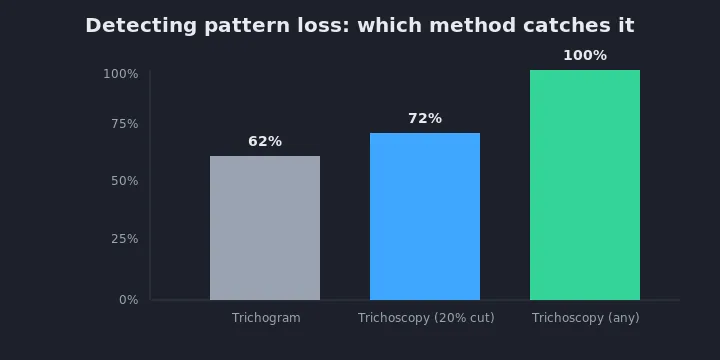
The numbers make the point. A diameter diversity above roughly 20 percent of hairs is treated as a diagnostic threshold,[3] but Galliker and Trüeb found that if you drop the strict cutoff and simply look for any meaningful diversity, trichoscopy caught pattern hair loss in 100 percent of confirmed cases, versus 62 percent for the older trichogram method.[4] In a 2024 trichoscopy study of men with pattern loss, every single patient showed hair diameter diversity, making it the most common finding of all.[5] Translation: by the time you have pattern loss, you almost certainly have diameter diversity, and it shows up before bare scalp.
Sign two: a temple line that’s actually moving
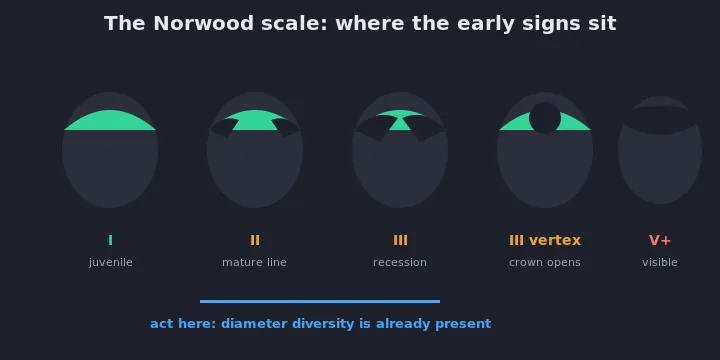
Here’s where men panic for the wrong reason and then miss the real one. Almost every adult man’s hairline matures: in the late teens and early twenties the straight, low juvenile line recedes a bit at the corners into a slightly higher, shaped adult line. That’s a normal mature hairline, and it usually stops. The mistake is treating a mature hairline as the start of balding and chasing it, while ignoring the crown.
The signal that matters is movement that doesn’t stop, plus a loss of density behind the line. A mature hairline is stable and the hair just behind it stays thick. Early pattern recession keeps creeping, the corners deepen year over year, and the hair right behind the line gets visibly finer. The fingerprint I see in my audience all the time: a 22-year-old terrified of a normal mature hairline, while a 28-year-old shrugs off the crown thinning that’s the genuinely progressive one. Watch the back of the top of your head as hard as you watch the front.
Sign three: the crown, the part, and the peripilar sign
The vertex (crown) is the other early front. It’s hard to see, which is exactly why it’s missed, and it carries a dense population of DHT-sensitive follicles. Two cheap home checks: photograph your crown from above in bright overhead light every few months, and watch your part width. A part that’s slowly getting wider over a year is density loss in slow motion.
Under trichoscopy, dermatologists also look for the peripilar sign, a subtle brown halo of pigment around the follicle openings that reflects low-grade inflammation, plus an increase in single-hair follicular units where there used to be twos and threes.[6] You won’t grade these at home, but knowing they exist tells you why a quick scalp scope at a clinic can confirm what your mirror can’t yet.
The family-history shortcut
You don’t have to wait for symptoms to know your odds. Pattern baldness is strongly heritable. In a community study of men, those whose fathers had hair loss were about 2.5 times as likely to have it themselves, even after adjusting for age.[7] It isn’t only your dad, the maternal line counts too, but a balding father is a genuine risk flag. If the men in your family went thin early, treat your twenties as the window to watch closely, not the decade to ignore it.
“You can’t see the start of balding in a mirror. You can see it in the thickness of the hairs you still have. That’s the whole game.”
What to do if you spot it early
The reason early detection is worth anything is that miniaturization is a spectrum you can stall, not a switch that flips. A follicle that’s thinning but still cycling responds far better than one that’s been dormant for years. So the early-signs checklist is simple: compare your hair-shaft thickness front and crown against the back of your head, take dated overhead crown photos, watch your part width, note whether a receding line is stable or still moving, and weigh your family history honestly. If two or more of those point the same way, that’s your cue to look into options while the odds are still in your favor.
If you want the order I’d actually go in, from the cheapest sensible steps up, I keep a free evidence-based protocol at philippeb.pro. No hype, just what I’d do in your shoes.
I’m Philippe Boissard, a hair-loss and male-physiology researcher and author (M.Sc., Aalborg University). I published a comparative review of finasteride and dutasteride in androgenetic alopecia, openly available at doi.org/10.5281/zenodo.20507736. More of my work is at philippeb.pro.
References
- Kinoshita-Ise M, Fukuyama M, Ohyama M. Recent Advances in Understanding of the Etiopathogenesis, Diagnosis, and Management of Hair Loss Diseases. J Clin Med, 2023. doi.org/10.3390/jcm12093259
- Inui S. Trichoscopy for common hair loss diseases: algorithmic method for diagnosis. J Dermatol, 2011. doi.org/10.1111/j.1346-8138.2010.01119.x
- Chiramel MJ, Sharma VK, Khandpur S, Sreenivas V. Relevance of trichoscopy in the differential diagnosis of alopecia: a cross-sectional study from North India. Indian J Dermatol Venereol Leprol, 2016. doi.org/10.4103/0378-6323.183636
- Galliker NA, Trüeb RM. Value of trichoscopy versus trichogram for diagnosis of female androgenetic alopecia. Int J Trichology, 2012. doi.org/10.4103/0974-7753.96080
- Legiawati L, Suseno LS, Sitohang IBS, et al. Trichoscopy Features of Indonesian Males with Androgenetic Alopecia in Association with Disease Severity. Int J Trichology, 2024. doi.org/10.4103/ijt.ijt_31_22
- Inui S, et al; and trichoscopy review. Peripilar sign and follicular-unit changes in androgenetic alopecia. J Dermatol, 2011. doi.org/10.1111/j.1346-8138.2010.01119.x
- Chumlea WC, Rhodes T, Girman CJ, et al. Family history and risk of hair loss. Dermatology, 2004. doi.org/10.1159/000078584
Get my free hair-loss protocol
The exact evidence-based routine I actually use and recommend: what works, in what order, with no hype. Enter your email on the next page and I’ll send it straight to you.

[…] your hairline is going, wear whatever you like and go and look at what the early signs actually are, because that is the question underneath this […]