
Veradermics VDPHL01: Is the New Once-Daily Oral Minoxidil Worth It?
VDPHL01 is an extended-release oral minoxidil with positive Phase 3 data. Here is what it does, how it stacks up against the existing low-dose oral minoxidil evidence, and whether it is worth it.

Veradermics VDPHL01: Is the New Once-Daily Oral Minoxidil Worth It?
A pill that grows hair has existed for years. Dermatologists have been quietly prescribing low-dose oral minoxidil off-label since the late 2010s, and it works. So when Veradermics announced positive Phase 3 results for VDPHL01, an extended-release oral minoxidil tablet built specifically for hair loss, the right question wasn’t “does a minoxidil pill work?” We know it does. The right question is “is a purpose-built, FDA-track version actually better than the cheap generic your doctor can write today?” Let me answer that honestly.
What VDPHL01 actually is
VDPHL01 is an extended-release tablet of minoxidil, the same molecule that’s been in the famous topical foam for decades. Veradermics designed it as a once-daily, controlled-release dose aimed at male androgenetic alopecia, and they’re running it through the formal FDA clinical trial process rather than relying on off-label prescribing. In late 2024 and 2025 the company reported that its Phase 3 program met its primary endpoints, with statistically significant hair growth versus placebo and a safety profile they described as favorable.[1] Those Phase 3 numbers are company-reported and not yet peer-reviewed, so I’m flagging that clearly. Take them as a press release, not a published paper, until the full data lands in a journal.
Here’s why that matters and why I’m still paying attention. The mechanism isn’t new, the delivery is. An extended-release tablet smooths out the peaks and valleys of a normal minoxidil dose, which in theory means steadier exposure with fewer of the spikes that can drive side effects like fluid retention or a racing heart. If you’ve ever wondered why a company would patent something you can already get generically, that’s the bet: same engine, better fuel injection.
The mechanism, in plain terms
Minoxidil is a vasodilator. It was originally a blood-pressure drug, and the hair growth was a side effect so reliable that the whole industry pivoted around it. In the follicle, minoxidil opens potassium channels, widens local blood vessels, and most importantly drags resting follicles back into the active growth phase and stretches that phase out. Think of the hair cycle like a crop rotation. Most of your follicles are growing, a few are resting, a few are shedding. Minoxidil keeps more fields planted and growing for longer.
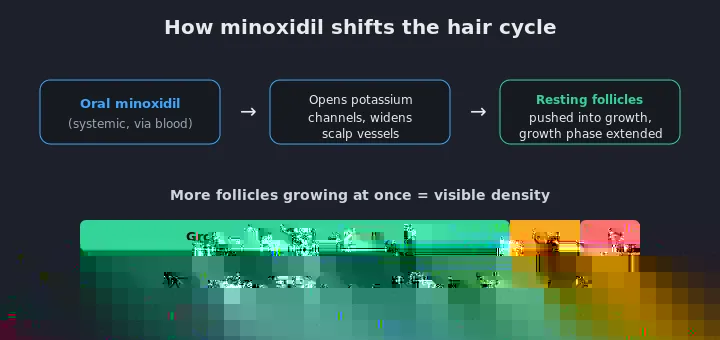
One thing minoxidil does not do: touch DHT. It doesn’t address the hormonal cause of male pattern hair loss at all. That’s the job of finasteride or dutasteride. So minoxidil and a DHT blocker aren’t competitors, they’re a pair. Minoxidil grows, the blocker protects.
What the established oral minoxidil evidence shows
This is the part that should anchor your expectations, because VDPHL01 is minoxidil. The track record of the molecule taken orally is the most honest preview of what the branded pill will do.
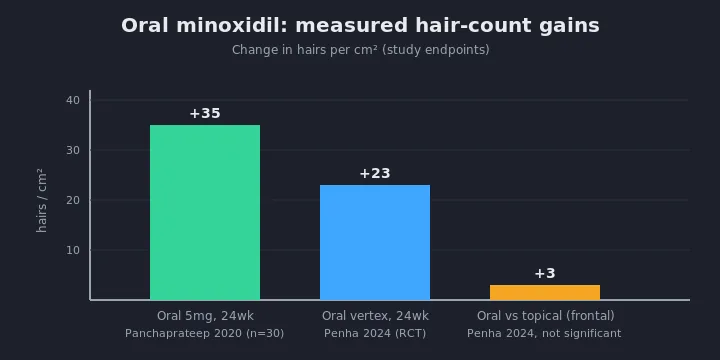
The cleanest single study is Panchaprateep and Lueangarun, 2020. They gave 30 men with androgenetic alopecia 5 mg of oral minoxidil once daily for 24 weeks. Total hair count rose by a mean of about 35 hairs per square centimeter at 24 weeks, a statistically significant gain (p = 0.007), and expert photographic review rated 100% of patients as improved.[2] That’s a real, measurable effect from a pill. The catch, and I always name the catch, is the design: it was open-label, single-arm, only 30 men, and just six months long. No placebo group, no blinding. Encouraging, not definitive.
The bigger reality check came from Penha and colleagues in JAMA Dermatology, 2024, a properly double-blind randomized trial pitting oral minoxidil 5 mg daily against topical 5% minoxidil twice daily in 90 men over 24 weeks.[3] The headline finding surprised a lot of people: oral minoxidil did not beat topical on the primary endpoint. For terminal hair density on the frontal scalp, the difference between the two was about 3 hairs per square centimeter and not statistically significant. Oral edged ahead only on a photographic vertex score. In plain English, the pill and the foam landed in roughly the same place for growth. The pill’s advantage isn’t more hair, it’s that people actually keep taking it.
Oral vs topical: the real trade-off
So if the growth is comparable, why does anyone bother with a pill? Adherence. A topical you smear on twice a day, that dries sticky, that you forget on travel days, gets abandoned. A once-daily tablet does not. In real-world hair clinics, the switch to oral minoxidil happened largely because patients quit the foam. The drug that works is the one you keep using.
| Oral minoxidil (incl. VDPHL01) | Topical 5% minoxidil | |
|---|---|---|
| Growth (head to head) | Roughly equal | Roughly equal |
| Convenience | One pill, done | Twice daily, messy |
| Adherence | High | Often poor |
| Scalp irritation | None | Common (the carrier) |
| Body hair growth | Common (systemic) | Rare (local) |
| Fluid retention / heart | Possible, dose-related | Negligible |
Side effects: what the big safety data says
This is where the oral route earns its respect, and its asterisks. The largest safety dataset is Vano-Galvan and colleagues, 2021, a multicenter study of 1,404 patients on low-dose oral minoxidil.[4] The most common side effect was hypertrichosis, unwanted body hair, in 15.1% of patients, but it forced only 0.5% to quit. Systemic effects were uncommon: lightheadedness 1.7%, fluid retention 1.3%, fast heartbeat 0.9%. Only 1.7% stopped the drug for side effects overall, and no life-threatening events occurred. A follow-up study even in patients with existing hypertension or arrhythmia found a similar favorable profile.[5]
That body-hair number is the honest downside nobody mentions in the ads. Take a systemic vasodilator and you may grow hair where you didn’t ask for it, on the cheeks, forearms, or back. For some people that’s a dealbreaker. This is exactly where VDPHL01’s extended-release pitch could matter: a smoother, possibly lower effective dose might trim the hypertrichosis and fluid-retention rates. Could. The company-reported Phase 3 hints at a clean profile, but until the full peer-reviewed data is out, I’m not treating “smoother release” as proven to mean “fewer side effects.”
Worth knowing: oral minoxidil can cause a temporary shed in the first weeks as follicles reset their cycle together. It looks alarming and it is normal. It is the same synchronized-reset shed people see starting topical minoxidil. It is not the drug failing.
So, is VDPHL01 worth it?
Here’s my actual take. The molecule works, the data on oral minoxidil is genuinely solid, and a once-daily branded tablet with a smoother release and a real FDA approval behind it is a legitimately good thing. It will make this treatment easier to prescribe, easier to trust, and easier to stick with. If you’re someone who quit the foam or never started, a clean pill is a real upgrade in convenience.
But be clear-eyed about the value question. VDPHL01 is not going to grow dramatically more hair than the cheap generic oral minoxidil your dermatologist can prescribe off-label today. The head-to-head evidence says oral minoxidil is about as effective as the topical you can already buy, and roughly as effective whether it’s branded or generic. What you’re paying the premium for is the extended-release formulation and the regulatory stamp, not a new tier of results. If the price is reasonable and the side-effect profile genuinely improves, worth it. If it’s priced like a breakthrough, the generic is sitting right there.
“VDPHL01 is a better-packaged version of a drug that already works. That’s useful and unglamorous. Just don’t confuse a smoother delivery system with a stronger result.”
My personal rule, and I say this as someone whose inbox fills with the same question every launch cycle: never stop a treatment that’s working for you to chase a new brand of the same molecule. If oral or topical minoxidil is holding your hairline, keep it. Watch VDPHL01’s full data land, compare the real-world price, and switch only if it clearly improves your convenience or your side effects. For more of how I think about layering these treatments, see the rest of my work at philippeb.pro.
I’m Philippe Boissard, a hair-loss and male-physiology researcher and author (M.Sc., Aalborg University). I published a comparative review of finasteride and dutasteride in androgenetic alopecia, openly available at doi.org/10.5281/zenodo.20507736. More of my work is at philippeb.pro.
This article names prescription medication. Education, not medical advice.
References
- Veradermics, Inc. VDPHL01 (extended-release oral minoxidil) Phase 3 topline results for androgenetic alopecia. Company-reported, not peer-reviewed. veradermics.com
- Panchaprateep R, Lueangarun S. Efficacy and Safety of Oral Minoxidil 5 mg Once Daily in the Treatment of Male Patients with Androgenetic Alopecia. Dermatol Ther (Heidelb), 2020. doi.org/10.1007/s13555-020-00448-x
- Penha MA, Miot HA, Kasprzak M, Müller Ramos P. Oral Minoxidil vs Topical Minoxidil for Male Androgenetic Alopecia: A Randomized Clinical Trial. JAMA Dermatol, 2024. doi.org/10.1001/jamadermatol.2024.0284
- Vaño-Galván S, Pirmez R, Hermosa-Gelbard A, et al. Safety of low-dose oral minoxidil for hair loss: A multicenter study of 1404 patients. J Am Acad Dermatol, 2021. doi.org/10.1016/j.jaad.2021.02.054
- Jimenez-Cauhe J, Pirmez R, Müller-Ramos P, et al. Safety of Low-Dose Oral Minoxidil in Patients With Hypertension and Arrhythmia: A Multicenter Study of 264 Patients. Actas Dermosifiliogr, 2023. doi.org/10.1016/j.ad.2023.07.019
Get my free hair-loss protocol
The exact evidence-based routine I actually use and recommend: what works, in what order, with no hype. Enter your email on the next page and I’ll send it straight to you.
