
What RU58841 + Minoxidil Progress Posts Don’t Show (4-Month Case)

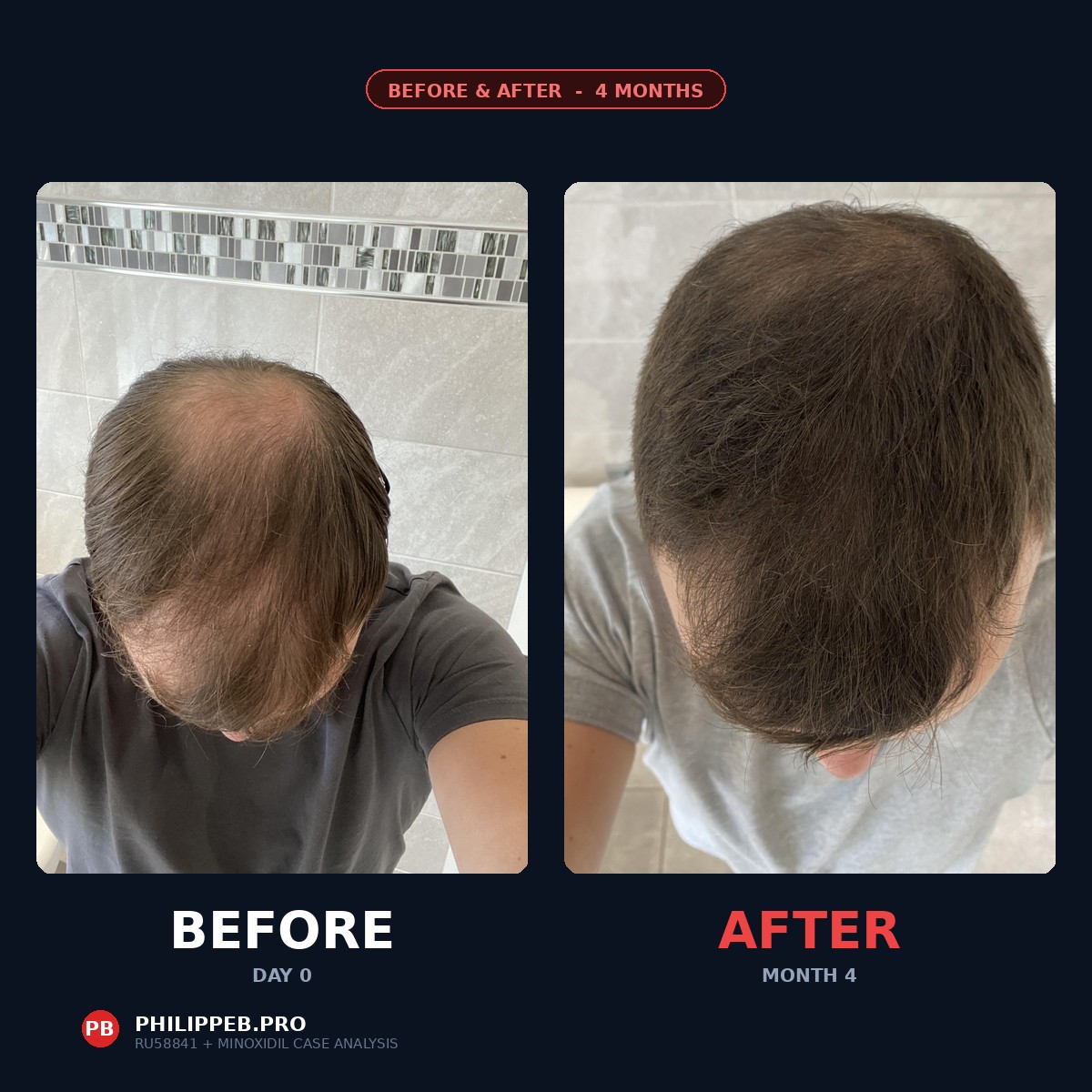
I keep coming back to a particular kind of post on r/tressless: the multi-month progress thread where someone running RU58841 plus minoxidil shows real, visible regrowth. The photos are usually impressive. The protocols are usually meticulous. The comments are usually a mix of celebration and “what dose are you using.” These threads are one of the most useful real-world data sources we have – and one of the most consistently misread. This article is the framework I use to read them.
Quick answer: why these posts get over-weighted
RU58841 plus minoxidil is one of the most-discussed combinations on r/tressless and across the broader online hair loss research community. There is a steady stream of progress threads describing real before-and-after change over 4 to 12 months. The combination is mechanistically rational: minoxidil forces blood flow and prolongs anagen as a vasodilator, RU58841 is a topical androgen receptor antagonist that blocks DHT signaling at the receptor itself. Two different mechanisms, working in parallel, applied to the same scalp.
The progress posts that come out of this combination are usually impressive. They are also, almost without exception, missing the information that would let you decide whether the protocol is right for you. The framework below is what I apply to any stack-based case data I read – on Reddit, on YouTube, in Discord servers, anywhere a user is reporting on a multi-compound protocol with a single before-and-after frame.
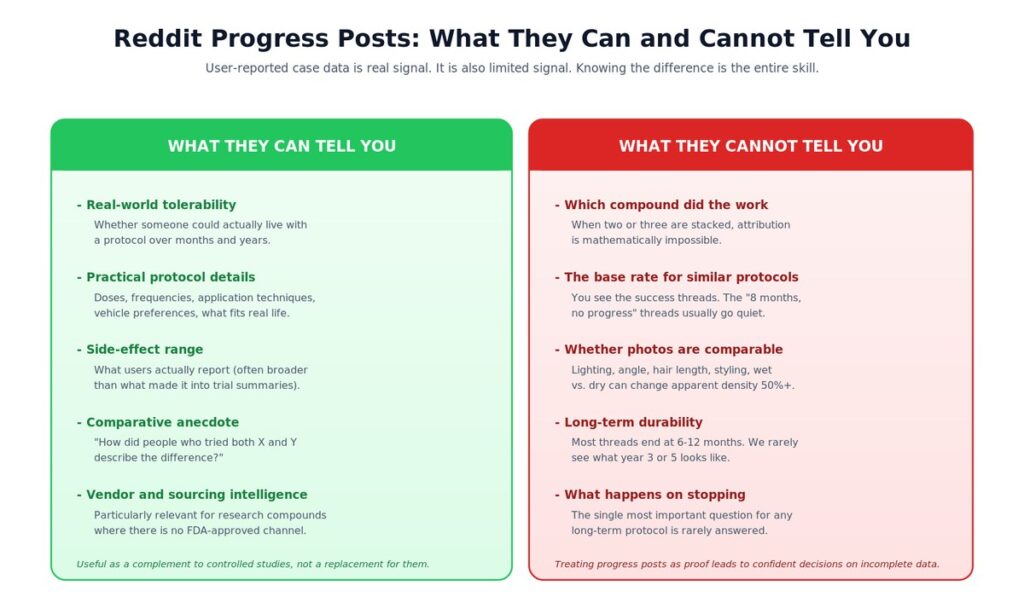
What progress posts can – and cannot – tell you
Both halves of this matter. Treating user-reported case data as worthless is a mistake. Treating it as proof is a bigger one.
What they’re good for
Real-world tolerability. A 12-month progress thread tells you whether a real human being could integrate twice-daily topical RU58841 plus minoxidil into their actual life. Trial data tells you what happened in a controlled environment with study coordinators reminding patients to apply on schedule. Reddit tells you what happens during travel, illness, busy weeks, new jobs, breakups. That signal is real. It is also one of the few signals you can only get from the field.
Protocol details that don’t make it into trials. Vehicle preference, application technique, what time of day, whether to apply pre- or post-microneedling, how to handle dryness or scalp irritation, how the smell affects daily life. These are practical engineering questions that controlled trials answer poorly because they were not designed to.
The breadth of side effects. Trial-reported side-effect tables tend to under-report the long tail. User reports often surface things the trials didn’t catch or didn’t emphasize – shedding patterns, scalp sensitivity profiles, brain-fog complaints with topical anti-androgens (rare but documented), changes in body hair, etc.
Vendor and sourcing intelligence. RU58841 is not FDA-approved and is sold as a research compound. Purity, vehicle, and concentration vary substantially across vendors. The collective experience of thousands of users on r/tressless is, in practice, the closest thing the research-compound space has to a quality-control mechanism. That is genuinely useful information that doesn’t exist anywhere else.
What they’re not good for
Attributing the result. When two compounds run simultaneously, no progress photo can tell you which one did the work. We will get back to this in a moment.
Estimating the base rate. The success threads are visible. The “8 months of strict adherence and nothing changed” threads usually go quiet, get deleted, or never get posted. This is classic survivorship bias – the data you can see is systematically different from the data that exists.
Photo comparability. Lighting, camera angle, focal length, hair length, hair styling, and wet-vs-dry state can change apparent density by 50% or more without a single follicle changing. Standardized photography is rare in user-posted progress threads. Most “before/after” pairs are not comparing the same scalp under the same conditions; they are comparing two different photographic situations of the same scalp.
Long-term durability. Most progress threads end at 6 to 12 months. We almost never see what year three or year five looks like. For a protocol someone may run for the rest of their life, that is the most important window – and it is also the window that is missing from almost every Reddit progress post.
What happens when you stop. The single most informative answer about any long-term hair loss protocol – and the one that is almost never reported in progress posts.
The attribution problem
If there is one analytical idea that should travel with you whenever you read a stacked-protocol progress post, it is this: combining two compounds with two different mechanisms makes the result un-attributable. Not “harder to attribute.” Un-attributable. Mathematically.
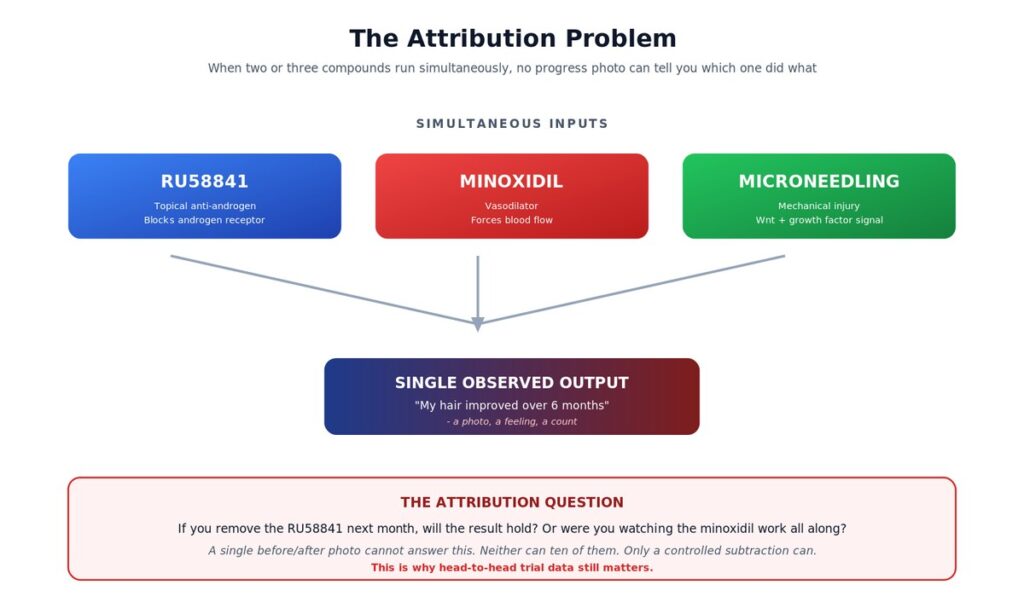
When someone runs RU58841 and minoxidil for six months and posts an impressive comparison, you have one observed output – their scalp – and two simultaneous inputs. Without controlled subtraction, you cannot tell which input produced what fraction of the output. You cannot even tell whether the combination produced more than either compound would have alone, less than the sum, or exactly the sum.
This is not a theoretical problem. Many users run minoxidil for years before adding RU58841, then post progress photos that compare “before adding RU” to “after six months of RU.” That comparison gives you a delta, but the delta sits on top of an already-active minoxidil baseline. It tells you that adding RU produced visible additional change – it does not tell you that RU is responsible for the underlying density they had before adding it. And it cannot tell you what would happen if they removed minoxidil tomorrow and ran RU alone.
The reverse case is even more common: a user starts both compounds at the same time, sees regrowth, and credits “the stack.” The result is real, but the question of whether they could drop one compound and keep the result is unanswerable from the photos.
This is precisely why head-to-head and placebo-controlled trial data still matters even in a category where progress posts are abundant. The two information sources are not redundant. Trials can isolate single compounds; field reports can show what real-world adherence and side-effect profiles look like. Each one fills a gap the other cannot.
The “if you stopped tomorrow” framework, applied
The single most useful question to overlay on any progress post is the one I keep coming back to: if this person had to stop their protocol tomorrow, what happens?
For a stack like RU58841 plus minoxidil, the answers split unevenly. Stopping minoxidil triggers, in a meaningful percentage of users, the well-documented post-discontinuation shedding pattern, with hair counts often falling below the pre-treatment baseline before re-stabilizing. I have written about this at length in why I no longer use minoxidil. Stopping RU58841, by contrast, does not produce the same documented “below baseline” rebound – because RU58841 is acting at the receptor rather than forcing a vasodilatory override. Stopping it means the underlying DHT signaling resumes, which means the underlying disease resumes – but the follicle population you have at the moment of stopping is closer to a true biological state than the minoxidil-supported version.
Apply that to a Reddit progress photo. The 6-month “before-and-after” you are looking at is, for someone on the combination, a snapshot of a scalp under simultaneous minoxidil-induced vasodilation and RU58841-induced anti-androgen activity. Some unknown fraction of the visible result is durable. Some unknown fraction would unwind on stopping minoxidil. The progress photo does not tell you the ratio.
This isn’t an argument against the combination – it is an argument for being honest with yourself about what the visible photo actually represents.
Watch: a working example of progress reporting done right
If you’d rather see what conservative progress reporting looks like in practice, the video below is one of my own recent updates – specifically about why I declined to publish a “before and after” too early. It demonstrates the methodology side of this article in real time:
A 10-point checklist for reading any progress post
Use this when you read a thread on r/tressless, watch a YouTube transformation, or evaluate a Discord post. The first time you run through it, most posts will fail half of the points – and that is fine. The point is not to dismiss; it is to weigh.
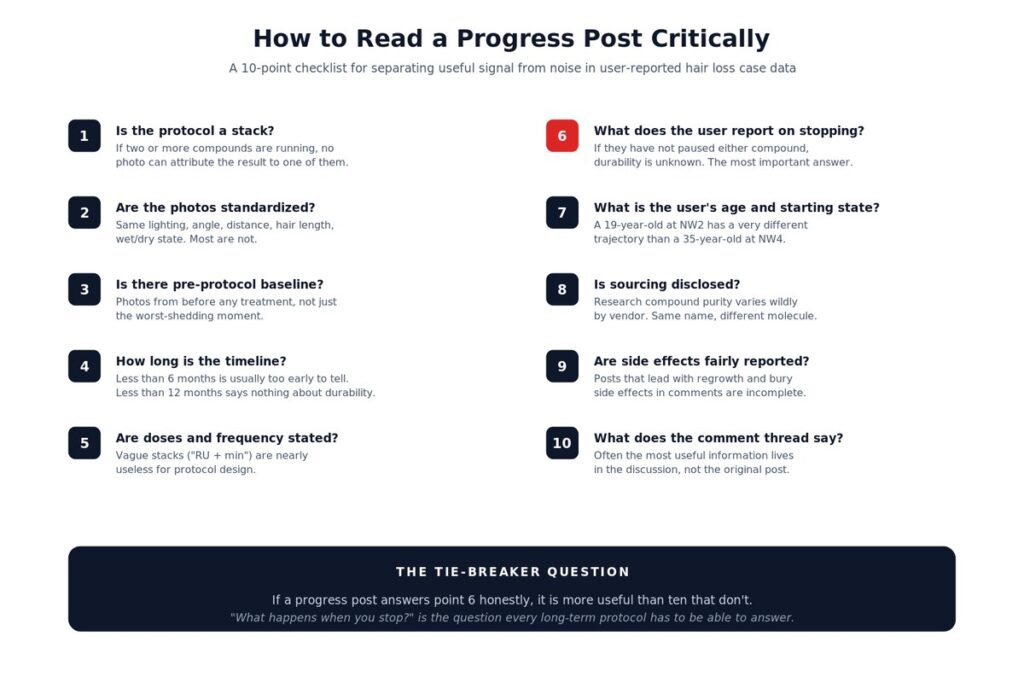
- Is the protocol a stack? If two or more compounds are running, attribution is not possible from the photos.
- Are the photos standardized? Same lighting, same angle, same camera distance, same hair length, same wet-or-dry state. Most are not.
- Is there a true pre-protocol baseline? A photo from before any treatment, not the worst-shedding moment of week-three telogen.
- How long is the timeline? Less than 6 months is usually too early to read meaningful results; less than 12 months says nothing about durability.
- Are doses, frequencies, and vehicles stated? “RU plus minoxidil” without numbers is unusable for protocol design. Real numbers are what you can actually reason about.
- What does the user report on stopping? The single most informative answer about any long-term protocol. Most posts skip it.
- What is the user’s age and starting state? A 19-year-old at Norwood 2 is on a completely different trajectory than a 35-year-old at Norwood 4. The same protocol behaves differently in each case.
- Is sourcing disclosed? Particularly relevant for research compounds. RU58841 from vendor A is not necessarily the same molecule, purity, or vehicle as RU58841 from vendor B.
- Are side effects fairly reported? Posts that lead with regrowth and bury side effects in deep comment threads are giving you an edited story.
- What does the comment thread reveal? Often the most useful information is the discussion below, not the OP. Look for users who tried the same protocol with different outcomes.
If a thread answers fewer than five of these, treat the result as “encouraging anecdote” and not “evidence.” If it answers seven or more, you are in unusually rich territory, and the post is worth bookmarking and going back to in 12 and 24 months to see if the user updates.
What good RU58841 + minoxidil progress data would actually look like
The constructive version of this critique is to sketch what an ideal progress thread on this combination would contain. If you ever post one yourself – or you find one that does this – it is far more valuable than an average thread. The components:
- A pre-protocol baseline photo from before any compound was started, taken under standardized lighting.
- Either a single-compound run-in (3 to 6 months on minoxidil alone, then add RU58841) or a single-compound regimen with no minoxidil at all – so the contribution of each compound is at least separable.
- Standardized monthly photos: same camera, same room, same time of day, same hair state.
- Doses, vehicles, vendors, and application schedules disclosed.
- A 12 to 24-month timeline minimum.
- Honest reporting of side effects – including the boring ones, like dry skin or scalp irritation – rather than only the dramatic ones.
- Ideally, a planned controlled subtraction at some point: either stopping minoxidil while continuing RU58841, or vice versa, with photos.
That last point – the controlled subtraction – is the rarest. It requires the user to deliberately disrupt their protocol to generate information. Most users understandably won’t do this; they are running the protocol to maintain their hair, not to produce research. But the few who do are giving the rest of us extraordinary information. If you find one of those threads, treat it as gold.
A working example: applying the framework to a real 4-month thread
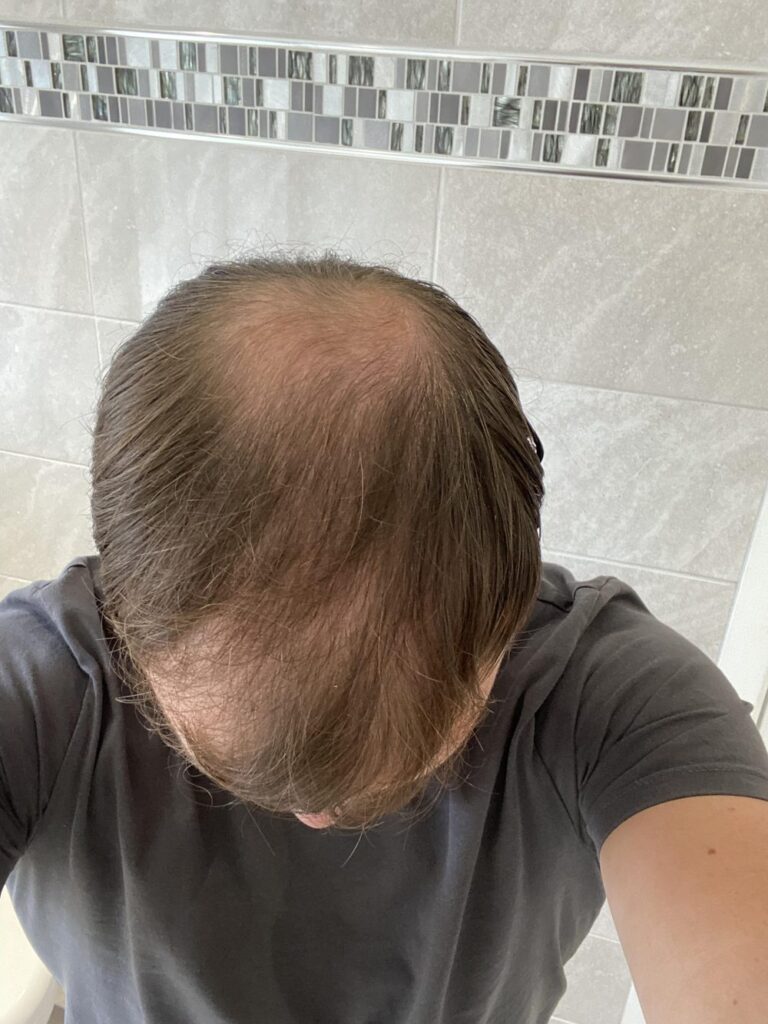
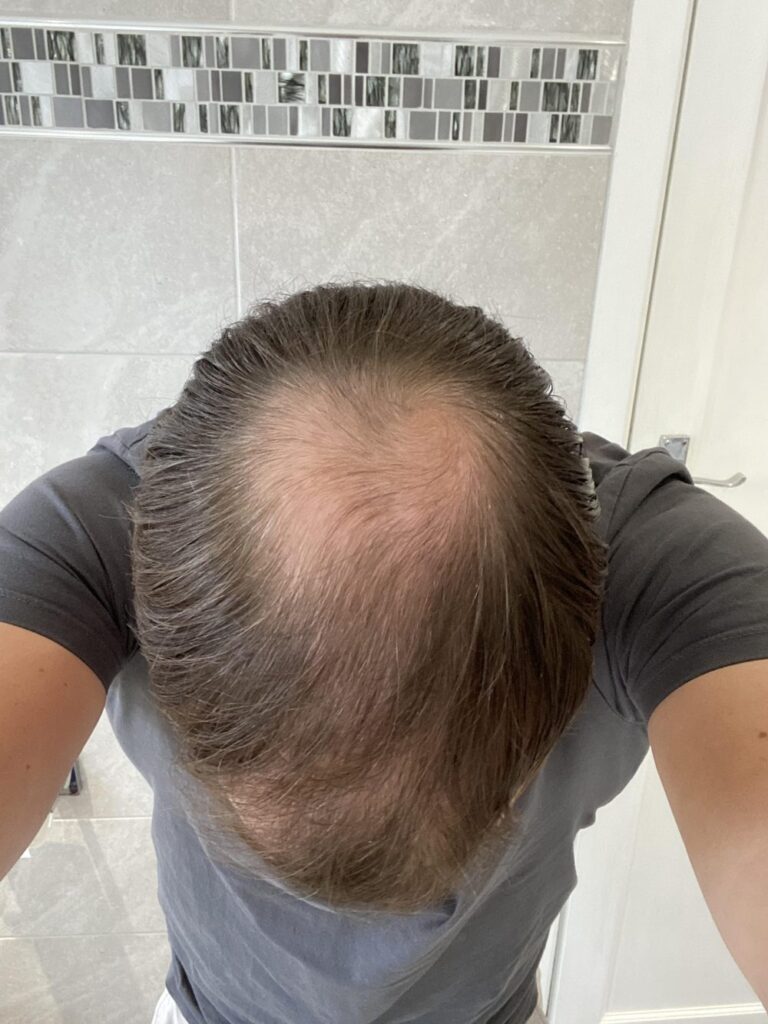
Rather than leave the framework abstract, let’s apply it to a real r/tressless progress thread on this exact combination. The poster (used with permission) had been gradually losing hair over roughly three years, with shedding accelerating in the year before starting treatment. The vertex bald spot had visibly worsened and started spreading toward the mid-scalp. The protocol they started:
- RU58841: 1 ml per day at 50 mg/ml.
- Minoxidil: 1 to 2 ml twice daily, morning and night, using Regaine 5% foam.
- Microneedling: 1.5 mm needle, once weekly, with RU58841 and one minoxidil dose skipped on derma-roll days.
- Adjunct: Nizoral 2% shampoo approximately 3 times per week.
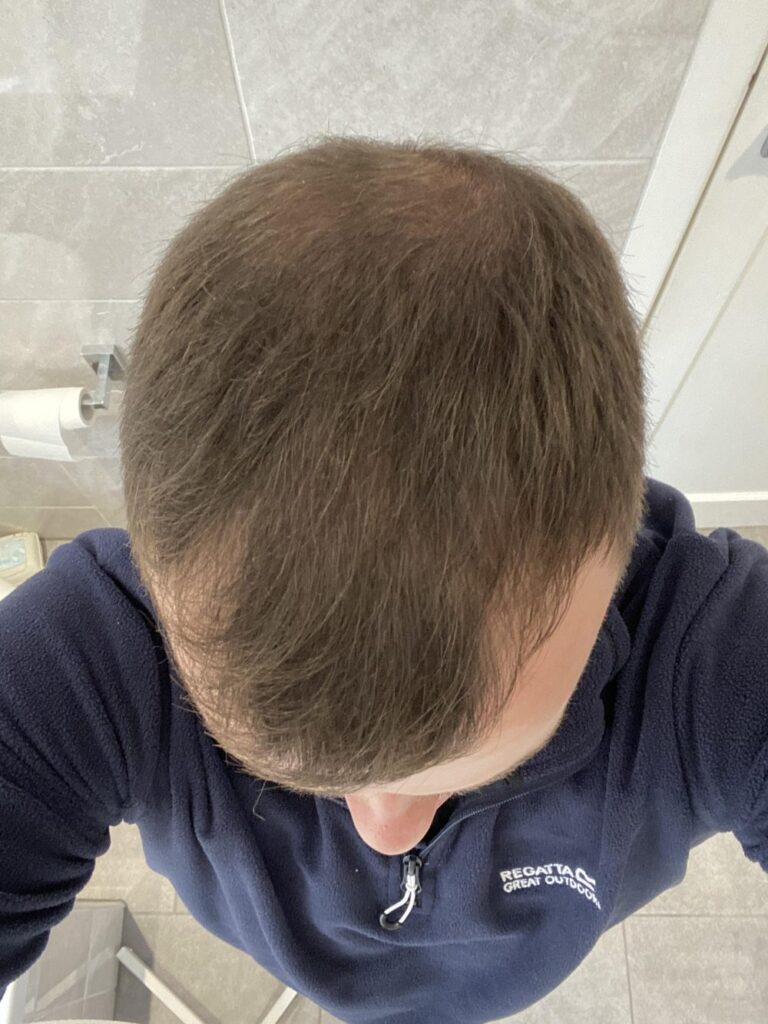
Reported timeline: substantial shedding in month one, first noticeable improvement just before the two-month mark, visible regrowth at 3.5 months, with continued progress through month four. The only side effect noted was minor dandruff attributed to the minoxidil. The original photos posted at baseline, three months, and four months are included below with permission.
Baseline (before starting the protocol)
3 months in
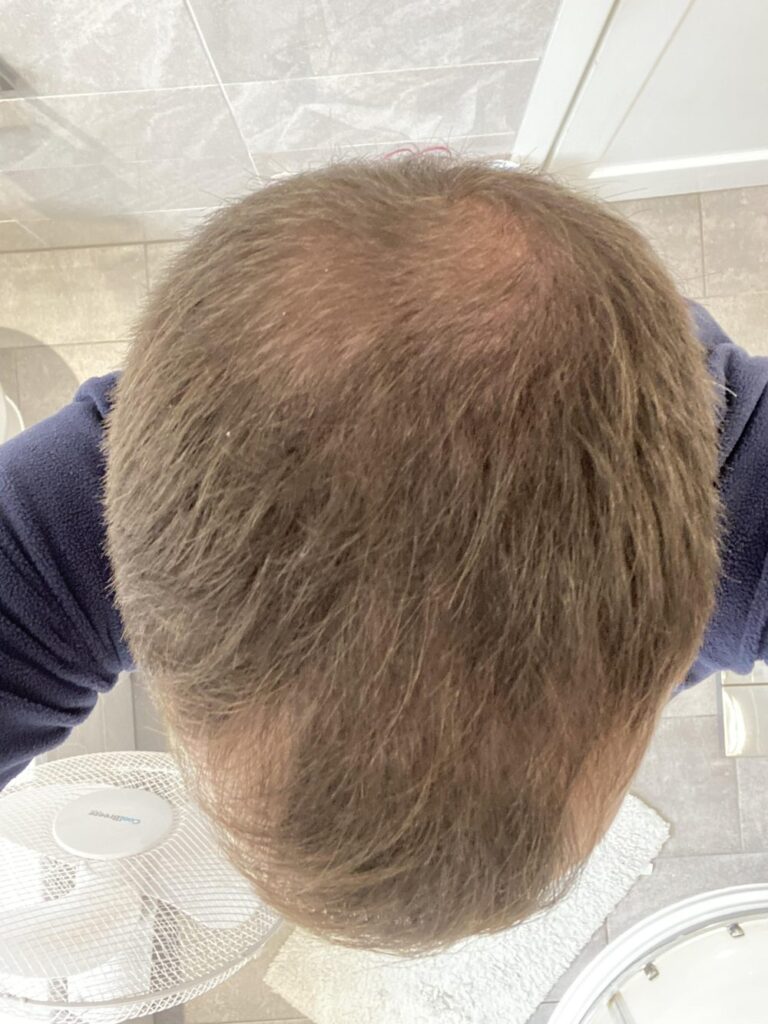
4 months in
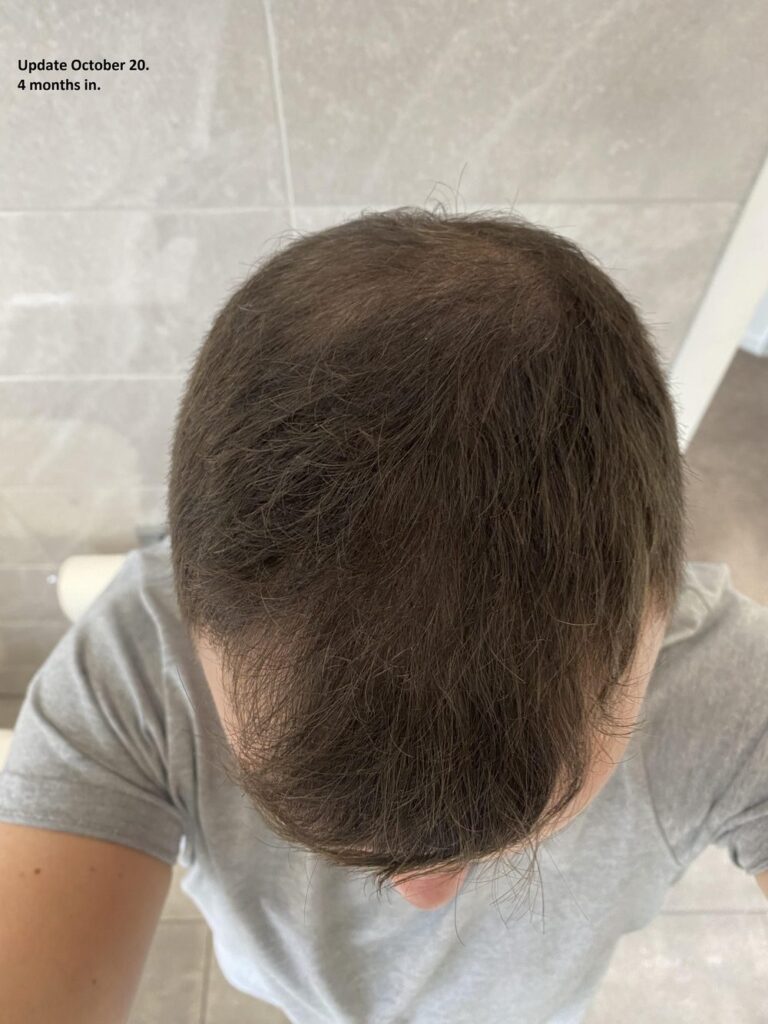
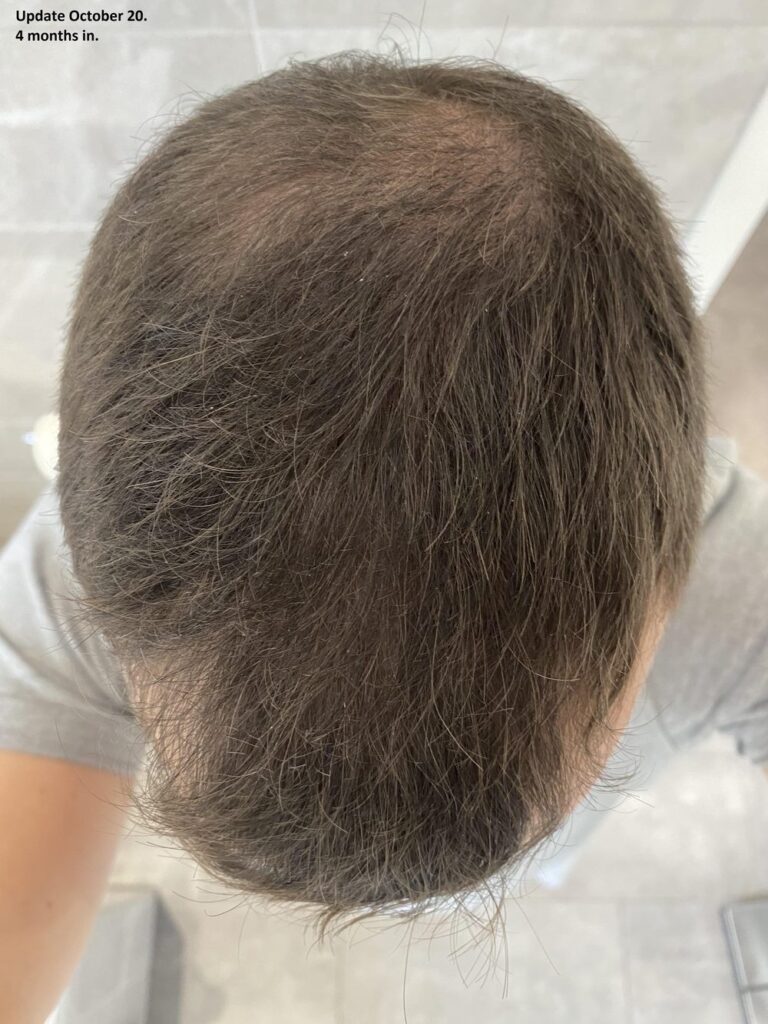
Photos used with permission from the original poster.
Running the framework on this case
This is a particularly clean example by Reddit standards. The protocol is fully specified – dose, concentration, frequency, vehicle, microneedling depth, schedule integration. Side effects are reported (and reported as minor, attributed to the right compound). The timeline is articulated. The progression matches what the literature predicts: an early shedding phase from minoxidil-induced anagen entry, followed by visible recovery as the new growth phase matures.
Now overlay the 10-point checklist:
- Stack? Yes – RU58841 plus minoxidil plus microneedling plus ketoconazole. Four simultaneous interventions. Attribution from the photos alone is impossible.
- Standardized photos? Lighting and angle vary somewhat between the baseline and follow-ups, which is typical of self-shot scalp photography.
- True pre-protocol baseline? Yes. Photos taken before starting any of the four interventions.
- Timeline? 4 months. Long enough to see real change, too short to assess durability.
- Doses, frequencies, vehicles stated? Yes, completely. This is the rarest and most useful element of the post.
- What happens on stopping? Not addressed. The poster is still on protocol.
- Age and starting state? Mid-progression vertex thinning with mid-scalp involvement, three years of gradual loss. Not specified by exact age in the post.
- Sourcing? Not disclosed in the original post. Worth knowing for any reader trying to replicate.
- Side effects fairly reported? Yes – one minor side effect attributed to the right compound. Honest in tone.
- Comment thread useful? Worth reading for protocol questions other users asked.
This thread answers seven of ten on the framework. That puts it in unusually rich territory – well above the typical “two photos and a caption” progress post. It is genuinely useful evidence that the combination produces visible cosmetic change in this user over four months. It is not, on its own, evidence that any single one of the four interventions is responsible, that the result will hold at year three, or that stopping any of the four would not unwind the gain.
If I were the poster, the highest-leverage update I could give the community a year from now would be exactly the one most progress threads never include: pause one component (most informatively, the minoxidil) for three months and document what happens. That single experiment would convert this from an encouraging anecdote into something approaching real evidence about the contribution of each compound in the stack.
Where this leaves the RU58841 + minoxidil combination itself
None of the above is an argument against the combination. RU58841 is mechanistically rational – it works at the receptor, downstream of where finasteride works on 5-alpha reductase. (For a related read on receptor-level vs upstream blockade, the piece on why finasteride fails some men even when it is working covers the gap between hormone reduction and outcome.) Minoxidil’s mechanism is well-characterized; my objections to it as a long-term anchor compound are about dependency and durability, not about whether it produces a visible cosmetic result while you are using it.
What the analysis above is meant to do is help you read the specific class of evidence that progress posts represent without over-interpreting it. The biology behind every compound discussed in those threads sits in how hair loss actually works – which is the foundational read for evaluating any protocol, not just this one.
Frequently asked questions
Are RU58841 progress photos on Reddit reliable?
Reliable as anecdotes; not reliable as proof of effect size, attribution, or durability. They are a useful complement to controlled-trial data, not a substitute for it.
If RU58841 plus minoxidil works for one Redditor, will it work for me?
Possibly. Hair loss outcomes are heavily influenced by age, starting Norwood, family history, AR-gene variants, and a half-dozen other factors. A single positive case tells you the protocol can work in some users; it tells you almost nothing about whether it will work in you specifically.
Why is the RU58841 plus minoxidil combination so popular?
Because the mechanisms are non-overlapping (DHT receptor blockade plus vasodilation), because both can be applied topically, because RU58841 is available without a prescription as a research compound, and because the visible result on someone running both is often more dramatic than either alone. The combination is reasonable; it is just not as well-characterized as the popularity suggests.
Are RU58841 progress photos faked?
The vast majority are not deliberately faked. Most apparent inflation comes from non-standardized photography rather than intent. The result on someone’s actual scalp is usually real; the magnitude as represented in the photo pair is often overstated by lighting and angle alone.
What single piece of information would I most like to see in any progress post?
An honest answer to “what happened when you stopped one of your compounds.” Almost no posts contain this. The ones that do are disproportionately useful.
Bringing it together
User-reported progress data is one of the richest information sources available to anyone navigating hair loss. It is also one of the most abused. Read carefully, with the attribution problem and the survivorship problem in mind, those threads on r/tressless are genuinely useful – especially for the texture of how a protocol fits into a real life. Read uncritically, they will lead you to confident decisions on incomplete data.
The 10-point checklist is a starting point. The deeper habit it is trying to build is the same one I apply to my own protocol: knowing the difference between a result you can show in a photo and a result you can defend if you had to explain to a clinician why each compound is in the stack. Progress posts produce the first kind. Studies, mechanism, and time produce the second.
Disclaimer: This article is for educational and informational purposes only and is not medical advice. RU58841 is a research compound that is not FDA-approved for hair loss; any decision to use it should involve a qualified clinician and your own due diligence. Topical and oral minoxidil are not without documented risks; see the linked minoxidil article for the long-form discussion. (c) Philippe Boissard – philippeb.pro
About the author
Philippe Boissard
Author of Men’s Hairloss Protocol (2020), Better, Smarter, Stronger (2023), and Multi-Axis Body (2025). Researches and writes about hair loss and male physiology, citing primary literature and disclosing affiliate relationships in full. Not a medical doctor; all content is educational. More about Philippe.
Get my free hair-loss protocol
The exact evidence-based routine I actually use and recommend: what works, in what order, with no hype. Enter your email on the next page and I’ll send it straight to you.
Send me the free protocol →