
Hair Loss Diet: Keto, Mediterranean, Plant-Based Compared
Diet for hair loss is real but secondary. Mediterranean has the data. Keto has a transition shedding phase. Plant-based is neutral when nutrients are managed. Honest read on what diet can and cannot do.


“What should I eat for my hair?” is one of the most common questions men ask after they start losing it. The honest answer is unsatisfying: diet matters less than most online discussion suggests, the diets most-recommended for hair (Mediterranean, “anti-inflammatory,” plant-based) have modest correlational support rather than strong causal evidence, and the diets occasionally feared for hair (keto, carnivore) do not have the dramatic effects men assume. The dominant pathway in male pattern hair loss is androgenetic alopecia, which is genetic and DHT-driven, and which no diet realistically reverses. What diet does affect is the surrounding context: nutrient adequacy, inflammatory load, telogen effluvium risk, and the rate at which existing AGA progression is or is not amplified by metabolic dysfunction. This article walks through what the literature actually supports.
Quick answer: which diet is best for hair loss?
Mediterranean has the largest correlational evidence base showing modestly reduced AGA progression. Keto is neutral to slightly favorable for AGA via mild reduction in serum androgens but should not be assumed to “treat” hair loss. Plant-based is neutral assuming protein and iron adequacy but raises the risk of nutrient deficiency-driven shedding if not managed. None of these diets approach the effect size of finasteride or minoxidil. The diet question is real but secondary; the medication question is primary.
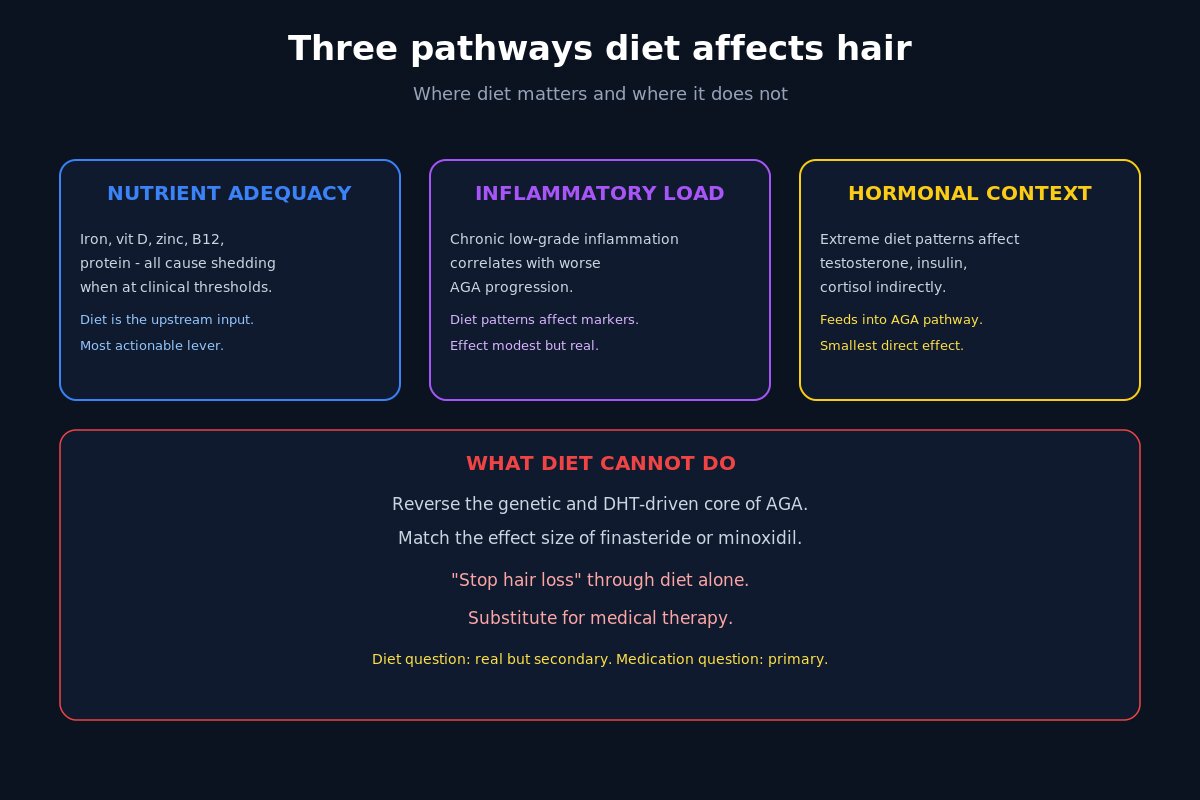
What diet actually affects in hair
Three pathways. First, nutrient adequacy: iron, vitamin D, zinc, B12, and protein deficiency all cause shedding when they reach clinical thresholds, and diet is the upstream determinant of whether you reach those thresholds. Second, inflammatory load: chronic low-grade systemic inflammation correlates with worse AGA progression in observational studies, and dietary patterns affect inflammatory markers. Third, hormonal context: extreme dietary patterns affect testosterone, insulin sensitivity, and cortisol, all of which feed indirectly into the AGA pathway.
None of these pathways replace the genetic and DHT-driven core of AGA. The diet question is “is your diet making your AGA progress faster or slower than it would with optimal nutrition” rather than “can your diet stop your AGA.” The honest answer to the second question is no; the honest answer to the first is yes, modestly, and Mediterranean is the most supported choice if you want to optimize.

Mediterranean diet: the strongest evidence
Fortes et al. 2018 published the most-cited paper on diet and AGA, an observational study in 104 men with androgenetic alopecia compared to controls. They found Mediterranean adherence (high vegetable, herb, and fresh herb intake) was associated with reduced AGA severity and slower self-reported progression. The effect size was modest but the direction was consistent across diet patterns, and the mechanism plausibly runs through anti-inflammatory and antioxidant effects.
The caveat is that this is correlational, not causal. The men eating Mediterranean diets in the study were also more likely to be in better metabolic shape, sleep more, exercise more, and have lower stress, all of which independently affect hair. Disentangling diet from the broader healthy-lifestyle bundle is difficult. The conservative read is that Mediterranean is associated with better hair outcomes, and the most likely mechanism is metabolic and inflammatory rather than diet acting directly on follicles.

Keto and hair loss
Ketogenic diets reduce insulin and modestly lower serum testosterone in some men, particularly when combined with caloric restriction. The naive expectation is “lower testosterone = lower DHT = less AGA progression.” The reality is more complicated. Some men experience increased shedding 2-3 months into a keto transition, consistent with telogen effluvium driven by the metabolic shift, even though their baseline serum DHT may be slightly lower. The TE typically resolves once the metabolism stabilizes, which takes 3-6 months.
For men whose AGA was driven by elevated insulin/IGF-1 signaling and metabolic dysfunction, keto can produce a mild improvement once the transition shedding settles. For men whose AGA is straightforwardly DHT-driven without major metabolic component, keto produces minimal effect on the hair-loss trajectory. The framing “keto stops hair loss” overstates the effect; the framing “keto is neutral to slightly favorable for some men” is closer to honest.

Plant-based diets and hair
Plant-based diets are neutral for hair when protein adequacy, iron, vitamin B12, zinc, and vitamin D are managed. They are problematic for hair when nutrient deficiency develops, which happens to a meaningful subset of plant-based eaters who do not actively manage these nutrients. Iron is the biggest single risk factor: heme iron from animal sources is more bioavailable than non-heme iron from plants, and ferritin levels in plant-based men are on average lower. Low ferritin is a documented driver of telogen effluvium.
Almohanna et al. 2019 reviewed nutrient deficiencies in hair loss and found iron, vitamin D, and B12 as the most commonly implicated. All three are typically lower in plant-based eaters who do not supplement. The corrective is not “stop being plant-based” but “supplement strategically and check ferritin annually.” A plant-based diet with adequate protein, iron, B12, and vitamin D is hair-neutral. A plant-based diet without those is hair-problematic.
Watch this on the channel
No Before & After Yet – frames why diet effects on hair require months to evaluate properly and why short-term changes after diet shifts often reflect TE rather than AGA progression.

Protein adequacy is the foundation
Hair is built primarily from keratin, a structural protein. Protein-deficient diets can cause clinical hair shedding within months. The threshold below which protein inadequacy starts visibly affecting hair is around 0.8 grams per kg body weight per day for sustained periods, though athletes and active men benefit from 1.2-1.6 g/kg. Most reasonable diets in any pattern (Mediterranean, keto, plant-based with proper planning) provide adequate protein. Hair-related protein deficiency in modern Western populations is unusual but real, especially in elderly men with reduced appetite and in younger men on extreme calorie restriction.
The framework “protein first, pattern second” is the most useful organizing principle. Once protein is adequate, the choice between Mediterranean, keto, plant-based, or other patterns matters less than the consistency of the pattern. Diet whiplash and yo-yo dieting produce repeated metabolic shifts that drive intermittent TE, often more than any specific dietary content choice would.
Supplements vs whole food
If you have confirmed deficiency in iron, vitamin D, zinc, or B12, supplementation corrects it more reliably than dietary change alone. Hair vitamin formulas as a category are mostly marketing (covered in the DHT detox supplement myth article); single-nutrient supplements at appropriate doses are appropriate when bloodwork shows deficiency. The “whole food first, supplement second” framework applies to AGA exactly as it applies to general health: get nutrients from food when possible, supplement when food alone is insufficient or when deficiency is documented.
The exceptions are vitamin D in northern latitudes (deficiency is the norm and supplementation is reasonable without bloodwork) and B12 in plant-based eaters (deficiency develops over years and supplementation is mandatory rather than optional). Iron should always be checked via ferritin before supplementation; oral iron in non-deficient men can cause GI side effects and excess accumulation.
Common myths about diet and hair
The myth that any diet “stops” AGA progression overstates what diet can do. The myth that keto raises testosterone and accelerates baldness inverts the typical clinical picture (keto often modestly lowers serum T and DHT). The myth that going plant-based saves your hair through “lower IGF-1 signaling” ignores the iron deficiency risk that often emerges. The myth that biotin-rich foods grow hair beyond filling a deficiency is unsupported. The myth that “anti-inflammatory diets” reverse AGA confuses correlational evidence with causal evidence. The myth that any single food or food group is uniquely good or bad for hair is almost always supplement-marketing or wellness-influencer framing rather than literature-supported.
Frequently asked questions about diet and hair loss
What is the best diet for hair loss?
Mediterranean has the largest correlational evidence base showing modestly reduced AGA progression. The effect size is small compared to medication. Mediterranean is reasonable; treating it as a hair-loss intervention substitute for finasteride is not.
Does keto cause hair loss?
Some men experience telogen effluvium 2-3 months into a keto transition. The TE typically resolves within 3-6 months as metabolism stabilizes. Long-term keto is neutral to slightly favorable for some men with metabolic-driven AGA components.
Will going plant-based save my hair?
Probably not by itself. Plant-based diets are hair-neutral when iron, B12, vitamin D, and protein are managed. They are hair-problematic when nutrient deficiencies develop. The framework is “manage the nutrients, then the pattern is fine.”
How much protein do I need?
Roughly 0.8-1.6 grams per kg body weight depending on activity level. Below 0.8 g/kg sustained, hair-related protein deficiency becomes plausible. Most reasonable diets in any pattern provide adequate protein.
Does sugar cause hair loss?
Indirectly, modestly. High-sugar diets correlate with insulin dysregulation, inflammation, and metabolic dysfunction, which correlate with worse AGA progression. The effect is small compared to medication. Reducing sugar is reasonable; treating sugar as the cause of AGA is incorrect.
Should I take a multivitamin for hair?
Generally not. Single-nutrient supplements when deficiency is documented are more useful. Multi-ingredient hair vitamins are mostly marketing. Get bloodwork. Supplement what is actually low.
How quickly does diet affect hair?
2-4 months for visible changes via the hair cycle. Faster changes are usually TE responding to a diet shift, not actual AGA modulation. Evaluation timeline is months, not weeks.
Does intermittent fasting help hair?
Probably neutral. The metabolic effects could theoretically help via insulin sensitivity, but the literature does not show direct hair-loss reversal. Reasonable to do for general metabolic health; not a hair-loss intervention.

Bringing it together
Diet for hair loss is real but secondary. The dominant pathway in male pattern hair loss is androgenetic alopecia, which is genetic and DHT-driven and which no diet realistically reverses. What diet does affect is nutrient adequacy, inflammatory load, and the metabolic context that modulates AGA progression rate. Mediterranean has the largest correlational evidence base. Keto is neutral to slightly favorable for some men, with a transition TE risk. Plant-based is neutral when nutrients are managed. Protein adequacy is the foundation. The diet question is a real input, but it is not the lever that finasteride and minoxidil are. Treat diet as one factor among several, optimize where reasonable, and do not let the diet conversation distract from the medication conversation that actually moves AGA outcomes.
About the author
Philippe Boissard
Author of Men’s Hairloss Protocol (2020), Better, Smarter, Stronger (2023), and Multi-Axis Body (2025). Researches and writes about hair loss and male physiology, citing primary literature and disclosing affiliate relationships in full. Not a medical doctor; all content is educational. More about Philippe.
Related reading
Get my free hair-loss protocol
The exact evidence-based routine I actually use and recommend: what works, in what order, with no hype. Enter your email on the next page and I’ll send it straight to you.
Send me the free protocol →