
Why I Don’t Take Minoxidil

Topical minoxidil is the most widely used hair loss treatment in the world. It is also, in my view, one of the most poorly framed. Not because it does nothing, it does something. But what it actually does, what stops happening when you stop using it, and what it fails to address entirely, is a conversation almost nobody is having clearly. This article is my attempt to change that.
Minoxidil Was Not Built for Hair Loss
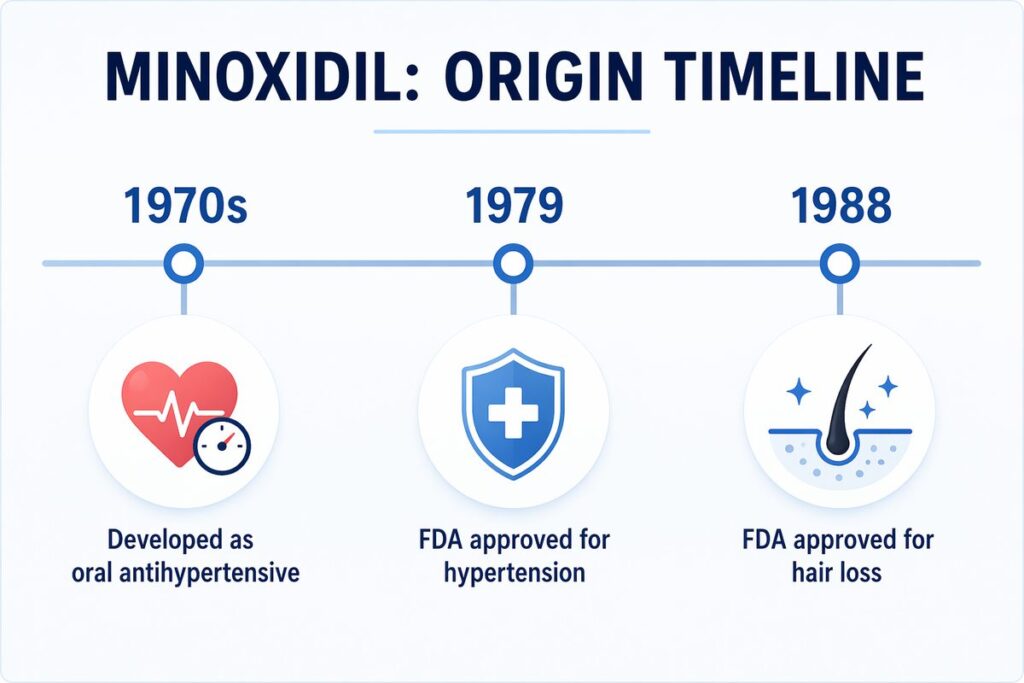
The first thing worth understanding about minoxidil is that it was never designed as a hair loss drug. That is not an opinion, it is simply the compound’s history. Minoxidil was developed in the 1970s as an oral antihypertensive, prescribed to patients with severe hypertension who had not responded to other medications. Hair growth was an unintended side effect observed during clinical trials. That side effect was eventually commercialized as what most people now know as Rogaine.
That origin matters, because it tells you what this molecule actually is at a mechanistic level. Minoxidil is a potassium channel opener. Its pharmacological action is vasodilation, it relaxes vascular smooth muscle and widens blood vessels. When applied topically to the scalp, the working theory is that increased local blood flow reaches hair follicles and prolongs the anagen (growth) phase of the hair cycle.
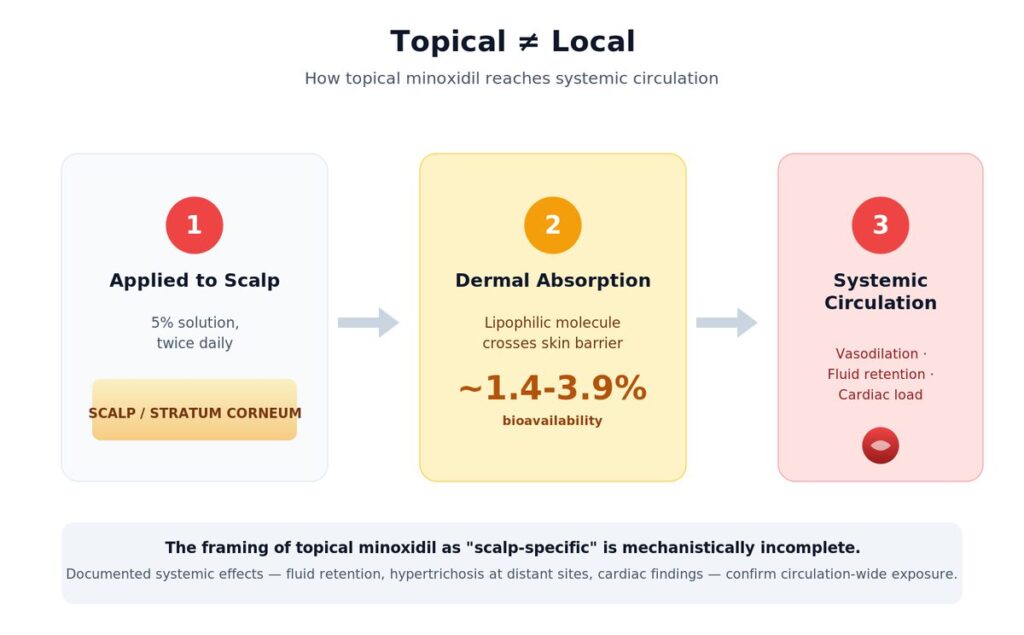
The problem with that framing is simple: your body does not have a separate cardiovascular system for your scalp. Vasodilation is a systemic event. And a compound engineered to lower blood pressure in high-risk cardiac patients does not become biologically “local” because it is delivered through a pipette instead of a pill.
The Cardiovascular Risk Nobody Discusses at the Pharmacy Counter
A 2023 paper published in the Dermatology Online Journal (Ibraheim et al.) documented cardiovascular adverse events in patients using minoxidil. The list is not gentle: ischemic heart disease, left ventricular hypertrophy, pleural effusions, and pericardial effusions. These are not theoretical risks buried deep inside a product insert. They are documented clinical outcomes, and they are the reason oral minoxidil is prescribed with monitoring when it is prescribed at all.
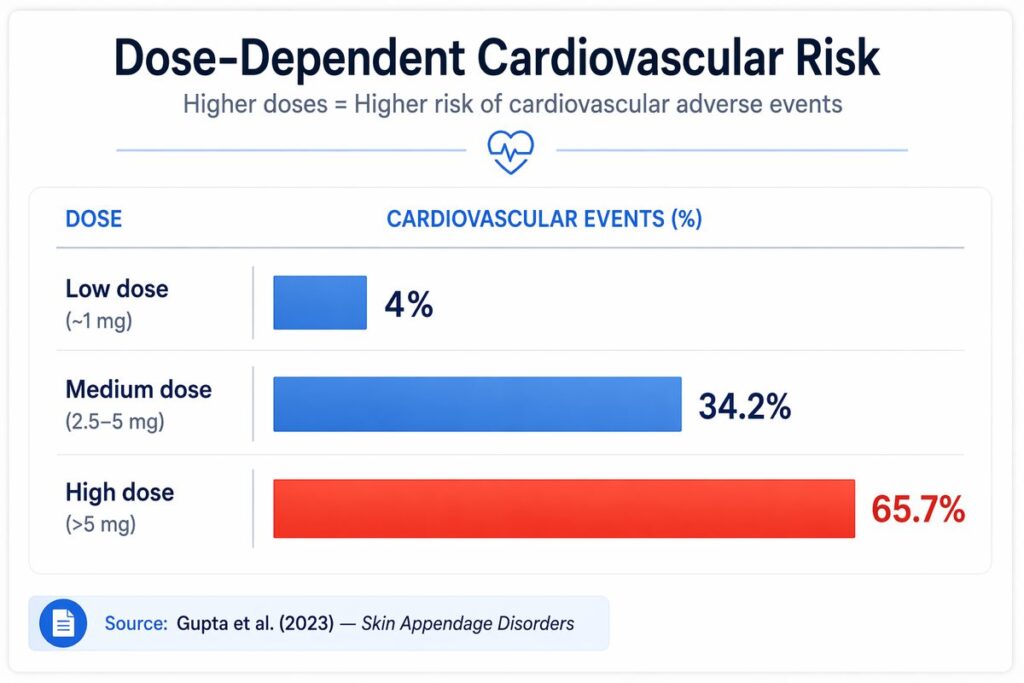
A separate 2023 review found that the risk of cardiovascular side effects scales cleanly with dose. At low doses (around 1 mg/day), about 4% of patients experienced adverse cardiovascular events. At 2.5 to 5 mg per day, that number climbed to 34.2%. Even at 0.25 mg, a fraction of a standard dose, there are documented cases of fluid accumulation around the heart.
With oral minoxidil, this conversation at least exists inside the clinic. Most dermatologists prescribing it are aware. But with topical minoxidil, the 5% solution you can buy without a prescription, most people applying it at home are not being monitored for cardiac outcomes at all. That gap between pharmacology and clinical attention is worth sitting with for a moment.
The Dependency Trap, Why Stopping Can Be Worse Than Never Starting
Here is where minoxidil becomes a long-term problem even for users who tolerate it well.
Minoxidil does not fix anything. It does not touch the reason your hair is falling out. It forces blood flow to follicles and temporarily extends the growth phase. When you stop forcing that, the effect reverses, and not cleanly. Published clinical data shows that roughly 4 in 10 men who discontinue topical minoxidil see their hair counts fall below their pre-treatment baseline. Not back to where they started. Below it.
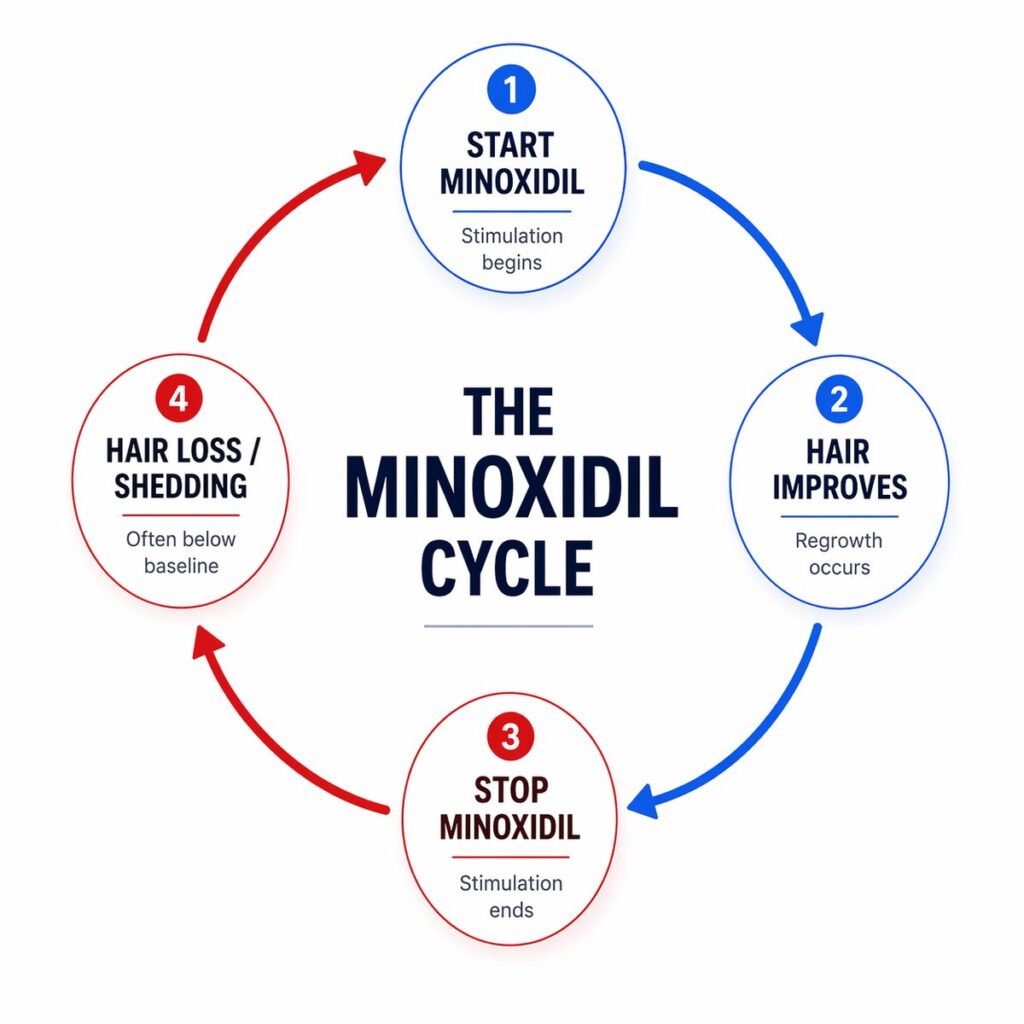
Within three to six months of stopping, all of the regrowth is gone, and hair can temporarily overshoot the original loss before eventually stabilizing closer to where it would have been without the treatment.
Translate that to a practical scenario. You start at Norwood 3. You use minoxidil daily for two years. You stop, for any reason: a trip, a hospitalization, a breakup with your bathroom routine, and you temporarily drop toward Norwood 4 or 5 before slowly crawling back. The compound did not improve your underlying situation. It created a dependency and penalized you for leaving it.
If you restart, you go through the initial shedding phase all over again. A compound that demands perfect daily compliance for the rest of your life, does not address the underlying mechanism of the disease, and punishes you for stopping, that is dependency framed as treatment.
The Real-World Stress Test: Does Your Protocol Survive Normal Life?
The dependency issue becomes concrete the moment you take minoxidil out of the controlled environment of a stable home routine. Last year I spent three months in Japan, hotels, day trips, constant movement. Maintaining a twice-daily topical application protocol across that kind of schedule is not just inconvenient. It is, in practice, unsustainable.
And that turns out to be a useful test for any long-term treatment. If a protocol breaks down under normal life conditions, not extreme conditions, just travel, it was never robust to begin with. A hair loss strategy has to work in your actual life, not an idealized version of it in which everything is consistent.
With minoxidil specifically, any significant break becomes more than a pause. It becomes a setback with a measurable cost: every long trip, every hospitalization, every disruption compounds. For someone with limited hair to lose, the “restart risk” is not an acceptable long-term design.
Systemic Absorption: Why “Topical” Is Not “Local”
Topical minoxidil’s side effect profile contains two findings that, in my opinion, are chronically underweighted in the way the compound is marketed.
1. Fluid retention
Minoxidil is a vasodilator. Even applied topically, a clinically meaningful percentage of the dose is absorbed systemically, and one of the hallmark systemic effects of vasodilation is fluid retention. Clinically, this presents as that soft, puffy appearance around the jawline and under the eyes. The 2023 literature review put the incidence at 1.3 to 10% of patients, typically appearing within one to three months of starting. In my own case, the facial change was visible within weeks.
What makes this more than a cosmetic issue is what it reveals mechanistically. Fluid retention driven by vasodilation is a systemic signal. It means the compound is reaching your systemic circulation. That directly contradicts the standard framing of topical minoxidil as a localized, scalp-specific intervention. It is not staying on your scalp, and it is the same molecule originally developed to manage blood pressure in patients with serious cardiac disease.
2. Hypertrichosis
The second finding is hypertrichosis, unwanted hair growth outside the scalp. Face, neck, arms. Documented in approximately 15% of patients. When you apply a vasodilator solution to your scalp, the surrounding skin does not respect your target area, and the circulating drug stimulates follicles in regions you never intended to treat.
The Root Problem: Androgenetic Alopecia Is a DHT Problem, Not a Blood-Flow Problem
All of the above points back to the same fundamental issue with minoxidil as a strategy.
Androgenetic alopecia is driven by dihydrotestosterone (DHT) acting on genetically susceptible follicles. Repeated DHT exposure causes follicular miniaturization, the follicle shrinks, the growth phase shortens, and eventually visible hair production stops. Scalp inflammation and perifollicular fibrosis accelerate the process.
Minoxidil addresses none of that. It increases local blood flow, which may temporarily sustain follicle size and output, but the DHT signaling, the inflammation, and the fibrosis are all untouched. When you stop, those mechanisms are still there. In fact, because time has passed, they have had more runway to progress. You have not been treating the condition. You have been applying an external input to temporarily override the damage while the underlying process continues beneath the surface.
What I Use Instead: Alternatives That Work With Biology
The alternatives I have settled on are not experimental, fringe, or exotic. They are well-documented and they share one important property: they work closer to the actual mechanism of the disease, and none of them penalize you for stopping.
Ketoconazole shampoo
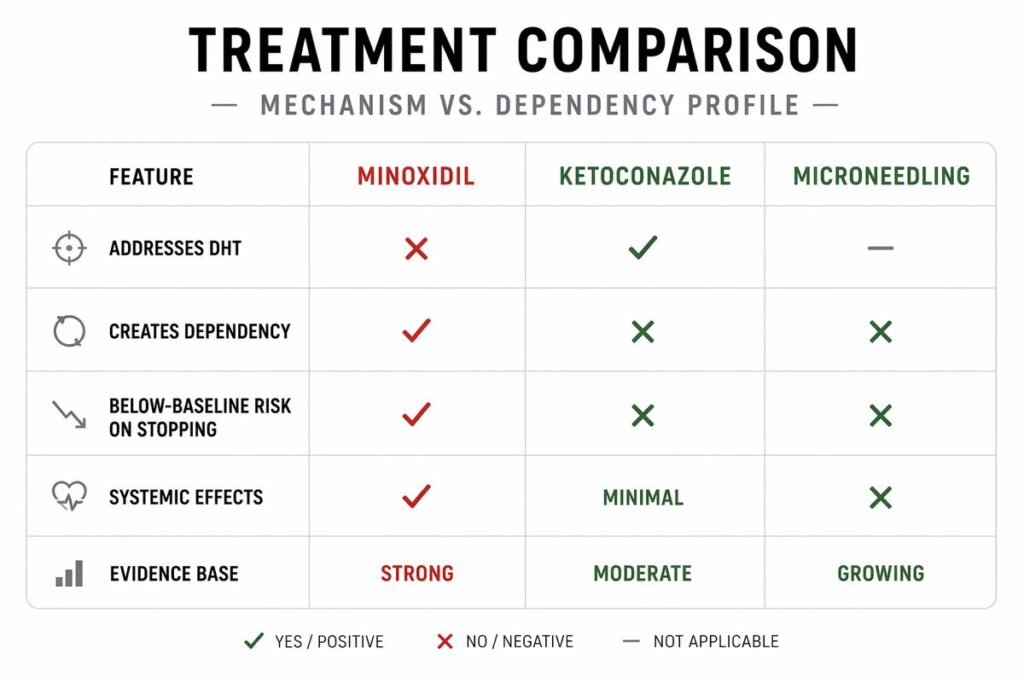
A 1998 study by Piérard-Franchimont and colleagues, published in Dermatology, found that 2% ketoconazole improved hair density and anagen follicle proportion at rates almost comparable to 2% minoxidil, through a completely different pathway. A 2025 review confirmed that ketoconazole inhibits 5-alpha reductase locally, directly reducing DHT at the scalp, while also suppressing inflammatory prostaglandins. You are reducing one of the actual drivers of follicular miniaturization rather than overriding the symptoms.
Microneedling
A 2023 meta-analysis (Abdi et al.) covering 10 randomized controlled trials and 466 patients found statistically significant improvements in hair count with microneedling. A 2025 follow-up covering 12 trials and 631 patients found that microneedling outperformed minoxidil monotherapy outright. The mechanism, controlled micro-injury triggering wound-healing signaling, Wnt/β-catenin activation, and growth-factor release, stimulates the follicle through its own regenerative biology rather than forcing a vasodilatory override.
Topical anti-androgens (research compounds)
For readers willing to go deeper into the research space, topical anti-androgens like RU58841 and pyrilutamide attack the DHT problem directly at the receptor level, without the systemic endocrine impact of oral finasteride. JXL069, a research compound inspired by PP405, targets follicular stem-cell metabolism rather than the hormonal axis, an entirely different lever. None of these are FDA-approved for hair loss and I do not recommend them without your own research and medical supervision; this article is not medical advice.
What unites all of these options is a shared property that minoxidil lacks: stopping has a cost, but it is not catastrophic. Stop ketoconazole and the DHT inhibition relaxes, but you do not drop below baseline. Stop microneedling and you lose the stimulus, but there is no collapse, no forced restart phase, no penalty for missing a dose on a flight.
The Exact Products I Use (and Where to Get Them)
These are the tools and compounds I actually have on my shelf. Everything here is affiliate-linked because I use them personally, and the discount codes below exist because the brands extended them to readers of this site.
AnagenInc, research compounds (RU58841, Pyrilutamide, JXL069, K&B)
Exclusive 10% discount code: blueprint at checkout.
- JXL069, PP405-inspired research compound
- RU58841 50ml pre-mixed solution
- Pyrilutamide, topical androgen receptor antagonist
- K&B Solution, carrier solution designed for RU58841
INTELLIGENT, ketoconazole shampoo & microneedling tools
Discount code PHILIPPE for 10% off.
- INTELLIGENT shampoo (the formulation I use daily)
- Dermapen from INTELLIGENT, my microneedling device of choice
GrowBand 2.0 by Hairguard
Passive mechanical stimulation device I use on rest days. $100 discount plus free shipping through my link, with an extra 10% off using code blueprint.
The One Question Worth Asking Before You Start Any Protocol
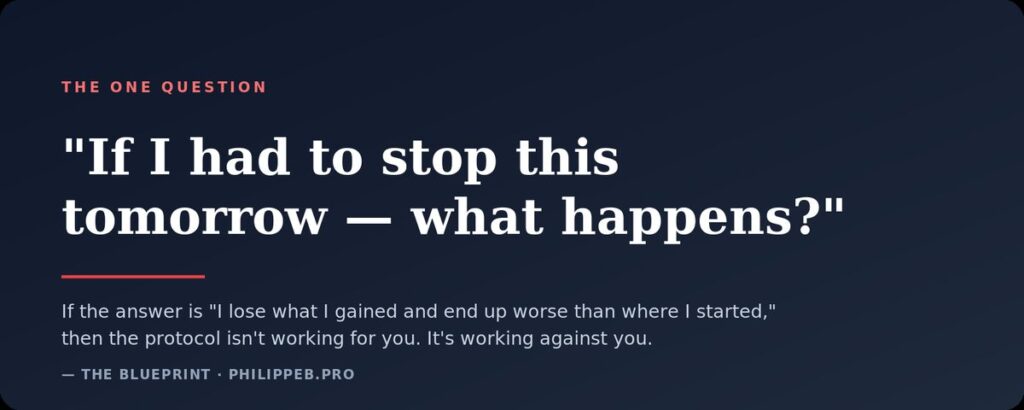
Before you start any hair loss treatment, mine, someone else’s, or the one your dermatologist prescribed by default, ask yourself one question:
If I had to stop this tomorrow, what happens?
If the answer is “I lose what I gained and end up worse than where I started,” then the protocol is not working for you. It is working against you. And for a condition you will carry for the rest of your life, optionality, the ability to pause, travel, adjust, or stop without catastrophic cost, is not a luxury. It is the central design requirement.
That is why I do not take minoxidil. And that is the framework I apply to every new compound, device, and intervention before I bring it into the rotation.
🎥 You can also watch the full video breakdown of this topic here on YouTube.
Disclaimer: This article is for educational and informational purposes only. It is not medical advice, and nothing here should be interpreted as a diagnosis or treatment recommendation. Research compounds mentioned (RU58841, pyrilutamide, JXL069, K&B solution) are not FDA-approved for hair loss. Consult a qualified healthcare professional before starting, stopping, or modifying any treatment. Links on this page are affiliate links; using them supports the research and testing I share at philippeb.pro at no additional cost to you.
About the author
Philippe Boissard
Author of Men’s Hairloss Protocol (2020), Better, Smarter, Stronger (2023), and Multi-Axis Body (2025). Researches and writes about hair loss and male physiology, citing primary literature and disclosing affiliate relationships in full. Not a medical doctor; all content is educational. More about Philippe.
Get my free hair-loss protocol
The exact evidence-based routine I actually use and recommend: what works, in what order, with no hype. Enter your email on the next page and I’ll send it straight to you.
Send me the free protocol →
[…] Force more blood flow to the follicle (the minoxidil approach) – addresses none of the above mechanisms; produces dependency without addressing the disease, which is why I no longer use it. […]
[…] Stack with: finasteride/dutasteride, minoxidil, microneedling. See why finasteride fails some men and why I do not take minoxidil. […]
[…] the question is usually “why” before “switch to rosemary oil” – and my analysis of minoxidil long-term covers that question. For the broader pattern of what stalls hair protocols, the framework is in […]
[…] loss protocol is not working covers the seven hidden reasons most men miss, and the analysis of why I do not take minoxidil demonstrates the same effect-size discipline applied to a different intervention. LLLT belongs in […]